




How Two-Chamber Processing Lines Balance Energy Use and Production Speed
This kiln needs to move more glass through each shift and use less electricity per square meter at the same time. Those goals don't always match up. While running a furnace faster will make more heat, it can waste energy by heating when it's not needed, cooling when it's not needed, and idling when it's not being used. It may take longer and cost more to heat if you cut the power. People look at all of an energy-saving two-chamber processing line's features at once, like how fast it heats up, how much energy each batch uses, and whether the glass still meets quality standards. What does the Easttec data show and what does it not show? How to pick a fair test before you buy is covered in this article.
Why Speed and Energy Pull in Different Directions
You can use energy per unit of glass, such as kWh per m² for a certain thickness and loading rate, to figure out how much energy a tempering furnace needs. Electricity prices are not shown by the square metre of added power. Instead, it shows how big the power grid is. Even if a heater has a lot of power, it can still have a low cost per square meter if it heats up quickly and always works at full capacity. Even if it has less power, the furnace may cost more per square meter if it runs slowly or is only half full.
Three practical effects follow:
Cycle time and standby. Faster heating reduces the time the furnace spends hot but not producing.
Loading rate. Partly loaded batches use nearly as much heating energy per cycle as full ones, so energy per square meter rises.
Cooling. The quench stage uses substantial airflow power. Karvinen notes that thinner glass needs higher heat transfer in cooling, and that because air flow rates are high, power consumption has to be considered when designing the chilling system [3].
Any energy figure should therefore come with its conditions: glass thickness, loading, product mix, and the baseline used for comparison. ISO 50001 supports this approach. It is a management framework for establishing, implementing, and improving an energy management system, and it requires demonstrating continual improvement in energy performance without prescribing levels to be achieved [1]. It is not a furnace specification, but its discipline of baselines and measurement is what a buyer needs when comparing quotations.
How a Two-Chamber Line Heats Glass
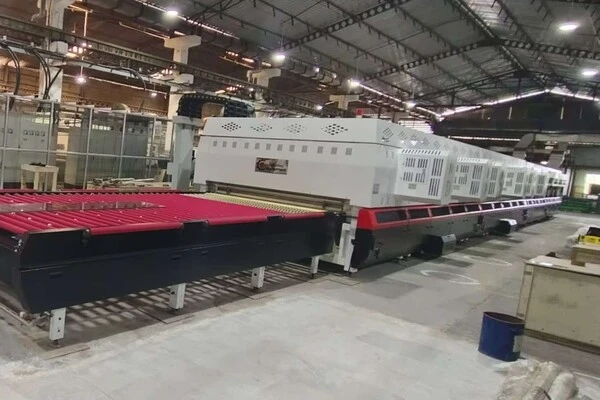
A two-chamber furnace divides the heat into a chamber for pre-heating and a room for high temperature. This way, two groups can be heated at the same time. Easttec says this makes it possible to pre-warm the next batch while the first one is finishing up. This makes the production flow more continuous. The specs it comes with say it can handle glass from 4 mm to 19 mm thick and has a capacity 1.8 to 2 times that of regular single-chamber furnaces.
Staged heating is established practice. Vitkala describes a two-stage convection furnace in which the first chamber runs at 350–450 °C using convection, and the second finishes heating by convection and radiation, noting that control of temperature and air flow is easier at lower temperatures [2]. That paper describes another manufacturer’s equipment, so it supports the principle only.
Convection is the other half of the speed story. Vitkala reports that in a high-convection furnace, the heating time is shorter because the heat-up curve is steeper than in a radiation furnace. For an Energy-Saving Two-Chamber Processing Line, this highlights the potential importance of convection technology in improving heating efficiency. In his 1997 results for 4 mm Low-E glass on one manufacturer’s furnaces, heating time per batch was about 200 seconds for a radiation furnace, 125 seconds for a high-convection single chamber, and 100 seconds for a two-stage convection system, each with a ±5% tolerance [2]. These are one supplier’s historical figures for a specific glass, not Easttec data, and should not be read as expected results for any current machine.
Easttec describes its forced convection system as a high-temperature blower circulating hot air through the furnace, with convection components and structures made of ceramic rated to 1,300 °C. The company states this reduces unnecessary energy consumption and speeds heating. Its product information also mentions “matrix heating technology”. The supplied material does not explain what this involves, so ask the supplier to describe it and show how it behaves in operation.
Control ties the two chambers together. Easttec’s furnace uses an Industrial PC (IPC) that synchronizes timing between both chambers and the quench section. Without that synchronization, one chamber waits for another, and the speed gain disappears.
Where Energy Savings Could Come From
The supplied information makes three energy-related statements that should be kept separate:
| Statement | Context | What to confirm |
|---|---|---|
| Capacity 1.8–2× that of single-chamber furnaces | Throughput of the two-chamber design | Baseline furnace, thickness, loading |
| Advanced insulation reduces thermal energy loss by 20% | Insulation of the furnace | What is being compared, and over what period |
| Energy-saving design helps customers save one-third of electricity | Company-level statement | Baseline and test conditions |
The 20% figure is a loss reduction, so it does not translate into a 20% lower electricity bill. The one-third figure comes from a different part of the company’s material and lacks a baseline. Do not add these numbers together, and do not apply one to another’s conditions.
There are sound physical reasons why a two-chamber line could lower energy per square meter, though your results depend on your operation:
Heating cycles are shorter, so less time is spent hot per square meter produced.
Pre-warming the next batch keeps the furnace working continuously, instead of cycling between idle and loaded states.
Better insulation limits losses from the furnace shell. This matters more for a larger two-zone furnace with more hot surface.
Power management between chambers, which Easttec describes as optimizing electricity distribution, can avoid heating a chamber that has no glass in it.
There are also trade-offs to consider when evaluating an Energy-Saving Two-Chamber Processing Line. Convection blowers consume additional power, and a two-chamber furnace requires more heated volume to maintain operating temperatures. If your plant cannot keep both chambers loaded, much of the potential energy-saving benefit may disappear. Therefore, energy efficiency should be evaluated under your expected production loading conditions rather than at full load alone.
The Quench Section and the Rest of the Line
Doubling heating throughput moves the bottleneck. If quenching, loading, unloading, cutting, edging or washing cannot match the new rate, the extra capacity goes unused. The cooling stage also carries its own energy cost. A 2024 study of spray cooling during glass tempering found that reducing spray distance and increasing spray loading fraction and pressure improved the cooling rate and reduced energy consumption, but made temperature across the glass surface less uniform. It also found that moderately raising the final cooling temperature greatly reduced cooling energy with little effect on tempering quality, with 573.15 K optimal within the experimental range [4]. That work concerns spray cooling in an experimental setting, not the air quench in a typical tempering furnace, but it illustrates the same principle: cooling settings trade energy against uniformity, and they need to be tuned with quality in view.
Ask Easttec how the quench section is sized for your thinnest glass at full furnace rate, and what the quench energy consumption is at that condition.
Quality Is the Constraint on Savings
Saved energy means little if glass is rejected. Rejects waste the energy already spent heating them. EN 12150-1 specifies tolerances, flatness, edgework, fragmentation and physical and mechanical characteristics for flat thermally toughened soda lime silicate safety glass for buildings [5]. Its contents include limits on overall bow, wave and perimeter deformation, and a method for measuring edge lift on horizontally toughened glass [5]. Whatever the furnace reports for energy, request yield and flatness results on your own glass, measured against the standard your customers require.
Easttec states its two-stage process gives a more gradual, uniform temperature rise that reduces thermal shock and stress, giving better flatness than rapid single-stage heating. The literature supports balancing heat transfer in staged convection heating [2][3], but the claim should still be verified on your products.
How to Specify an Energy and Speed Test
To compare furnaces fairly, define the test before collecting quotations:
Glass: state thickness (for example, 4 mm and 12 mm), size, and whether it is clear or coated.
Loading: state the loading rate, for example, full load and a typical partial load.
Duration: run continuous production, not a single batch, so idle and transfer losses are captured.
Measure: record electricity consumed, square meters produced, cycle time, and the number of rejects.
Report: express results as kWh per m² and m² per hour, with the flatness and fragmentation results.
Baseline: compare against the furnace you use today, measured the same way, so the improvement is real for you.
Ask the supplier to run this test at the factory, or to agree it as an acceptance condition at commissioning.
When a Two-Chamber Furnace Makes Sense
A two-chamber line is most likely to pay off for plants that run long batches of similar thickness, can keep both chambers loaded, and have a quench and handling system matched to the higher rate. Easttec says the speed advantage is greatest for 4–6 mm architectural lites with a lot of them. Before assuming the 1.8–2 number is correct, a plant that often changes the thickness and size of batches, works with small amounts, or doesn't have a lot of downstream capacity should find out how changes to the recipe affect the actual output. Architectural, appliance, furniture, and shower glass, as well as contract glass makers, are all target groups here. Each has a different batch design.
Evaluating the Manufacturer
Luoyang Easttec Glass Automation Equipment Co., Ltd. states it has worked in glass tempering technology since 1994, with technicians who have developed and manufactured glass deep-processing equipment for more than twenty years. It also states it applies European (Italy) standard quality management and Italian convection technology. Ask for a reference list of two-chamber installations at plants comparable to yours, and visit one if possible.
Concerning conformity, the information given states that the furnace meets CE standards. Directive 2006/42/EC says that when a piece of machinery is sold in the EU, the company that made it has to include an EC statement of conformity [6]. Ask for the declaration itself as well as a list of the rules and guidelines that were used. It says that Regulation (EU) 2023/1230 replaces that order [6], so make sure you know which one applies to your arrival date.
Customisation is important for energy efficiency and processing speed, especially when configuring an Energy-Saving Two-Chamber Processing Line to meet specific production requirements. It allows you to adjust voltage and frequency (220V, 380V, 415V, 50/60 Hz), equipment size and colour, as well as heating and cooling curves and parameters. The language options for the main screen include English, Spanish, Russian, Korean, and Portuguese. Easttec states that new operators can learn to operate and maintain the equipment within one week, with technicians available online 24 hours a day. What does the training cover, and how does online support work for operators in different time zones?
Cost, Delivery and Implementation
No price or warranty terms were supplied, so none are given here. Easttec states that its furnaces are customized equipment with delivery of 60–120 working days depending on model. Confirm the date for your configuration in the contract.
Factors that shape cost include furnace size, thickness range, quench capacity, control package, electrical configuration, and customization. To judge value, compare total cost of ownership: purchase price plus electricity per m² at your loading, maintenance and spare parts, and the value of extra output. Prepare power supply, foundation, floor space, compressed air and glass handling ahead of installation. Easttec’s collaboration process runs from preliminary inquiry and project design through manufacturing, installation and commissioning, operator training and after-sales service. Before signing, agree on acceptance tests, spare parts supply, warranty scope, and response times.
Conclusion
An Energy-Saving Two-Chamber Processing Line balances energy efficiency and production speed by heating glass in stages, keeping both chambers operating efficiently, and reducing heat loss. However, these benefits must be verified using your own glass. Easttec’s supplied data indicates higher capacity, a processing thickness range of 4–19 mm, and reduced thermal loss through insulation, although comparative baselines are not specified. Before comparing quotations, define performance tests using kWh per m² and m² per hour, establish acceptable quality limits, check whether the quenching and handling systems can keep pace with production, and confirm the documentation and technical support available after start-up.
FAQ
Does a two-chamber furnace use less energy per square meter?
It can, but only under the right conditions. Shorter heating cycles, continuous batch flow, and better insulation all help, while extra heated volume and blower power work against it. The result depends on glass thickness and how fully the chambers are loaded. Measure kWh per m² on your own glass and loading, against your current furnace.
Is the 20% figure a 20% saving on electricity?
No. Easttec describes it as a reduction in thermal energy loss from insulation, which is only one part of total consumption. The separate claim that customers save one-third of electricity has no baseline in the supplied material, so ask what it is measured against.
What thickness range suits a two-chamber line?
Easttec specifies 4 mm to 19 mm, with the highest speeds for 4–6 mm architectural glass. Check recipes at both ends of your own range, since thick glass needs a more gradual heating profile .
What should I measure during acceptance?
Measure kWh per m², m² per hour, cycle time, flatness and fragmentation results, and reject rate, using continuous production at your expected loading. Use the product standard your customers apply, such as EN 12150-1.
What should I confirm before ordering?
Confirm the conditions behind the capacity, the 20% and one-third figures, quench capacity for your thinnest glass, how “matrix heating technology” works, CE documentation, committed delivery date, training scope, spare parts, and warranty.
Partner With EASTTEC EQUIPMENT for Energy-Efficient Glass Processing Solutions
If you are evaluating an energy-saving two-chamber processing line, Easttec’s team can review your glass thicknesses, batch sizes, daily output target, and site power supply, and discuss a suitable configuration and test plan. Send your project details to sales@easttecmachine.com, including the products you process, the current furnace you want to compare against, and your voltage and frequency.
References
1. International Organization for Standardization. (2018). ISO 50001:2018: Energy management systems – Requirements with guidance for use. https://www.iso.org/standard/69426.html
2. Vitkala, J. (1997). Low-E glass tempering. Glass Processing Days, 13–15 September 1997, Tampere, Finland, pp. 103–107. https://aisglass.com/wp-content/uploads/2020/10/AIS-226.pdf
3. Karvinen, R. (1997). Connection between glass quality and the convection furnace. Glass Processing Days, 13–15 September 1997, Tampere, Finland, pp. 67–71. https://aisglass.com/wp-content/uploads/2020/10/AIS-68.pdf
4. Li, J., Tian, L., Wang, H., & Liu, F. (2024). Computational analysis of spray cooling heat transfer and influential factors during glass tempering. Case Studies in Thermal Engineering, 61, 104857. https://doi.org/10.1016/j.csite.2024.104857
5. European Committee for Standardization (CEN). (2019). EN 12150-1:2015+A1:2019 – Glass in building – Thermally toughened soda lime silicate safety glass – Part 1: Definition and description. https://genorma.com/en/standards/en-12150-1-2015-a1-2019
6. European Parliament and Council of the European Union. (2006). Directive 2006/42/EC of 17 May 2006 on machinery, and amending Directive 95/16/EC (recast). https://eur-lex.europa.eu/eli/dir/2006/42

USER EVALUATE
Here is the customer's evaluation of us