




Dual-Chamber Architectural Glass Tempering Furnace for Curtain Walls
A Dual-Chamber Architectural Glass Tempering Furnace for curtain walls uses a pre-heating chamber and a high-heating chamber to process two glass batches at the same time. At EASTTEC EQUIPMENT, we build this design with true forced convection technology, so Low-E glass heats faster and more evenly. The furnace tempers glass from 4mm to 19mm, reaches 1.8 to 2 times the capacity of a standard single-chamber furnace, and carries CE certification. If you run a façade glass plant in the United States, this guide explains how the furnace works, what to check before buying, and how to compare suppliers.
What Is a Dual-Chamber Architectural Glass Tempering Furnace?
A Two-Stage Heating Design
The glass in curtain walls has to be able to stand up to wind load, impact, and still look good on the building. Putting heat on glass makes it strong. The heating step is split into two by a Dual-Chamber Architectural Glass Tempering Furnace. The first section warms the glass up ahead of time. It reaches the tempering temperature in the second chamber, which is the high-heating chamber. For architectural glass, this temperature is usually between 680°C and 720°C. One batch is going to finish in the second chamber while the first batch starts to warm up. This makes a steady flow of production. Every batch in a single-chamber furnace moves at its own pace, so the line has to wait between loads.
Main Components of the Line
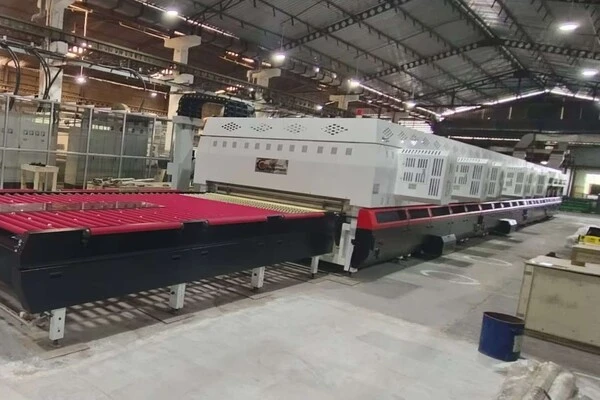
The standard layout for our line is horizontal. Panels are put on ceramic wheels by loading tools. After going through the pre-heating chamber and the high-heating chamber, the glass goes through a transfer section and into the quench. The final pieces are then taken away by unloading equipment. The timing, convection, and heating between the two chambers and the quench section are all controlled by an industrial PC (IPC). When glass is heated, but then left to cool for too long, the temperature drops and the stress pattern becomes uneven. A high-temperature blower moves hot air around inside the heater as part of our convection system. The ceramic parts that go with it can handle temperatures up to 1300°C.
Glass Types and Thickness Range
From 4mm to 19mm, the furnace can handle clear, colored, mirrored, and Low-E glass. In that range, you can find thin lites for unitized curtain walls as well as thick panels (12mm to 19mm) for structural glass and balustrades. At high speeds, large amounts of 4mm to 6mm architectural lites are made. If the operator slows down the cooling rate, the same line can also make heat-strengthened glass. ASTM C1048 says that the surface compression range for heat-strengthened glass is between 24 and 52 MPa. For fully tempered glass, the range must be at least 69 MPa. Mixed orders still work best when you put together items of the same thickness.
How the Furnace Works: Heating, Convection, and Quenching
From Loading to the High-Heating Chamber
Good cooling starts before the glass goes into the oven. The panels are loaded, put in place, and the edges are checked by the operators. When you wash, you get rid of dirt that could leave marks. The temperature of the glass slowly rises in the pre-heating chamber. This slow rise lowers thermal shock and stress, which helps keep the surface flat and less distorted than rapid heating in a single stage. The glass reaches its final tempering temperature in the room with a lot of heat. The settings, such as roller speed and stay time, are changed by the covering type, thickness, and size. Set these parameters for different thicknesses with our software. This way, the process stays the same from batch to batch.
Forced Convection for Low-E Glass
Low-E coatings make heat bounce back, so this glass only gets warmer slowly through radiation in a Dual-Chamber Architectural Glass Tempering Furnace. That problem can be fixed by forcing hot air to move across the glass. A high-temperature blower moves hot air around in our system, which is based on Italian convection technology. Top convection and the two-chamber design make Low-E heating cycles 30% faster. Balanced heating also stops film oxidation, which keeps the optical quality of architectural coatings that are sensitive. The ceramic convection parts speed up the heating of the glass and cut down on energy use that isn't needed. This increases both output and efficiency. This style works with both double and triple silver Low-E glass.
Quenching and Cooling Control
The glass is quickly moved into the quench area after it has been heated. The compression layer that makes toughened glass strong is created by balanced air jets that cool both the top and bottom sides at the same time. Things like air pressure, nozzle balance, and cooling time need to be tightly managed. Roller wave, bow, incomplete tempering, or breakage can all be caused by bad settings. Our IPC makes sure that both cylinders and the quench section work together at the same time. There is a minimum number of fragments in a 50 mm by 50 mm area that must be met by EN 12150-1, and ASTM C1048 sets the limits for stress. Because of this, finished panels give you proof of quality that you can measure.
Benefits for Curtain Wall Production
Higher Output for High-Volume Orders
Wall projects have due dates and lots of glass. By cutting down on the heating cycle, the Dual-Chamber Architectural Glass Tempering Furnace can handle two batches at once and 1.8 to 2 times as much as a regular single-chamber furnace. The quench section stays busy by getting the next batch ready to go while the first one finishes. The furnace is made to be used by industry 24 hours a day, seven days a week, so companies with multiple shifts can stick to a routine. Another way for a processing plant to take on more work is to have a higher throughput. No matter what boiler size you use, you should measure the gain in finished square feet per hour.
Flatness and Coating Protection
The sky and nearby buildings are reflected in curtain walls, so even small waves in the glass can be seen. The two-step heating process makes the temperature rise slowly and evenly. This lowers the heat stress and makes the surface flatter with less deformation. Balanced convection heating stops the layer on Low-E glass from oxidizing, which means the film keeps its optical quality. This should be possible with any good Low-E glass tempering furnace from 4mm to 19mm. Your quality team can check it with polariscopes to look for strain patterns and rolling wave measurements to make sure the edges are flat. Your customers can see that the quality is good before you ship it with these checks.
Lower Energy Cost and Easier Operation
It takes a lot of power to temper, so the cost of energy determines long-term earnings. A smart power management system splits electricity between the two rooms, which lowers the cost per square meter, and advanced insulation cuts thermal energy loss by 20%. Customers can save one-third of their electricity with our design. From a single hub, the IPC controls all the parameters for convection and heating. There are different language versions of the working menu, such as English, Spanish, Russian, Korean, Portuguese, and more. Within a week, new operators can learn how to run and fix things, and our techs offer online help 24 hours a day, 7 days a week to keep downtime to a minimum.
Dual-Chamber vs. Single-Chamber Furnaces and Key Specifications
Comparing the Two Designs
The right furnace depends on your production mix, glass specifications, output target, and budget. A Dual-Chamber Architectural Glass Tempering Furnace can handle more recipes and produce more at once. It also costs more, needs more upkeep, and needs more equipment than a single-chamber model. A business that makes standard, low-volume items can use a burner with only one chamber. Warming glass by convection works best for thin, coated, or hard-to-heat glass. Warming clear glass with radiation still works. Large, flat architectural panels work well with horizontal furnaces. Instead of picking by category alone, we suggest that you compare your real order data to each choice.
Specifications to Verify Before You Buy
The advertized largest panel size only tells you part of the story. Find out the maximum length, minimum glass size, effective working width, and the situations in which those sizes apply. Check the range of thicknesses, compatibility with Low-E, and ability to strengthen through heat. Our range goes from 4 mm to 19 mm, and we can change the size of the equipment, the heating curves, and the cooling parameters to fit the needs of your product. The actual output relies on the size and thickness of the glass, how well it is loaded, how long the machine runs, and the return. Ask for sample testing and information on how much energy the glass uses before you sign, so you can see the results for the types of glass you use.
Quality Standards for Finished Glass
The finished glass you use should meet certain standards; compare your panels to these standards. ASTM C1048 is often used in US projects for fully toughened and heat-strengthened flat glass, and ANSI Z97.1 is often used for safety windows in buildings. EN 12150-1 is often used in export projects. Roller wave distortion, edge smoothness, surface compression measured with a grazing-angle surface polariscope, fragmentation count, and optical anisotropy, which is sometimes called leopard spots, are all common things that are checked. The furnace is CE-certified, which means it meets the technical standards of building projects around the world. Write down these checks for each group of products so that you can build a history of quality.
Choosing, Buying, and Installing the Equipment
Define Your Production Mix First
Write down your own numbers, such as the average and largest glass sizes, monthly output, Low-E share, personalized project share, and growth you expect over the next three to five years. Fit the furnace to the mix you usually use, not the biggest panel you use once in a while. Someone on your team asks a different kind of question. The owners look at the return on investment, the production managers look at the output and energy use, the process engineers look at the quality and range of thicknesses, and the maintenance managers look at the uptime and spare parts. Before you ask for quotes, write down these priorities. They make it fair to compare suppliers and speed up the decision-making process.
Compare Quotes, Customization, and Lead Time
A similar request for quotes lists the sizes, thicknesses, percentages of coating, production goals, utilities, service expectations, and delivery location of the glass. The price depends on the size of the work area, the type of convection technology used, the configuration of the quench, automation, and customization. Because we build each furnace to order, it takes between 60 and 120 working days to get it to you. We can change the power system to work with 220V, 380V, or 415V at 50Hz or 60Hz, and you can choose the color of the equipment and the language used by the software. Check out what each price covers when it comes to training, installation, warranty, and extra parts. We also welcome trips to the factory and shows of our tools.
Installation, Training, and Maintenance
From taking your inquiry and planning the project to manufacturing, installation, commissioning, training operators, and providing service after the sale, we do it all in one place. Make sure the floor is loaded, the base is solid, the crane can get to it, and there is power, compressed air, cooling, and airflow. Test common glass sizes, thicknesses, and coatings during startup to see if the temperature is constant, the glass is flat, and the surface is stress-free. Check the ceramic rollers every day for damage and plan to deep clean and align them every three to six months, depending on how much you make. Always have important spares on hand, like heating elements, sensors, and rollers. Our techs offer online support 24 hours a day, 7 days a week, and we've been in the glass tempering business since 1994.
Conclusion
A Dual-Chamber Architectural Glass Tempering Furnace divides the heat into a chamber for pre-heating and a chamber for high-temperature heating. This lets two batches go through the line at the same time. This arrangement has 1.8 to 2 times the capacity of a single-chamber boiler for making curtain walls. It also heats slowly, which keeps the surface flat, and uses forced convection to heat Low-E glass 30% faster while keeping the coating safe. Heat loss is cut by 20% when insulation is used, and the IPC keeps warmth, airflow, and cooling in sync across glass thicknesses from 4 mm to 19 mm. When compared to single-chamber models, it's clear that suitability depends on the type of production, the budget, and the amount of maintenance that can be done. Before buying, buyers should check the working measurements, Low-E compatibility, realistic output, and finished-glass results against ASTM C1048, ANSI Z97.1, or EN 12150-1. They should also plan for installation, training, and maintenance from the start.
FAQ
Is a dual-chamber furnace always better than a single-chamber furnace?
No, it only works when there are a lot of orders or a lot of low-e orders. A plant that does the same amount of low-volume work all the time might do well with just one chamber. What you make and how much you spend determine the answer.
Can it temper Low-E glass?
Yes. This method of heating the glass evenly with forced convection helps keep the coating from rusting. This style works with both double and triple silver Low-E glass.
What thickness range does it cover?
It makes glass from 4 mm to 19 mm stronger. Thin lites that are 4 to 6 mm thick move very quickly.
How long does delivery take?
Every oven is made to order. Depending on the model, delivery takes between 60 and 120 business days.
Can it match my plant's power supply?
Yes. We make the power system work with 220V, 380V, and 415V at 50Hz or 60Hz. Send us your plant specifications, and we'll make sure the configuration is correct.
Request a Dual-Chamber Architectural Glass Tempering Furnace Quote from EASTTEC EQUIPMENT
Looking for a company that makes Dual-Chamber Architectural Glass Tempering Furnaces and knows how to make curtain walls? EASTTEC EQUIPMENT has true convection technology, is CE-compliant, has online support 24 hours a day, and can customize voltage, size, and software language. For the best match, send your glass sizes, thickness range, and Low-E share to sales@easttecmachine.com, and our engineers will make suggestions. Find out more at easttecglass.com.
References
1. ASTM International, Standard Specification for Heat-Strengthened and Fully Tempered Flat Glass (ASTM C1048), 2018
2. European Committee for Standardization, Glass in Building – Thermally Toughened Soda Lime Silicate Safety Glass, Part 1: Definition and Description (EN 12150-1), 2015
3. American National Standards Institute, Safety Glazing Materials Used in Buildings – Safety Performance Specifications and Methods of Test (ANSI Z97.1), 2015
4. European Parliament and Council of the European Union, Machinery Directive 2006/42/EC, 2006
5. Shelby, J. E., Introduction to Glass Science and Technology, Royal Society of Chemistry, 2005
6. Haldimann, M., Luible, A., and Overend, M., Structural Use of Glass, International Association for Bridge and Structural Engineering (IABSE), 2008.

USER EVALUATE
Here is the customer's evaluation of us