




Why Use Hard Roller Machines for High Precision Curved Glass?
When manufacturers ask about achieving tight tolerances in bent glass production, the answer consistently points to one technology: the Forced Convection Curved Glass Toughening Machine with Hard Roller. Unlike soft-roller systems or purely radiant furnaces, this configuration combines rigid mechanical pressing with actively circulated heated air, creating the thermal uniformity and dimensional control that precision curved glass demands. Whether the application is a high-rise curtain wall, an automotive windshield, or a premium appliance panel, this pairing resolves the two root causes of curved glass defects—uneven heat distribution and not enough forming pressure—simultaneously.
Understanding Hard Roller Technology in Curved Glass Toughening
What Makes Hard Rollers Different from Soft Rollers?
Heat-resistant alloys are used to make hard rollers that can keep their shape at high burner temperatures for long periods of time. On the other hand, soft rollers change shape when they are loaded and when they are heated up. This change in shape is then transferred straight to the glass surface as warpage or rolling wave. For curved uses, a panel can't meet architectural standards with even a 1.5 mm arc deviation. This variable is taken away by hard rollers, which keep the same contact shape throughout the whole bending cycle.
How Does Forced Convection Elevate Thermal Precision?
Infrared radiation heats glass unevenly because reflective coatings, especially Low-E coatings with an emissivity as low as 0.01, block the energy before it can reach the glass mass. Forced convection gets rid of this problem by sending hot, high-pressure air onto the glass surface through precise nozzles. This gets around the coating's ability to reflect light. This creates a temperature field that is the same across the whole panel, which is needed for an arc to form consistently without any stress concentrations remaining.
These two systems work together to make sure that the glass softens evenly, that the hard rollers press it into the right shape, and that the cooling cycle locks in the pattern of compression stress evenly. That sequence is what makes the combination work better than any single technology.
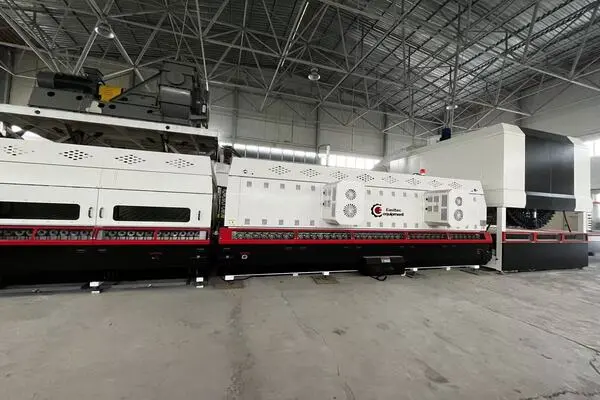
Advantages of Using Hard Roller Machines for High Precision Curved Glass
When manufacturers look at curved glass processing equipment, they usually pay attention to the cycle time and yield rate. With Forced Convection Curved Glass Toughening Machines with Hard Roller, both measures get a lot better, and the reasons aren't marketing claims but specific engineering choices.
Here are the core performance advantages that define this technology category:
- Arc deviation control within 1.0mm: To keep the arc variation within 1.0 mm, a uniform convection thermal field and stiff hard-roller pressing are used together. This meets the geometric limits needed by major international building standards. It is hard to get this level of consistency with soft-roller or radiant-only setups.
- 30% faster heating cycles: Variable-frequency high-pressure top convection cuts the time it takes to soften coated glass by more than 30% compared to normal radiant models. Shorter heat contact also lowers the chance of coating oxidation on Low-E surfaces that are sensitive to it. This protects the structure of the film and increases output at the same time.
- Glass thickness ranges from 3mm to 19mm: Because processing is reliable across this range, a single production line can handle both thin architectural lites and heavy structural panels without having to switch out equipment, which makes the best use of capital.
- 20% reduction in thermal loss: Using high-density composite insulation with inverter-controlled convection fans cuts energy loss by about 20%, which lowers the cost of energy per unit over longer production runs.
A better return on investment is a direct result of these benefits. A plant that bends 500 square meters of Low-E glass every day saves a lot of money on energy costs and lessens the amount of scrap caused by arc nonconformance. These are two numbers that speed up the payback of capital equipment.
Because it has faster cycles, lower scrap rates, and uses less energy, Forced Convection Curved Glass Toughening Machine with Hard Roller technology is the best choice for any medium- to large-sized glass processor that wants to compete on both quality and price.
Comparing Hard Roller Machines with Other Glass Toughening Technologies
There are three main types of bending furnaces that procurement teams look at: soft-roller radiant furnaces, hard-roller radiant furnaces, and forced-convection curved glass toughening machines with hard rollers. When you know what each one does best, you can see why the third configuration is most common for high-specification production.
Soft-roller radiant furnaces can handle clear float glass in moderate thicknesses, but their mechanical flaws make them unsuitable for Low-E coats or tight arc limits. The material on the roller changes shape, and radiant heating can't go through shiny surfaces evenly. Hard-roller radiant heaters make the dimensions more stable, but they still can't heat very well. Low-E shadowing is still a problem, and cycle times are still long.
Forced Convection Curved Glass Toughening Machines with Hard Roller fix both problems at the same time. Coating reflectivity can't stop the convection system, and the hard rollers maintain geometric accuracy. For companies that make architectural Low-E glass, car glass, or high-end device glass and have to meet contractual standards for surface quality and dimensional accuracy, this setup is not an extra; it is the standard.
Besides performance, the frequency of maintenance also varies. Because forced convection heating lowers the highest temperature differences inside the furnace chamber, thermal cycling stress on internal parts goes down. This means that parts last longer than in systems that only use radiant heat.
Maintenance and Safety Considerations for Forced Convection Hard Roller Machines
Regular maintenance schedules are more important than one-time fixes for keeping production going. There are several parts of Forced Convection Curved Glass Toughening Machines with Hard Roller that need regular maintenance. These include the roller alignment and surface condition, the convection fan bearing integrity, the nozzle shape, the condition of the insulation panels, and the thermal management of the electrical cabinet.
It is very important to check the roller surface. Heat-resistant metal rollers keep their shape for a lot longer than ceramic fiber rollers, but they need to be maintained. Visual inspections once a week and measurement checks once a month keep arc uniformity from getting worse over time. When convection fan bearings are working at high temperatures, they work better when their lubrication schedules are based on actual operating hours instead of calendar dates.
The working environment must be taken into account in safety rules. During rounds of processing, furnace rooms get hotter than 700°C. Lockout/tagout processes, thermal-rated PPE, and clearly posted emergency shutdown routines are all things that must be in place. Training programs for operators that cover both normal operation and how to respond to a fault lower the risk of injuries and unplanned downtime. Both of these benefits come from operators who fully understand the equipment.
Adding these practices to standard operating procedures saves workers, extends the life of tools, and keeps the process stable, which is important for customers and contracts.
Procurement Guide: Selecting the Right Forced Convection Hard Roller Machine for Your Business
Choosing a Forced Convection Curved Glass Toughening Machine with Hard Roller is a big investment that will pay for itself over many years. Technical potential alignment, supplier trustworthiness, and post-installation help depth are the most important things to look at when evaluating a product in real life.
Technical capability alignment means making sure that the machine's rated thickness range, maximum panel dimensions, and arc radius capabilities match the types of materials you actually use, not the types you think you should use. Oversizing costs more and causes problems when it comes to flow. Ask for written records of the handling of glass that meets your standards.
For this type of equipment, a supplier's credibility is judged by how long they've been in business, how many installations they can show, and how well they manage quality. When it comes to foreign architectural projects, CE approval is the standard way to show that the equipment meets safety and quality standards.
The level of after-sales support may be the most undervalued factor during the procurement process. A burner that works on 500 square meters of space every day makes a lot of money every hour it's on. The time it takes to go from installation to full-yield production is cut down by a large amount when suppliers offer online technical help 24 hours a day, IPC recipe libraries that are already loaded with popular coating types, and on-site commissioning.
Most of the time, it takes 60 to 120 working days to deliver unique setups. Adding that time to the project plan helps keep the installation part from being delayed, which costs a lot of money.
Conclusion
When you combine hard roller technology with forced convection heating in the Forced Convection Curved Glass Toughening Machine with Hard Roller, you can solve two of the biggest problems in making precision curved glass: making sure that the heat is evenly distributed across reflective surfaces and making sure that the glass is formed consistently at high temperatures. If you combine active heat transfer with strict geometric control, you get measured results like arc deviation within 1.0 mm, 30% faster cycle times, and 20% less thermal loss. These results are not just ideas; they are based on engineering logic. This mix of technologies gives makers who compete on quality and production efficiency yield rates and energy costs that other configurations can't match.
FAQ
What glass types can a hard roller bending furnace process?
Many kinds of glass can be worked on in Forced Convection Curved Glass Toughening Machines with Hard Roller. These include clear float glass, Low-E coated glass, ultra-clear glass, and layered glass substrates. Most of the time, thickness compatibility ranges from 3 mm to 19 mm. Because it can get around coating reflectivity, the convection system works especially well with high-performance Low-E versions that have very low emissivity values.
How does forced convection prevent Low-E coating damage?
Radiant heating makes Low-E films absorb light unevenly, causing hot spots that oxidize or break down the film. Forced convection gets heat through direct contact with air instead of electromagnetic radiation, which bypasses the coating's ability to reflect light. In this way, the film is under less stress at its highest temperature, and the glass temperature stays the same. This keeps the coating's integrity throughout the whole toughening cycle.
What maintenance intervals are standard for hard roller systems?
A roller surface review is done once a week, and a measurement check is done once a month. According to the manufacturer's instructions, convection fan bearings are repaired based on how many hours they have been used. Inspection plans are followed every year for insulation panels and electrical parts. Suppliers who offer IPC monitoring tools that are already loaded can spot problems as they arise before they stop production.
Is CE certification required for export projects?
In European markets, glass goods used in architecture and building must have CE approval. This requirement is becoming more common in foreign project standards around the world. When furnaces are built according to CE guidelines, they give processors the paperwork they need to bid on high-spec foreign building projects.
Connect with EASTTEC EQUIPMENT for Your Next Curved Glass Project
Since 1994, EASTTEC EQUIPMENT has been making precise thermal processing solutions for glass by combining Italian convection technology with strict manufacturing that meets CE standards. Our Forced Convection Curved Glass Toughening Machine with Hard Roller is available for customized configurations—contact us as a trusted manufacturer and supplier to discuss your production specifications, capacity requirements, and coating compatibility needs. Reach our engineering team directly at sales@easttecmachine.com to request a technical consultation or equipment quotation.
References
1. Glass Technology: European Journal of Glass Science and Technology, 2021.
2. Tempering of Glass: Theory and Practice — Society of Glass Technology, 2019.
3. Energy Efficiency in Industrial Furnaces — U.S. Department of Energy, Industrial Technologies Program, 2020.
4. Architectural Glass to BS EN ISO 12543 — British Standards Institution, 2022.
5. Safety Glazing Materials in Buildings — American National Standards Institute (ANSI Z97.1), 2021.
6. Flat Glass Technology: Forming and Processing — Springer, Doremus, R.H., 2018.

USER EVALUATE
Here is the customer's evaluation of us