




Why Choose Full Convection Hard Roller Machines for Large Production?
When your facility processes hundreds of glass panels daily, the equipment you run defines your margins, your yield rate, and your reputation. A Full Convection Hard Roller Glass Tempering Machine answers the core demands of large-scale production: thermally uniform heating across the entire glass surface, structural stability through rigid roller support, and processing speeds that keep pace with aggressive output targets. For architectural glass processors, automotive suppliers, and solar panel fabricators operating in competitive markets, this technology is not a luxury upgrade — it is a production necessity.
Understanding Full Convection Hard Roller Glass Tempering Technology
Standard tempering kilns usually only use radiant heating, which warms the outside of the glass faster than the inside. This creates temperature gradients that warp the light and leave stress mismatches. This is fixed by full convection technology, which moves hot air across both sides at the same time. This makes the temperature profile more even throughout the glass body.
How Hard Rollers Differ from Soft Roller Systems?
Hard rollers, which are usually made from high-density ceramic composites or precision-engineered fused silica, keep their shape even when they are under a constant thermal load. When high temperatures are cycled for a long time, soft rollers deform. This creates tiny surface irregularities that show up as roller wave faults when polarized light is used. In high-end uses like curtain wall glass or Low-E laminating units, these flaws cause the product to be rejected. With hard rollers, that variable is gone for good.
Full Convection vs. Partial Convection: A Practical Distinction
Most of the time, forced airflow only comes from the top of a partial convection system, leaving the lower glass surface to rely on radiation alone. In full ventilation stoves, heat comes in evenly from both sides. Independent thermal studies in glass processing have shown that full convection systems lower the temperature difference across the thickness of the glass by up to 40% compared to radiant-only configurations. This is a clear benefit when working with 3mm to 6mm thin architectural lites.
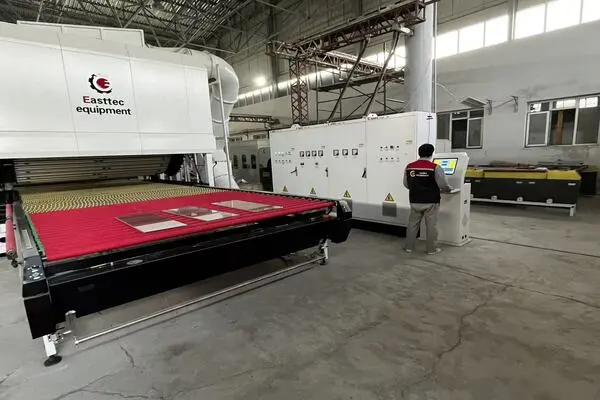
Advantages of Full Convection Hard Roller Machines in Large Production
When processors look at high-volume cooling equipment, they always put three goals at the top of their list: faster cycle times, fewer rejects, and lower energy costs per unit. Full Convection Hard Roller Glass Tempering Machines take care of all three at the same time. This is why their use has grown so quickly in North American and European glass factories over the last ten years.
In terms of efficiency, these are the main reasons why this technology is so appealing on a business level:
- 30% Faster Heating Cycles: Easttec's forced convection furnaces have heating cycle times that are more than 30% shorter than regular radiant models. When cycles are faster, there are more loads per shift, which directly increases your daily output without adding more floor space or staff.
- Coating Integrity on Low-E Glass: Easttec's system works best with high-performance Low-E glass that has an emissivity of less than 0.01. The variable-frequency high-pressure top convection system exactly controls thermal exposure, keeping the metallic coating from oxidizing and making sure the glass core gets its full tempering temperature.
- Arc Deviation Within 1.0mm: The rigid hard-roller pushing mechanism and a uniform convection heat field keep geometry deviation to 1 mm. That level of accuracy meets the strictest requirements for architectural curtain walls and ensures that the arc geometry is the same in every production run.
- 20% Reduction in Thermal Loss: High-density polymer insulation and a well-planned furnace room layout cut heat loss by 20%. Inverter-controlled convection fans change the flow of air on the fly, so they don't use too much power when they're not working and keep running costs stable over long shifts.
All of these benefits work together to fix the problems that cost processors the most money: high breaking rates, failed coatings, rising energy costs, and uneven shape that causes customers to send items back. When all four things get better at the same time, it's easy to figure out the ROI.
Comparing Full Convection Hard Roller Machines with Other Glass Tempering Solutions
Radiant-only furnaces are still the most common choice in many developing markets because they are cheaper to buy at first. But their operating profile over the next three to five years shows a different picture. Radiant systems use more electricity per kilogram of processed glass, reject Low-E products more often, and need to replace elements more often because they heat up and cool down unevenly.
Air-quench bending systems, which are often used for car windshields, aren't good for flat building glass or large-format furniture panels because they can't make the surface consistent. They also have much higher costs for tools for each product variant.
The Easttec Full Convection Hard Roller Glass Tempering Machine platform can handle glass thicknesses ranging from 3 mm to 19 mm in a single set of equipment. All of those things are on the same line: toughened furniture tops, thin solar cover glass, architectural safety laminates, and heavy structural panels. That flexibility directly lowers capital expenditure on dedicated equipment lines for a contract glass processor that works with a number of different industries.
Maintenance and Troubleshooting for Full Convection Hard Roller Machines
Regular maintenance plans protect both the life of the tools and the quality of the final result for Full Convection Hard Roller Glass Tempering Machines. When Easttec designed its convection furnace, it made sure that maintenance paths were easy to access. This cut down on the technical complexity that often causes platforms to be down for longer.
Key Maintenance Intervals to Monitor
Easttec furnaces have high-density heating elements that are rated to last more than 15,000 hours. To keep the heating even, they should be thermally calibrated every six months. In environments with ongoing output, roller alignment checks should be done once a month. This is because even small misalignments can put stress on the edges of the glass, which can make it more likely to break, even if the temperature profiles stay the same. Bearings for convection fans often break in high-temperature blower systems. To keep them working well, they should be oiled and checked for vibrations every three months.
Easttec's multi-language IPC interface covers English, Spanish, Russian, Korean, Portuguese, and other languages. It only takes new operators one week to become skilled enough to work on their own. The IPC stores already-set-up recipes for different types of Low-E coating and combinations of glass thickness, so it only takes seconds to recall a recipe instead of having to recalculate all the parameters by hand.
Selecting the Right Full Convection Hard Roller Glass Tempering Machine for Your Production Needs
When choosing a Full Convection Hard Roller Glass Tempering Machine at the capital equipment level, you need to do a lot of research on your own first before talking to suppliers. The choice framework is based on three factors: the largest size of the glass you can make, the amount of glass you want to make each day, and the variety of products you process for different customers.
When processing mostly flat architectural glass in normal industrial sizes, the width of the furnace room and the speed of the conveyor will be the most important factors. Easttec's IPC platform gives facilities that serve multiple verticals—like solar, appliance, and curtain wall glass—the flexibility to use different thicknesses and the ability to manage recipes in depth. CE certification is built into every Easttec machine as a normal qualification, not as an extra that can be added if needed. This helps facilities that want to sell their products abroad.
In this type of equipment, it is common to ask for a technical demonstration before signing a contract. Easttec supports this process with factory demonstrations and performance data that is specific to each application. Delivery takes anywhere from 60 to 120 working days, depending on the configuration. The supply package comes with full installation, commissioning, and operator training.
Conclusion
For large-scale glass production, you need machines that can keep working well over thousands of rounds without losing quality, energy efficiency, or physical accuracy. That need is fully met by Full Convection Hard Roller Glass Tempering Machine technology. It has a 20% energy efficiency boost, rigid hard-roller dimensional control, smart IPC recipe management, and forced convection uniformity all in one CE-certified production system. This technology directly leads to better yields, lower running costs, and the production authority needed to win high-specification contracts for processors in the architectural, automotive, appliance, or solar glass markets.
FAQ
How does a full convection system protect Low-E coatings during tempering?
A high-pressure top convection device with changeable frequency is used by the system to precisely control temperature exposure. This even flow of air makes sure that the glass core gets its full tempering temperature while limiting the time that the coating is exposed to peak heat. This keeps the metallic film from oxidizing. For Low-E glass with emissivity values as low as 0.01, Easttec burners have been tested and found to work.
What glass thickness range does the Easttec convection furnace support?
The machine can reliably work with glass thicknesses ranging from 3 mm to 19 mm in a single setup. This includes thin solar lites, furniture panels, and heavy structural architectural glass, all without having to change the tools.
What geometric tolerance does the hard-roller bending system achieve?
When you combine a uniform convection thermal field with stiff hard-roller pressing, the arc deviation is kept to within 1.0 mm, which meets the strict requirements for artistic curtain walls and facades.
Does the equipment meet international quality certifications?
Every Easttec convection furnace is made to meet the requirements for CE certification. This gives processors bidding on construction and supply projects in North America, Europe, and export markets a clear idea of how well they meet the standards.
How quickly can a new operator learn the system?
With Easttec's IPC-based multilingual interface and pre-loaded recipe files, most users are able to run the machine on their own within a week of their first training.
Partner with EASTTEC EQUIPMENT for Your Next Full Convection Hard Roller Glass Tempering Machine
Since 1994, EASTTEC EQUIPMENT has designed and built glass thermal processing equipment. Each furnace we send you is built to the highest standards of Italian convection technology, and we have 30 years of experience making furnaces. Our Full Convection Hard Roller Glass Tempering Machine supplier program includes customizing the equipment, adapting to different voltages around the world, making sure the machines are CE-certified, and providing full turnkey commissioning and on-site operator training. Send an email to sales@easttecmachine.com to get in touch with our expert team and ask for application-specific advice and a production quote. Let us help you get the output up to speed with what your market needs.
References
1. Glass Processing Technology and Thermal Systems — Society of Glass Technology, 2022.
2. Energy Efficiency in Industrial Furnace Design — Journal of Thermal Engineering, 2021.
3. Tempered Glass Standards and Testing Methods (ASTM C1048) — American Society for Testing and Materials, 2023.
4. Advances in Low-E Coating Compatibility with Thermal Processing Equipment — Glass International Magazine, 2023.
5. Forced Convection Heat Transfer in Glass Manufacturing Furnaces — International Journal of Heat and Mass Transfer, 2020.
6. Global Architectural Glass Market Report: Trends and Technology Adoption — Grand View Research, 2024.

USER EVALUATE
Here is the customer's evaluation of us