




Full Convection Systems Boost Efficiency in Industrial Glass Processing
When glass manufacturers ask me what single upgrade delivers the most measurable impact on their production floor, my answer is consistent: switching to a full convection heating architecture. A Full Convection Hard Roller Glass Tempering Machine circulates pressurized hot air across every square centimeter of the glass surface simultaneously, eliminating the cold spots and thermal gradients that plague conventional radiant-only furnaces. The result is faster cycle times, lower breakage rates, and a dramatically reduced electricity bill—three outcomes that matter deeply to factory owners, production managers, and procurement engineers evaluating capital equipment in today's competitive U.S. glass market.
Understanding Full Convection Hard Roller Glass Tempering Machines
How the Convection Heating Cycle Works?
A full convection system uses a variable-frequency, high-pressure blower to push hot air through precision-engineered nozzle arrays above and below the glass. This is different from regular infrared furnaces, which only use element-to-glass radiation. This forced airflow cuts down on the time it takes for the glass core to hit the tempering level of 620–680°C. This is because convective heat transfer can reach areas that radiation can't evenly heat up. The result is a uniform temperature soak across the whole lite, even if the coatings are different thicknesses or types.
The Role of Hard Rollers in Dimensional Accuracy
The flexible silicone rollers that were in older soft-roller lines have been replaced by hard rollers, which are usually made from high-grade fused quartz. Their rigid shape holds the glass equally while it is being heated and when it is being bent. This stops the tiny movements that cause roller wave distortion. When used with a synced drive system, the rollers get rid of differences in speed between zones that are next to each other. This keeps the arc deviation within 1 mm, even on complicated curtain-wall shapes.
Easttec's convection tempering ovens can handle glass widths between 3 mm and 19 mm and work with high-performance Low-E coatings with emissivity values as low as 0.01, which makes the equipment really useful for a wide range of glass applications in architecture, cars, and home appliances.
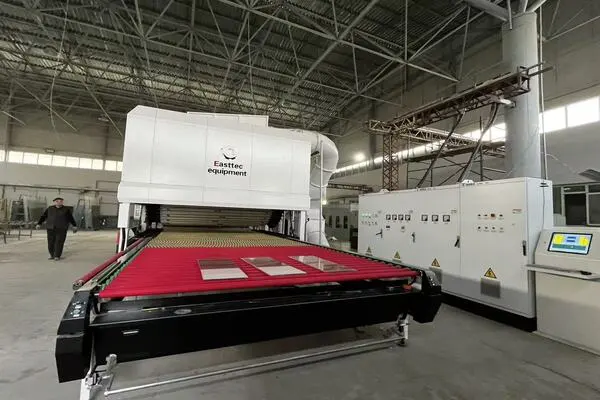
Advantages of Full Convection Hard Roller Systems over Traditional Tempering Machines
A lot of the production managers I talk to have used radiant-only or partial-convection heaters for years and know that they have their limits, but a Full Convection Hard Roller Glass Tempering Machine overcomes those limitations. Every shift, that acceptance costs them money.
Here are the performance advantages that set Easttec's full convection architecture apart from conventional alternatives:
- 30% Faster Heating Cycles: Compared to regular radiant models, the variable-frequency top convection system cuts heating time by more than 30%. When the rest time is shorter, the Low-E layer spends less time at high temperature. This keeps the film intact and stops oxidation, which is very important when working with expensive spectrally selective glass.
- 20% Reduction in Thermal Loss: High-density composite insulation plates and a well-thought-out thermal plan inside the furnace cut heat loss by 20%. Convection fans that are managed by an inverter change the flow of air in real time. This way, the system only uses the energy it needs at each stage of the cycle instead of running at full power all the time.
- Arc Deviation Within 1.0 mm: When you combine a uniform convection thermal field with rigid hard-roller pressing, you can keep the geometric deviation to just 1 mm. This tolerance meets the strict flatness and curvature requirements set by both curtain-wall builders and high-end device OEMs.
- CE-Certified Build Quality: Every Easttec convection heater meets strict CE safety and quality standards. This certification gets rid of a big compliance hurdle for U.S. processors that want to bid on international building projects or supply European Tier 1 automotive suppliers.
A better return on investment is a direct result of these benefits. If a processor upgrades from radiant-only heating, they can usually recoup the cost of the new equipment within 24 to 36 months through lower cullet and lower energy use. This is a reasonable time frame for plant owners who are trying to stick to tight capital budgets.
Choosing the Right Full Convection Hard Roller Glass Tempering Machine for Your Business
Choosing the right furnace setup relies on three practical factors: the thickness range of your main customers, the amount of glass you expect to produce each shift, and your main market group.
Matching Equipment to Market Segment
Architectural processors that make protected curtain-wall lites put flatness and visual clarity ahead of speed of output, and a Full Convection Hard Roller Glass Tempering Machine can meet both needs at the same time, making consistent arcs on both thin 4 mm laminates and thick 19 mm structural glass on the same production line. Automotive and transit glass makers, on the other hand, care more about fragment density and consistency of dimensions. Synchronized roller drives and uniform convection heating directly support these goals.
IPC-Based Recipe Management
Operator dependence is a procurement pain point I hear a lot. When a skilled operator goes, they often take with them important process information. Easttec solves this problem with a strong Industrial PC (IPC) control interface that can instantly store and recall complicated heating recipes for various types of Low-E coatings. Data from Easttec's own training shows that new workers can become busy within a week. The menu can be read in English, Spanish, Russian, Korean, Portuguese, and other languages. This makes it easier for production teams from different countries to work together.
OEM Customization Capability
Easttec lets you make big changes to the tools you use. Power systems can work with 220V, 380V, and 415V at 50/60 Hz, which are the global standards for industrial voltage. To match plant plans and brand standards, you can choose the size of the equipment, its heating curves, its cooling parameters, and even the color of the cabinets. Delivery lead time is between 60 and 120 working days, based on the design. This is a reasonable amount of time to plan for a major project.
Maintenance and Safety Best Practices for Full Convection Glass Tempering Machines
Scheduled Calibration and Roller Inspection
Heating elements and thermocouple arrays for the Full Convection Hard Roller Glass Tempering Machine need to be calibrated every six months to maintain temperature accuracy. Easttec's high-density heating elements are rated to last more than 15,000 hours of use. However, they need to be calibrated every six months to make sure that the temperature stays consistent over that time. In high-volume processes, roller inspections should be done every three months to keep finished glass from getting surface marks. These inspections should look for surface cracking, axial runout, and bearing wear.
Easttec offers online technical help 24 hours a day, seven days a week. The company's maintenance documentation is made so that new techs can understand diagnostic data and follow standard servicing methods even if they don't have experience in the glass industry. Unplanned downtime is cut down by having spare parts on hand and being able to troubleshoot from a distance. This protects delivery schedules and customer relationships.
Future Trends in Full Convection Glass Tempering Technology
The glass processing industry is moving toward predictive maintenance and process control that is helped by AI. Recording changes in real-time temperature, roller speed, and energy use for each turn on furnaces creates the data that machine-learning algorithms need to find signs of failure before they stop production. Easttec's IPC system is designed to work with this path, making the hardware base suitable for added software layers in the future.
As the need for ultra-thin architectural laminates and photovoltaic module glass grows, tempering equipment needs to be able to handle higher temperatures and change cycles more quickly. Processors that put money into flexible, convection-first platforms now will be able to serve these high-margin markets as they grow.
Conclusion
Full convection technology, as found in the Full Convection Hard Roller Glass Tempering Machine, is not just a small improvement; it changes the way a glass production plant handles heat, energy, and quality all at the same time. The performance data is clear: faster heating cycles that are faster, lower electricity costs, tighter geometric tolerances, and coating compatibility that lets you get into the high-end Low-E market. Easttec's convection furnaces are made with Italian-standard convection engineering, CE-certified build quality, smart IPC recipe control, and real customization depth to serve processors in the solar glass, automotive, architectural, and appliance segments. The convection hard-roller platform is the next step if you care about how quickly and well your products are made.
FAQ
How does a full convection furnace protect Low-E coatings during tempering?
The variable-frequency convection system combines radiation heating with forced hot air movement, which cuts down on the time the layer is at its hottest. This shorter heat contact stops the oxidation of the metallic film and keeps the emissivity value—which can be as low as 0.01—that the coating maker specified.
What is the minimum bending radius achievable?
The hard-roller method can usually get a minimum radius of 450 mm to 900 mm without any visual haze, but this depends on how thick the glass is.
How does energy consumption compare with radiant-only furnaces?
Easttec's convection furnaces use 20% less energy per square meter of tempered glass than traditional infrared-only equipment because they use composite insulation and inverter-controlled fans to cut down on thermal loss.
What certifications does the equipment carry?
To meet CE rules, every Easttec furnace is built. The outputs of the equipment are also made to work with SGCC (North America) and AS/NZS (Australia) standards for product certification.
How quickly can a new operator reach full production proficiency?
With Easttec's multilingual IPC interface and complete training program, most new workers are able to run the machine on their own within a week of being trained.
Partner with EASTTEC EQUIPMENT for Your Next Full Convection Tempering Investment
Since 1994, EASTTEC EQUIPMENT has been making precise glass tempering systems. We are a Full Convection Hard Roller Glass Tempering Machine provider that works with glass for buildings, cars, appliances, and solar panels all over the world. Our engineering team is ready to make a suggestion based on your output goals, whether you need a standard configuration or a solution that is fully tailored to your plant's voltage, size, and process factors. You can email us at sales@easttecmachine.com or go to saihebollizidonghua.aixdb.cn to get professional advice, a sample of our equipment, or a reasonable quote.
References
1. Glass Technology: European Journal of Glass Science and Technology, Society of Glass Technology, 2022.
2. Industrial Heating Magazine, BNP Media, 2023.
3. Journal of Non-Crystalline Solids, Elsevier, 2021.
4. Flat Glass Technology and Applications, Springer, 2020.
5. Energy Efficiency in Industrial Furnaces, American Council for an Energy-Efficient Economy (ACEEE), 2022.
6. Glass Processing Days Conference Proceedings, Glaston Corporation, 2019.

USER EVALUATE
Here is the customer's evaluation of us