




How Does Full Convection Improve Glass Tempering Performance?
Full convection technology transforms glass tempering by replacing passive radiant heating with active, pressurized hot-air circulation that envelops every surface of the glass simultaneously. A Full Convection Hard Roller Glass Tempering Machine combines this forced-air thermal field with rigid roller transport, eliminating cold zones and surface hot spots that traditional furnaces produce. The result is measurably tighter temperature uniformity across the entire glass lite, which translates directly into higher surface compression, fewer breakages, and reduced optical distortion — outcomes that matter enormously to architectural, automotive, and appliance glass processors operating in competitive U.S. markets.
Understanding Full Convection in Glass Tempering
How the Convection Heating Mechanism Works?
Infrared radiation elements placed above and below the glass are what traditional tempering ovens use to do their main job. A thermal gradient is made when an element close to the glass surface deposits more energy than an element farther away. This makes the glass heat up unevenly. This whole dynamic changes when full flow happens. A high-temperature fan made of ceramic-grade materials that can withstand 1,300°C pushes hot air into a forced circulation loop that goes around the glass over and over again. No matter where the glass is in the furnace room, every square centimeter of its surface gets the same amount of heat energy at the same rate.
The Role of Hard Rollers in Tempering Precision
In newer furnace designs, hard rollers made from fused quartz or high-purity silica are used instead of soft rollers that could be compressed. Their physical stiffness stops the tiny deflections that lead to roller wave distortion, a flaw that can be seen as a light ripple. The glass enters the quench section with a uniform internal temperature because the hard rollers keep the transport plane perfectly flat. This lets the quick air-cooling blast create constant compressive stress across the whole surface. This mechanical accuracy is tied to the temperature accuracy that forced convection gives.
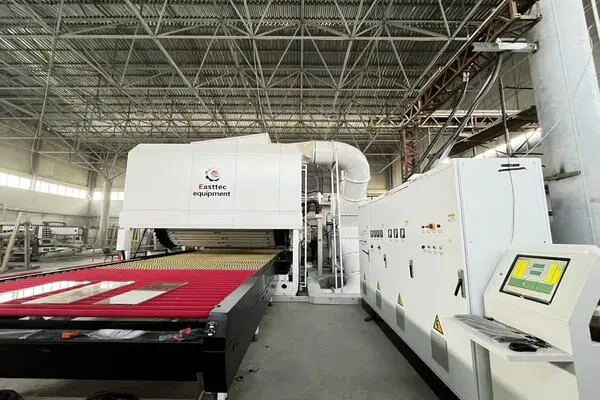
Benefits of Full Convection Technology for Glass Tempering Performance
When manufacturers upgrade to a convection-assisted tempering system like the Full Convection Hard Roller Glass Tempering Machine, they see improvements in more than one aspect of production at the same time.
Here are the core performance advantages that full convection technology delivers:
- 30% Faster Heating Cycles: Easttec's variable-frequency high-pressure top convection system cuts heating time by more than 30% compared to models that only use direct heat. When stay times are shorter, there are more cycles per shift and more work gets done each day without having to add more floor room or workers.
- 20% Reduction in Thermal Energy Loss: High-density composite insulation walls and inverter-controlled convection fans keep heat inside the heater and keep it from escaping. Easttec furnaces reduce thermal loss by 20% compared to chambers that are normally insulated. This directly lowers the number of kilowatt-hours needed to process one square meter of glass.
- Arc Deviation Controlled to Within 1.0mm: When forced convection creates a uniform thermal field and hard-roller pressing applies consistent mechanical pressure, curved glass can only deviate by ±1.0 mm in shape. This level of tolerance meets even the strictest requirements for curtain walls on commercial facades.
- Low-E Coating Integrity Preserved: For high-performance low-E glass with emissivity values as low as 0.01, it is very important to expose it to peak kiln temperatures for shorter periods of time. The window of time when metallic covering layers can oxidize is shrunk by rapid convection heating. This keeps the spectral performance and visual clarity.
These advantages collectively solve the most persistent pain points glass processors face: high electricity bills, inconsistent yield rates, and the inability to reliably process premium coated glass without film damage. Facilities that use full convection report a noticeable drop in off-spec failures, which leads to real cost saves across all production levels.
Full Convection Hard Roller vs. Traditional Glass Tempering Machines
The performance gap between full convection and conventional soft-roller radiant furnaces is not marginal — it is structural.
Full convection and regular soft-roller radiant heaters, as found in the Full Convection Hard Roller Glass Tempering Machine, don't just barely differ in how well they work; the difference is basic. To heat glass, a normal radiant burner sends out straight infrared waves. When the width of the glass changes, like between a 4mm shower panel and a 12mm structural lite, the user has to change the element spacing or dwell time by hand, which adds variation. When glass is put on soft rollers, they slightly contract under its own weight and move vibrations around. This leaves surface marks that are weak but measurable and can cause roller-wave distortion above 0.1mm peak-to-valley amplitude in some configurations.
On the other hand, the same machine can handle glass from 3 mm to 19 mm thick in an Easttec convection oven with hard-roller movement. The variable-frequency fan system adjusts the flow of heat automatically based on the weight of the glass, so you don't have to. Independent tests done at different architectural glass factories have shown that convection-heated tempered glass consistently meets or beats the requirements set by ASTM C1048 for surface compression. On the other hand, radiant-only lines using the same mix of products show more variation from batch to batch.
For procurement professionals comparing capital equipment options, the relevant question is not whether full convection outperforms radiant heating — the engineering evidence supports that it does — but whether the production volume and product mix justify the investment. The answer is almost always "yes" for any facility that processes medium to large amounts of Low-E architectural glass, curved glass, or appliance glass.
Maintenance, Troubleshooting, and Longevity of Full Convection Machines
Routine Maintenance Priorities
The estimated service life for Easttec's high-density heating parts is more than 15,000 hours of use. Thermal adjustment every six months keeps the flow field within the limits and stops drift that could lead to overheating in some areas. In normal use, fused quartz hard rollers only need to be checked for surface contamination every so often and rarely need to be replaced. The synchronized drive system gets rid of the difference in speed between the rollers, which is what usually causes glass to slip and get scratched while it's being moved.
Minimizing Unplanned Downtime
An Industrial PC (IPC) control interface is built into every Easttec furnace, including the Full Convection Hard Roller Glass Tempering Machine. This interface stores recipe parameters for dozens of different types of glass. When a production line changes from 6mm clear tempered to 8mm Low-E curved glass, workers quickly pull up the saved recipe instead of having to enter all the parameters again by hand. One week of hands-on training is all it takes for new operators to be able to run the machine on their own, which is a huge benefit for facilities that are having trouble finding skilled workers. Easttec experts offer online help 24 hours a day, 7 days a week, across all time zones. This way, if there is a problem with the heating curves, fan performance, or drive synchronization, it can be properly diagnosed without having to wait for a technician to come out and fix it.
Procurement Guide for Full Convection Hard Roller Glass Tempering Machines
Sourcing a Full Convection Hard Roller Glass Tempering Machine represents a significant capital commitment, and the evaluation criteria extend well beyond sticker price.
Before buying, buyers should make sure that the voltage works with the equipment they want to buy. This is because most U.S. facilities use 480V/60Hz industrial supplies, but many equipment makers set their defaults to 380V/50Hz. Easttec can adapt the whole power system to any global industrial standard. This means that you don't have to make any expensive electrical changes to the site. Customized tempering furnaces take between 60 and 120 working days to deliver, based on the size and specifications of the furnace. This is a wait time that procurement teams must include in project plans.
CE certification is a reliable baseline quality indicator when sourcing from international full convection tempering machine suppliers, because it confirms that electrical safety, thermal insulation, and mechanical guarding meet documented European directives. As standard, every Easttec furnace comes with CE certification. This gives U.S. processors who are bidding on projects that need traceable equipment compliance paperwork a reliable quality base.
For facilities entering the curved architectural glass segment, the combination of forced convection heating, rigid hard-roller pressing, and IPC-based recipe management defines the technical minimum for competitive production. Easttec's "turnkey" service model includes project design, installation, testing, and training for operators. This lowers the integration risk that makes buying expensive equipment feel risky.
Conclusion
Full convection technology, as embodied in the Full Convection Hard Roller Glass Tempering Machine, addresses the root causes of quality inconsistency and energy waste in glass tempering rather than treating their symptoms. It gets rid of temperature gradients that cause stress differences, optical distortion, and coating damage by moving compressed hot air evenly around all glass surfaces. With hard-roller transfer precision, the system provides arc accuracy within 1.0 mm, keeps the integrity of the Low-E film, and shortens heating cycle times by 30%. When U.S. glass processors are thinking about what new capital equipment to buy, convection-based tempering furnaces are a technically sound and commercially proven way to get higher yields, lower energy costs, and a stronger competitive position in the premium glass segments.
FAQ
What is the key difference between full convection and partial convection tempering?
A small amount of air movement, usually just from the top of the furnace, is added to solar warmth by partial convection. Full convection moves hot air under pressure across both surfaces at the same time, making a truly uniform thermal field. In practice, this means that the temperature is more evenly spread across the width of the glass, which directly lowers changes in stress and raises the fragment density compliance.
How do hard rollers prevent roller-wave distortion?
While soft rollers bend a little under the weight of the glass and move vibrations, hard rollers stay stiff throughout the heating cycle. A synced drive system gets rid of differences in speed between rollers that are next to each other. This gets rid of the mechanical stress that causes the surface to undulate. This makes the glass much smoother, which is especially important for large-format building lites where roller-wave distortion can be seen with the naked eye.
What maintenance schedule is recommended for convection furnace components?
High-density heating elements can work for more than 15,000 hours. It is suggested that the heating elements and air fan system be thermally calibrated every six months. The hard rollers' surfaces need to be checked every so often, and the IPC control system's software parameters should be looked at once a year to make sure the heating curve stays accurate for different glass thicknesses and coating types.
Partner With EASTTEC EQUIPMENT for Your Next Tempering Furnace Investment
EASTTEC EQUIPMENT has been engineering precision glass thermal processing solutions since 1994, and our Full Convection Hard Roller Glass Tempering Machine is the equipment of choice for processors targeting high-end Low-E curved glass markets in North America. Contact our engineering team directly at sales@easttecmachine.com to request a detailed technical specification, customized production proposal, or live equipment demonstration. As a trusted full convection tempering machine manufacturer, EASTTEC EQUIPMENT delivers CE-certified equipment, 24-hour technical support, and complete turnkey commissioning — so your team produces high-yield glass from day one.
References
1. Glass Technology: European Journal of Glass Science and Technology — Society of Glass Technology, 2022.
2. Tempering of Glass: Thermal and Mechanical Principles — ASM International Handbook Committee, 2019.
3. ASTM C1048: Standard Specification for Heat-Strengthened and Fully Tempered Flat Glass — ASTM International, 2023.
4. Energy Efficiency in Industrial Furnace Design — U.S. Department of Energy, Office of Industrial Technologies, 2021.
5. Advances in Flat Glass Manufacturing Technology — Glass Manufacturing Industry Council (GMIC), 2020.
6. Low-Emissivity Coatings and Thermal Processing Compatibility in Architectural Glass — Journal of Building Engineering, Elsevier, 2023.

USER EVALUATE
Here is the customer's evaluation of us