




Why Choose Forced Convection Curved Glass Toughening Machine with Flexible Roller for Automotive Glass?
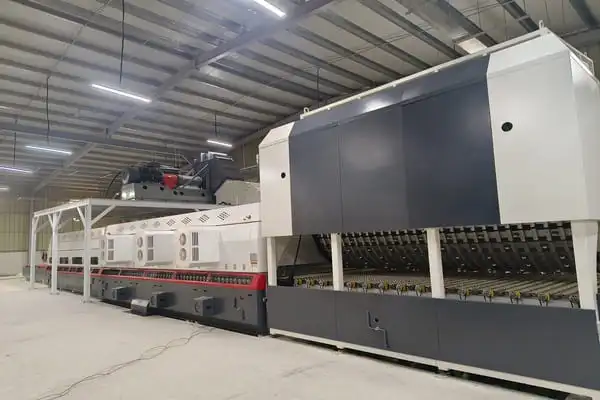
If you are sourcing equipment for automotive glass processing, the Forced Convection Curved Glass Toughening Machine with Flexible Roller stands out as a technically sound answer to the industry's most persistent production challenges. Unlike conventional radiant heating furnaces, this machine combines high-velocity convection airflow with a servo-controlled adjustable roller bed, producing curved tempered glass with surface stress exceeding 90 MPa, minimal optical distortion, and consistent batch-to-batch quality — all critical requirements for windshields, side windows, and rear glazing.
Understanding the Forced Convection Curved Glass Toughening Technology
How Forced Convection Works
Infrared elements passively move heat from the furnace walls to the glass surface in traditional radiant heating. For forced convection, on the other hand, a high-temperature blower moves hot air around inside the machine, pushing heat toward the glass at a controlled speed. Temperature differences across the glass surface are lowered by this process to well below 5°C. This is necessary to keep thermal stress cracks from happening during the bending stage.
The Role of the Flexible Roller System
Because fixed rollers can only handle one preset curve, changing molds takes a long time and costs a lot of money. This is replaced by the customizable flexible roller system, which has servo-motor-driven rollers wrapped in heat-resistant Kevlar fiber. CNC software changes the shape of these rollers on the fly. It only takes a few minutes to switch to a new bend radius through the HMI panel, which is a big time saver compared to the hours it takes to physically swap molds.
Convection vs. Radiant Heating for Automotive Glass
Radiant furnaces have trouble with Low-E coated auto glass that has an emissivity of as little as 0.01, because metallic coatings reflect infrared energy, making it absorb unevenly. This barrier against reflection is not an issue for forced convection because it moves heat through air molecules instead of radiation. This leads to even heating across the coated surfaces, which protects the film's structure while hitting the 680°C–720°C tempering level needed by ASTM C1048 and EN 12150-1.
Benefits of Using Forced Convection with Flexible Rollers in Automotive Glass Manufacturing
There are clear and measurable benefits to using both convection heating and a movable Forced Convection Curved Glass Toughening Machine with Flexible Rollers together in the production process. The main performance perks of this type of tool are:
- 30% Faster Heating Cycle: The high-pressure convection system cuts heating time by roughly 30% compared to radiant-only models, increasing daily throughput without adding shift hours or energy overhead.
- Broad Thickness Compatibility: The machine processes glass from 4 mm to 19 mm reliably, covering everything from thin decorative panels to heavy structural automotive glazing within a single production line.
- 20% Reduction in Thermal Energy Loss: Optimized furnace insulation and thermal management reduce energy dissipation, lowering monthly electricity costs and reducing the carbon output per production cycle.
- Minimal Roller Wave Distortion: Precision frequency converters and fiber-wrapped rollers keep surface wave distortion below 0.05 mm, meeting automotive-grade optical clarity standards.
Low Roller Wave Distortion: Accurate frequency converters and fiber-wrapped rollers keep surface wave distortion below 0.05 mm, which meets standards for optical clarity in the automotive industry.
Reduced Maintenance Demands
The flexible roller system makes maintenance a lot easier because it gets rid of the need to store molds physically and install them by hand. With just one week of training, operators can use a multilingual HMI interface that supports English, Spanish, Russian, Korean, and Portuguese, among other languages, to make digital changes to recipes. This directly solves the problem of a lack of trained workers that many glass companies in North America are having right now.
Comparing Forced Convection Curved Glass Toughening Machines with Other Technologies
Forced Convection vs. Infrared Radiant Heating
Infrared kilns are cheaper up front, but they are much harder to use when working with Low-E or treated glass. Because the coating is reflective, it creates hot and cold spots in certain areas, which makes visual confusion and breaking more likely. Forced convection gets rid of this variation by spreading heat evenly through the air across the whole surface of the glass, no matter what kind of layer is on it.
Flexible Rollers vs. Fixed Mold Systems
For fixed mold systems to work, each type of glass curvature needs its own mold. Mold inventory alone is a big capital and storage cost for car providers that work on multiple vehicle types at the same time. This is not a problem at all with the movable roller bed. The roller profile is set by software, so new curvature recipes are saved digitally and can be retrieved instantly. This means that the system can be used for both small custom orders and large-scale production.
What Leading Equipment Specifications Reveal
In the year 2024, advanced convection curved tempering systems must meet a minimum bent radius of about 450 mm, a heating range of 680°C to 720°C, and quality standards set by CE, ASTM C1048, and EN 12150-1. An Industrial PC (IPC) and a PLC interface allow for safe data management and quick recipe recall, which lowers setup mistakes in operations that run on multiple shifts.
Procurement Considerations for Forced Convection Curved Glass Toughening Machines with Flexible Rollers
Total Cost of Ownership
Price is only one part of figuring out how good a curved glass tempering furnace is. The real cost over a five- to ten-year equipment life is based on how much energy it uses, how easy it is to get replacement parts, how often it breaks down, and how much it costs to train new employees. For example, a 20% drop in thermal energy loss could save a medium-sized auto glass company that works two shifts a day tens of thousands of dollars in power costs every year.
Supplier Evaluation Criteria
Buyers should make sure the provider has CE certification and a history of working with car glass. They should also ask for proof of surface stress test results and optical distortion readings. During the first year of production, operating risk is greatly reduced by suppliers who offer online technical help 24 hours a day, on-site installation and commissioning services, and ongoing training for operators. In general, customizable units take between 60 and 120 working days to deliver, so this should be taken into account when planning when to buy something.
Customization and Voltage Compatibility
In North America, companies use different power and frequency standards than in many other countries. A good company that sells a Forced Convection Curved Glass Toughening Machine with Flexible Roller should be able to adapt to all types of power systems, such as 380V/60Hz and 415V/50Hz. Some production settings, like heating curves, cooling intensity, and roller spacing, should be able to be changed to fit the needs of each glass type and facility.
Why Forced Convection Curved Glass Toughening Machines with Flexible Rollers Are the Preferred Choice for Automotive Glass
Meeting Automotive Safety Standards at Scale
Auto glass has to meet strict standards for fragmentation. ISO 12543 says that for fully toughened glass, destructive tests must have a particle count of more than 40 pieces per 50x50 mm square. The engineering behind this standard is that uniform convection heating creates a surface stress above 90 MPa that stays the same from batch to batch.
Industry 4.0 Integration and Data Management
Traceability is becoming more and more important on modern car glass production lines. Advanced convection furnaces have IPC and PLC control architectures that let you store recipes, keep track of batches, and keep an eye on process parameters. All of these features connect to quality management systems. With this level of data security, glass makers can meet the OEM supplier qualification standards that are becoming common in the car industry.
Measurable Return on Investment
When a plant replaces a radiant furnace with a forced convection curved tempering line, it usually sees payback in three ways: lower energy bills (20% less heat loss), higher output (30% faster cycle times), and lower scrap rates due to more even heating. Within 18 to 36 months of installation, these gains add up to a big increase in the annual margin for a medium-sized car glass business that makes 500 units per shift.
Conclusion
The real problems that car glass makers have to deal with in production are coating integrity, curvature accuracy, energy cost, and inconsistent output. Using forced convection heating and an adjustable, flexible Forced Convection Curved Glass Toughening Machine with Flexible Roller system solves these problems. When buyers buy equipment that meets CE, ASTM C1048, and EN 12150-1 standards and gets full customization and technical support 24 hours a day, seven days a week, they are making a technically and financially sound investment. This type of technology makes it possible for companies that work with different types of glass for different types of vehicles to get better yield rates and lower running costs.
FAQ
1. How does forced convection improve tempering quality for Low-E automotive glass?
Instead of infrared light, forced convection moves heat through the air by moving hot air around. This gets around the reflective barrier that metallic Low-E coatings create, making sure that the temperature is the same all over the glass surface. This leads to even surface stress and less optical distortion, which are both very important for automotive glazing.
2. What glass thickness range does the flexible roller system support?
The machine works with glass that is 4 mm to 19 mm thick. The bendable roller shape can be digitally adjusted to fit different thicknesses. As the thickness of the glass goes up, so does the minimum bending radius, which usually ends up being about 450 mm.
3. How long does it take to change to a new curvature recipe?
Because the roller system is controlled by software instead of a mold, using the HMI console to change the bend radius only takes one to five minutes. There is no need to physically remove or add a mold.
4. What certifications should I verify before purchasing?
Check that the product has CE approval as a minimum standard for safety. Make sure the equipment also meets the standards set by ASTM C1048 and EN 12150-1. Before signing any contracts, make sure you get fragmentation test results and thermal uniformity profiles from the seller.
5. Does EASTTEC support voltage customization for North American facilities?
Yes, EASTTEC's bent tempering furnaces can work with all types of power systems, such as 380V, 415V, and 60Hz, to meet North American industrial standards.
Partner with EASTTEC EQUIPMENT for Your Next Curved Glass Tempering Project
Since 1994, EASTTEC EQUIPMENT has been working on developing thermal processing technology for glass. They use European convection standards for use in car and architectural glass around the world. You can get our Forced Convection Curved Glass Toughening Machine with Flexible Roller as a fully customized supplier option, set up to meet your production rate, glass specs, and power needs. To get a project consultation or equipment quote, please email our technical team at sales@easttecmachine.com right now.
References
1. Glass Technology: European Journal of Glass Science and Technology, Society of Glass Technology, 2022.
2. ASTM C1048: Standard Specification for Heat-Strengthened and Fully Tempered Flat Glass, ASTM International, 2023.
3. EN 12150-1: Glass in Building — Thermally Toughened Soda Lime Silicate Safety Glass, European Committee for Standardization, 2022.
4. ISO 12543-2: Glass in Building — Laminated Glass and Laminated Safety Glass, International Organization for Standardization, 2021.
5. Automotive Glass Technology and Manufacturing Standards, Society of Automotive Engineers (SAE International), 2023.
6. Energy Efficiency in Industrial Furnaces and Thermal Processing Systems, U.S. Department of Energy — Office of Industrial Technologies, 2021.

USER EVALUATE
Here is the customer's evaluation of us