




What Industries Need Forced Convection Curved Glass Toughening Machine with Flexible Roller?
Industries that need a Forced Convection Curved Glass Toughening Machine with Flexible Roller include architectural glass manufacturing, automotive glazing, home appliance production, furniture and interior glass, solar panel processing, and independent glass deep-processing service providers. These sectors all share a common requirement: they must produce curved, tempered glass with consistent surface stress, minimal optical distortion, and reliable safety compliance. The flexible roller system eliminates fixed-mold tooling costs, while forced convection heating delivers uniform temperatures across Low-E coatings and specialty glass — making this equipment a practical solution for any factory processing bent safety glass at scale.
Understanding Forced Convection Curved Glass Toughening Machines with Flexible Rollers
Before buying any big pieces of equipment, it's helpful to know exactly what it does and why the way it's built is important for your work floor.
What Is the Core Machine Design?
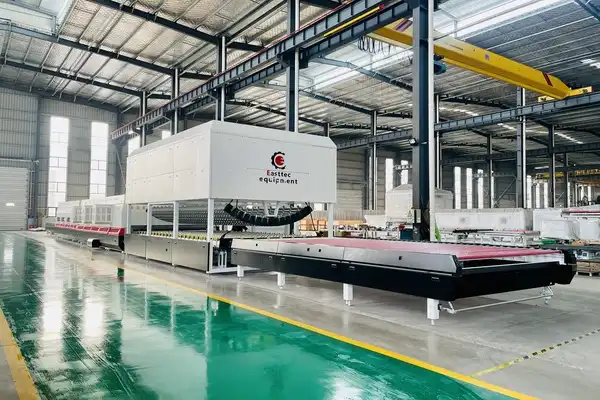
Flat glass is heated to between 680°C and 720°C in a curved glass toughening machine with a flexible roller bed. During the tempering cycle, the glass is shaped by a movable roller mechanism. The flexible roller bed is different from fixed-mold bending systems because it has servo-motor-controlled rollers wrapped in heat-resistant Kevlar-style fiber that can make exact curves without changing the mold. This means that using the HMI console to switch between different bend radii takes about one to five minutes.
How Does Forced Convection Work?
A high-temperature fan is used in forced convection technology to move hot air around inside the heating room. All of the convection parts are made of ceramics that can handle temperatures up to 1,300°C. This method spreads heat more evenly across the glass surface than solar heating alone. This is especially important for Low-E polished glass, where metallic layers can make it harder for heat to pass through. Because of this, the heating procedure is 30% faster, and the hardening is more even across all sheets in a batch.
Why Do Flexible Rollers Outperform Fixed Systems?
When a new curve needs to be made, expensive new tools have to be bought for fixed roller or fixed-mold systems. Flexible roller technology solves this problem by letting CNC control of roller height along multiple axes. This makes it possible to make J-shaped curves, large architectural arcs, or complex multi-focal geometries all on the same production line. Surface smoothness deviation stays below 0.2%, and Forced Convection Curved Glass Toughening Machine with Flexible Roller wave distortion stays below 0.05mm. These numbers meet the quality standards set by ASTM C1048 and EN 12150-1.
Industries Benefiting from Forced Convection Curved Glass Toughening Machines
The range of industries that rely on this equipment is broader than many buyers initially expect. Each sector has distinct requirements, but all of them benefit from the same core capability: precise, repeatable curved tempering at production scale.
Architectural and Construction Glass
Modern facades, curtain walls, and skylights increasingly specify curved Low-E glass for both aesthetic and energy-performance reasons. Architectural glass processors need equipment that handles glass thicknesses from 4mm up to 19mm and maintains optical clarity under high wind-load conditions. Easttec's flagship convection line is specifically engineered for sophisticated Low-E bent glass, featuring high-velocity top airflow that ensures uniform heat distribution across delicate coatings while supporting large-span and complex architectural arcs.
Automotive Glass Manufacturing
Bus glazing, specialty vehicle rear windows, and panoramic roofs require complex curvatures with high shatter resistance and precise frame fitment. The multi-axis flexible roller system accommodates variable radii within a single sheet — a capability that radiant-only machines simply cannot match. Surface stress consistency exceeding 90 MPa for fully tempered glass ensures that automotive components meet the structural safety thresholds required by vehicle certification programs.
Home Appliance, Furniture, and Solar Glass
Oven door panels, refrigerator shelves, and shower enclosures demand precise tempering without coating damage. Curved display freezer lids and solar panel glass require both thermal integrity and optical uniformity. The same flexible bending system that serves architectural work adapts to these smaller, thinner applications. With a processing range spanning 4mm to 19mm and Low-E emissivity support as low as 0.01, the equipment protects high-performance coatings while meeting batch-to-batch consistency targets across diverse product categories.
Why Choose Forced Convection Curved Glass Toughening Machines with Flexible Rollers?
There are still a lot of factories that use older radiant heating systems with bending beds that don't move. When you know how much those systems actually cost, it's easy to make the case for updating.
Infrared energy is reflected by Low-E layers on glass, which makes traditional radiant burners heat the glass unevenly. This makes soft spots that can be seen with thermal imaging, which makes it more likely for things to break and drops the output. When you use mold-based bending, every new radius costs more in tools, and it can take hours to switch between tools. Here are the main ways that the adjustable Forced Convection Curved Glass Toughening Machine with Flexible Roller technology is better at what it does:
- 30% Faster Heating Cycle: High-pressure convection delivers heat uniformly and rapidly, cutting cycle time compared to radiant-only models and increasing daily output for architectural and automotive projects.
- 20% Lower Energy Loss: Optimized insulation and thermal management reduce thermal energy loss, lowering monthly electricity overhead and supporting sustainability targets.
- No-Mold Bending Flexibility: The adjustable high-strength flexible roller system accommodates large-span and diverse curvatures without tooling replacement, reducing changeover time to under five minutes.
- Stable IPC/PLC Control: A robust Industrial PC and PLC interface manages heating curves, cooling parameters, and bending recipes with instant recall, guaranteeing high batch-to-batch consistency.
- CE Certification: Full CE compliance ensures the equipment meets rigorous international safety standards, making it immediately eligible for high-specification construction tenders and global export markets.
The three biggest problems that glass producers say they have are high energy costs, uneven quality, and taking too long to adapt to new product requirements. These benefits directly address these problems. A plant that works 250 days a year can get back a lot of its money just by saving energy and breaking things less often.
How to Select and Procure the Right Forced Convection Curved Glass Toughening Machine with Flexible Roller
Selecting the right equipment requires more than comparing headline specifications. Procurement managers and production engineers should work through the following criteria systematically.
Match Capacity to Your Production Volume
Identify your daily throughput target in square meters and confirm that the furnace's loading size, cycle time, and cooling section can sustain that output across shifts. Easttec's furnaces support deep customization of equipment size, heating curves, and cooling parameters to match specific product specifications.
Verify Coating and Thickness Compatibility
If your product mix includes Low-E glass, confirm that the supplier's convection system is engineered to prevent film oxidation. The machine should handle your full thickness range — from thin decorative panels to 19mm structural glass — without parameter changes that disrupt production flow.
Evaluate Control Systems and Operator Training
A stable IPC-driven system with a multilingual interface (English, Spanish, Russian, Korean, Portuguese, and others available) allows new operators to reach operational proficiency within one week. This matters significantly in markets facing skilled-labor shortages. Verify that the supplier provides on-site commissioning, full operator training, and 24-hour online technical support.
Future Trends and Innovations in Curved Glass Toughening Technology
There is a clear trend in the glass-making industry toward more automation, less energy use, and more complicated geometric shapes. Advanced tempering lines are starting to use AI-assisted process control, which changes the temperatures of the heating zones automatically based on real-time thermal imaging feedback to get rid of soft spots in the glass before it gets to the bending stage. Also, flexible roller materials are getting better. For example, next-generation metal and fiber composites make rollers last longer while keeping wave distortion limits below 0.05 mm. Tougher rules about energy efficiency for commercial building glass are being put in place in the US and the EU. This is pushing architectural glass makers to buy equipment that keeps track of and lowers the amount of kilowatt-hours used per square meter handled. If a factory is going to make big purchases soon, choosing equipment with open-architecture control systems and modular update paths will help the production line adapt to these changes without having to be completely replaced.
Conclusion
The Forced Convection Curved Glass Toughening Machine with Flexible Roller is a production asset that works well in building glass, car glazing, home appliances, furniture, solar processing, and contract tempering. It is not just useful for one industry. It is an excellent investment for any factory that works with curved safety glass because it heats evenly, bends easily without a mold, insulates well, and is CE-certified for build quality. To find the best long-term partner, you should look at suppliers based on their convection technology depth, control system stability, customization range, and expert help after the sale.
FAQ
1. What glass thicknesses can a flexible roller curved toughening machine process?
Up-to-date units can work with glass from 3 mm to 19 mm thick. As the width of the glass goes up, so does the minimum bend radius. This means that panels with more glass need a bigger radius to keep stress from building up. Easttec's machines can handle sizes from 4 mm to 19 mm by default, and they can be set up in any way needed for a particular job.
2. How do flexible rollers prevent roller-mark distortion on finished glass?
Frequency converters that are precisely timed and high-density fiber rope wrapped around the roller surface reduce the contact pressure when the roller is bent. This keeps the curvature of the roller waves below 0.05mm, which meets the standards for visual clarity in both Architectural Grade and Automotive Grade.
3. What safety and quality standards apply to this equipment?
The machine itself should have a CE mark on it. The finished glass that is made on it is checked for surface stress and fracture count using ASTM C1048 and EN 12150-1. According to ISO 12543, destructive fragment testing proves that there are more than 40 pieces of material in a 50x50mm square.
4. How long does changeover between different bend radii take?
Since the system doesn't use molds but a digitally managed flexible roller bed, changing the radius only takes a few minutes through the HMI panel. This is a big time saver compared to systems that use molds.
Partner with EASTTEC EQUIPMENT for Your Next Curved Glass Tempering Line
EASTTEC EQUIPMENT has been making thermal processing equipment for glass since 1994. They use European convection technology and have more than thirty years of experience in the field. You can buy our Forced Convection Curved Glass Toughening Machine with Flexible Roller right now, and we can make it exactly how you want it. Get in touch with our team to talk about your production needs, ask for a technical presentation, or get a quote that is tailored to your plant. Please email us at sales@easttecmachine.com. We are a reputable company that makes Forced Convection Curved Glass Toughening Machines with Flexible Rollers, and we are ready to help you reach your production goals from the planning stages to the start-up phase.
References
1. Glass Processing Technology Review — Glass International, 2022
2. Thermal Processing Standards for Architectural Safety Glass — ASTM International, 2021
3. Energy Efficiency in Industrial Glass Furnaces — U.S. Department of Energy, Industrial Technologies Program, 2020
4. EN 12150-1: Glass in Building — Thermally Toughened Soda Lime Silicate Safety Glass — European Committee for Standardization (CEN), 2019
5. Automotive Glazing: Curvature, Safety and Thermal Processing Requirements — Society of Automotive Engineers (SAE) Technical Paper Series, 2021
6. Global Flat Glass Market: Technology Trends and Capital Equipment Demand — Freedonia Group Industry Study, 2023

USER EVALUATE
Here is the customer's evaluation of us