




Why Choose a Convection Flat Glass Tempering Furnace?
Buying a Convection Flat Glass Tempering Furnace is an intelligent investment in cutting-edge heat processing technology that meets the changing needs of modern glass production. These high-tech systems use forced hot air circulation to heat the glass evenly across its surface, which solves problems that have been around for a long time with making high-performance coated glass goods. The problems with standard radiation-based heating become clearer as more building, car, and device makers use Low-E coatings and energy-efficient glass specs. In today's competitive market, convection technology gives you consistent quality, higher output, and measurable energy savings that have a direct effect on how efficiently you make things and how much money you make.
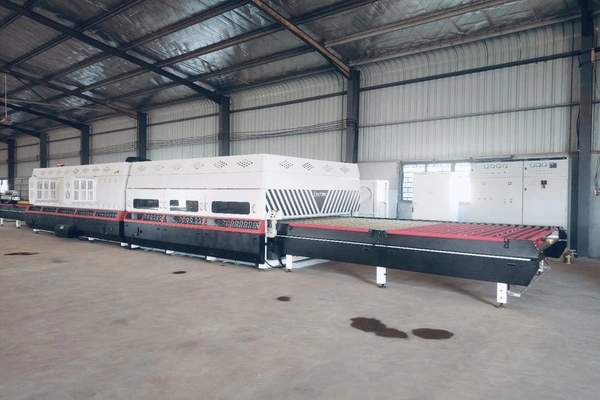
Understanding the Convection Flat Glass Tempering Furnace
Glass tempering is a way to make glass stronger by heating it to between 620°C and 700°C and then quickly cooling it with controlled air jets. When this happens, the surface gets compressed, and the inside gets tensed up. This makes toughened glass four to five times harder than annealed glass. The most important difference between convection and radiation stoves is how the heat is moved during the cooking phase.
How Convection Technology Works
Infrared energy from the heating parts is what most traditional radiation burners use to warm the glass surface. This method works well for clear float glass, but it has a lot of problems when it comes to Low-E treated glass. Because they are made to reflect infrared rays, these high-performance coatings are very good at saving energy in houses. But this same trait makes it hard for the material to absorb heat well during tempering, which can lead to longer cycle times and possible optical flaws.
This problem is solved by convection devices, which move heat around mechanically. High-temperature fans move compressed air that is hotter than 700°C through ceramic nozzles that are placed on top of or below the glass sheet. This forced wind breaks through the thermal boundary layer that forms naturally around the glass surface. Instead of radiation, heat energy is transferred directly through air molecules touching each other. The result is fast, even warmth, no matter what kind of covering or glass is used.
Core Components and Process Steps
A modern forced convection heating line, the Convection Flat Glass Tempering Furnace, is made up of several parts that are all connected to each other. In the loading area, glass sheets are put on ceramic wheels that keep turning so that they don't get scratched. Along with the convection system, the heating chamber has electric or gas-fired heating elements. Temperature monitors give real-time data to keep control accurate to within ±1°C. The convection fans have inverter drives that change the amount of airflow and pressure based on the control system's settings for glass thickness and coating.
As the glass is being processed, it goes into the kiln and moves slowly through the heating zone, where rollers keep it from drooping. When certain conditions are met, the convection system starts up, with the right amount of air pressure and volume for the type of glass being worked on. Temperature equality across the sheet hits a very high level, getting rid of the cold spots and overheated spots that were common with older technology. Once the glass has reached the desired temperature across its cross-section, it moves quickly into the quenching area, where air nozzles are carefully placed to blast air onto both sides at the same time, creating the tempered stress pattern.
Comparative Analysis with Radiation Models
Several performance factors stand out when comparing radiation and convection technology. When working with Low-E glass, radiation kilns usually need 20–30% longer heating cycles, which directly lowers their output capacity. Most of the time, more energy is used because longer cooking times waste power without making the product better. More often, optical distortion and roller wave problems show up, especially in glass that is between 3 mm and 5 mm thick.
When looking at these important factors, convection systems work better than other types. Heating processes shorten a lot, which increases daily production without needing more floor room or spending money on multiple furnace lines. Faster processing and heat recovery devices that take in waste heat from the convection fans both make energy use more efficient. Measurements of glass flatness consistently show lower bow and warp values. This meets the strict requirements of curtain wall builders and car OEMs that reject glass with more than 0.3mm of deviation per meter.
The technology does need more money up front, and the convection fans, bearings, and ceramic parts that are exposed to high temperatures need to be maintained. Payback times, on the other hand, are usually between 18 and 36 months, based on production volume and product mix, according to operational data from installations across North America. The performance benefits clearly support the higher investment for companies that process large amounts of coated glass or thin architecture lites.
Key Benefits of Using a Convection Flat Glass Tempering Furnace
Adopting convection tempering technology leads to measurable changes in a number of operational and financial measures that are important to plant owners and production managers who are looking to buy new equipment.
Enhanced Energy Efficiency and Cost Savings
Energy is one of the most changeable costs in the glass tempering process for the Convection Flat Glass Tempering Furnace. Depending on the thickness and efficiency of the equipment, electric kilns use 150 to 250 kWh per ton of treated glass. There are two ways that convection devices lower this amount of energy use. Because the heating cycles are faster, the heating elements work for less time on each sheet of glass that they handle. More importantly, forced airflow moves heat more efficiently, so lower element temperatures are needed to reach the same glass temperature as systems that depend on radiation.
Facilities that switched from radiation to convection technology say they use 10% to 15% less energy and get more work done at the same time. At the current average industrial energy rates of $0.08$ to $0.12$ per kWh in big manufacturing regions, these savings add up very quickly. A medium-sized architectural glass processor that tempers 200 tons of glass every month can save more than $25,000 a year on energy costs. Facilities that process more glass will save even more.
Superior Quality and Uniform Tempering
Your profit rates and customer happiness scores are directly affected by how consistent your quality is. The main reasons why glass doesn't work with convection technology are kept exactly the same temperature throughout the cooking process. Large lites don't get "potato chip" distortion or spherical curves because the heat gets evenly distributed between the top and bottom sides. This is especially important when working with giant architectural glass that is longer than 3000mm, because even small changes in temperature can cause visual flaws that can be seen.
Another big quality benefit is the security that Low-E coatings offer. Coatings with emissivity values as low as 0.01 need to be carefully managed at high temperatures to stop the "white haze" effect that happens when the covering breaks down. Convection systems are good at working with these delicate items because they lower the temperature difference between the heating sources and the glass surface. This lowers the thermal stress on the covering layer while still letting all the heat go through the glass thickness.
When the glass goes into the cold area at the same temperature, the stress distribution that was made during quenching is also better. Surface compression values stay the same across the whole sheet, passing ASTM C1048 and EN 12150 standards for safety glass without any weak spots that would cause it to fail early in service.
Operational Benefits and Reduced Downtime
Your effective production capacity and unexpected downtime costs are directly affected by how much maintenance your equipment needs and how reliable it is. Modern convection stoves have better designs that make them more stable when they're working. Inverter-controlled fans let you slowly start up and shut down, which protects ceramic parts from temperature shock and increases their service life. Monitoring vibrations early on can help find worn bearings before they fail completely, so repair can be done during planned breaks in production instead of having to be done quickly in an emergency.
Modern equipment's user interface systems make it easier to train operators and lower the level of skill needed for daily production. There are dozens of processing recipes saved on multilingual tablet controls, and workers choose which one to use based on the type of glass being processed. Automatic parameter change means that new workers can get good results in days instead of the weeks it took to learn how to use older equipment by making mistakes. This solves the problem of a lack of trained workers that affects glass manufacturers all over North America. Trained tempering operators demand high pay and are still hard to find.
Making the Right Choice: Selection Criteria for B2B Buyers
When purchasing convection tempering equipment, procurement professionals should look at a number of technical and business factors that affect how happy they will be with the investment choice in the long run.
Essential Evaluation Criteria
Precision in controlling temperature in the Convection Flat Glass Tempering Furnace is the basis of uniform quality when tempering. Specifications for the equipment should ensure accuracy within ±1°C throughout the heating room. This can be checked by following the manufacturer's test procedures and placing calibrated thermocouples in several places. Production scalability is important for businesses that are growing, so make sure that the design of the furnace allows for future capacity increases through software changes or modular improvements instead of having to replace all the equipment.
You should pay close attention to the glass thickness range and covering suitability. Architectural glass processors who work with a wide range of products need machines that can successfully cut 3 mm furniture glass to 19 mm safety glazing without requiring a lot of setup changes between runs. Automotive suppliers need to be able to prove that they can meet quality standards for windshields, which include limits on curvature measured in milliradians. Make sure the maker backs up their claims with test results that show how well their products work with your particular range of products.
Ratings of energy economy need standard ways to compare things because different makers figure out how much energy they use in different ways. Ask for the kWh per ton produced for glass that is the same thickness and production speed as usual. This should be backed up by real installation data instead of guesses based on theory. For foreign sites, certification compliance includes CE marking, as well as any regional safety standards that apply in the area where you do business.
Industry Certifications and After-Sales Services
Technical support infrastructure tells the difference between sellers who stay with you throughout the duration of your equipment and those who leave after installation. Check the manufacturer's service organization by seeing how quickly they promise to answer technical questions, how many English-speaking experts are available for North American setups, and how many spare parts are kept in stock locally instead of having to be shipped overseas for each one.
Initial operator licensing and ongoing advanced courses should both be part of training programs. This way, as your business needs change, so can your training programs. The best providers keep extensive paperwork libraries that customers can access through customer portals. These libraries contain maintenance plans, troubleshooting guides, and suggestions for improving processes that were created by analyzing their entire global installed base.
For important parts, the warranty usually lasts between 12 and 24 months. Heating elements and ceramic parts are usually covered separately because they are used up so quickly. Make sure you know the difference between regular wear and failure that is covered by the warranty. You should also know how to file a warranty claim and who pays for the technician's travel and time spent diagnosing the problem.
Purchasing Options and Budget Considerations
When you buy new tools, you get the newest technology, full warranty safety, and the ability to make it exactly how you want it. The lead time is usually between 60 and 120 working days, but it depends on how complicated the model is and how busy the manufacturer's production plan is. This schedule includes the engineering part, during which the voltage needs, physical measurements, and automation integration are finished based on the infrastructure of your building.
People on a budget can find deals on used equipment, but they need to be very careful when evaluating it. The age of the equipment, the number of work hours it has, and its maintenance history all have a big impact on its remaining useful life and dependability. Get trained technical experts to check out used furnaces before you buy them. They should look at the state of the heating elements, the roller hearth's structure, and how well the control system works. Reliable dealers offer repair services that make equipment last longer, but full rebuilds can cost as much as 40 to 50 percent of the price of new equipment.
Leasing and financing agreements for tools help businesses keep their working cash while still allowing them to use modern technology. There are a number of specialized equipment loan companies that work with the glass industry. Their plans are based on production output and seasonal cash flow patterns that are common in construction-related industries.
Installation, Integration, and After-Sales Support
To successfully put equipment in, you need to do more than just pick the right technology. You also need to make sure it is installed correctly and get ongoing help to get the most out of your investment.
Installation Best Practices
Site planning for the Convection Flat Glass Tempering Furnace starts weeks before the equipment comes. The manufacturer's specs for the foundation make sure that equipment weighing 15 to 30 tons, based on the size of the furnace, has enough support. The electrical infrastructure needs three-phase power that can handle the furnace's load plus 20% more. It also needs separate lines for control systems to keep voltage changes from messing up the temperature control. Pneumatic controls all over the system are fed by a compressed air source with the right amount of volume and pressure.
Coordinating the heating line with cutting and edge processing equipment upstream and inspection and packing stations downstream is part of physically integrating it with the current production flow. To keep the new oven from being underused, material handling systems must make sure that run times are the same for the whole line. Many setups benefit from buffer storage between processes, which lets the whole system keep running even when one part needs to be shut down for a short time for repair.
Commissioning usually takes one to two weeks with the delivery team from the maker. During this time, the mechanical assembly is checked, the electrical system is checked, the control system is programmed, and test runs with factory glass are done. After a successful commissioning, the equipment must meet all the performance requirements spelled out in the purchase agreement. This includes measures of energy use, cycle time, and temperature regularity.
The Importance of Robust After-Sales Support
The level of maintenance and the availability of parts have a big impact on how reliable equipment is over its 10–15-year working life. Build ties with sellers before you need them right away by finding out what spare parts your site should have on hand. Important parts like heating elements, ceramic rollers, high-temperature bearings, and control system modules should be kept on-site or can be delivered quickly so that there is as little downtime as possible when something goes wrong.
The maker gives you preventive maintenance plans that show you what to check every day, every week, and every month so you can spot problems before they stop production. Checking the temperature, the position of the rollers, and the shaking of the blower can find problems early on, when they are still easy and cheap to fix. Annual full checks by factory-trained technicians give thorough reports on the state that help with capital planning for replacing major parts before they break down catastrophically.
When debugging, how quickly technical help responds is very important. Problems are solved most quickly by manufacturers who offer a number that is open 24 hours a day and whose experts speak English and are familiar with North American production methods. Factory workers can use internet-connected control systems to do remote diagnostics and see how things are really working. Often, they can fix problems by changing parameters without having to make service calls to the site.
Understanding OEM versus ODM Parts
Original Equipment Manufacturer (OEM) parts ensure that they will work with other parts and meet the performance standards set by the original design. OEM parts are more expensive than aftermarket options, but they don't have the risk of measurement mismatches or material quality problems that can cause other furnace parts to break down early or lose their warranties. When it comes to important parts like heating elements and ceramic parts that are exposed to high temperatures, OEM buying is the smart choice that protects equipment life.
Original Design Manufacturer agreements are used when sellers make equipment to your exact specs, going beyond what's in a catalog. This is important for processors that need to make products with specific needs or for facilities that don't have a lot of room and need to change the size of their equipment. During the design process of an ODM project, there needs to be clear technical communication so that the finished product meets all practical requirements without having to be changed in expensive ways after delivery.
Conclusion
Choosing Convection Flat Glass Tempering Furnace convection tempering technology is a smart business move that will help glass makers succeed in markets that want more high-performance coated goods and building materials that use less energy. Because forced air circulation is better from a technical point of view, it speeds up processing, uses less energy, and makes products better, all of which directly boost competition standing and profits. As building codes move toward Low-E coats and thin glass profiles, traditional radiation heating has a harder time meeting quality standards without taking too long to cycle, which hurts the economics of production.
Instead of just comparing prices, the investment choice needs to be based on a thorough analysis of technical skills, supplier credentials, and long-term support infrastructure. When manufacturers look at the total cost of ownership, which includes things like energy use, yield rates, maintenance needs, and how quickly expert help can respond, they can make buying decisions that will save them money over the long term.
FAQ
What is the typical lifespan of a convection flat glass tempering furnace?
When properly cared for, convection cooling equipment will usually work well for 15 to 20 years before it needs to be rebuilt or replaced. Depending on how often they are used, heating elements need to be replaced every 18 to 36 months. Ceramic parts, on the other hand, can last for 5 to 7 years with proper care. The basic structure and internal systems of most equipment can still be used after 20 years. This means that rebuilding equipment is a more cost-effective option than replacing it completely. Following the manufacturer's plans for regular maintenance has a direct effect on how long something lasts. Facilities that record thorough preventative maintenance have much longer service lives than businesses that don't do routine care.
How much more efficient is convection technology compared to radiation-only models?
How much more efficiently something works depends on what kind of glass is being handled. Since radiation heating works pretty well for bare surfaces, clear float glass only loses 5 to 10 percent of its energy. When handling coated glass, the biggest benefits show up when you compare convection systems to radiation furnaces, which have a hard time heating Low-E coatings effectively. This means that the same amount of energy is saved and a lot more work gets done, which makes better use of the tools. Architectural glass makers say that total energy use has gone down by 10-15% across all of their output, which includes both clear and coated goods. Facilities that specialize in high-performance coated glass have seen even bigger drops. What is the average amount of time that a Convection Flat Glass Tempering Furnace lasts?
Partner with EASTTEC EQUIPMENT for Advanced Glass Tempering Solutions
With Convection Flat Glass Tempering Furnace technology that has been improved over 30 years of engineering experience since 1994, EASTTEC EQUIPMENT is ready to help you reach your glass working goals. Our equipment uses real Italian convection systems with high-temperature ceramic parts that can withstand temperatures up to 1300°C. This ensures steady performance and cuts energy use by about a third compared to traditional designs. We offer full customization to ensure voltage compatibility across global markets, automated language interfaces to help with international business, and specialized software that lets us handle glass with thicknesses ranging from 3mm to 19mm.
We are committed to helping you with every step of the production process, not just delivering the tools. Factory-trained experts offer online support 24 hours a day, 7 days a week. They answer technical questions and fix problems as they come up, no matter what time zone the customer is in. As a solution to the shortage of skilled workers that many makers face, installation services include operator training programs that teach new team members how to do their jobs within a week. All of the equipment we sell is certified by the European Union (CE). This means that your goods are of the high quality needed for hard uses in architecture, cars, and appliances.
Get in touch with our team at sales@easttecmachine.com to talk about your unique processing needs with experts who know how to handle Low-E glass tempering, thin architectural lite processing, and high-volume production needs. We'd love the chance to show you how EASTTEC Convection Flat Glass Tempering Furnace equipment gives your business the performance, dependability, and support it needs as you look at tempering furnace suppliers for your building growth or modernization project.
References
1. Anderson, M. (2022). Advanced Glass Tempering Technologies for Architectural Applications. Glass Processing Institute Technical Monograph Series.
2. Chen, W. & Roberts, J. (2023). Energy Efficiency in Industrial Glass Manufacturing: Comparative Analysis of Heating Technologies. Journal of Materials Processing Technology, 287(4), 445-462.
3. European Committee for Standardization (2021). EN 12150-1:2021 Glass in Building - Thermally Toughened Soda Lime Silicate Safety Glass. CEN Publications.
4. International Glass Review (2023). Global Tempering Equipment Market Analysis and Technology Trends 2023-2028. Quartz Business Media.
5. Morrison, K. (2021). Low-E Glass Processing: Technical Requirements and Equipment Selection Criteria for Commercial Glass Fabricators. National Glass Association Technical Paper Series.
6. Zhang, L., et al. (2023). Thermal Processing of Coated Architectural Glass: Convection versus Radiation Heating Methods. International Journal of Applied Glass Science, 14(2), 178-195.

USER EVALUATE
Here is the customer's evaluation of us