




What Should Buyers Consider When Sourcing a Top Convection Curved Glass Tempering Machine with Hard Roller?
If someone wants to buy a Top Convection Curved Glass Tempering Machine with Hard Roller, they should think about six things: how evenly it heats coated glass, how well its hard rollers hold curves, the range of thicknesses and sizes it can handle, how much energy it uses, the safety and quality standards it meets, and the service the supplier offers after the sale. I think you should start by making your own list of products and then use your real glass to test each machine on the list. This guide breaks down every point in simple terms so you can confidently compare quotes and avoid unpleasant and expensive surprises during installation.
Start With Your Production Requirements and the Tempering Process
You can avoid weeks of back-and-forth with suppliers if you write a clear brief before you ask for quotes.
Document Your Glass, Sizes, and Output Targets
You should make a list of all the things you want to bend, like door panels, oven doors, shower enclosures, furniture glass, and windshield blanks. Writing down the thickness, length, width, weight, bending radius, and type of coating for each one is important. Set your goal for pieces per hour, the amount you want to make in a year, and how often you switch products. You can quickly compare your range to that number since our machine works with glass from 3 mm to 19 mm. With a written brief, suppliers can't just compare machines based on their advertized capacity or price.
Understand How Convection Curved Tempering Works
A curve loads the glass, heats it until it softens, shapes it, and then quickly cools it down to keep the stress in. A process called convection heating moves hot air across the surface of the glass, and hard rollers move and support the sheet through important stages. These steps need to happen at the same time. If the quenching or bending process starts too early or too late, the shape may change, the optical quality may be affected, the strength may be uneven, or there may be more rejects. In the control logic, you should ask each supplier how the heating, conveying speed, and quench timing are linked.
Match Low-E Curved Glass to the Right Machine
Low-E coatings reduce heat loss, and the Top Convection Curved Glass Tempering Machine with Hard Roller can process high-performance coated glass with an emissivity as low as 0.02. These coatings can slow down radiant heating because they reflect infrared energy. EASTTEC's high-speed top-air convection system distributes heat more evenly across coated glass surfaces, helping the glass reach the required plasticity before the forming process begins. When evaluating suppliers, provide your shortlist with the exact coating specifications and the orientation of the coated surface. Rather than relying on general performance claims, request a written testing plan based on these specific requirements. This approach provides measurable results and helps verify whether the machine can meet your actual production needs.
Judge the Heating System and Hard Roller Design
Heating and rolling are the most important parts of making good glass, so that's what I look at first.
Compare Forced Convection With Radiant Heating
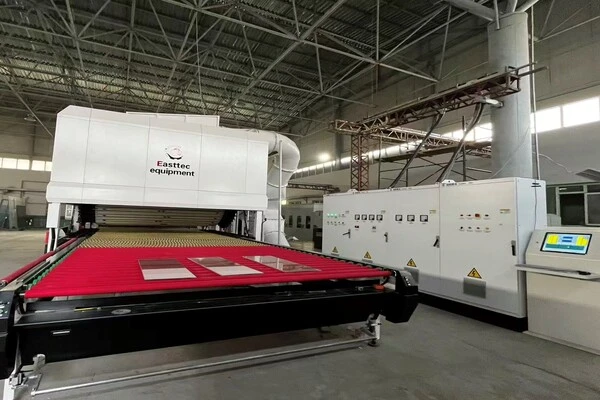
The surface of the glass can warm up faster than the core with radiant systems because they send heat from heating elements to it. For forced convection, a high-temperature blower is added to the chamber to move hot air around. Our Top Convection Curved Glass Tempering Machine with Hard Roller has ceramic convection parts that can handle temperatures up to 1300°C. The design is based on Italian convection technology. Heat moves evenly between coated and uncoated areas, which cuts down on cycle times and energy use. Get a drawing from each supplier and ask them to explain how their system moves air.
Check Temperature Control and Recipe Management
Look for heating zones that can be controlled separately, reliable sensors, the ability to store recipes, and the ability to log data. An industrial PC and a PLC that sync up frequency and pressure run our system. Different Low-E coatings, thicknesses, and bend radii have been tested and found to work with these parameters. It also remembers which recipes worked best. You can choose from an English, Spanish, Russian, Korean, Portuguese, and other language menu. When skilled workers are hard to find, this is important because new operators can learn how to run and fix things in just one week. Ask each supplier to show you how to change a recipe in real time.
Inspect Hard Roller Material and Distortion Control
The glass is held in place by hard rollers. The material, diameter, surface finish, straightness, and alignment of these rollers all affect the glass's curvature and optical quality. When the material is softening, our horizontal hard-roller technology applies even mechanical pressure. This keeps optical distortion and geometric deviation to a minimum. The rollers are made from a special alloy steel that is made to resist heat over time. What does the supplier do to check for runout, wear, and contamination of the rollers? How often do the rollers need to be replaced? Inquire about how the drive synchronization maintains a steady rotation speed, as a difference in speed can cause a roller wave.
Compare Specifications, Energy Use, and Alternatives
When you compare the numbers on a data sheet to your own products, they become useful.
Read Technical Specifications Beyond Maximum Size
The largest glass size doesn't tell the whole story. Check out the minimum bending radius, curvature depth, ability to do single or double curvature, aspect ratio, heating cycle time, quench pressure, and recipe changeover time. Our Industrial PC and PLC keep frequency and pressure in sync, so the quality of every piece is the same, from the first one to the tenth thousandth. Write down all of the requirements and make sure that each one matches the products on your list. If a supplier can't give you a number for your smallest radius or thickest glass, test a sample first.
Calculate Energy and Utility Costs
Since tempering uses a lot of electricity, you should set aside money each month to cover the cost of energy. To keep heat in, high-density composite insulation wraps around our heating chamber, and inverter-controlled fans change speed based on real-time feedback. The system we make is meant to help people save one-third of their electricity. ASK EACH PROVIDER about the installed power, the average amount used per cycle, the compressed air, the cooling water, the ventilation, and the floor space. So that we can set up the power system correctly, US buyers should let us know early on what their supply voltage and 60 Hz frequency are.
Weigh Curved Lines Against Flat Lines and Roller Types
What you make will determine which machine is best for you. A curved line is better for shaping than a flat tempering furnace, but a flat line might work better for flat products that don't need to be bent. You can compare hard and soft roller systems on your own glass to see how they work in terms of optical quality, surface marking, heat resistance, maintenance, and cost over time. For orders that might change in the next few years, find out if a combined or customized system fits your space, staffing, and planned machine use better than a line that only does one thing.
Verify Quality, Safety, Supplier Strength, and Total Cost
Tests, documentation, and service are all ways that a good machine proves itself.
Set Measurable Quality and Acceptance Tests
Write down the conditions of acceptance before you sign. Break pattern, surface stress, edge quality, bow, warp, roller wave, optical distortion, and curvature tolerance are all useful indicators. EN 12150-1 covers thermally toughened soda lime silicate safety glass, even if it breaks, and ASTM C1048 in the US covers heat-treated flat glass. Your clients may also ask for safety glazing in buildings that meets ANSI Z97.1 standards. Since ASTM C1048 talks about flat glass, you should ask your testing lab how it applies to products that are bent. Test your own glass in the factory and write down the results in the contract.
Confirm Safety Compliance and Maintenance Access
The CE safety and quality directives show that our machines meet European standards for health, safety, and the environment. It's important to remember that CE marking doesn't replace US site rules, so make sure that your inspector checks that the guarding, emergency stops, interlocks, and electrical installation meet OSHA standards and local electrical codes. Safety and maintenance are both important. Find out how to get to the heating and roller areas, how often they will be serviced, if spare parts are available, and what paperwork is needed. Our technicians offer online support 24 hours a day, seven days a week. This is helpful when a problem puts a delivery date at risk.
Evaluate Supplier Experience and Total Cost of Ownership
A supplier should have a lot of engineering knowledge, experience with applications, the ability to export, and customization tools. ASTEC EQUIPMENT has been working with glass tempering technology since 1994, and for more than twenty years, our technicians have been making deep-processing equipment for glass. Our one-stop process includes answering questions, planning the project, making it, installing it, commissioning it, training operators, and providing service after the sale. When you add up the price of the machine, shipping, setup, utilities, labor, maintenance, spare parts, downtime, and yield, you get the total cost of ownership. It can take anywhere from 60 to 120 working days to deliver a customized furnace, so keep that in mind.
Match the Machine to Your Plant and Follow a Clear Buying Process
The right configuration depends on your business, the site, and the time frame.
Match Features to Your Industry
Architectural glass processors need equipment that can handle large formats, accommodate Low-E coatings, and deliver precise curvature. Automotive glass manufacturers place greater emphasis on tight shape tolerances, optical clarity, and reliable part traceability. Appliance manufacturers producing curved oven doors, refrigerator panels, and display covers require repeatable heating recipes and fast production changeovers. Interior glass manufacturers making shower enclosures and decorative walls value equipment that can process thin glass with precise control. Solar and specialty glass processors should pay particular attention to coating compatibility, temperature uniformity, and energy consumption. The Top Convection Curved Glass Tempering Machine with Hard Roller is designed to serve architectural curtain wall, automotive glass, appliance glass, and interior glass applications. You can compare its technical capabilities with your own production priorities to determine whether it meets your specific requirements.
Plan Customization for Your Plant
Each plant needs a different amount of space, power, and software. The size, heating curves, cooling parameters, and color of the equipment are all changed to fit your products. The power system can also be changed to fit your voltage and frequency, and the menu can be read in English, Spanish, and other languages. Before signing, OEMs, distributors, and contract processors should find out about modular options, documentation, training, and support in their area. If you give us all the information early on, we can make fewer changes to the design during the 60–120 working day production window.
Follow a Step-by-Step Procurement Process
It can take three to twelve months to decide on new capital equipment, so having a clear process saves time. First, write your document of requirements. Make a short list of suppliers that have references for curved glass and CE paperwork. Ask for quotes that break down the standard equipment into automation, tooling, and spare parts that are optional. You can compare the energy use, distortion, break pattern, and curvature of glass samples that you test yourself. If you can, go to the factory and watch a live show. Finally, write down the terms of acceptance, delivery milestones, installation, training, and the warranty. We welcome buyers to visit our factory and will walk them through every step of the process of working with us.
Conclusion
When looking for a Top Convection Curved Glass Tempering Machine with Hard Roller, it helps to have a written list of things they need, such as the type of glass, its thickness, size, curvature, and output. Forced convection works well with Low-E glass because it evenly distributes heat. Hard roller material, alignment, and synchronized drives keep distortion and curvature to a minimum. Specifications, energy use, and utility needs make it necessary to compare two things next to each other. Curved lines work best for complex shapes, while flat lines work best for standard items. Then, quality checks, safety checks, the experience of the supplier, and the total cost of ownership are used to make sure that the machine fits. By putting supplier claims to the test with real glass samples and writing down acceptance criteria, you can turn them into measurable results that protect yield, delivery dates, and operating costs.
FAQ
What glass thickness can the machine process?
Glass from 3 mm to 19 mm can be worked on by our Top Convection Curved Glass Tempering Machine with Hard Roller. The practical limit is also affected by the size and shape of the panel, so send us your details so we can look them over.
Does it handle Low-E glass?
Yes. It is made for high-performance Low-E curved glass that has an emissivity of less than 0.02. Still, I think you should do a test sample with your exact coating.
Can you match a US power supply?
We make sure that the power system works with voltage and frequency standards around the world, such as 50 Hz and 60 Hz. Give us your plant's voltage, and our engineers will make sure the configuration is correct.
How long does delivery take?
Every furnace is made just for you. Depending on the model, delivery takes between 60 and 120 business days.
How fast can new operators learn the system?
Within a week, new operators can learn how to run and fix things. The multilingual menu and saved recipes make it easier to learn. Our techs also offer online support 24 hours a day, 7 days a week.
Contact EASTTEC EQUIPMENT for Your Curved Glass Tempering Project
Are you looking for a Top Convection Curved Glass Tempering Machine with Hard Roller manufacturer that can help you with everything from planning to service after the sale? With CE-compliant construction, custom voltage and language settings, and online support 24 hours a day, 7 days a week, EASTTEC EQUIPMENT offers quality management and convection technology that meet Italian standards. Our engineers will make a technical and business proposal based on the glass specifications, coating type, and output goal you send to sales@easttecmachine.com. For more information, go to easttecglass.com.
References
1. ASTM C1048 Standard Specification for Heat-Treated Flat Glass—Kind HS, Kind FT Coated and Uncoated Glass, 2018
2. ANSI Z97.1 Safety Glazing Materials Used in Buildings, 2015
3. EN 12150-1 Glass in Building—Thermally Toughened Soda Lime Silicate Safety Glass, 2015
4. Machinery Directive 2006/42/EC, 2006
5. Glass Construction Manual, 2007
6. Introduction to Glass Science and Technology, 2005

USER EVALUATE
Here is the customer's evaluation of us