




How to Choose a Radiation Flat Glass Tempering Machine for Standard Architectural Glass?
To pick the right Radiation Flat Glass Tempering Machine for standard architectural glass, you should first think about the types of glass you use, how thick they are, how big their sheets are, and how much you make every day. Finally, don't just look at price; compare heating uniformity, flatness, energy use, controls, and the total cost of ownership as well. Ask each supplier to test your own glass samples and write down the terms of service, installation, training, and utilities. Check to see if the finished glass meets ASTM C1048 and ANSI Z97.1 standards. Last but not least, choose a manufacturer with reliable remote support. Delivery dates are hurt just as much by downtime as by poor quality.
This guide was written for factory owners, plant managers, process engineers, and procurement teams that want to buy something in the next three to twelve months. Electric elements that use infrared energy to warm the glass before air quenching are used in radiant heating. There's nothing to do with radioactive stuff. The sections that follow are written in the order that most buyers use to look at a line.
Start with Your Glass Requirements and the Heating Process
Define Glass Types, Sizes, and Real Output
Before you ask for quotes, write down what the line needs to do. Write down the names of the thinnest and thickest sheets, the biggest and smallest sizes, and the amount of space you need every day. The real output will be less than the catalog figures because of things like loading time, recipe changes, inspection, and pieces that are rejected. Also, write down any items you might want to add in the next three to five years. If you give the supplier a clear list of your needs, they can help you choose the right furnace size and level of automation, so you don't have to pay for more space than you need.
How Radiant Heating Works
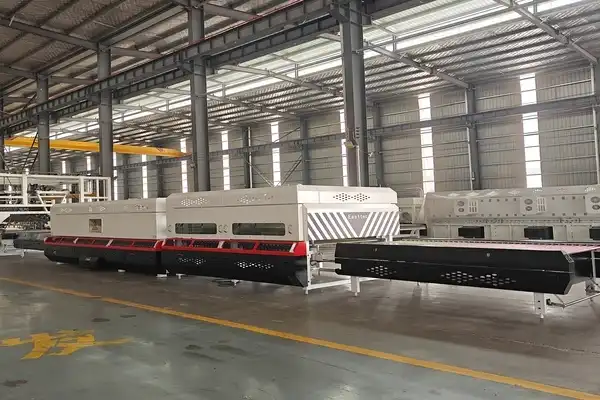
A Radiation Flat Glass Tempering Machine moves glass on rollers through a furnace. Infrared energy from electric heating elements warms the glass. The glass then moves quickly to a section called "quench." In this section, balanced air jets cool the outside of the glass faster than the inside. The difference in temperature makes the surface tight under stress. The Glass Association of North America says that fully tempered glass is about four times stronger than the same thickness of annealed glass. Our EASTTEC EQUIPMENT machine has a matrix radiant heating system with a PID controller that works on its own for each zone. This helps keep the temperature even across the sheet.
Test Your Own Glass Before You Decide
Color, coating, thickness, and the emissivity of the surface all affect how quickly glass takes in heat. For instance, tinted glass soaks up more radiant energy than clear glass, so it needs its own way to heat up. Ask each supplier to run your real samples and report on the quality of the images, flatness, and fragmentation. According to EN 12150-1, there is a fragmentation test that counts the number of particles in a 50 × 50 mm area. This gives a clear pass or fail result. Your technical director can also see real machine settings instead of a brochure when you test samples.
Compare Heating Methods and Screen Technical Parameters
Radiation, Convection, and Hybrid Heating
Radiant heating works with clear, tinted, and printed decorative float glass, which is most of the time what architects need. It has more accurate zone control and a simpler furnace design. Coated glass acts in a different way. Because soft-coat Low-E surfaces reflect infrared energy, they usually need a forced convection system. Hard-coat Low-E, on the other hand, can be worked on with radiant heating. Since EASTTEC EQUIPMENT makes both radiant and true forced convection furnaces, we don't push a single design on you. Instead, we match the heating method to your coating plan.
Furnace Size and Layout
When it comes to flexibility and floor space, size matters. Our largest model can hold 3300 x 6000 mm of large architectural panels, and our smallest model can handle 50 × 100 mm lites. The machine can work with glass that is 3 mm to 19 mm thick. Make sure that the furnace sections can fit through your door's width, ceiling's height, and floor's weight. Plan the areas where people will load and unload as well, since a full line needs space for moving parts, inspection tables, and stacking racks.
Parameters to Confirm Before You Request a Quote
You can compare supplier quotations fairly by requesting the same technical information from each manufacturer. When evaluating a Radiation Flat Glass Tempering Machine, ask about its effective processing dimensions, supported glass thickness range, number of heating zones, roller materials, quenching pressure, fan capacity, and utility requirements. You should also carefully review the control system and its functionality. Our machines are equipped with Siemens or Schneider electrical components and industrial PLC systems with pre-programmed production recipes. The operating interface supports multiple languages, including English, Spanish, Russian, Korean, and Portuguese. In addition, request CE documentation, electrical schematics, and detailed information about maintenance access. Missing technical details can lead to unexpected expenses, maintenance difficulties, and additional costs later in the equipment's service life.
Match the Configuration to Your Business Needs
Fit the Machine to Your Product Mix
Normal clear and colored glass needs to be heated steadily, distorted little, and its thickness can be changed easily. A plant that makes a lot of things might add automated loading, unloading, and tracking of production. A job shop that changes sizes all day needs to be able to change recipes quickly. The PLC stores pre-set recipes, and a one-key recall feature lets new operators run complicated cycles consistently. It only takes about a week for new operators to learn how to run and fix things. This is helpful when it's hard to find skilled workers. We set it up during project design if your plant needs a certain size or heating curve.
Energy Efficiency and Operating Cost
A lot of electricity is needed for tempering, so ask for energy data that is based on real production, like kWh per square meter of glass. That number is affected by things like insulation, airflow design, standby controls, and zone management. Our design for insulation and airflow cut power use by 15–20%. Check any claim against how full or empty your plant really is, since a furnace that is only half full uses energy in a different way than one that is full. Payback times are shorter when less power is used, which is important for both owners and plant managers.
Total Cost of Ownership and Return on Investment
Costs can be hidden by a low price. Add up the cost of shipping, setting up, commissioning, training, spare parts, software, maintenance labor, and any downtime that you expect. Then add scrap and rework, because every sheet that is broken or skewed wastes time, energy, and glass. To figure out payback, use your own product mix and rate of use. When it comes to getting its money back, a machine that wastes less glass and saves 15–20% on power can do it faster. Each supplier should write down these numbers and show them to you.
Evaluate Suppliers and Run a Clear Procurement Process
Experience, Quality Systems, and Customization
As important as the specification sheet is the strength of the supplier. EASTTEC EQUIPMENT has been making thermal processing equipment for glass since 1994. They have more than 300 installations around the world and make sure they meet European quality standards. Ask each supplier about furnaces of similar sizes, export references, warranty terms, lists of spare parts, and how long it takes for service to arrive. Because tempering furnaces are custom made, make sure you know the lead time early on. Based on the model, ours take between 60 and 120 working days. We work with voltage and frequency standards around the world, like 220V, 380V, and 415V at 50/60 Hz. Please let us know what your plant's power standard is.
Core Advantages of the EASTTEC EQUIPMENT Machine
The best things about our Radiation Flat Glass Tempering Machine are these:.
- Precision heating: A multi-zone matrix radiant system with independent PID control for each zone supports temperature uniformity, flatness, and minimal optical distortion on clear float, tinted, and decorative printed glass from 3 mm to 19 mm thick, which protects yield on large architectural sheets.
- Dependable hardware: Siemens or Schneider electronics and premium ceramic rollers support stable daily production, and more than 20 years of experience behind these designs means your maintenance team works with familiar components and can plan upkeep with confidence.
- Turnkey service: We handle layout planning, installation, commissioning, and operator training, and our technicians provide 24-hour online support, including remote diagnostics, so your team gets technical backing wherever the plant sits and problems stop production for less time.
These benefits help with three common issues in production: uneven quality, high power costs, and unplanned downtime.
Run a Structured Evaluation
For a clean comparison of bids, send all of them the same requirement sheet. Score each one on glass compatibility, quality, capacity, energy, automation, service, delivery, and total cost. Test a sample or see a factory demonstration to make sure the performance is good before you sign. Specifications, acceptance criteria, training, warranty, spare parts, and service response times should all be spelled out in the contract. Our one-stop process always goes in this order: inquiry, project design, design change, agreement, manufacturing, installation and commissioning, training for operators, and service after the sale.
Avoid Common Mistakes and Use a Final Checklist
Mistakes That Cost Buyers Money
People make the same mistakes over and over again: they choose based only on price, they trust the theoretical capacity, they think that every furnace handles Low-E glass the same way, and they don't prepare the site. If the price is low, it's possible that the quote doesn't include things like setup, training, testing, or spare parts. In an ideal world, capacity numbers might be based on a single glass size instead of mixed orders. Real samples should be used to test how the coating acts, the door's width, and its utilities should be checked. The contract should also include measurable acceptance standards for quality, output, and energy so that everyone knows what to expect.
Quality Checks to Request
As of now, ASTM C1048 is the standard used to test tempered architectural glass in the United States. ANSI Z97.1 or the U.S. 16 CFR 1201 is a rule from the Consumer Product Safety Commission. You should ask the supplier to show you measurements of your samples' thermal uniformity, flatness, roller wave, fragmentation, and surface stress. As the furnace heats up and the rollers wear down, long production runs also show if the quality stays the same. Find out who does each check and how the outcomes are saved.
Final Selection Checklist
Check four groups of things before you sign. Product: Kinds of glass, their thicknesses, sizes, coverings, and plans for growth. Technical: the size of the furnace, its heating zones, its quench system, its rollers, its controls, its data logging, and its safety documents. For commercial use, you need to know the real capacity, energy data, installation scope, warranty, spare parts, and total cost. Suppliers should provide references, test samples, documentation, support, a delivery schedule, and payment terms. If you need an answer, ask before the order, not after, and write down every answer you get.
Conclusion
It comes down to proven needs when picking a Radiation Flat Glass Tempering Machine for regular architectural glass. Float glass that is clear, tinted, or printed for decoration can be heated with radiant heat, but soft-coat Low-E products usually need convection. First, buyers should know what kinds of glass, how big they are, and how much they really produce. Then, they should compare zone control, flatness, fragmentation results, controls, and energy use on an equal level. Cost of ownership is more important than price because scrap, downtime, power, and service all affect return on investment. Risk is lower when there are sample tests, written acceptance criteria, and clear terms of support. The best machine gives you consistent quality, low operating costs, and reliable support for the products you make.
FAQ
Can a Radiation Flat Glass Tempering Machine process Low-E glass?
It is possible to work with hard-coat Low-E glass, but a forced convection system is usually needed to protect soft-coat Low-E glass. Before you order, you should always run your own samples.
What thickness and sizes can the machine handle?
Our machine can work with glass that is 3 mm to 19 mm thick. This includes clear float glass, tinted glass, and printed glass for decoration. The biggest one can hold 3300 x 6000 mm of stuff, and the smallest one can hold 50 x 100 mm.
How long does delivery take?
Tempering furnaces are custom-made pieces of equipment. Delivery takes between 60 and 120 business days, depending on the model and how it is set up.
How easy is the machine to learn?
The PLC stores pre-set recipes that can be recalled with a single key. It usually takes new operators one week to learn how to operate and maintain the machine.
Request a Radiation Flat Glass Tempering Machine Quote from EASTTEC EQUIPMENT
Planning to buy something? Radiation Flat Glass Tempering Machine maker EASTTEC EQUIPMENT has been in business for more than 20 years and offers custom configurations and online support 24 hours a day, 7 days a week. Send sales@easttecmachine.com the types of glass, thickness range, sizes, output goal, and power standard you need, and our team will come up with a good configuration and quote. You can find out more and set up a factory tour at easttecglass.com.
References
1. ASTM International, ASTM C1048: Standard Specification for Heat-Treated Flat Glass—Kind HS, Kind FT Coated and Uncoated Glass, 2018
2. European Committee for Standardization, EN 12150-1: Glass in Building—Thermally Toughened Soda Lime Silicate Safety Glass, 2015
3. American National Standards Institute, ANSI Z97.1: Safety Glazing Materials Used in Buildings, 2015
4. Glass Association of North America, GANA Glazing Manual, 2010
5. Haldimann, Luible, and Overend, Structural Use of Glass (IABSE Structural Engineering Documents), 2008
6. Varshneya, Fundamentals of Inorganic Glasses, 2006

USER EVALUATE
Here is the customer's evaluation of us