




Radiation Flat & Bend Glass Toughening Equipment of Hard Roller for Custom Glass Manufacturing
The Radiation Flat & Bend Glass Toughening Equipment of Hard Roller is a two-mode furnace that can temper flat glass and curve glass at the same time. Radiant heating evenly softens the glass, and before it is quenched, a hard roller system that works with the heating system keeps each panel in the same shape. This model of EASTTEC EQUIPMENT can work with glass thicknesses from 3 mm to 19 mm and has a flat tempering area that is 2440 mm by 3660 mm and a minimum bending radius of R ≥ 500 mm. It works well for making custom glass, where one plant has to switch between making flat panels and curved parts without affecting the quality of the glass. I'll explain how it works and how to judge it below.
How Radiation Flat and Bend Glass Toughening Equipment Works
What Is a Radiation Flat and Bend Glass Toughening Furnace?
To make glass tougher, a radiation flat and bend furnace heats it to a set temperature and then quickly cools it with air. This process puts compressive stress on the surfaces of the glass. Because of this, tempered glass is better at handling impact and heat than annealed glass of the same thickness. People who buy glass in the US often compare it to ASTM C1048 for heat-treated flat glass and ANSI Z97.1 for safety glazing. There is a radiant heating chamber, hard roller transmission, a bending section, an air quenching unit, controls, and unloading on a typical line. Our design has two modes, so the same machine can be used for both flat tempering and bent tempering. If you want to buy coated, tinted, or patterned glass, you should test a sample first to see where the coating is placed, how the surface is, and how thick it is.
How Does Hard Roller Glass Toughening Equipment Work?
At the start of the process, the edges are carefully lined up and loaded. The glass then moves through radiant heating zones that are controlled separately. In these zones, upper and lower elements create a steady temperature profile. The glass is held up by hard rollers that move it in sync through the furnace. The hard-roller pressing system works in sync with the bending section to shape each panel to the set radius. Next, balanced air quenching sets the stress pattern that decides how strong, fragmented, flat, and curved the metal stays. Lastly, inspection and production records help make recipes work again and again. As the one step feeds into the next, a mistake in heating or aligning will show up later as distortion or breakage. That's why we make heating, moving, and shaping all part of the same system.
Radiation Heating vs. Convection Glass Tempering Furnaces
Radiation and convection are the two main methods of transferring heat to glass, while "electric" refers to the energy source. In a radiation heating system, energy travels directly from the heating elements to the glass, allowing fast and localized temperature control. Since many radiation furnaces use electricity, these terms are sometimes used interchangeably, but each feature should be evaluated separately. Convection heating can be particularly effective for certain coated glass types and a wide range of glass thicknesses. EASTTEC EQUIPMENT also manufactures true convection furnaces featuring a ceramic core and high-temperature blowers capable of withstanding temperatures of up to 1300°C. For matrix radiant heating applications, the Radiation Flat & Bend Glass Toughening Equipment of Hard Roller is designed to process both flat and bent glass. When comparing supplier quotations, look beyond installed power and consider energy consumption per square meter, cycle time, production yield, temperature uniformity, and maintenance requirements under consistent operating conditions.
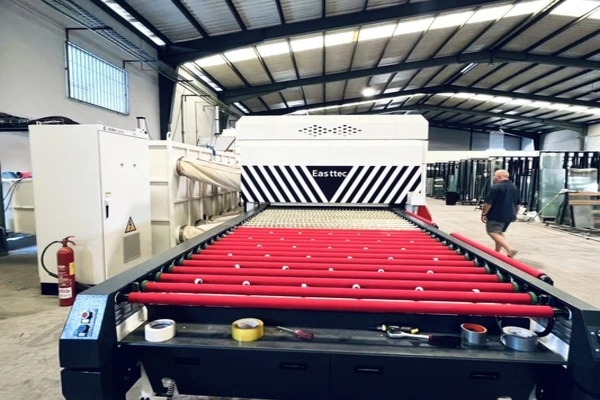
Key Features and Technical Specifications of Hard Roller Toughening Equipment
Core Specifications at a Glance
The following numbers show the main parts of our hard roller radiation furnace. The glass is between 3 mm and 19 mm thick, which is 1/8 inch to 3/4 inch. The flat tempering area is 2440 mm x 3660 mm, which is 96 × 144 inches. The section that bends is 2440 mm x 1500 mm, and the smallest radius of bend is R ≥ 500 mm, which is 20 inches. A matrix radiant system with independent multi-zone temperature control is used for heating. You can choose between 50Hz or 60Hz 220V, 380V, or 415V power. You can use English, Spanish, Russian, Korean, Portuguese, French, German, or Turkish to run the interface. For rollers, high-temperature-resistant alloy steel is used. We check your glass drawings against the final limits for size, weight, and curve.
Intelligent Thermal Zones and IPC Recipe Control
With matrix radiant heating, the furnace is split into zones, and each zone has its own temperature setting. It's easier to bend complicated shapes when operators can change the heat profile to work with different thicknesses and types of glass. It's important to soften things because cold spots make things lose their shape and hot spots leave marks. We use less energy with our heating system, but it still keeps the heat in. Manufacturing recipes are saved on the Industrial PC, which means that your team can quickly switch from flat tempering to bent glass. It stays easy and consistent to make mechanical adjustments for different radii, which cuts down on setup waste on mixed orders. The IPC also keeps all production data in one safe place so that it can be tracked and quality checks can be done.
Rigid-Axis Pressing and Heavy-Duty Construction
When they are loaded, flexible shaft systems can bend. That won't happen with our synchronized mechanical transmission, so each curved panel will always have the same curvature tolerance. For parts like car windshields, furniture doors, and appliance panels, this repeatability is important for the fit when they are put together. Rollers that are precisely ground and radiant heat distribution work together to make surfaces that don't have any ghosting or other optical flaws. That level of clarity meets the needs of people who buy high-end furniture and cars. We use high-temperature-resistant alloy steel to make the hard-axis drive so that it can work for long shifts. Because of how it's built, the furnace can handle 24/7 production schedules with fewer maintenance stops because it doesn't need to be serviced as often and replacement parts are cheaper.
How to Choose the Best Hard Roller Machine for Flat and Curved Glass
Match the Machine to Your Product Mix
Start with your growth plans, production targets, shift patterns, and product mix. Architectural glass processors usually prioritize furnace utilization, processing speed, and glass flatness. Custom curved glass manufacturers need precise shaping, flexible tooling, recipe management, and sample approval. For mixed production orders, check the changeover time between different glass sizes and shapes, as well as the consistency of the finished quality. The Radiation Flat & Bend Glass Toughening Equipment of Hard Roller is suitable for production facilities that switch between flat panels and bent glass components, as its IPC recipe management and repeatable radius adjustments help make production changes more efficient. Compare your largest glass panels with the available flat processing area of 2440 mm x 3660 mm and bending section of 2440 mm x 1500 mm. Ultimately, your actual glass dimensions and technical drawings will determine whether the equipment is the right choice for your production requirements.
Compare Energy Use and Total Cost of Ownership
Use a unit of measure like kilowatt-hours per square meter to compare energy to output. The cost of running a furnace is affected by its insulation, how well it loads, how efficient it is, and its standby settings. Scrap can be more important than a low price, so look at things like roller marks, uneven tempering, broken edges, distortion, and uneven curvature. Our zoned radiant heating and hard rollers that work together go after these flaws where they start. Make a budget for the whole lifecycle of the machine that includes filters, rollers, heating elements, cooling systems, software, spare parts, and compressors. Because the price of electricity is going up, this calculation needs to be done again for each quote. Have each supplier give you the same information about the same conditions. Then, put the yield and energy use next to each other and compare them.
Check Training, Maintenance, and Service Support
It's hard to find skilled workers, so training time is important. Our control software and touchscreen interface that can be used in multiple languages walk operators through different glass specifications. Most teams finish training in just one week. Maintenance managers should find out about spare parts, how often they are serviced, and if they can get help from afar. Technicians at EASTTEC EQUIPMENT are available online 24 hours a day, 7 days a week to help with installation, commissioning, operation training, and support after the sale. Delivery dates are harmed by downtime, so get technical answers quickly to protect your delivery dates. We also help new teams with journeyman work and give advice on glass deep-processing technology.
Customization and Procurement Process for Industrial Glass Manufacturers
Information We Need for a Precise Quotation
A precise quote starts with full information. Please send the type of glass, coating, thickness range, measurements, drawings, curvature tolerances, desired output, and level of automation. Add the address of your factory, the voltage and frequency that are available, and the standards that you need to meet, like ASTM C1048, ANSI Z97.1, or CPSC 16 CFR 1201 for architectural glazing. With this information, our engineers can decide on the size of the furnace, its heating curves, its cooling parameters, and even its color on the outside. We make sure that the equipment works with 220V, 380V, or 415V at 50Hz or 60Hz, and we can set the software language to the one you need. Making inputs clear also cuts down on changes later in the project.
From Inquiry to Commissioning
We have an eight-step process that you can go through in one stop: initial inquiry, project design, optimal design, cooperation agreement, production manufacturing, installation and commissioning, operation training, and service after the sale. Because glass tempering furnaces are made to order, delivery can take anywhere from 60 to 120 business days, depending on the model. During that time, get the foundations, air flow, cooling, crane access, and utilities ready. Write down what you agree to do about shipping, customs, insurance, and installation. It can take months to decide on new capital equipment, so we welcome technical reviews and visits to the factory along the way.
How to Verify a Supplier
Check whether the supplier manufactures its own equipment or simply resells products made by other companies. Luoyang Easttec Glass Automation Equipment Co., Ltd. is a high-tech enterprise specializing in the design, manufacturing, and sales of glass thermal processing equipment. Our technical team has more than 20 years of experience in glass deep-processing equipment, while our glass tempering technology dates back to 1994. Our equipment complies with CE requirements, and our quality management practices follow standards influenced by Italian manufacturing technology. When evaluating the Radiation Flat & Bend Glass Toughening Equipment of Hard Roller, ask suppliers to provide examples of previous projects, relevant documentation, warranty terms, spare parts plans, and equipment acceptance procedures. You can also visit our factory and training center to see our manufacturing facilities, equipment, and technical team firsthand before making your purchasing decision.
Applications of Radiation Flat and Bend Glass Toughening Equipment
Architectural and Interior Glass
Thickening can be flat or bent, and it can be used for doors, windows, facades, curtain walls, balustrades, partitions, and curved glazing. When surface clarity and repeatable dimensions are important, interior and furniture designers can make shower enclosures, shelves, display cases, tables, and decorative panels. From 3 mm to 19 mm, you can find everything from thin furniture glass to thick architectural panels. Zoned radiant heating and rigid-axis pressing help surfaces have the clear reflections that buyers want. This is what CPSC 16 CFR 1201 and ANSI Z97.1 say about architectural glazing in the US. Make sure you know what tests are needed before you quote a job.
Automotive and Appliance Glass
In our product information, we list curved parts like car windshields, furniture doors, and appliance panels. These parts need to be consistently curved so that they fit together well when they are put together. Customers may have extra standards, testing, or handling rules for parts used in cars, trucks, and appliances. It's important to know what those are early on. Tell our engineers about your drawings, tolerances, and ways of inspecting them. We are going to check to see if the part fits with the furnace's configuration, heating curves, and cooling parameters. The smallest radius of bending for this model is R ≥ 500mm. The maximum radius of bending depends on the thickness, size, and shape.
OEM and Contract Processing
Order changes happen a lot for contract processors and OEM manufacturers. You can run small batches and private-label orders without losing process control with the Industrial PC's ability to store recipes, switch between jobs quickly, and change the radius of the circle again and again. Customers who want records can use production data on the IPC to find out what happened. A deep-processing plant can match the furnace to its order mix because we can change the size, heating curves, cooling parameters, and color of the equipment. There is only one dual-mode line you need to maintain if you sell tempered and bent glass to different industries. This is because it can handle more types of products.
Conclusion
Zoned radiant heating, synchronized roller pressing, and air quenching are key features of a hard roller radiation line. This technology allows the machine to temper flat glass and shape curved glass within the same production system. The Radiation Flat & Bend Glass Toughening Equipment of Hard Roller from EASTTEC EQUIPMENT can process glass thicknesses from 3 mm to 19 mm, with a flat processing area of 2440 mm x 3660 mm, a bending section of 2440 mm x 1500 mm, and a minimum bending radius of R ≥ 500 mm. Since radiation and convection transfer heat in different ways, buyers should look beyond installed power ratings when comparing equipment. Energy consumption per square meter, production yield, heating uniformity, and maintenance requirements are equally important. Long-term operating costs also depend on the initial investment, changeover efficiency, operator training, spare parts availability, and after-sales service. Clear technical specifications and sample testing help verify whether the production line can handle different glass types and meet the requirements of architectural, furniture, automotive, appliance, and contract manufacturing applications.
FAQ
Can one hard roller system process both flat and curved glass?
Yes. The two-mode furnace cools flat glass over an area of 2440mm x 3660mm and bends glass over an area of 2440mm x 1500mm, all the way down to R ≥ 500mm. With IPC recipes, operators can quickly change modes.
What glass thickness can it process?
It goes from 3 mm to 19 mm. Size, weight, and curvature limits are still based on the glass, so we check them against your drawings before giving you a quote.
Can the equipment match my facility's power and product needs?
Yes. We set the voltage and frequency to work with your building and let you change the size, heating curves, cooling parameters, language of the interface, and color.
How long does delivery take?
Every furnace is made to order. Depending on the model, delivery takes between 60 and 120 business days.
Request a Quote for Radiation Flat & Bend Glass Toughening Equipment of Hard Roller from EASTTEC EQUIPMENT
In the United States, are you looking for Radiation Flat & Bend Glass Toughening Equipment of Hard Roller? EASTTEC EQUIPMENT is a manufacturer that uses quality management that meets Italian standards. They offer full customization, operator training that most teams can finish in one week, and online support 24 hours a day, 7 days a week. Our engineers will make a proposal for your project based on the type of glass, thickness range, curvature, and output you want. Just email sales@easttecmachine.com with these details. For more information, go to easttecglass.com.
References
1. ASTM International – ASTM C1048: Standard Specification for Heat-Treated Flat Glass—Kind HS, Kind FT Coated and Uncoated Glass, 2018
2. American National Standards Institute / Safety Glazing Certification Council – ANSI Z97.1: Safety Glazing Materials Used in Buildings, 2015
3. U.S. Consumer Product Safety Commission – Safety Standard for Architectural Glazing Materials (16 CFR Part 1201), 1977
4. European Committee for Standardization – EN 12150-1: Glass in Building—Thermally Toughened Soda Lime Silicate Safety Glass, Part 1, 2015
5. ASTM International – ASTM C1036: Standard Specification for Flat Glass, 2021
6. Society of Glass Technology – Fundamentals of Inorganic Glasses (A. K. Varshneya), 2006

USER EVALUATE
Here is the customer's evaluation of us