




What Production Requirements Matter When Buying a Double Chamber Flat Glass Toughening System?
When looking to buy a Double Chamber Flat Glass Toughening System, the most important things to consider are the type of glass you use, the actual hourly output, the level of automation, the energy use, quality compliance, site readiness, and support after the sale. Before you compare prices or brochure sizes, you should make a list of these needs. Your yield and delivery dates will be safe if you have a furnace that works with your range of thicknesses, coatings, sheet sizes, and order frequency. I go over each requirement, show you how to test it, and talk about how the EASTTEC EQUIPMENT dual-chamber design meets them all in this guide.
Define Your Glass, Output, and Process Requirements
Start With Your Glass Products and Production Mix
Make a list of all the products you want to sell first. Note down the types of glass (clear float, Low-E, reflective, and solar), the thickness, the largest sheet size, the weight, and the quality goals. The settings for heating and quenching need to be changed for each product. 4–6 mm thick glass responds quickly to heat shock, but thick glass takes longer to heat up. For the coating to stay on, coated glass needs controlled convection. Nominal specification sheets are not enough. You should also ask each supplier for test data on their own products. One line of EASTTEC EQUIPMENT can handle glass from 4 mm to 19 mm thick, so a plant can move between shower doors, countertops, and wall panels. By matching the furnace to the products that are being made or will be made in the future, breakage and early limits can be avoided.
Determine the Required Capacity and Production Rhythm
Don't use the maximum number on a brochure to figure out capacity; instead, use how the shop is actually set up. Look at the daily and yearly demand, batch sizes, changeover times, inspection windows, reject rates, and the number of changes that happen. Then, for your own glass sizes, compare the output in square meters per hour and sheets per hour. One load heats up in the pre-heating chamber while another finishes in the high-heating chamber. This makes the two-stage design work better. Easttec says that this flow makes the capacity up to 1.8 to 1.9 times that of a single-chamber furnace. That number should only be used as a guide. You should then ask for a capacity calculation based on the mix of thickness and size. Plan for growth as well, like getting bigger sheets or more automation.
Evaluate Heating, Quenching, and Temperature-Control Performance
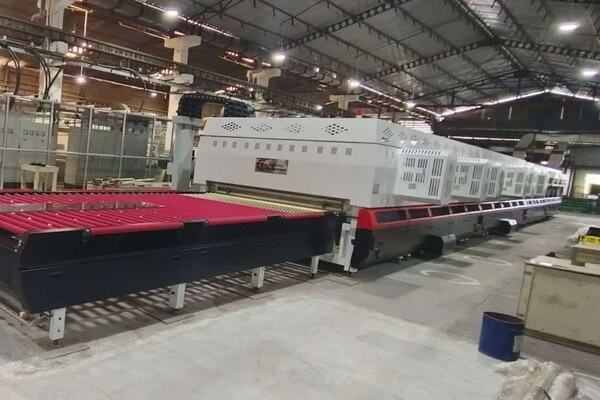
Heating and cooling of glass in a Double Chamber Flat Glass Toughening System has a significant effect on the strength, flatness and optical clarity of the finished glass. Consider the heating zones, temperature sensors, roller movement, insulation, nozzle design, and cooling uniformity in a Double Chamber Flat Glass Toughening System. Also important is to know how the two chambers work together and if they are run through synchronised production recipes. The key feature of Easttec’s Double Chamber Flat Glass Toughening System is a high-temperature blower that circulates hot air inside the furnace through true forced convection. The ceramic convection parts can withstand temperatures of up to 1300°C and guarantee a uniform distribution of heat over the entire glass surface, thereby minimising cold spots. Such heating technology enables Double Chamber Flat Glass Toughening System to have more stable temperature control and reliable processing results, particularly when challenged with demanding glass applications. Buyers can also request sample runs, recipe storage, production data logging, and alarm records to assess the performance of the Double Chamber Flat Glass Toughening System. These functions help to make the verification of process stability, comparison of production results and keep the same glass quality at different shifts easier.
Match Automation, Energy Use, and Quality Standards to Your Plant
Match Automation and Operating Requirements to Your Team
There aren't enough skilled workers in many factories, so automation should work with the workers you already have. Compare loading and unloading that is done by hand, partially automatically, or fully automatically. You can also compare glass positioning, recipe selection, and fault alerts. Your cutting, edging, washing, and inspection stations should all be able to connect to the furnace. Safety interlocks and locked doors are important around hot, moving parts. The pre-heating, high-heating, and quenching parts of our furnace are timed by an industrial PC (IPC) that works with a PLC. It's possible to get the interface in English, Spanish, Russian, Korean, Portuguese, French, German, and Turkish. In about a week, new operators can learn how to run and fix things, and our technicians are available online 24 hours a day.
Calculate Energy Efficiency and Total Cost of Ownership
The price you pay for it only covers part of the cost. Find out how much energy your glass uses in kilowatt-hours per square meter or per sheet, taking into account its size, thickness, and coatings. Then you can add shipping, installation, utilities, building changes, training, options, and commissioning. Figure out how much spare parts for fans, filters, rollers, heating elements, and sensors will cost. To get a full picture of the total cost of ownership, add these numbers to those for labor, downtime, rejects, and yield. Advanced insulation cuts down on thermal loss in the two-chamber design, and the IPC keeps the power balanced between the chambers to avoid spikes. Easttec says that its energy-saving design helps customers save one-third of the electricity they use. To find out how much you can save, ask for a calculation that fits your production schedule.
Verify Product Quality, Safety, and Compliance
You must be able to measure quality. ASTM C1048 specifies that fully tempered glass shall have a minimum surface compression of 69 MPa. This is what most tempered glass in the US is built to. ANSI Z97.1 covers safety glazing materials for buildings. For float glass, EN 12150-1 requires that the number of fragments in a 50 mm by 50 mm area should not exceed 40. Add flatness, roller wave, edge quality, and coating integrity to the list of things that will be accepted. Then write down the requirements for the tests to be carried out at the factory and on site. Our system is CE certified, which supports the safety documentation of electrical and mechanical parts. US buyers should also check with their inspector about local electrical codes such as NFPA 79.
Prepare Your Site and Choose the Right Supplier
Check Installation, Facility, and After-Sales Requirements
Plan the site in advance. Verify footprint, ceiling height, foundation, loading access, maintenance clearance, power supply, compressed air, airflow, cooling, and ventilation. Most plants in the US use 60 Hz power. Send us your exact supply information, and we will help you. Easttec operates at 50 or 60 Hz with 220V, 380V, and 415V. The lead time is 80 to 100 working days, as the system is made to order. List the time for assembly, calibration, commissioning, training, and warranty visits. Develop a list of spare parts for critical components, including their expected arrival dates and recommended service intervals. One-stop process from installation, commissioning, operator training to after-sale service.
Compare Suppliers and Request a Complete Technical Proposal
When choosing a Double Chamber Flat Glass Toughening System, look beyond the price and consider the engineering capabilities, manufacturing experience and project support. First, determine if each supplier is a direct manufacturer, system integrator, or reseller. Ask about their experience dealing with glass similar to your particular needs, and whether they have successfully delivered similar Double Chamber Flat Glass Toughening System projects. The full proposal will include equipment layout, factory utility requirements, anticipated production capacity, delivery schedules, itemized prices, installation services, operator training, warranty, and spare parts. Suppliers should also explain the calculation of the energy consumption and the production capacity of their Double Chamber Flat Glass Toughening System, preferably with technical data. Request sample testing, customer references, and an opportunity to visit the manufacturing facility to confirm actual performance. Luoyang Easttec Glass Automation Equipment Co., Ltd. is a high-tech company specializing in the manufacture of glass thermal processing equipment and glass tempering technology since 1994. Easttec has rich experience in the industry. We can customize the Double Chamber Flat Glass Toughening System according to different production requirements, such as equipment color, heating curves, power system, and machine dimensions. It gives customers the chance to choose a Double Chamber Flat Glass Toughening System that better suits their factory layout, glass processing requirements, and long-term production objectives.
Build a Practical Decision Matrix for the Final Purchase
This selection is made objectively by a weighted decision matrix. Better to look at things like glass compatibility, tested quality, real capacity, heating control, service, and spare parts first than the price. For large architectural plants, automation and large sheet stability may be high on the list. Mixed-order processors may be concerned with fast changeovers and stored recipes. “The coated and solar glass producers need to be able to control the process and make sure the surface is good. Test each of the short-listed suppliers on a representative sample and use the results to finalize the requirements, performance guarantees, and acceptance tests. Also, this method can help owners, engineers, and buyers all come to agree on one ranking.
Common Buying Mistakes and How to Avoid Them
Most of the time, buyers choose the product with the lowest price, accept theoretical capacity numbers, or skip tests on products that are hard to test, like Low-E, thin, or oversized glass. Others forget about things like utilities, foundation work, ventilation, or how much important options cost. Then, expensive downtime can happen because of bad after-sales service and a lack of spare parts. You can keep these issues from happening if you get a site survey, a detailed scope of supply, product-specific capacity math, sample testing, written acceptance criteria, and a full review of the warranty terms before you sign. I also think you should go to a running line. A specification sheet doesn't tell you as much as seeing real glass come out of the quench section.
How the EASTTEC Dual-Chamber Design Meets These Requirements
Capacity and Cost per Sheet
Double Chamber Flat Glass Toughening System has a double-stage heating platform; one chamber is for preheating, and the other is for high-temperature heating. One batch is being brought to the required tempering temperature in the high-heating chamber, while the next batch is being preheated in the first chamber. The synchronization enables the Double Chamber Flat Glass Toughening System to maintain a continuous production cycle and reduce the waiting time between batches to a minimum. It can hold about 1.8 to 1.9 times as much glass as a conventional single chamber furnace, helping manufacturers meet tight delivery schedules without the need for additional shifts. The Double Chamber Flat Glass Toughening System also incorporates advanced insulation technology to reduce heat loss and lower energy consumption per glass sheet processed. The system also helps to reduce overall production costs by improving heating efficiency and reducing wasted thermal energy. The Double Chamber Flat Glass Toughening System is an ideal production solution for factories looking to increase output without taking on more workers or expanding their existing floor space. The Double Chamber Flat Glass Toughening System is an ideal solution for manufacturers who wish to increase productivity, improve equipment utilization, and have a more cost-effective glass tempering process. The double chamber configuration, continuous heating process, and energy-saving insulation contribute to the advantages of the system.
Quality for Thin Glass and Low-E Coatings
Glass 4 to 6 mm thick can be damaged by thermal shock. Our two-step process gradually increases the temperature, which eliminates stress points and distortion. The roller wave can also be diminished by reducing the time the ceramic rollers are held at peak temperature. Forced convection also ensures uniform heating. With the system’s flexible convection settings, there is a broad range of coatings possible, from clear float to high-end Low-E coatings. The multi-recipe program stores heating curves for different thicknesses and coatings. Operators can go from 4 mm shower doors to 8 mm tabletops to 12 mm building panels without having to change the hardware.
Automation, CE Certification, and Turnkey Support
The pre-heating, high-heating, and quenching sections are all timed by the IPC and PLC control system so operators don’t have to wait for a chamber to reset. CE marking makes it easier to sell in markets with regulations. From one location, we respond to your inquiry, plan your project, manufacture, install, commission, train your operators, and provide after-sales service. Online support is available 24/7, and the multilingual menu assists crews that speak different languages. Also, we can give you advice on deep-processing technology of glass and equipment transformation. 50 or 60 Hz 220V, 380V or 415V are manageable in power systems.
Conclusion
If your major concern is the production requirements, then a Double Chamber Flat Glass Toughening System is your best bet. The heating and cooling requirements depend on the type of glass, the thickness range, and the coatings. You can verify if the furnace fits your order schedule with real-life calculations. The cost per day depends on the energy data, the degree of automation, and the training of the operator. The total cost of ownership matters more than the initial price. Standards such as ASTM C1048 and EN 12150-1 define what is acceptable. Spare parts, after-sales support, and site readiness protect uptime. Claims are false. Sample trials and detailed proposals reveal. A weighted matrix allows for fair comparison of these things. In this article, a two-stage design including pre-heating and high-heating chambers is described to increase output without loss of quality.
FAQ
When does a double chamber system beat a single chamber furnace?
It works for plants that need to get a lot done quickly. Up to 1.8 to 1.9 times more can be made with the Easttec design by pre-heating one batch while another finishes. Plants with low volumes and few thicknesses might not need that.
How do I verify Low-E glass compatibility?
Ask for tests to be done on your own coated glass samples. Then, compare the coating's integrity, flatness, and fragmentation to the standards that were agreed upon. For Low-E, our system has special convection options.
What information do you need for an accurate quote?
Send the types of glass, their thicknesses, sizes, coatings, the output you want, your automation preferences, the voltage and frequency, the country where the glass is going, and the conditions at the site.
What is the delivery time?
The system is made to order, and the lead time is 80 to 100 working days.
Request a Production-Matched Double Chamber Toughening System Proposal
Tell us about the types of glass, the range of thicknesses, the sheet sizes, the coatings, the output you want, and the voltage at the site, and EASTTEC EQUIPMENT will suggest a configuration that fits your needs in terms of capacity, energy, layout, and delivery. We make the Double Chamber Flat Glass Toughening System and offer customization, installation, training, and online support 24 hours a day, 7 days a week. To start your question, email sales@easttecmachine.com or go to easttecglass.com.
References
1. ASTM International, Standard Specification for Heat-Strengthened and Fully Tempered Flat Glass (ASTM C1048), 2018
2. European Committee for Standardization, Glass in Building – Thermally Toughened Soda Lime Silicate Safety Glass, Part 1 (EN 12150-1), 2015
3. American National Standards Institute, Safety Glazing Materials Used in Buildings (ANSI Z97.1), 2015
4. European Parliament and Council, Machinery Directive 2006/42/EC, 2006
5. National Fire Protection Association, Electrical Standard for Industrial Machinery (NFPA 79), 2021
6. Society of Glass Technology, Fundamentals of Inorganic Glasses (Varshneya), 2006

USER EVALUATE
Here is the customer's evaluation of us