




What Production Factors Matter When Buying Radiation Flat & Bend Glass Toughening Equipment of Hard Roller?
Heating uniformity, roller alignment, bending repeatability, quench control, energy draw per square meter, and the extent of the supplier's technical support are the production factors that determine whether Radiation Flat & Bend Glass Toughening Equipment of Hard Roller pays for itself. Each of these shapes gives way long before it shows up on an invoice. I've seen plants buy something because it was cheap, but then lose the money they saved because of breakage, roller waves, and unplanned downtime. Check a machine against the types of glass you make (thicknesses, coatings, radii, and volume), and the cheapest quote doesn't stay the cheapest for ten years.
Getting a tempering furnace is a ten-year investment, and the price you pay for it only covers the first month. The real cost is set by things like electricity, yield, spare parts, training, and service calls. This is a field guide to the most important production factors, along with the tests I ask buyers to do before they sign anything.
Start With the Production Profile, Not the Price List
Glass Types, Thickness Range and Coating Conditions
Start by writing down all the jobs that need to be done on the line. This should include clear, tinted, Low-E, printed, and coated glass, as well as any other odd jobs that your customers keep sending you. Thickness is important because a range of 3–19mm includes both thin 3mm panels and thick 19mm stock. Each thickness needs a different heating curve. Inside the furnace, curtain walls, shower enclosures, oven doors, and furniture tops all act in different ways. More limits are set by cutouts, holes, and the quality of the edges. Everyone who wants to bid should be given this list and asked to mark the items they can't handle. Those answers show which suppliers are serious and which ones are just trying to make sales.
Realistic Capacity Instead of Nominal Panels per Hour
The nominal output that suppliers give is for ideal loads. When you add in inspection, heating, bending, quenching, changing over, loading, unloading, and heating, the real output goes down. How many square meters, what thicknesses, and what mix of sizes should be in your weekly model? Use your actual order book as a guide. A furnace that changes from 4mm to 12mm every few hours acts very differently from one that runs at 6mm all day. For each supplier, ask them to explain what they think their capacity number means, and then compare that with your model. Both sides can be honest and useful when they use the same glass to figure out their numbers.
Flat and Curved Product Mix
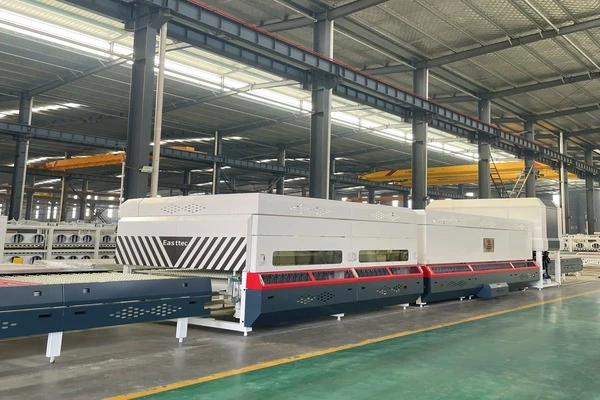
When you have enough production volume of curved-glass, the Hard Roller Radiation Flat & Bend Glass Toughening Equipment has strong production value. The machine has a flat processing area of 2440 x 3660 mm and a bending area of 2440 x 1500 mm. The bending section of Radiation Flat & Bend Glass Toughening Equipment of Hard Roller is especially fit for repeated order and the request of the same radius from R≥500mm. If curved panels are a small percentage of your total output you have to weigh carefully whether the additional molds, set up time and skilled labor to operate Hard Roller's Radiation Flat & Bend Glass Toughening Equipment will give you adequate returns. For buyers whose production is primarily flat glass, a dedicated flat tempering line with an external partner for the occasional curved-glass order might be the more economical solution. Don't just look at the sales figures when considering the Radiation Flat & Bend Glass Toughening Equipment of Hard Roller, but look at the required production volume, changeover costs, labor requirements and potential return on investment before you buy.
Judge the Radiant Heating System and Its Energy Draw
Zone Layout and Temperature Uniformity
Infrared energy from radiant heating brings glass to the right temperature for tempering, and the layout of the zones controls how evenly that happens. A matrix design with separate zone control lets an operator make up for long panels, cold edges, and heavy loads in the middle. Not a brochure diagram, but a thermal map from a test on glass that is close to yours. In order to understand cycle time and defect rates, you need to keep an eye on how fast the furnace recovers after a load leaves. Even heating from edge to edge keeps the stress during tempering the same and stops breaking at the quench.
Coated, Tinted and Low-E Compatibility
Coatings change how heat is absorbed by glass. To heat low-E surfaces without warping or damaging the coating, a radiant furnace needs to be set up with the right zone settings and dwell times. Body-tinted glass takes in heat more quickly and can get too hot around the edges. Send coated samples to each of the shortlisted suppliers and then put the panels back together next to each other under the same lighting. This test will tell you more than any specification sheet. Suppliers who ask what Low-E product you use before giving you a quote usually know how coatings work. People who don't ask should have their references checked again.
Energy per Square Metre and Lifecycle Cost
Since electricity is the most expensive part of tempering, ask for how much is used per square meter at a specific thickness instead of a vague percentage. It depends on the type of insulation, the standby modes, the zone control, and the design of the blower. EASTTEC EQUIPMENT builds its furnaces around an energy-saving design that the company says can cut electricity use by about a third compared to older setups. Buyers should check these claims with their own glass mix. To the energy number, add up the cost of repairs, spare parts, labor, and downtime. That number, not the quote, tells you how much the machine costs.
Inspect Hard Roller Conveying, Bending Mechanics and Quench Quality
Roller Material, Alignment and Roller Wave
Therefore the condition of the rollers of a Hard Roller Radiation Flat & Bend Glass Toughening Equipment can affect the quality of each square meter of glass you sell. High temperature alloy steel rollers can keep their shape even after repeated heating cycles. Vibration and surface marking in service are dependent on bearing design, bearing spacing, and control of roller runout. Roller waves are periodic ripples that can have adverse effects on reflections in furniture glass and architectural facades . They are caused by roller misalignment or improper adjustment . For a Radiation Flat & Bend Glass Toughening Equipment of Hard Roller, ask the supplier how roller runout is measured, and how often rollers are checked or replaced. If you visit a factory, look at the maintenance procedures and ask to see the records of roller run out measurements. The condition of the rollers on a Radiation Flat & Bend Glass Toughening Equipment of Hard Roller should be checked regularly so that problems can be identified before they lead to excessive defects, rejected panels or customer complaints. Documented roller maintenance program also helps to achieve more stable production quality and longer service life of the equipment.
Bending Method, Minimum Radius and Changeover
The way it works determines how accurately it bends. When you press glass between two mechanical axs that are working together, you get a hard roller system. This keeps the curve stable over the course of a production run and doesn't cause deformation like flexible shaft arrangements can. Managing the mold, adjusting the radius, and the time it takes to switch over all affect how profitable it is to take on small curved orders. Find out how long it takes for two people to change the radius, and ask for samples from three different production days instead of just one showpiece panel. Because assembly lines notice changes quickly, consistent curvature from day to day is more important than a perfect first article.
Quenching Airflow and Acceptance Criteria
When the stress is heated, it stays there. Optical, fragmentation, and flatness goals for a mixed batch of glass are met or not based on air pressure, nozzle layout, and upper and lower zone control. Before you sign, make sure that the contract includes acceptance criteria like the number of fragmentation particles that meet EN 12150-1 standards, the limits for flatness and roller waves, and a clear sample size for visual inspection. Buyers have been arguing for months about what "acceptable quality" means because no one has written it down. Putting numbers in a contract puts an end to that argument and gives both sides a fair point of reference.
Review Controls, Maintenance and Site Readiness
IPC and PLC Recipe Control
An Industrial PC that runs the furnace keeps recipes for each thickness, coating, and radius. This way, an operator can just pull up a profile that was saved instead of having to rebuild the settings from scratch. Access levels stop changes that aren't supposed to be made, and alarm history makes it faster for nite shift workers to find problems. When plants train new operators or change staff, having menus in more than one language can help. As more and more architectural projects ask for traceability, find out if the system exports batch records for customer audits. Controlling the recipes also speeds up the changeover process, which is where small-batch processors can make or lose money.
Maintenance Intervals, Spare Parts and Training
Ask for a maintenance plan that includes bearings, fans, nozzles, insulation, sensors, rollers, and heating elements. Then, ask what you should keep on hand. A line's idle time is more important than the price of a spare part's lead time. Training should be looked at with the same level of care, since even a well-built machine can break down in the hands of someone who hasn't been trained on it. Easttec Equipment says that its control software makes it easy for new operators to learn how to run and fix machines in just one week. They can get help from online technicians 24 hours a day, 7 days a week. Check to see who answers the phone at 2 a.m. in your time zone and what language they speak.
Factory Layout, Utilities and Safety
When planning for a Radiation Flat & Bend Glass Toughening Equipment of Hard Roller, you need more space than the furnace footprint. 3. Plan the flow of material from cutting and edging through to tempering, inspection and storage. Provide enough space for mould handling, crane access, maintenance activities and future production expansion. Check the floor load capacity, electrical supply requirement at 220V, 380V or 415V with 50 or 60 Hz, availability of airflow and compressed air before delivery of the Radiation Flat & Bend Glass Toughening Equipment of Hard Roller. Safety reviews should also include guarding, interlocks, emergency stops, access to hot zones, and broken glass removal procedures. Including these site requirements into the quotation and installation plan can help to ensure the Radiation Flat & Bend Glass Toughening Equipment of Hard Roller is compatible with the facility and can be smoothly commissioned. Good preparatory work also minimises the likelihood of unexpected delays in the installation due to lack of space in the building, utilities, or safety provisions.
Score the Supplier, the Quotation and the Contract
A Weighted Scorecard and Identical Test Conditions
Look at all of the suppliers in the same way. Make a weighted scorecard with your own priorities: even heating, stable rollers, repeatable bending, energy use, automation, spares, and support. You should mark required features as pass or fail and score optional benefits separately, that way a long list of features can't hide a feature that isn't there. Send each bidder the same sample of glass, and then use the same light to look over the panels they send back. There should be clear consequences in contracts for not meeting goals for output, quality, energy, uptime, and delivery.
Common Buying Mistakes to Avoid
The workshop is not where most furnace problems begin; they begin in the specifications. When a mixed order book hits nominal capacity, it looks great. When element layout, zone control, emissivity settings, and software are very different, radiant systems are treated as if they were interchangeable. People don't test low-E compatibility, they just assume it works. Roller alignment doesn't get as much attention as it should, even though it causes distortion and marking. After-sales duties aren't clear until there's a problem. Each gap is easy to close during negotiations but hard to close afterward.
Matching Configuration to Your Buyer Profile
Most of the time, architectural processors need big panels, a lot of uptime, and steady output across 6mm to 12mm stock. Shops that make shower doors and furniture depend on turnovers, small batches, and clean looks. This is why recipe speed and radius control are more important than raw tonnage. Suppliers of cars and appliances need tight shape control and the ability to track parts. Distributors and new plants look at things like paperwork, training, and space to grow. Before you compare machines, write down your profile. Then, make sure that each bidder's configuration fits it. You will always feel like the machine you built was made for someone else's order book.
Conclusion
When purchasing a Radiation Flat & Bend Glass Toughening Equipment of Hard Roller, the decision should not be based on price alone but on how well the equipment matches your production requirements. A vague request can be transformed into a clear technical specification by providing detailed information about glass types, thicknesses, coatings, bending radii, and production volumes. For a Radiation Flat & Bend Glass Toughening Equipment of Hard Roller, important performance factors such as heating efficiency, temperature zone control, roller condition, bending mechanisms, quenching airflow, energy consumption per square meter, and control software should all be measurable. Site readiness, maintenance planning, spare parts availability, and operator training also determine how well the equipment maintains its performance during daily operation. Using a weighted evaluation scorecard, identical sample tests, and written acceptance criteria helps ensure that all suppliers are assessed under the same conditions and provides both parties with clear performance benchmarks for future reference. By considering these factors when selecting a Radiation Flat & Bend Glass Toughening Equipment of Hard Roller, manufacturers can make a more informed investment. In many cases, the furnace offering the best overall performance and reliability will have a lower total cost of ownership over ten years than a machine selected solely because of its initial purchase price.
FAQ
That's what buyers ask most often during the technical evaluation.
How does radiant heating handle Low-E and coated glass?
Because coatings reflect infrared energy, heat acts differently on them than it does on clear glass. Ask the supplier to test the samples they've coated and give you recipes for the Low-E products you use. Before committing, look at the returned panels to see if they are distorted, have changed colors, or have coating damage.
Can one machine run both flat and bent glass?
Yes, if the shapes you sell can be made with the bending section, molds, and control recipes. For flat work, the 2440 x 3660mm area is used. For curved work, the bending section with a minimum radius of R ≥ 500mm is used. Make sure you know the changeover time for radius adjustments. That number determines whether small curved orders can still make money.
What should a quotation include beyond the machine price?
installation, commissioning, training for operators, documentation, a list of spare parts, warranty terms, and criteria for an acceptance test. Ask how much energy is used per square meter at your thicknesses and what assumptions were used to come up with the capacity number. Don't compare headline prices, compare totals.
Talk to EASTTEC EQUIPMENT About Your Radiation Flat & Bend Glass Toughening Equipment of Hard Roller Project
Send Easttec Equipment your glass mix, including thicknesses, coatings, radii, and the output you want to achieve. The team will then match it with the Radiation Flat & Bend Glass Toughening Equipment of Hard Roller that works best for your facility. You can get a technical proposal, sample testing, and a quote for installation, training, and support by emailing sales@easttecmachine.com. As a company that sells tempering furnaces to factories all over the world, EASTTEC EQUIPMENT builds each line based on your order book instead of a fixed catalog.
References
1. ASTM C1048, Standard Specification for Heat-Strengthened and Fully Tempered Flat Glass, ASTM International, 2018.
2. EN 12150-1, Glass in Building — Thermally Toughened Soda Lime Silicate Safety Glass — Part 1: Definition and Description, European Committee for Standardization, 2015.
3. ANSI Z97.1, Safety Glazing Materials Used in Buildings — Safety Performance Specifications and Methods of Test, American National Standards Institute, 2015.
4. 16 CFR Part 1201, Safety Standard for Architectural Glazing Materials, U.S. Consumer Product Safety Commission, Code of Federal Regulations, 2021.
5. Manufacturing Energy Consumption Survey, U.S. Energy Information Administration, 2018.
6. ISO 9001, Quality Management Systems — Requirements, International Organization for Standardization, 2015.

USER EVALUATE
Here is the customer's evaluation of us