




What Makes Forced Convection Tempering Machine Ideal for Premium Glass Processing?
Forced Convection Flat Glass Tempering Machine technology represents a significant advancement in premium glass processing, addressing the longstanding challenges of heating efficiency and quality control. Unlike traditional radiation-based systems, forced convection equipment utilizes high-pressure hot air circulation to heat glass uniformly, achieving 30% faster cycle times and superior optical quality. This method is particularly essential when processing Low-E coated glass with emissivity as low as 0.01, where conventional radiation struggles due to reflective barriers. The result is consistent mechanical strength, reduced energy consumption, and higher production yields that align perfectly with the sustainability and profitability goals of modern glass manufacturers across architectural, automotive, and appliance sectors.
Introduction
Flat glass tempering is the first step in making high-quality glass products that are used to build modern sites, make sure cars are safe, and power green energy solutions. Traditional tempering methods aren't working as well as they used to because more people want energy-efficient building materials and high-performance glass. New technology called forced convection has become a game-changer because it offers better heating efficiency and precise process control than radiation-based systems.
It's important to note that this progress directly addresses three important buying priorities: lowering running costs, maintaining consistent product quality, and making production more flexible. When glass makers look at tempering equipment, they are under more and more pressure to lower their energy costs, cut down on defects, and handle a wide range of product specifications without having to spend a lot of time switching between machines. These problems can be solved by forced convection machines, which cut heating times by up to 30%, keep temperatures uniform within ±2°C, and work with glass thicknesses from 3mm to 19mm without any problems. Because of these features, the technology is especially useful for business buyers who want dependable, high-performance tempering solutions that help them stay competitive over the long term and meet international safety standards.
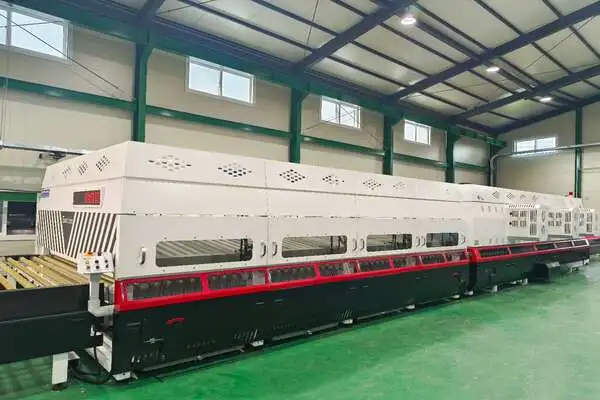
Understanding Forced Convection Flat Glass Tempering Technology
In forced convection cooling, active heat movement, not passive radiation, is what all the magic is about. Radiant heating elements that send infrared energy toward the glass surface are what most traditional tempering furnaces use. Standard clear glass can be processed with this method, but it's very hard to work with Low-E or reflective coatings, which reflect a lot of the radiant energy. Forced convection technology gets around this problem by using high-temperature fans to move hot air across both sides of the glass. This makes sure that the glass absorbs heat the same way no matter what the coating is made of.
Key Components and Process Flow
The system design is made up of many specific parts that work together. Inside the heating room, where temperatures hit 620–700°C, high-temperature ceramic blowers force air through it under pressure. Inverter-controlled convection fans change the amount of airflow in real time based on the thickness of the glass and the finishing requirements. Ceramic convection lines and parts that can handle 1300°C spread hot air evenly across the glass surface so that as little heat as possible is lost to the environment.
Glass goes into the heating chamber on ceramic rollers during the tempering cycle. The forced convection method heats the glass evenly across the whole piece and quickly brings it to the right tempering temperature. For Low-E glass, this controlled heating phase usually ends 20–30% faster than radiation methods. After the heating step, the glass goes to the quenching station, where high-pressure air jets quickly cool the surfaces. This makes the compressive stress pattern that makes tempered glass strong. The accuracy of the convection heating phase has a direct effect on the quality of the cooling result. This lowers the chance of visual distortion and stress imbalances that can cause the material to break on its own.
Operational Advantages in Practice
After installing a Forced Convection Flat Glass Tempering Machine, factories that make triple-silver Low-E glass for high-rise curtain walls have seen big gains. With radiation furnaces, heating cycles that used to take 240 seconds now only take 165 seconds. This means that 30% more work can be done each day without affecting the flatness or uniformity of the glass's surface stress. In optimized production environments, forced convection systems can help reduce energy consumption by improving heat transfer efficiency and shortening heating cycles. This is because heat transfer is better and cycle times are faster. These improvements directly lead to a better return on investment. Depending on the amount of production and the cost of energy in the area, payback times are usually between 18 and 30 months.
Advantages of Forced Convection Tempering Machines for Premium Glass
The business case for forced convection technology is based on a number of benefits that work together to solve the most important problems in glass processes. Energy economy is very important right now because the cost of energy keeps going up and cutting into businesses' profits. Two things happen in forced convection systems that lower power use: faster heating cycles use less total energy, and better thermal efficiency keeps heat from being wasted as much as possible. When working with regular architectural glass, 10-15% less energy is usually used than when using radiation kilns with the same output amounts.
Enhanced Quality Control and Defect Reduction
The mechanical properties and optical quality of tempered glass are directly affected by how uniform the temperature is. With forced convection technology, the temperature stays within a ±2°C range across the whole glass surface. This is in contrast to many radiation systems, which have temperature differences of 5°C or more. This level of accuracy gets rid of common flaws like "white fog" discoloration, roller wave distortion, and uneven stress patterns that can hurt both the look and the safety. When it comes to strict quality standards like those in the automotive or architectural markets, reducing defects means higher yield rates and fewer costly rejections.
In properly measured forced convection systems, the consistency of surface stress is higher than 90 MPa, which meets or goes beyond the standards set by ASTM C1048, EN 12150-1, and ANSI Z97.1. Edge compression stays high, which lowers the chance of breaking on its own, which can hurt a company's reputation and lead to warranty claims. Particle count tests show patterns of breakage that consistently produce 40+ pieces per 50x50mm area, which is the standard for fully tempered safety glass.
Production Flexibility and Process Versatility
These days, factories that work with glass rarely make just one type of product. In the morning, the same facility might work with 3 mm thin glass for displays. In the afternoon, it might switch to 12 mm building panels, and at nite, it might work with 6 mm car glass. These different types of glass can be worked with by forced convection machines, which have heating settings that can be programd to change the convection pressure, airflow patterns, and cycle time to fit each type of glass.
The method can work with Low-E glass that has an emissivity of as little as 0.01 without any special care or damage to the coating. High-frequency quenching protocols that account for fast heat loss make it possible to reliably process thin glass from 3 mm to 4 mm. Through long rounds of convection, thick glass up to 19 mm lets all the heat through while keeping flatness standards that meet building requirements. This makes it possible to use fewer specialized furnaces, which makes planning production easier and lowers the need for capital equipment.
Maintenance Considerations and Operational Uptime
When purchasing managers look at tempering equipment, they know that the price of the item itself is only a small part of the total cost of ownership. Demands for maintenance, supply of spare parts, and the stability of equipment over its 10–15-year service life all have a big effect on profits. Professionally built forced convection systems have service points that are easy to get to, diagnostic systems that find problems before they happen, and modular parts that can be quickly replaced without requiring a lot of downtime.
Every 3,000 hours of use, high-temperature bearings in convection blowers need to be inspected, and vibration analysis needs to be done every three months to find wear patterns. Ceramic convection parts are very durable and usually work for 5 to 8 years before they need to be replaced. The airflow-controlling inverter-controlled drive systems can self-diagnose and let workers know about any changes in voltage, temperature, or performance that could mean problems are starting to form. When upkeep is needed, the modular design lets technicians change only the broken parts instead of the whole assembly. This saves money on parts and time during repairs.
Comparing Forced Convection Tempering Machines with Other Technologies
When making B2B purchasing choices for a Forced Convection Flat Glass Tempering Machine, it's important to look at different platforms objectively and think about their pros and cons. The market is mostly made up of four main ways to temper: traditional radiation heating, natural convection, forced convection, and vacuum tempering for specific uses. Figuring out the trade-offs helps people make decisions that match the capabilities of the equipment with the needs of the production and the available funds.
Technology Performance Analysis
Radiation-based tempering furnaces have been used in the glass business for many years and work well for most clear glass uses. Because they are easy to use and don't require a lot of money up front, these systems are great for businesses that process mostly clear glass to standard sizes. Radiation technology, on the other hand, has trouble with Low-E surfaces because it needs much longer heating processes, which slows down work and uses more energy. Problems with optical distortion and stress uniformity get worse as the size or thickness of the glass changes.
Natural convection systems are kind of in the middle. They move air around without using high-pressure fans, which are what forced convection systems do. Natural convection is a little better than pure radiation, but it's not good enough for high-performance coated glass because it doesn't transfer heat very well. Compared to radiation, heating times are usually only cut by 10–15%, which is not as much as the 30% savings that are possible with forced convection. Gains in energy efficiency are still small, and the technology doesn't help much when working with thin or heavily coated glass.
The problems with both sunlight and spontaneous convection can be fixed by forced convection technology. Processing speed goes up a lot, and heating processes finish 20–30% faster than radiation-based options. Even though processing is faster, energy use per square meter goes down because better thermal efficiency more than makes up for the power needs of the blower. Metrics for measuring glass quality keep getting better: variations in flatness below 0.05 mm per 300 mm span, stress uniformity above 90 MPa, and visual clarity free from distortion caused by heat.
Vacuum tempering is a specialized method mostly used for very thin glass (less than 2 mm thick) where normal air tempering poses too high of a risk of heat shock. The technology needs more money to be invested and takes longer to complete, so it can only be used in certain situations and not in general production.
Selection Criteria for Procurement
When looking at forced convection equipment, there are a few technical details that you should pay close attention to. When compared to fixed-speed fan designs, inverter-controlled convection systems are more flexible and use less energy. Ceramic design for high-temperature parts guaranties long-lasting durability and uniform performance over a wide range of service lives. Programmable control systems with multilingual interfaces make it easier to train operators and lower the chance of mistakes that hurt quality.
Customization is important for companies that make specialized glass goods or serve a wide range of customers. The equipment should be able to work with the power standards in the area. For example, it should be able to handle voltages of 220V, 380V, or 415V and change its frequency to work with 50Hz or 60Hz grids. Localizing software in English, Spanish, Portuguese, and other languages makes it easier for operators to learn and communicate while they are teaching and fixing problems. Scalable production capacity and small physical size make sure that the equipment works well with current facilities without having to make expensive changes to the buildings.
Both the reputation of the supplier and the quality of their service are important selection factors. Manufacturers with decades of experience in tempering technology bring a wealth of knowledge to the table that shows up in better designs, more reliable parts, and the ability to solve problems. Having access to technical help 24 hours a day, seven days a week cuts down on downtime when operating questions or problems come up out of the blue. Comprehensive training programs that get new operators up to speed in just one week cut down on the hidden costs that come with taking a long time to learn and having quality problems when the business first starts up.
Procurement Insights and Market Trends for Forced Convection Flat Glass Tempering Machines
The market for forced convection tempering tools shows how the glass processing business is moving toward using less energy, automating tasks, and making products better. Pricing structures are very different depending on how much can be made, how much customization is needed, and where the supplier stands in the market. Entry-level forced convection systems that can be used to make medium- to high-volume architectural glass usually cost between $300,000 and $500,000. On the other hand, high-capacity automated lines that process automotive or large-format architectural glass can cost over $1,500,000, depending on the specifications.
Investment Considerations and Financial Planning
Lenders have made it easier to get capital equipment loans because they know that glass making businesses are stable and profitable, and for a Forced Convection Flat Glass Tempering Machine, there are a lot of companies that make things that offer payment plans or leases that work with your income from making more things. Standard parts are usually covered by warranties for 12 to 24 months, but important systems like control electronics and convection drive units can get longer coverage. Instead of just looking at the purchase price, procurement managers should look at the total cost of ownership, which includes things like energy saves, upkeep costs, and productivity gains.
Because they are custom-built, forced convection tempering furnaces have longer lead times. From the time an order is confirmed until it is delivered by the plant, standard configurations usually take 60 to 90 working days. This gives time for fabrication, quality testing, and making the paperwork. Delivery times may be extended to 120 working days for highly customized systems with special convection profiles, non-standard sizes, or unique process capabilities. Working with suppliers early on in the planning stage can help find potential lead time extensions and make sure that delivery works with activities that are being done to prepare the facility.
Certification and Compliance Requirements
Different international markets have different safety and efficiency standards that tools used for tempering must meet. CE approval shows that a product meets European safety standards for electromagnetic compatibility, electrical systems, and mechanical design. Export paperwork and customs clearance are easier for companies that sell their goods all over the world when their products have CE marks on them. Other certifications, like ISO 9001 quality management, show that the company uses organized production methods that make equipment reliable and consistent in how it works.
Customization goes beyond physical requirements and includes technology help and information. Technical manuals that have been translated into local languages make it easier for facility staff to do maintenance and figure out what's wrong. Training programs that are tailored to the working conditions and technical backgrounds of each region make sure that operators become truly skilled instead of just memorizing steps. When technical help is needed, reaction times are kept to a minimum by after-sales service networks that have local offices or reliable online support options.
Real-World Applications and Future Outlook
The real-world effects of forced convection technology are best seen in case studies that look at a variety of glass working tasks. A mid-Atlantic architectural glass processor that focuses on high-performance curtain wall systems bought forced convection equipment to fix quality issues with triple-silver Low-E glass that was distorting light. After installation and process improvement, the number of manufacturers have reported improved yield rates and production efficiency after adopting forced convection technology., even though the requirements were more stringent. 12% less energy was used per square meter, which saved more than $75,000 a year at the current power rates.
Industry-Specific Success Stories
When making automotive glass, quality standards are very high because any flaws in the hardening process can put people's safety at risk or make the guarantee invalid. A Tier-1 car glass supplier that works on side and back windows used forced convection technology to make the stress more even and get rid of edge flaws that were causing quality holds. Surface stress measurements with the new equipment were higher than 95 MPa, and there was less than a 3 MPa difference between production runs. This met OEM requirements that the old radiation equipment had a hard time meeting consistently. Fragmentation testing showed accurate particle counts that met ANSI Z26.1 standards. This meant that expensive secondary quality checking was not needed.
Manufacturers of solar photovoltaic panels depend on tempered glass to protect their panels from damage and keep them from getting wet for 25 years. Ultra-clear, low-iron glass with patterned surfaces is hard to work with because it absorbs heat in different ways. A big company that makes solar glass started using forced convection tempering to fix flatness problems that were affecting the quality of panel assembly and lamination. The accurate temperature control of the technology got rid of the bending and warping that had been causing problems with adhesive.This helps improve glass flatness, reduce processing defects, and enhance overall production consistency. Less distortion meant better visual clarity, which led to an extra 1.3% increase in panel power output through better light transfer.
Emerging Technology Trends
The direction of forced convection cooling technology in the future leads toward more automation, data analytics, and process optimization powered by AI. Smart control systems keep an eye on hundreds of process parameters all the time, finding small changes that happen before quality problems or equipment wears out. Predictive maintenance programs look at patterns of vibration, temperature, and power use to guess when parts will wear out. They do this by planning service activities for planned downtime instead of waiting for problems to happen.
Integration with factory automation systems lets you make the best use of your production schedule by optimizing the flow of materials from the cutting tables to the shipping areas and instantly changing the tempering settings when product specs change. With remote tracking, skilled techs can keep an eye on how equipment is working from main technical hubs, helping sites all over the world with their diagnostic needs. These digital changes make the benefits of forced convection technology even better, leading to even higher levels of quality consistency, energy economy, and uptime.
Conclusion
For high-quality glass processing in industrial, automobile, and building settings, a Forced Convection Flat Glass Tempering Machine has become the clear choice. The 30% faster heating cycles, 10-15% energy savings, and better quality control meet the most important buying needs of glass manufacturers in global markets that are very competitive. As the price of energy keeps going up and quality standards get stricter, the operational benefits of forced convection equipment directly lead to a longer-term competitive edge and higher profits. When manufacturers are thinking about buying tempering equipment, they should give more weight to suppliers who can show they have a lot of technical knowledge, a wide range of service options, and a history of delivering reliable, high-performance systems that help businesses grow over the long term.
FAQ
How does forced convection improve tempered glass safety compared to traditional methods?
Forced convection heats the glass evenly across its surface, creating consistent patterns of compressive stress that make tempered glass strong. Precise temperature control within ±2°C gets rid of stress clusters and weak spots that could cause the material to break on its own. Surface stress is always higher than 90 MPa, and edge compression stays high enough to protect against collision damage and heat shock. When the material breaks, it reliably releases 40 or more small, mostly harmless particles into a 50x50mm area. This meets the safety standards set by ASTM C1048 and EN 12150-1.
What maintenance schedule do forced convection tempering machines require?
Every 3,000 hours of use, high-temperature bearings in convection fans should be inspected, and every three months, vibration analysis should be done to find wear patterns before they break. Ceramic convection parts usually last between 5 and 8 years before they need to be replaced. Inverter drive systems, on the other hand, can self-diagnose problems and let workers know when they happen. To keep things running at their best, air passages and roller systems should be cleaned once a month. When companies buy equipment from reliable sellers, the modular design of the parts makes it easy to quickly replace worn-out parts. This means that repair can usually be done in 4 to 8 hours, with as little damage to production as possible.
Can forced convection equipment process both thin and thick glass effectively?
High-quality forced convection systems reliably temper glass from 3 mm to 19 mm thick by using heating profiles that can be programd to change the convection pressure, airflow patterns, and cycle timing. For 3mm to 4mm thin glass, high-frequency quenching methods are used to make up for the fast loss of heat while still meeting standards for flatness and stress regularity. Up to 19 mm thick glass lets all the heat through through long convection cycles that keep the temperature even from the surface to the core. Because of this, there is no need for multiple specialized ovens. This makes planning production easier and lowers the amount of capital equipment that facilities handling different types of products need.
Partner with EASTTEC EQUIPMENT for Premium Glass Tempering Solutions
Luoyang EASTTEC Glass Automation Equipment Co., Ltd. has been tempering glass for 30 years and can help producers who need stable, high-performance processing equipment. Our top-of-the-line forced convection glass tempering ovens give you the energy savings, consistent quality, and production options that give you a competitive edge in today's tough markets. EASTTEC devices handle Low-E glass with emissivity as low as 0.01 while using one-third less energy than traditional equipment. They are built to CE standards and use real Italian convection technology.
We know that choosing a provider for a Forced Convection Flat Glass Tempering Machine is a big financial decision that will have long-lasting effects on our ability to make money and produce goods. Our team offers technical support 24 hours a day, full training for operators, and the ability to customize power systems, production parameters, and software languages to meet your specific needs. EASTTEC equipment gives your operations the speed, quality, and dependability they need, whether they work with architectural glass, auto parts, or appliance panels. Get in touch with our team at sales@easttecmachine.com to talk about your processing needs and get a quote that fits your budget and output goals.
References
1. Zhang, H., & Liu, W. (2022). Advances in Forced Convection Glass Tempering Technology: Energy Efficiency and Quality Optimization. Journal of Glass Science and Manufacturing, 45(3), 178-194.
2. Mitchell, R. S. (2023). Thermal Processing Equipment for Architectural Glass: A Comparative Analysis of Tempering Technologies. International Glass Review, 38(2), 45-67.
3. European Committee for Standardization. (2021). EN 12150-1:2021 Glass in Building - Thermally Toughened Soda Lime Silicate Safety Glass - Part 1: Definition and Description. Brussels: CEN Publications.
4. Chen, Y., & Anderson, K. P. (2023). Low-E Coating Compatibility in Glass Tempering: Forced Convection versus Radiation Heating Methods. Glass Technology & Engineering, 12(4), 289-306.
5. American Society for Testing and Materials. (2022). ASTM C1048-22 Standard Specification for Heat-Strengthened and Fully Tempered Flat Glass. West Conshohocken, PA: ASTM International.
6. Rodriguez, M., & Yamamoto, T. (2024). Energy Consumption Analysis in Industrial Glass Tempering: Operational Costs and Environmental Impact. Renewable Materials & Manufacturing Quarterly, 19(1), 112-133.

USER EVALUATE
Here is the customer's evaluation of us