




What Factors Matter When Purchasing a Radiation Flat Glass Toughening Furnace?
The main factors to weigh when buying a Radiation Flat Glass Toughening Furnace are your product mix, heating uniformity, quench performance, energy cost, total cost of ownership, and supplier service. Start with the glass sizes, thicknesses, and coatings you process. Then check that the furnace heats evenly, cools in a balanced way, and produces glass that meets safety standards such as ASTM C1048. Compare measured energy use instead of rated power. Finally, confirm installation, training, spare parts, and remote support in writing. I wrote this guide for plant owners, production managers, and engineers who want a clear way to compare offers before they request quotes.
Define Your Production Needs Before You Compare Furnaces
A clear production profile makes every later quote easier to judge. Here is where I suggest you begin.
Start with Your Products and Output Targets
List the glass you process, including type, thickness, size, shape, and quality tolerance. Then count current and expected output by square foot, piece count, and shift pattern. Decide whether a batch or continuous system fits your order pattern. Batch furnaces handle mixed orders and frequent changeovers well, while continuous lines suit long runs of one product. Leave room for realistic growth, but do not pay for capacity you cannot fill. Add compliance items early, such as site electrical requirements, CE or local approvals, and destination-market standards. In the United States, buyers often check ASTM C1048 and ANSI Z97.1 for safety glazing. Writing these needs down first keeps every supplier working from the same facts.
Match Furnace Size and Thickness Range to Your Mix
Advertised capacity can mislead. Check the usable loading area, the smallest and largest lite, the thickness range, and the real throughput for mixed sizes. Our radiation furnace processes glass from 3 mm to 19 mm, which covers standard architectural and furniture glass. The largest model offers a loading area of 3300 × 6000 mm for large panels. The smallest model handles lites down to 50 × 100 mm, which suits specialized components. A machine built only for large sheets may run inefficiently on small orders. Ask for throughput figures at your typical size, not only at the maximum.
Check Glass Type and Coating Compatibility
Glass type changes the heating result. Our Radiation Flat Glass Toughening Furnace is engineered for clear float, tinted, and decorative printed glass, and it keeps high optical clarity after tempering. Coated glass behaves differently because emissivity and reflectivity change how the sheet absorbs radiant heat. If you process Low-E or reflective glass, tell the supplier before the quote and ask for sample tests on your own glass. Some coated products need extra heating control or a forced convection furnace instead. We also build Italy-standard forced convection equipment, so we can advise which type matches your products. A general promise never replaces a trial.
Evaluate Heating Performance, Quench Quality, and Safety
With your needs defined, you can test how well a furnace performs. Heating, cooling, and safety each deserve separate proof.
Heating Uniformity Decides Flatness
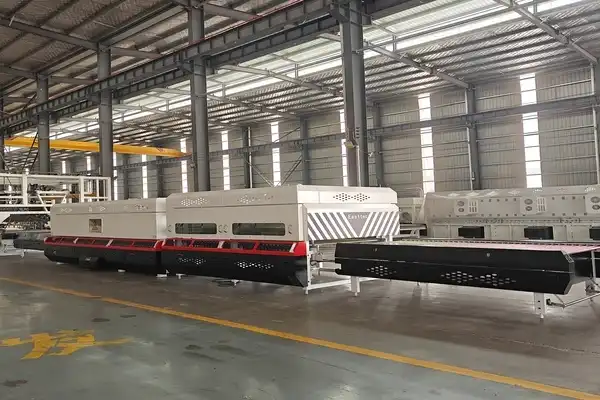
Radiation heating moves energy from heating elements to the glass surface. The sheet must leave the furnace at the same temperature across its whole area, because uneven heat causes bow, roller wave, and breakage. Ask about zone control, top-to-bottom balance, response time, and how easily crews can reach the elements. Our furnace uses a multi-zone matrix radiant heating system with an independent PID controller for each zone. This design supports flatness and keeps optical distortion low. Request temperature maps and production records from every supplier. Periodic furnace mapping also helps you spot thermocouple drift or element wear later.
Quench Performance and Quality Tests
The quench section sets strength and breakage pattern. Fully tempered glass reaches roughly four to five times the strength of annealed glass, but only when cooling is balanced. Ask for documented results on five checks. The fragmentation test under EN 12150 counts particles inside a 50 × 50 mm square. Roller wave is measured with a digital scanner or laser profilometer, and ASTM C1651 describes the method. Edge lift shows warping at the leading and trailing edges. Surface stress, measured with a non-destructive refractometer, should meet your specified megapascal values. A thermal uniformity survey checks the furnace itself. Agree on pass or fail numbers before you sign.
Safety Standards and Electrical Compliance
Safety covers both the glass and the machine. For glass, US buyers commonly reference ASTM C1048 and ANSI Z97.1. For the machine, inspect guarding, emergency stops, interlocks, alarms, overheating protection, and fan-failure controls. Electrical rules matter as well, and NFPA 79 is a common reference for industrial machinery in the United States. Your local inspector may ask for specific approvals. Our furnaces comply with CE standards, and we configure power systems for voltage and frequency needs such as 220V, 380V, or 415V at 50/60 Hz. Share your site's electrical details at the start so we can plan the configuration with your team.
Calculate Energy Use and Total Cost of Ownership
Performance on the test bench is only part of the picture. Operating cost decides how the machine pays back.
Compare Measured Energy, Not Rated Power
Rated power shows the maximum draw, not the cost per sheet. When evaluating a Radiation Flat Glass Toughening Furnace, ask each supplier for kilowatt-hours per square metre or per batch. Then confirm the glass thickness, loading level, production rate, and standby conditions behind the number. Glass tempering uses a great deal of electricity, so small differences add up across thousands of loads. Our insulation and airflow design reduces energy use by 15–20%, and we encourage buyers to check any such claim against their own load pattern. Look at insulation quality, zone control, standby modes, and quench-fan efficiency. These details explain why two furnaces with the same rated power can cost very different amounts to run.
Count Every Cost Over Five to Ten Years
Purchase price is one line in the budget. Add installation, site utilities, operators, heating elements, rollers, software, warranty service, spare parts, and downtime. A five-to-ten-year comparison often picks a different winner than the quote alone. Component quality affects this math. Our furnaces use Siemens and Schneider electronics and global tier-1 components, and the design targets a service life of 20+ years with stable 24/7 operation. Downtime costs the most when orders run late. Ask for a spare-parts list with lead times for items that wear, so your maintenance manager can plan stock before the first shipment arrives.
Judge ROI Through Yield, Labor, and Uptime
Return on investment comes from more than power savings. Higher yield means fewer rejected sheets. Simple controls cut training time. Our interface offers one-key recipe recall, so entry-level operators can run complex tempering processes, and new operators can learn operation and maintenance within one week. The multi-language menu offers English, Spanish, Russian, Korean, Portuguese, and other options. This matters when skilled labor is hard to find, because a new hire who needs months of training delays output. Estimate the value of lower reject rates, faster staffing, and fewer stops, then set that figure against the purchase price.
Assess the Manufacturer, Customization, and After-Sales Support
Once the machine looks right on paper, look at the company behind it. A furnace stays in your plant for decades, so the supplier relationship matters as much as the steel.
Check Experience and Track Record
Machine specifications tell only half the story. Ask whether the company designs and builds its equipment or resells it, and request references from customers with similar glass products. Luoyang Easttec Glass Automation Equipment Co., Ltd. has worked in glass tempering technology since 1994, and our team has more than twenty years of experience in glass deep-processing equipment. We serve clients in 40+ countries and follow European (Italy) standard quality management. Our range includes flat and bent glass tempering furnaces, architectural glass tempering machines, and automotive glass tempering machines. We welcome factory visits, which are a normal step in a long purchase decision.
Customization and Delivery Time
A tempering furnace is made to order, so confirm what can change when selecting a Radiation Flat Glass Toughening Furnace. We customize power systems, equipment size, heating curves, cooling parameters, and software language, and we can match the machine color to your plant. Delivery takes 60 to 120 working days, depending on the model. Build that range into your project schedule, along with site preparation and shipping. Ask every supplier to state lead times in writing, including critical spares such as heating elements, rollers, sensors, and fans. A clear schedule protects your launch date and your customer commitments.
Installation, Training, and Remote Support
Downtime hits delivery dates and profit, so review service terms before you review price. Our process runs from preliminary inquiry and project design to the cooperation agreement, manufacturing, installation, commissioning, operator training, and after-sales service. Technicians provide 24-hour online support, including remote digital diagnostics. We also offer advice on glass deep-processing technology and equipment modification. Ask each supplier who handles layout, transport, calibration, and trial production, and how quickly they respond to a fault. Documented warranty terms and spare-parts availability give your maintenance manager clear expectations.
Compare Suppliers and Avoid Common Purchasing Mistakes
These last steps turn research into a decision. A structured comparison protects you from the most common errors.
Build a Supplier Scorecard
Send the same technical specification to every supplier, so quotes match. Score each offer on glass compatibility, thermal uniformity, throughput, energy use, quality results, automation, safety, service, delivery, and lifecycle cost. Separate must-have items from nice-to-have features. Then review the commercial scope: included equipment, optional items, installation, training, warranty, payment terms, customs, travel, and software licences. Factory tests, sample glass, energy data, and customer references show whether claims hold up. A scorecard lets you compare technically equal proposals instead of choosing the lowest number.
Mistakes That Cost Money Later
Several errors appear again and again. Buyers confuse maximum glass size with efficient processing of small sheets. They mistake rated power for real consumption. They accept general coating promises without sample tests. They overlook service response and spare-parts logistics. They sign before agreeing on acceptance criteria for quality, energy, throughput, and safety. Each mistake is easy to avoid with early questions and written terms. Add a factory acceptance test to the contract, and define pass or fail numbers before the machine ships.
Make the Final Choice on Long-Term Fit
The best furnace matches your product mix, order pattern, and growth plan. Horizontal radiation furnaces suit large flat architectural glass, where surface quality and flexibility matter. Batch equipment handles varied orders, while continuous lines suit high-volume output. Demanding coated or specialty products may need hybrid heating or a forced convection system. Compare price against capacity use, labor savings, energy cost, reject rates, maintenance, and uptime. Our team can review your glass list and recommend a configuration, whether radiation or convection.
Conclusion
Choosing a Radiation Flat Glass Toughening Furnace comes down to fit, performance, cost, and support. Your product mix, size range, and thickness range define the capacity you need, while coated glass requires sample testing. Even heating and balanced quenching drive flatness and strength, and fragmentation, roller wave, edge lift, and stress tests confirm them. Safety and electrical compliance must match your site. Measured energy use and a five-to-ten-year cost view give a truer picture than price alone. Supplier experience, customization, lead time, training, and remote support affect uptime. Buyers who define requirements first, compare measured data, and write acceptance terms down reduce risk and select equipment that serves production for years.
FAQ
How does a radiation furnace differ from a forced convection furnace?
A radiation furnace heats glass mainly with energy from heating elements. A forced convection furnace adds a blower that circulates hot air through the chamber, which can help with some coated glass. EASTTEC EQUIPMENT builds both types, so we can match the technology to your products.
Can a radiation furnace process Low-E glass?
It depends on the coating and the heating design. Our radiation model is engineered for clear float, tinted, and decorative printed glass. For Low-E products, request sample tests on your own glass first, or consider a forced convection model built for coated glass.
What should I send for a quotation?
Send your glass types, coatings, size range, thickness range, daily output, local voltage and frequency, applicable standards, and site conditions. With these details, we can propose a configuration, delivery time, and installation plan that fit your plant.
Request a Radiation Flat Glass Toughening Furnace Quote from EASTTEC EQUIPMENT
EASTTEC EQUIPMENT is a Radiation Flat Glass Toughening Furnace manufacturer with 20+ years of experience, clients in 40+ nations, CE-compliant designs, and 24-hour online support. Send your glass types, sizes, and output targets to sales@easttecmachine.com, and our engineers will prepare a suitable configuration and delivery plan. Visit easttecglass.com to review our equipment and arrange a factory visit.
References
1. ASTM C1048, Standard Specification for Heat-Strengthened and Fully Tempered Flat Glass, ASTM International, 2018
2. EN 12150-1, Glass in Building: Thermally Toughened Soda Lime Silicate Safety Glass, European Committee for Standardization, 2015
3. ASTM C1651, Standard Test Method for Measurement of Roll Wave Optical Distortion in Heat-Treated Flat Glass, ASTM International, 2013
4. ANSI Z97.1, Safety Glazing Materials Used in Buildings, American National Standards Institute, 2015
5. NFPA 79, Electrical Standard for Industrial Machinery, National Fire Protection Association, 2021
6. Energy and Environmental Profile of the U.S. Glass Industry, U.S. Department of Energy, 2002

USER EVALUATE
Here is the customer's evaluation of us