




Radiation Glass Toughening Machine for Large-Scale Commercial Glass Processing
A Radiation Glass Toughening Machine for large-scale commercial glass processing is a radiant-heating tempering furnace that heats flat glass to roughly 620–650°C, then quenches it fast to build compressive stress. EASTTEC EQUIPMENT builds these machines with a 3 mm to 19 mm thickness range, matrix radiant heating with independent PID control in each zone, and 15–20% lower energy use. Our largest model offers a 3300 × 6000 mm loading area. In this guide, I explain how the machine works, which specifications matter, how to judge quality and cost, and how to choose a supplier with confidence.
What a Radiation Glass Toughening Machine Is and How It Works
Before comparing models, it helps to agree on what this equipment does.
Definition and Terminology
Many buyers ask me what the name means. In our product line, "radiation" refers to the heating method: electric elements deliver radiant heat straight to the glass surface. The same equipment is often called a radiant glass tempering furnace, a flat glass toughening line, or simply a glass tempering machine. Its job is to convert annealed glass into safety glass, which reaches roughly four to five times the strength of annealed glass of the same thickness. Some searchers also use the term for radiation-shielding glass. Toughening does not create radiation protection. Shielding comes from the glass composition and thickness, so confirm suitability for thermal processing with the glass producer.
The Toughening Process Step by Step
The cycle starts with inspection, cutting, edging, and washing, because chips and dirt cause breakage later. The operator loads the glass onto ceramic rollers, and the furnace heats it to the transformation range of about 620–650°C. Rollers oscillate the glass to keep heat even. Then the glass moves quickly into the quench section, where high-pressure air cools the surfaces faster than the core. That temperature difference locks compression into the surface and tension into the center. A final inspection checks fragmentation, flatness, and optical quality. Every step affects yield, so a stable furnace matters as much as a strong quench.
Radiant Heating vs. Forced Convection
Radiant heating transfers energy directly from the elements to the glass, which keeps the mechanical design simpler. It suits clear float, tinted, and decorative printed glass well. Forced convection uses a blower to circulate hot air, and it helps with coated glass that reflects heat, such as soft-coat Low-E. EASTTEC EQUIPMENT builds both types, so I recommend matching the furnace to your product mix instead of a trend. If most of your orders are clear or tinted architectural, furniture, and appliance glass, a radiant machine is often a practical fit. If Low-E dominates your orders, ask us about convection.
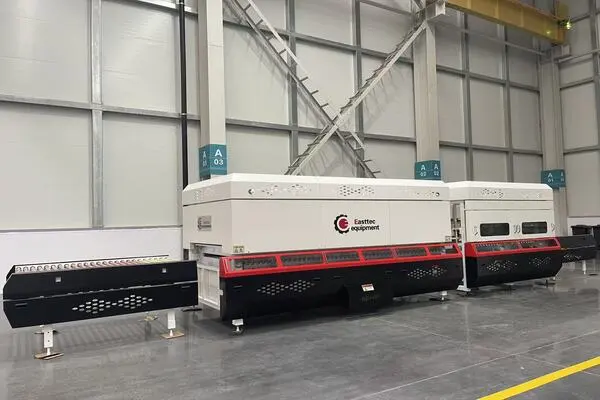
Specifications and Features for Large-Scale Commercial Production
Specifications decide whether a furnace fits your daily orders.
Size, Thickness, and Material Range
Judge a machine by the full range it covers, not just the biggest panel. Our Radiation Glass Toughening Machine is available in models with loading areas ranging from 3300 × 6000 mm for large architectural panels to configurations that handle lites as small as 50 × 100 mm. Glass thickness ranges from 3 mm to 19 mm, covering most architectural, furniture, and appliance orders. The machine is engineered to process clear float, tinted, and decorative printed glass while delivering high optical clarity after tempering. Plants handling mixed orders benefit from this wide processing range, as one furnace can serve several product lines without requiring a second investment.
Matrix Radiant Heating and Digital Control
Heating uniformity drives flatness and clarity. The matrix radiant system divides the furnace into zones, and each zone has its own PID controller, so the system adjusts power zone by zone. This supports flatness and low optical distortion. Siemens/Schneider electronics support stable operation, and the software stores recipes for each glass type. A one-key recipe recall lets less experienced operators run proven settings. The menu is available in several languages, including English and Spanish. In our experience, new operators can learn operation and maintenance within one week. Remote monitoring also lets our technicians review parameters when you call.
Core Advantages at a Glance
Here are the core advantages of this machine for commercial production.
- Energy savings: Our advanced insulation and airflow design reduces energy use by 15–20%. For a plant that runs several shifts, lower electricity use per square meter cuts operating costs every month and shortens payback. Ask us for a sample calculation based on your own utility rates and product mix, so the estimate reflects your plant.
- Stable quality: Independent PID control in each heating zone keeps temperature even across wide panels. Better uniformity supports flatness, limits optical distortion, and protects yield on large, high-value commercial lites. A one-key recipe recall also repeats proven settings, so each shift produces consistent results, even when newer operators run the line.
- Dependable support: Siemens/Schneider electronics support stable 24/7 operation. Our technicians provide 24-hour online support and remote diagnostics, and installation, commissioning, and operator training come with the project. One team stays responsible from design through after-sales service, which keeps downtime risk low when delivery dates are tight. Spare parts and troubleshooting advice stay one message away.
These advantages address three common production problems: high energy bills, uneven quality, and unplanned downtime.
Selecting the Right Machine, Quality Control, and US Compliance
Selection, testing, and compliance protect your yield and your customers.
Defining Your Purchasing Requirements
Start with the goal: more capacity, better yield, less labor, a wider product range, or replacement of an old furnace. Then document panel sizes, thicknesses, weights, glass types, annual demand, acceptable breakage rate, flatness targets, energy targets, and available floor space. Use these requirements to evaluate whether a Radiation Glass Toughening Machine has the appropriate furnace size, automation level, and handling system for your production needs, while leaving room for future expansion. Compare quotes by total ownership cost, not purchase price alone. A complete quotation lists utilities, layout drawings, installation, training, warranty, spare parts, and delivery terms. If a quote leaves any of these out, ask why before you sign.
Quality Checks That Prove Performance
Quality control should rely on measurable tests. A fragmentation test counts particles in a 50 × 50 mm area, and EN 12150-1 sets a minimum count, typically 40 for clear float glass. ASTM C1048 requires at least 69 MPa (10,000 psi) of surface compression for fully tempered glass, and a surface stress meter checks it without breaking the sample. Optical inspection with a zebra board or scanner reveals roller wave and edge kink, and a flatness check measures bow and warp. Ask any supplier to run your samples and share the results, so you can judge the machine on data from your own glass.
Safety and Compliance for US Buyers
US buyers should check three layers of compliance. First, the finished glass must meet the safety glazing rules that apply to your product, such as ANSI Z97.1 and the CPSC rule at 16 CFR 1201 for doors and other hazardous locations. Second, our machines comply with CE standards, and your local electrical inspector decides what the site requires, so share local code requirements early. Third, we can adapt voltage and frequency, with options such as 220V, 380V, and 415V at 50/60Hz, to your facility's supply. Ask each supplier to document guarding, emergency stops, and high-temperature protection, and keep digital recipes and maintenance logs for traceability.
Efficiency, Energy Use, and Return on Investment
Efficiency and cost decide whether the investment pays off.
Where Large-Scale Plants Lose Time
Furnace speed is only part of throughput. Plants often lose time to manual handling, uneven heating, long recovery after a thickness change, unstable quenching, worn rollers, and avoidable breakage. You can reduce these losses by grouping glass of the same thickness in one load, since consistent radiation absorption gives more uniform heating. Standardize validated recipes, clean glass before loading, and improve edge preparation. Preventive maintenance matters too. Check quench nozzles weekly for blockages, because clogged nozzles cause uneven cooling and spontaneous breakage. Inspect rollers, bearings, fans, sensors, and drives on a fixed schedule.
Energy Use and Total Cost of Ownership
Glass tempering uses a lot of electricity, so energy consumption per square meter tells you more than installed power when evaluating a Radiation Glass Toughening Machine. Our insulation and airflow design cuts energy use by 15–20%, and the savings repeat every shift. A fair comparison covers five to ten years and includes energy, labor, maintenance, downtime, product loss, spare parts, freight, and import costs. A low quote can hide freight, commissioning, or training charges, so request each item separately. Track kilowatt-hours per square meter, good-product yield, breakage rate, changeover time, and downtime from the first month, because those numbers show whether the machine meets its production targets.
Building the ROI Case
Return on investment comes from several sources: more sellable output, higher yield, lower outsourcing fees, less labor per panel, faster delivery, and access to new products such as large-format architectural panels. Factory owners should model each source with their own numbers. For example, if you outsource large lites today, count the fees you would avoid. If breakage costs you a set percentage of sales, count the recovery from better uniformity. Then weigh the 15–20% energy reduction against your utility rate. I suggest running three scenarios, cautious, expected, and strong, so decision makers see the range before approving a capital purchase.
Choosing a Manufacturer and Planning the Project
The supplier you choose shapes installation, uptime, and long-term support.
What to Check in a Supplier
A tempering furnace is a long-term purchase, so supplier credibility matters as much as the spec sheet. Ask whether you are dealing with a trading company or a factory-backed manufacturer. Look for engineering depth, sample-testing capacity, export experience, and service response time. EASTTEC EQUIPMENT has worked in glass tempering technology since 1994, and our team draws on more than twenty years of glass deep-processing equipment development, supported by dozens of partner factories with large-equipment experience. A factory visit or remote audit lets you verify assembly quality, testing, documentation, and customer references before you commit.
Customization and Delivery Time
Because every furnace is built to order, customization is part of the process. We configure equipment size, heating curves, and cooling parameters to your product specifications. We adapt the power system to global voltage and frequency standards, including 220V, 380V, and 415V at 50/60Hz. The software menu supports English, Spanish, Russian, Korean, Portuguese, and other languages, and we can change the equipment color. Depending on the model, delivery takes 60–120 working days, so plan your building, lifting equipment, and utilities during production. Share your layout early, and our engineers will help check it.
From Inquiry to Production
Our one-stop process has clear stages: preliminary inquiry, project design, design refinement, cooperation agreement, production, installation and commissioning, operator training, and after-sales service. Before shipment, confirm utilities, floor conditions, and safety arrangements. After installation, commissioning, training, and trial runs on your glass, confirm the settings. Our technicians offer 24-hour online support, and we also provide advisory services for glass deep-processing technology, personnel training, and equipment modification. This structure gives your purchasing, engineering, and maintenance teams one contact path from the first call to long-term service.
Conclusion
A Radiation Glass Toughening Machine uses radiant heat and rapid quenching to turn annealed glass into safety glass, and it suits clear float, tinted, and decorative printed glass from 3 mm to 19 mm. Matrix heating with independent zone control supports uniform temperature, flatness, and optical clarity, while insulation and airflow design lower energy use by 15–20%. Buyers should define sizes, thicknesses, and output first, verify quality through fragmentation, stress, and flatness tests against standards such as EN 12150-1 and ASTM C1048, and compare quotes by total ownership cost. Efficiency depends on grouping glass, standardizing recipes, and routine maintenance. Supplier credibility, customization, delivery planning, and service support complete the decision.
FAQ
Can a Radiation Glass Toughening Machine process Low-E glass?
Our machine is specified for clear float, tinted, and decorative printed glass. Hard-coat Low-E may work, but soft-coat Low-E usually needs forced convection. Send samples for confirmation.
What glass thickness can the machine handle?
It processes glass from 3 mm to 19 mm. For uniform radiation absorption, load glass of the same thickness together.
Does toughening make glass radiation-shielding?
No. Shielding depends on composition and thickness. Confirm with the glass producer that your glass suits thermal processing, then run sample trials.
How long does delivery take?
Each furnace is customized, and delivery takes 60–120 working days depending on the model.
Request a Radiation Glass Toughening Machine Proposal from EASTTEC EQUIPMENT
Planning a large-format tempering line in the United States? EASTTEC EQUIPMENT is a Radiation Glass Toughening Machine manufacturer with 20+ years of glass thermal processing experience, Siemens/Schneider electronics, CE compliance, and 24-hour online support. Send your glass sizes, thicknesses, and output targets to sales@easttecmachine.com, and our engineers will prepare a configuration and quotation. Visit easttecglass.com for more details or to arrange a factory visit.
References
1. ASTM C1048 Standard Specification for Heat-Strengthened and Fully Tempered Flat Glass, 2018
2. EN 12150-1 Glass in Building: Thermally Toughened Soda Lime Silicate Safety Glass, Part 1: Definition and Description, 2015
3. ANSI Z97.1 Safety Glazing Materials Used in Buildings: Safety Performance Specifications and Methods of Test, 2015
4. 16 CFR Part 1201 Safety Standard for Architectural Glazing Materials, U.S. Consumer Product Safety Commission, 1977
5. Introduction to Glass Science and Technology, Royal Society of Chemistry, 2005
6. Structural Use of Glass, IABSE Structural Engineering Documents, 2008

USER EVALUATE
Here is the customer's evaluation of us