




Radiation Flat Glass Toughening Furnace for Curtain Walls and Commercial Windows
A Radiation Flat Glass Toughening Furnace for curtain walls and commercial windows heats flat glass with radiant elements, holds it until the temperature evens out, and cools it quickly with controlled air. This process creates the surface compression that turns annealed glass into safety glass. For façade and window work, the furnace must deliver flat panels, low optical distortion, and steady results across many sizes and thicknesses. EASTTEC EQUIPMENT builds radiation furnaces that process 3 mm to 19 mm glass and load panels up to 3300 × 6000 mm. Below, I explain how the technology works and what to check before you buy.
Why Radiation Flat Glass Toughening Matters for Modern Buildings
Safer, Stronger Glass for Façades and Windows
Tempered glass has a compressed surface layer and a tensioned core. That balance makes it roughly four times stronger than annealed glass of the same thickness, and it breaks into small, blunt pieces instead of long shards. Architectural processors use it for curtain walls, storefronts, doors, partitions, balustrades, and skylights. In the United States, buyers and inspectors look for compliance with ASTM C1048, ANSI Z97.1, and the CPSC rule 16 CFR 1201 for architectural glazing. I always tell plant owners to start with these standards, because they define what your furnace must deliver every shift. Then list your glass sizes, thickness range, coating types, daily output, and available utilities.
What Is a Radiation Flat Glass Toughening Furnace?
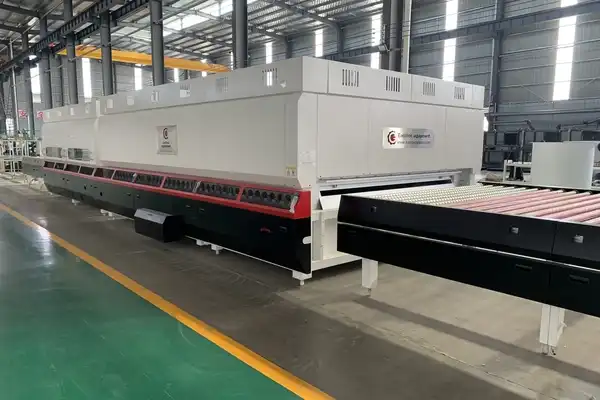
A radiation flat glass toughening furnace is a horizontal heat-treatment line. Glass rides on ceramic rollers through heating zones, where radiant energy brings it to a temperature well above 600°C. A soak period evens out the temperature through the thickness. Then the glass moves into the quench section, where high-volume air cools both surfaces fast and locks in the stress profile. A full line also includes loading and unloading equipment, controls, and inspection points. Settings change with glass thickness, size, coating, loading pattern, and speed. So I suggest judging a furnace by its temperature uniformity, zone control, and recipe management, not by its top temperature alone.
Why Use Radiation Heating for Curtain Wall and Commercial Window Glass?
Façade and window factories rarely run one product all day. Orders mix sizes, thicknesses, tints, and printed patterns. Radiant heating suits that mix because each zone can be tuned on its own. Stable roller movement and saved recipes help keep optical quality consistent and limit bow and warp. EASTTEC EQUIPMENT uses a multi-zone matrix radiant heating system with independent PID control for each zone, aimed at even temperature and high clarity after tempering. Energy cost matters as much as quality. I look at insulation, standby controls, heating-element efficiency, quench-fan power, utilization rate, and reject levels together, since each one moves the cost per square foot.
Radiation vs. Convection Heating and the Specifications That Matter
Radiation Heating vs. Convection Heating
The two furnace types move heat to glass in different ways. A Radiation Flat Glass Toughening Furnace relies mainly on radiant energy from heating elements, while convection systems add heated air circulation, which can help with some coated, thin, or complex glass. Coated surfaces and low-emissivity (low-E) films reflect radiant energy, so they need careful control in a radiation furnace. EASTTEC EQUIPMENT also supplies forced convection furnaces that use a high-temperature blower and ceramic convection parts rated to 1300°C, allowing our team to compare both options against your product mix. My advice is simple: do not assume either technology wins in every case. Compare real sample results from your own glass.
Technical Specifications to Evaluate Before Purchase
A headline number never tells the full story. Check the minimum and maximum thickness, the processable sizes, loading weight, practical throughput, and changeover time. Ask how the furnace performs with glass like yours. Review the heating-zone layout, temperature sensors, thermal mapping, and edge-effect control. The quench system deserves its own review: air pressure, nozzle design, fan control, and upper-to-lower balance. Then look at roller construction, drive synchronization, PLC and HMI functions, alarms, remote diagnostics, and data links to your factory systems. A furnace with a strong spec sheet but weak controls can still produce uneven batches, so test the whole package.
Applications in Curtain Walls and Commercial Windows
Tempered flat glass goes into unitized curtain walls, structural glazing, insulated glass units, point-supported façades, office windows, retail storefronts, entrance systems, and hotel interiors. These jobs demand strength, dimensional stability, low distortion, clean edges, and repeatable output. Thin glass needs careful roller and quench management. Thick glass needs longer heating cycles and stronger cooling. Coated and low-E glass adds questions about surface orientation, coating protection, and recipe control. Many façade panels also move on to heat soaking, laminating, or insulating-glass assembly, so flatness at the tempering stage affects every step after it. I suggest mapping each product to its downstream process before you set furnace requirements.
EASTTEC EQUIPMENT Radiation Flat Glass Toughening Furnace Features
Size, Thickness, and Glass Compatibility
EASTTEC EQUIPMENT designs this signature radiation furnace for global markets. It processes glass from 3 mm to 19 mm and follows international requirements for 4–19 mm glass tempering. The largest model offers a loading area of 3300 × 6000 mm for large panels, and the smallest model handles lites down to 50 × 100 mm. The furnace is engineered for clear float, tinted, and decorative printed glass, with high optical clarity after tempering. That range covers standard architectural and furniture glass on one platform. If your orders include low-E or other coated products, send us samples and specifications so we can review them before you commit.
Heating Control and Energy Use
The matrix radiant heating system divides the chamber into multiple zones, and each zone has an independent PID controller. This layout supports flat glass with minimal optical distortion, and it lets your process engineer shape the heating curve for each thickness. The insulation and airflow design reduces energy use by 15–20%, which shortens the payback period on the investment. Lower power draw also cuts the cost per square foot, a real advantage when you bid on large commercial projects. Heating curves and cooling parameters can be configured to your product specifications, so the same furnace can run a thin tinted lite in the morning and thick clear panels in the afternoon.
Components, Interface, and Support
The Radiation Flat Glass Toughening Furnace uses premium components, including Siemens and Schneider electronics, to ensure stable 24/7 operation and a service life of more than 20 years. A one-key recipe recall system allows entry-level operators to run complex tempering programs with ease, while new operators can learn equipment operation and maintenance within about one week. The multi-language menu supports English, Spanish, Russian, Korean, Portuguese, and more. The equipment complies with CE standards, and its power system can be customized to match your local supply, such as 220V, 380V, or 415V at 50/60Hz. Our technicians provide 24-hour online support, backed by over two decades of experience serving clients in more than 40 countries. Delivery typically takes 60–120 working days, depending on the model.
How to Choose a Furnace and Avoid Procurement Risks
How to Choose the Best Radiation Flat Glass Toughening Furnace
Start with your production scenario: product mix, factory conditions, and growth plans. Write down glass types, coatings, thicknesses, dimensions, annual volume, and shift pattern. New plants, façade specialists, window makers, and contract processors need different levels of automation. Build a weighted decision matrix that scores glass range, coated-glass capability, heating uniformity, tempering performance, capacity, energy use, automation, service, spare parts, and total ownership cost. Then ask whether the seller is a manufacturer, an integrator, or a trading company. Request project references, sample testing, technical documents, and a detailed answer to your RFQ. Because buying cycles often run three to twelve months, a written matrix keeps your team aligned.
Common Procurement Risks and How to Avoid Them
Several mistakes show up again and again. Buyers pick equipment based only on advertised capacity, overlook low-E compatibility, compare only purchase prices, or leave service duties undefined. Maximum conveyor speed rarely equals real output for thick, coated, large, or mixed-size glass, so ask for cycle times with your own products. Calculate total cost of ownership: energy, labor, maintenance, spare parts, installation, downtime, and rejects. Then write acceptance criteria, warranty terms, response times, training scope, and upgrade options into the contract. A written sample-test report also gives your team hard numbers to compare across suppliers. Clear paperwork protects both sides and keeps the project on schedule.
Why Work with an Experienced Radiation Glass Toughening Furnace Manufacturer?
An experienced manufacturer of Radiation Flat Glass Toughening Furnace equipment connects application analysis, process engineering, equipment design, testing, installation, and after-sales support. Luoyang Easttec Glass Automation Equipment Co., Ltd. has built glass thermal processing equipment for more than twenty years, backed by supporting factories with extensive experience in large-scale equipment manufacturing. Our one-stop process covers everything from initial inquiry and project design to agreement, manufacturing, installation, commissioning, operator training, and after-sales service. Customization options include equipment size, heating curves, cooling parameters, and color. We also provide advisory services for glass deep-processing technology, personnel training, and equipment modification. Request sample testing, performance data, customer references, export documents, and spare parts details from any supplier you consider.
Installation, Validation, and Quality Control
Site Planning Before Installation
Good performance starts before the furnace arrives. Plan floor loading, footprint, electrical supply, compressed air, ventilation, cooling, and safety clearances. Map the material flow between loading, tempering, inspection, and packing so glass does not wait in the aisle. Confirm your voltage and frequency early, because the power system can be adapted to the local supply. Because delivery runs 60–120 working days, use that window to prepare the foundation, utilities, and operator schedule. Share a plant drawing with the supplier so engineers can check layout and clearances before manufacturing begins. Early planning shortens commissioning and gets the line into production sooner.
Commissioning and Acceptance
Commissioning should include installation checks, empty-furnace tests, recipe calibration, trial production with representative glass, capacity verification, quality testing, operator training, and documented acceptance. Run your real products, not only clear test panels. Record the settings for each thickness so operators can recall them with one key. Our technicians train your team, and new operators can learn operation and maintenance within about one week. After acceptance, 24-hour online support gives your maintenance manager a direct line for troubleshooting. Put the acceptance criteria in the contract before shipment, so everyone knows what "done" means, and keep the test reports on file for future audits.
Quality Control and Long-Term Performance
Track a few measurements on a regular schedule. The fragmentation test under EN 12150 counts particles in a 50 × 50 mm square to confirm safe breakage. ASTM C1651 covers roll wave distortion measurement, and ASTM C1279 covers non-destructive photoelastic stress measurement. Check edge lift at the leading and trailing edges, and run periodic thermal uniformity surveys to catch thermocouple drift or element wear. Add preventive maintenance for heating elements, rollers, sensors, fans, filters, drives, and control cabinets. Watch energy per square meter, yield, reject rate, cycle time, and downtime. These numbers show problems early and protect your return on investment.
Conclusion
A radiation flat glass toughening furnace gives curtain wall and commercial window processors a controlled way to produce safety glass through heating, quenching, and recipe management. Quality depends on zone control, temperature uniformity, quench balance, and roller stability rather than on one headline number. Radiation and convection heating each suit different products, so sample testing with real glass settles the choice, especially for coated and low-E panels. The EASTTEC EQUIPMENT radiation furnace covers 3–19 mm glass, panels up to 3300 × 6000 mm, independent PID zones, and 15–20% lower energy use. Sound purchasing also depends on total ownership cost, clear contracts, site planning, commissioning tests, and routine checks such as fragmentation, roll wave, and stress measurements.
FAQ
What glass can your radiation furnace process?
It processes clear float, tinted, and decorative printed glass from 3 mm to 19 mm. The largest model loads 3300 × 6000 mm panels, and the smallest handles 50 × 100 mm lites. For low-E or other coated glass, send specifications so our engineers can review compatibility and arrange sample testing.
How is radiation heating different from convection heating?
Radiation heating relies mainly on radiant energy from the elements, while convection adds circulating hot air. Each suits different products. EASTTEC EQUIPMENT supplies both types, so we can compare results using your actual glass instead of guessing.
What do you need from me to prepare a quotation?
Send glass types, coatings, thickness range, maximum and minimum sizes, daily output, local voltage and frequency, preferred software language, and plant layout. With this data, we can propose a configuration, a delivery schedule of 60–120 working days, an installation scope, and a training plan.
Request a Technical Proposal for Your Radiation Flat Glass Toughening Furnace from EASTTEC EQUIPMENT
Ready to discuss a Radiation Flat Glass Toughening Furnace for your curtain wall or window line? EASTTEC EQUIPMENT is a Radiation Flat Glass Toughening Furnace manufacturer with 20+ years of experience, 24-hour online support, and customization for your voltage and software language. Email sales@easttecmachine.com with your glass specifications and target capacity to request a quotation, or visit easttecglass.com for details.
References
1. ASTM International, Standard Specification for Heat-Strengthened and Fully Tempered Flat Glass (ASTM C1048), 2018
2. European Committee for Standardization, Glass in Building – Thermally Toughened Soda Lime Silicate Safety Glass (EN 12150-1), 2015
3. American National Standards Institute, Safety Glazing Materials Used in Buildings (ANSI Z97.1), 2015
4. U.S. Consumer Product Safety Commission, Safety Standard for Architectural Glazing Materials (16 CFR Part 1201), 1977
5. ASTM International, Standard Test Method for Non-Destructive Photoelastic Measurement of Edge and Surface Stresses in Annealed, Heat-Strengthened, and Fully Tempered Flat Glass (ASTM C1279), 2013
6. Arun K. Varshneya, Fundamentals of Inorganic Glasses, 2006

USER EVALUATE
Here is the customer's evaluation of us