




Hidden Costs to Check Before Buying an Energy-Saving Glass Processing Line
The hidden costs of an energy-saving glass processing line usually sit outside the equipment price. They include installation and commissioning, real power use compared with the brochure, spare parts and seals, operator training, custom-build delays, and downtime. Before you sign for an Energy-Saving Two-Chamber Processing Line, ask for a written total cost of ownership (TCO) estimate that covers every item. Lower power bills matter only when the quote, the test results, and the service terms match what your factory floor will experience. This guide covers each cost in turn so you can compare offers on equal terms.
Understanding Hidden Costs in Energy-Saving Glass Processing Lines
Why Is the Quoted Price Only the Starting Point?
The price of the machine is shown in a quote. When you buy a furnace, you also have to pay for shipping, a crane and its ropes, foundation work, an electrical connection, and a supply of cool air or compressed air. Because glass tempering furnaces are custom-made, the things that can be supplied vary from model to model. I think you should make a simple scope table that lists each item, who pays for it, and comes up with it. Later, change orders are made for things that are missing. Also, check the length of the plan against your building. It is important to know how much floor space you need for a pre-heating chamber, a high-heating chamber, and a quenching area before you place your order.
Installation and Commissioning Fees to Confirm
A lot of the time, installation and testing costs are not included in the main price. Find out how many engineer days are included in the price and who pays for the hours worked, the hotel, and the daily rates. Find out what will happen if the electrical work isn't done when they get there. As part of the commissioning process, you should also set up recipes for the thicknesses you use and test loads on real glass sizes. Inquiries and project design are the first steps in our one-stop process. Next come production, installation and commissioning, operator training, and service after the sale. Ask any seller to write down these steps so that no one stage ends up with a surprise bill.
Why Total Cost of Ownership Protects Your ROI?
The price you pay to buy something is one part of the cost. The NIST Handbook 135 life-cycle costing method adds up the costs of buying, installing, running, maintaining, and replacing something over a certain amount of time. For a furnace, that method works because energy use and downtime can quickly make up for a small price difference. ROI claims based on marketing numbers aren't as accurate for a plant owner or general manager as TCO. Set your own glass mix, energy rate, and shift plan. Advanced insulation in our double-chamber design cuts thermal energy loss by 20%, and it can hold 1.8 to 2 times as much as a normal single-chamber heater. Test both numbers against the plan you have for making things.
Breaking Down the Operational and Maintenance Costs
The Gap Between Advertised and Actual Energy Use
What is the real power use? It depends on the load, the thickness of the glass, the temperature outside, the time the machine is not being used, and the heating recipe. When 4 mm to 6 mm architectural lites are put into a furnace, it acts differently than when 19 mm glass is put through it. Not just a percentage savings, but also the number of kWh used per square meter at a certain load and thickness. Our high-tech insulation cuts thermal energy loss by 20%, and the smart power management system splits electricity between the two rooms to lower the cost per square meter. The machine is also made to help people save about one-third of their electricity. Any percentage should be taken as a claim, and it should be checked with your own glass mix during acceptance testing.
Maintenance Tasks and Spare Parts Budget
It costs different amounts of money to fix an Energy-Saving Two-Chamber Processing Line based on how many parts wear out and how easy they are to get to. The heating elements, the convection blower, the rollers, the quench fans, the sensors, and the seals between the rooms should all be checked regularly. The parts and structures that make up our true convection system are made of ceramic, which can withstand temperatures up to 1300°C and prevents thermal wear. If you need spare parts, ask each supplier for a list with prices, and keep important parts on hand. Our software and the way the furnace is built make repair easy, and it only takes new workers one week to learn how to run and fix the furnace. Training time still costs money, so plan it out before work starts.
The Price of Downtime
Most buyers don't think about how much downtime costs. There is an easy formula that works: lost hours times hourly output times margin, plus any late-delivery fee on a car or building contract. Think about how much it would cost to hire another plant to do the cooling while your line is down. So, a maintenance manager shouldn't just ask how long the warranty lasts, but also how quickly the supplier responds. Our technicians are available online 24 hours a day, 7 days a week. The Industrial PC (IPC) control system manages the timing between both chambers and the quenching section, which lets technicians figure out problems from afar. Write down the response times before you compare prices.
Evaluating Supplier Offers: Beyond the Purchase Price
Warranty, Training, and Support Terms
The language in the warranty says who pays if something breaks. Check the warranty to see how long it lasts and what it covers, such as heating elements, fans, electrical parts, and software. Look for exclusions for parts that wear out, shipping costs for new parts, and terms for on-site work. Make sure of CE compliance. The EU Machinery Directive 2006/42/EC is the safety framework that our furnaces follow, and our furnaces meet CE standards. People in the US should also ask their electrician and the local government if NFPA 86 or other inspection rules apply to the site. This is because it costs a lot of money to make changes to the field after delivery. Finally, find out what kind of user and repair training is included.
Lead Time and Custom Manufacturing Costs
Because each unit is built to order, it takes between 60 and 120 working days to deliver one of our glass annealing ovens. If the supplier is late, you could lose contracts or have to pay someone else to temper the metal, so ask for a production schedule with checkpoints. Changes to the price can also be made. We can adapt to different voltages and frequencies, including 220V, 380V, and 415V at 50/60Hz. We can also make equipment that is the right size and color and has menus in English, Spanish, Russian, Korean, and Portuguese. Early on, let us know your plant's voltage and 60 Hz source so that the price is accurate.
Bulk Discounts and Supplier Credibility
You can get better deals on discounts if you buy a furnace with a spare parts kit or plan to buy more than one line. Get a quote with all the costs broken down so you can see where the discount fits in. When making a buy that takes three to twelve months to decide, credibility is just as important as price. Easttec has been working with glass tempering technology since 1994. They use Italian convection technology and quality control that meets Italian standards. People who are interested in buying should ask to see the factory and see a live demonstration. Seeing a furnace run your glass specification will tell you more than any brochure.
Comparison Guide: Energy-Saving Two-Chamber vs. Other Processing Lines
Single-Chamber Furnaces: Lower Entry Price, Higher Cycle Cost
A single-chamber kiln is cheaper to buy and works well for small or one-time sales. Cycle time is longer because each load goes through heating in one step. By cutting down on the heating cycle, our double-chamber furnace can make 1.8 to 2 times as much as a normal single-chamber furnace. If your plant always makes 4 mm to 6 mm architectural glass, that difference in thickness counts more for cost per square meter than the difference in price when you buy it. Use the same glass mix, shift pattern, and electricity rate to compare the two choices.
Multi-Chamber Designs: More Stages, More Parts
Lines with more than two rooms can handle very high output, but each extra section in an Energy-Saving Two-Chamber Processing Line means more doors, drives, sensors, and control software to check, store, and sync. That adds to the budget we talked about earlier for repairs and spare parts. Ask any supplier of a line with more than one stage for a full list of spare parts, information on how often the parts should be inspected, and the control system that makes sure everything works together. In general, a well-sized two-chamber design strikes a good mix between capacity and maintenance for medium- to big processors. However, your own volume should determine this.
How the Easttec Double Chamber Furnace Fits
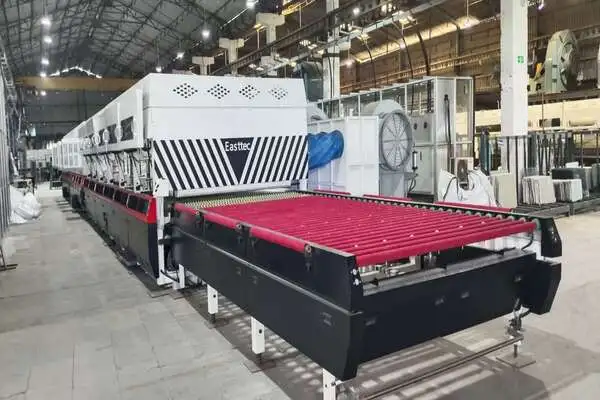
Our double chamber furnace has a separate chamber for pre-heating and a separate room for high-temperature heating, so two batches can work at the same time. Continuous flow is made possible by pre-warming the next batch while the first one finishes. The two-stage temperature rise and heating of the matrix lower thermal shock and stress, which helps keep the surface flat and free of warping. The furnace can work with building and industrial glass that is 4 mm to 19 mm thick. The IPC controls complicated production recipes and makes sure that both rooms are quenched at the same time. To meet CE standards, it was built to be used 24/7 for mass production.
Smart Ways to Avoid Hidden Costs When Buying
Questions to Ask Every Supplier
These are the three questions I would ask both us and any other supplier.
• Area and cost: Which of the following is included in the price? Freight, installation, testing, training, spare parts, program languages, and voltage adaptation? Ask for a list with the prices of all the optional items written next to each line. This way you can compare two quotes fairly and avoid having to make changes after signing a contract.
• Energy proof: How will you check how much energy is being used? Ask for the number of kWh per square meter for your own glass sizes and thicknesses at a certain load, and make sure it shows up in the acceptance test. This turns a claim in a brochure into a contract term that you can check after the job is done.
• Help: What does the heater do when it stops? Ask about response times, the ability to do diagnostics from afar, a list of spare parts with prices, and a plan for how operators and maintenance staff will be trained. Our techs offer online help 24 hours a day, seven days a week. Any service provider should write down their service terms.
These questions close the cost gaps that show up most of the time after the order has been placed.
Inspection and Testing Before Shipment
Go to the plant or join a live chat to see the furnace make glass like the one you're making. Check the cycle time on both 4 mm and 6 mm lites. Next, check the quality by looking for cracks, unevenness, and optical distortion. ASTM C1048 is for fully toughened and heat-strengthened flat glass, and ANSI Z97.1 is for safety windows in buildings. Test results should match up with these standards. You should also look over the IPC recipe screens, CE documents, and electrical drawings. The acceptance procedure is a list of all the results that both parties must sign before the shipment can happen.
Long-Term Cost Planning
Since staff changes happen a lot, make a budget every year for spare parts, planned maintenance, software updates, and training for new operators. Record the number of kWh used per square meter and the yield rate every month. You can tell early on when something is going to go wrong by a slow rise in either number. Choose a single way to talk to the supplier and go over any open service items every three months. Ask now if the control system and layout can be upgraded so that you don't have to start from scratch if you need to add more capacity or a new product line in the future.
Conclusion
An Energy-Saving Two-Chamber Processing Line has hidden costs that come from things like the size of the installation, the difference between how much energy is claimed to be used and how much is actually used, maintenance and spare parts, downtime, warranty gaps, lead time, and customization. You can get a more accurate ROI from the TCO view if you use your own glass mix, electricity rate, and shift plan. A double-chamber design has more space and less heat loss than a single-chamber design. Multi-stage lines have more parts to keep up. The best direct ways to cut down on unexpected costs after purchase are to have written scope tables, acceptance tests that are based on standards like ASTM C1048 and ANSI Z97.1, and clear service terms.
FAQ
How much energy can a double chamber furnace save?
Our high-tech insulation cuts thermal energy loss by 20%, and the machine is made to help customers save about one-third of their electricity. The real savings rely on the type of glass, the load, and the shift plan, so make sure they are correct in an acceptance test.
Which glass thicknesses can it process?
From 4 mm to 19 mm, the Easttec Double Chamber furnace can work with architectural and industrial glass. It quickly cuts a lot of 4 mm to 6 mm ornamental lites.
How long does delivery take?
Because every furnace is made to order, delivery takes between 60 and 120 working days, depending on the model. After installation, our technicians offer online support 24 hours a day, 7 days a week.
Request a Quote for Your Energy-Saving Two-Chamber Processing Line
EASTTEC EQUIPMENT makes Energy-Saving Two-Chamber Processing Lines. They have been tempering glass since 1994 and use true convection technology. Their machines are CE-compliant and have multilingual settings and online help that is available 24 hours a day. Get in touch with sales@easttecmachine.com with your glass sizes, thickness range, and local voltage, and our team will put together a detailed quote that includes installation, training, and delivery terms. Visit easttecglass.com for more details.
References
1. U.S. Department of Energy, Improving Process Heating System Performance: A Sourcebook for Industry, 2016
2. ASTM International, ASTM C1048 Standard Specification for Heat-Strengthened and Fully Tempered Flat Glass, 2018
3. American National Standards Institute, ANSI Z97.1 Safety Glazing Materials Used in Buildings, 2015
4. National Institute of Standards and Technology, NIST Handbook 135: Life-Cycle Costing Manual for the Federal Energy Management Program, 1996
5. European Parliament and Council, Machinery Directive 2006/42/EC, 2006
6. National Fire Protection Association, NFPA 86 Standard for Ovens and Furnaces, 2023

USER EVALUATE
Here is the customer's evaluation of us