




How to Avoid Quality Risks When Buying an Architectural Glass Tempering Furnace
The best way to avoid quality risks when buying an architectural glass tempering furnace is to match the machine to your glass mix, verify heating and cooling performance with test data, and confirm supplier support before you sign. A Dual-Chamber Architectural Glass Tempering Furnace is a strong starting point because it heats glass in two stages, which lowers thermal stress, protects Low-E coatings, and raises output. I wrote this guide for owners, plant managers, and process engineers who compare options carefully. Each section follows the buying decision from risk to purchase to maintenance.
Understanding Quality Risks in Architectural Glass Tempering Furnaces
Since a heater stays in good shape for years, I'll begin with the most dangerous ones.
Common Defects That Start Inside the Furnace
Most of the problems that get to your inspection table begin in the furnace. One thing that architects always keep an eye on is the visual anisotropy, which has spots that look like leopards. The other four are the fragmentation count, the surface compression, and the edge lift. A roller wave of less than 0.08 mm per 300 mm, an edge lift of less than 0.1 mm, a surface tension of more than 69 MPa for fully toughened glass, and more than 40 pieces in a 50 x 50 mm area are all common goals. They change places when the furnace heats unevenly or for too long, leaving glass on the rollers. You'll have to pay for glass, energy, and shipping times if you turn down lites.
Temperature Control and Low-E Coating Risks
Inequalities in the heat cause the metal to bow, warp, and break when it is quenched. Things are worse when the lites get thicker and bigger. Things are tougher with Low-E glass. The silver layers can get too hot and rust, and the coating makes some of the sun's heat bounce off of it. True forced flow can help with a lot of this. It uses convection technology from Italy. A high-temperature blower moves hot air around inside the furnace, and the parts that do the convection are made of clay that can handle temperatures up to 1300°C. The moving air makes the glass warm all over. Don't just ask how many heating zones the heater has when you look at a price; also ask how it moves air.
Safety, Energy, and Supplier Risks
There are three more risks that you might not know about because the price is so low. Designs that are old and don't have strong safety features are more likely to stop working and hurt people. To heat something, you need a lot of power. If your insulation is bad, each square meter you heat costs more. If you haven't checked the supplier's credentials, you might not be able to get training or spare parts after the job is done. For projects that involve more than one country, CE compliance proves that the machinery follows European rules such as the Machinery Directive 2006/42/EC. It's not just that they say they do; it's proof. You can handle all of these risks better before you sign the contract than after.
Why Choose a Dual-Chamber Glass Tempering Furnace?
This is why those chances are taken into account by a two-stage system.
How Does Two-Stage Heating Work?
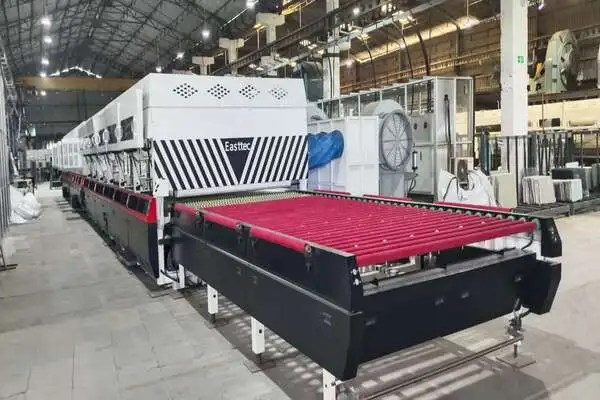
In Dual-Chamber Architectural Glass Tempering Furnace, energy is split between a chamber that warms up slowly and a chamber that heats up quickly. The glass slowly warms up in the first chamber. It then goes to the second chamber and reaches the tempering temperature, which is usually around 720°C to 680°C. Two batches can be worked on at the same time because the second batch warms up behind the first one while it's done. It can be quenched in a separate area. The cooling area, the two rooms, and the time are all kept in sync by an industrial PC. This steady flow gives the tank more space, and the slow rise in temperature protects the glass's quality.
Quality Gains for Low-E and Architectural Glass
Two-stage heating in a Dual-Chamber Architectural Glass Tempering Furnace is better than fast single-stage heating because it reduces thermal shock and stress. This means the surface is not curved as much and is flatter. For curtain wall glass, that's important because the images show every wave. Low-E glass that works well is ready for convection with the EASTTEC design. It works faster because it has two chambers and convection on top. Layer oxidation and Low-E heating cycles are stopped by balanced heating by 30%. This keeps the look of coverings that are sensitive safe. The furnace can heat glass that is 4 mm thick up to 19 mm thick. Standard 4–6 mm lites and thick structural glass are part of this. It is also possible to use controlled cooling to make glass stronger after it has been fired to between 24 and 52 MPa.
Capacity and Energy Compared With Single-Chamber Furnaces
It takes longer because a normal furnace with one chamber heats each batch in the same place from start to finish. This setup can make 1.8 to 2 times as many 4–6 mm lites as those units could because it shortens the cooking cycle. It's quick enough to do this. It gets better to use energy as well. Modern insulation cuts heat loss by 20%, and smart power management moves electricity between the chambers to keep the cost per square meter of running the machine low. The furnace is made to run all the time, seven days a week. Plants that buy a lot of energy-saving glass will get their money back faster because it makes more per shift.
Key Criteria to Evaluate When Purchasing a Dual-Chamber Architectural Glass Tempering Furnace
Next, use the same list to give each provider a score.
Heating, Convection, and Control Performance
Find out more about each supplier's heating consistency than just what they say in their ads. Find out how your own glass, including Low-E pieces, stacks up against ANSI Z97.1, ASTM C1048, and EN 12150-1 in terms of roller wave, edge lift, surface compression, and breakup. Then go over the controls one more time. All the ventilation and heating settings in the EASTTEC furnace are controlled by a central industrial PC. This keeps the process stable. Make sure that the software can handle different widths and that the menu can be read in the language that your workers speak. EASTTEC has a lot of languages, like English, Spanish, Russian, Korean, Portuguese, and more. The shop floor works better when data and controls are easy to see and use.
Chamber Size, Thickness Range, and Protective Features
Make sure the chamber size fits the largest sheet you want to print, and check that the range of thicknesses fits your order. From 4 mm to 19 mm thick, the EASTTEC oven can handle it and keep the top flat. In order to get the best quality, it's best to work sheets of the same thickness together. Software-based batching or gap control can help with mixed loads. The boiler is fully CE approved for safety, which means it can be used on high-end building projects in other countries. Ask each provider to write down a list of safety features, such as over-temperature alarms, fault tracking, and emergency stops. They should also be able to explain how the structure handles constant high-power use.
Supplier Strength, Customization, and After-Sales Support
Just as important as the specs is the history of the supplier. Luoyang Easttec Glass Automation Equipment Co., Ltd. has been in business since 1994 and uses rules for quality management that come from Italy. They know a lot about how to tint glass. Voltage (220V, 380V, 415V, 50/60Hz), equipment size, heating curves, cooling parameters, and color can all be changed. Right away, make sure you know the voltage where you are in the U.S. Installation, commissioning, operator training, and online help from technicians 24 hours a day, seven days a week are all part of the support. New employees can learn how to run and fix things in a week. Write down a list of spare parts and a due date for your answer. Giving clear answers now will make service easier later.
How to Avoid Quality Risks During Procurement: A Step-by-Step Approach
These four steps will turn the list into a plan, no matter how long it takes you to make a choice—three months, twelve months, or more.
Steps 1 and 2: Define Requirements and Compare Furnace Types
Write down the types of glass you make, the sizes they come in, the biggest sheet size, the amount you make each day, the coatings you use, and the voltage and frequency at your site for a Dual-Chamber Architectural Glass Tempering Furnace. Send them all the same list to get fair quotes. Next, check out how much each single-chamber, dual-chamber, and multi-chamber option costs, how well it warms up, and how much power it needs. A low price on the box might hide the fact that it makes less power and costs more to run. Use the estimated output per shift, the cost of energy per square meter, and the desired scrap rate to figure out how much a Dual-Chamber Architectural Glass Tempering Furnace will pay for itself. In other words, the choice is still based on ROI, not just price.
Step 3: Verify Supplier Credentials
Check three things: certificates, such as CE paperwork; client references from glass plants that you can call; and a visit to the factory or a show of the equipment. There is a production run that your technical head can watch at EASTTEC EQUIPMENT. They can also look at the ceramic convection parts and see how experts set up parameters. First, find out if you can bring your own glass pieces. Then, check the results against the rules given above. In the US, safety glass rules like ANSI Z97.1 and 16 CFR Part 1201 also cover walls, doors, and other places. Write-ups of the tests protect you in case the machine you are given doesn't work the way it did in the demonstration.
Step 4: Secure the Contract, Installation, and Training
Write down all the technical claims you make in the contract, such as the date of delivery, the range of widths, the promise to cut down on energy loss, and the capacity. Get ready, because it can take 60 to 120 working days to get a custom tempering furnace. Plan your building and utilities ahead of time. EASTTEC EQUIPMENT has a one-stop process that includes asking questions, planning a project, improving the plan, signing a cooperation agreement, making the equipment, setting it up and starting it up, teaching the user how to use it, and giving service after the sale. A training plan will show you how to do daily tasks, take care of the rollers, and fix problems. The furnace has to meet the numbers agreed upon on your production glass before it can be accepted for good.
Maintaining Dual-Chamber Glass Tempering Furnaces to Sustain Quality
After you turn on a good buy, you should still take good care of it.
Daily and Periodic Inspection Routines
Rollers need the most care. Every day, look for sulfur buildup on the clay rollers. Every three to six months, or as often as you make clay, deep clean and line them. If your rollers are dirty or not lined up right, they can leave lines and rolling waves. Check the temperature sensors and heating elements often, because a sensor that moves around can change the way your heater works before a problem shows up. Clean the cylinder and the parts that move air to stop buildup and rust. Keep track of the times you read, clean, and change pages. In written records, your repair manager can find trends. When you call, the techs can get the information they need.
Troubleshooting Common Quality Problems
Figure out what the symptoms are most likely caused by. Most of the time, temperature changes are caused by sensors, heating elements, or movement through convection. Roller wave and edge lift are often signs that the rollers are bent or that the heating profile keeps the glass in place for too long. One way to tell if the heating or cooling pressure needs to be changed is if the fracture count is low or the surface compression is weak. Change one thing at a time and write it down. The airflow and heating settings of the heater can be changed from the same Industrial PC. If you have longer-term problems, EASTTEC experts are available online 24 hours a day, seven days a week. This cuts down on downtime.
Training, Upgrades, and Long-Term Return
The results are changed by the workers every shift. New operators can easily learn how to run and maintain the plant in just one week thanks to EASTTEC's software and multilingual menu. This helps plants that are having trouble hiring people with the right skills. As your product mix changes, you should plan to make your power system and insulation better. EASTTEC also gives tips on how to change tools and deep-process glass. Because insulation cuts heat loss by 20%, it's important to be careful with it. But when insulation wears down, that gain is gone. Regular repair helps the return on investment because less waste is made, power costs go down, and machinery breaks down less often. Small changes won't become big, pricey problems that way. Every three months, look over these numbers.
Conclusion
Before you buy an architectural glass tempering kiln, you should know where the problems start: heating that isn't even, weak convection, worn-out rollers, and sources you haven't checked out. A Dual-Chamber Architectural Glass Tempering Furnace can help with some of these problems because it heats in two stages, which lowers thermal stress, protects Low-E coatings, boosts capacity by 1.8 to 2 times, and lowers thermal energy loss by 20%. We look at test results against ASTM C1048, EN 12150-1, and ANSI Z97.1 for a sound review. It also looks at the thickness range, room size, control system, CE compliance, customization, and the provider's past and support. Few mistakes happen when you go through a step-by-step process of listing your needs, comparing furnace types, checking credentials, and agreeing on the terms of the contract. There is a long-term return on investment that is protected by regular roller care, sensor and element checks, trained workers, and changes at the right time. The quality stays the same after it is set up.
FAQ
How does the dual-chamber design improve temperature stability?
The pre-heating room warms the glass slowly, and the high-heating room finishes the process. This process has two steps that work together to lower heat shock and stress. This helps it stay flat. A computer controlling both the chambers and the quenching section works in a business setting.
What is the typical lead time?
Delivery takes between 60 and 120 working days, depending on the type of furnace, because each one is made to order. Charge, size, heating curves, and software language can all change the schedule, so make sure you check them when you're planning the job.
How much energy can a dual-chamber furnace save?
Modern insulation keeps 20% of the heat inside, and smart power management makes sure that each room gets the same amount of electricity. The cost of running the machine per square meter goes down because of this. Your savings will vary based on the type of glass, how much you load, and how you shift.
Can it process Low-E glass?
Yes. The oven is ready for convection for high-performance Low-E glass. Top speeds for convection Low-E heating cycles are slowed down by 30%, and even heating stops the film from burning, which protects the coating's quality.
Contact EASTTEC EQUIPMENT for Your Dual-Chamber Architectural Glass Tempering Furnace
Are you ready to see what you can do? Dual-Chamber Architectural Glass Tempering Furnaces are made by EASTTEC EQUIPMENT. Since 1994, they've been making tools that heat glass, and all of their goods are CE-certified. They also have special power systems and are available online 24 hours a day, seven days a week. Send an email to sales@easttecmachine.com with the voltage, sheet sizes, and range of glass thicknesses that are available in your area. We'll then come up with a setting and price for you. In easttecglass.com, you can learn more about the goods or plan a visit to the plant.
References
1. ASTM International, Standard Specification for Heat-Strengthened and Fully Tempered Flat Glass (ASTM C1048), 2018.
2. European Committee for Standardization, Glass in Building – Thermally Toughened Soda Lime Silicate Safety Glass – Part 1: Definition and Description (EN 12150-1), 2015.
3. American National Standards Institute, Safety Glazing Materials Used in Buildings – Safety Performance Specifications and Methods of Test (ANSI Z97.1), 2015.
4. U.S. Consumer Product Safety Commission, Safety Standard for Architectural Glazing Materials (16 CFR Part 1201), 1977.
5. European Parliament and Council of the European Union, Machinery Directive 2006/42/EC, 2006.
6. Haldimann, M., Luible, A., and Overend, M., Structural Use of Glass, IABSE Structural Engineering Documents, 2008.

USER EVALUATE
Here is the customer's evaluation of us