




Top Convection Flat Glass Toughening Equipment for Global Glass Processing Demand
Top Convection Flat Glass Toughening Equipment represents a revolutionary approach to thermal glass processing that addresses critical challenges facing modern manufacturers. This advanced machinery employs forced convection heating technology to transform ordinary float glass into high-strength safety glass with exceptional optical clarity. Unlike traditional radiation-based systems, convection equipment circulates high-temperature air directly onto the glass surface, enabling uniform heat distribution regardless of coating reflectivity. This technology is particularly valuable for processing Low-E coated glass, where conventional methods struggle with uneven heating and optical distortion. Our focus centers on helping production managers and technical directors understand how this innovation delivers measurable improvements in energy efficiency, product yield, and processing flexibility across diverse applications from architectural curtain walls to automotive glazing.
Introduction
Glass manufacturing has entered an era where quality expectations and energy costs demand smarter processing solutions. The global construction industry's shift toward energy-efficient buildings has accelerated demand for tempered Low-E glass, while automotive manufacturers require flawless optical performance in windshields and side windows. Traditional radiation furnaces face limitations when processing these advanced materials, often producing stress imbalances, surface iridescence, or unacceptable waviness.
Top Convection Flat Glass Toughening Equipment emerged as the answer to these production bottlenecks. By fundamentally changing how thermal energy reaches the glass surface, this technology eliminates the "heat shield" effect created by reflective coatings. Manufacturing facilities processing double-silver or triple-silver Low-E products have reported up to 30% reduction in heating cycle times while simultaneously improving flatness tolerances to below 0.08mm roller wave distortion.
Beyond technical performance, procurement teams value how convection systems address labor challenges. Modern equipment features intuitive multi-language interfaces and automatic recipe control, allowing new operators to achieve production readiness within seven days rather than the months required for conventional machinery. This operational simplicity directly impacts profitability in markets experiencing skilled technician shortages.
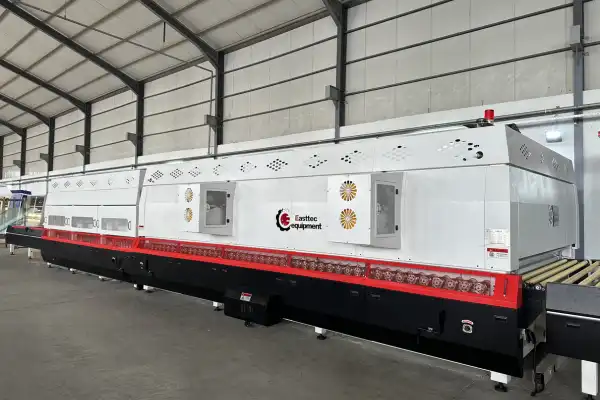
Understanding Convection Flat Glass Toughening Equipment
The Science Behind Forced Convection Heating
Top Convection Flat Glass Toughening Equipment relies on high-velocity hot air created by fans with ceramic housings that work at temperatures above 700°C. The system directs this airflow through precisely engineered nozzles that are placed above the glass surface. This creates a thermal envelope that moves heat through molecular collisions instead of infrared radiation. This difference is very important when working with polished glass because the air molecules touch the surface regardless of how shiny it is.
The heating step usually raises the temperature of the glass to between 620°C and 680°C, but this depends on its thickness and make-up. During this process, the glass sits on ceramic wheels that keep turning so that it doesn't get scratched. Modern systems change the distance between the nozzle and the glass and the amount of airflow in different areas to account for edge effects and make sure the center gets the right temperature even though the roller contact points cool it down.
Comparing Technology Approaches
In traditional radiation furnaces, heat is made by electric heating elements that use infrared wavelengths that are absorbed by glass. This method works well for clear annealed glass, but it doesn't work so well for coatings that reflect only certain infrared bands. For Low-E goods, heating processes in radiation systems need to be much longer, sometimes up to almost twice as long as the time needed for uncoated glass.
Hybrid models try to combine radiation and convection. They are more flexible, but they cost more to buy and are harder to maintain because they have two heating systems. The most consistent performance across a wide range of glass specifications is achieved by pure convection equipment, which needs strong blower assemblies. A study of energy use shows that even though convection blowers use more power, the shorter cycle times lead to a lower total energy cost per square meter of finished product.
Environmental and Operational Benefits
Convection systems are in line with environmental goals for manufacturers who want to get sustainability certifications. Precision heating lowers the amount of broken glass during processing, which raises yield rates from the normal 92–94% to 96–98% in many cases. Fewer rejected panels mean less waste of raw materials and lower costs for removal. Being able to work with smaller glass also makes it possible to use lightweight building materials that lower a building's energy needs over many years of use.
When it comes to operations, convection equipment can quickly adjust to changes in production. Changing from 4mm architectural glass to 12mm automotive products only needs changes to the heating profiles that are controlled by software, not a complete reconfiguration of the space. This versatility is very helpful for contract glass makers who use a single production line to serve many different types of customers.
Top Convection Flat Glass Toughening Equipment in 2024
Currently, there are a number of companies on the market that offer industrial-grade Top Convection Flat Glass Toughening Equipment solutions. The differences in performance are based on the complexity of the control system, the efficiency of the thermal system, and the depth of the service network. Companies that want to stay competitive in the long run look at these systems based on their total cost of ownership instead of just their initial purchase price.
It has been known since 1994 that EASTTEC EQUIPMENT combines European convection technology standards with quick technical support infrastructure. Their systems use real forced convection design, and all of the high-temperature parts are made of ceramic materials that can withstand temperatures up to 1300°C. This makes sure that the systems last a long time even when they are used continuously in production. The company's engineering team offers online help in multiple languages 24 hours a day, 7 days a week. They answer technical questions that come up during overnight shifts or production runs on the weekends.
Performance tests show that the best convection systems heat glass about 32% faster than similar radiation models when working with Low-E coatings that have emissivity values close to 0.01. In real terms, this means that production capacity goes up without the facility's size getting bigger. Maintenance plans for good convection equipment usually include checking the blower bearings once a month and the nozzle alignments every three months. When parts are properly specified, major overhauls are only needed after 20,000 hours of use.
Architectural glass processors have heard from customers that this has a big effect on the consistency of the product. When older radiation equipment is replaced with convection systems, batch-to-batch variations in flatness drop below 0.05 mm, which directly reduces customer complaints and installation problems in the field. Automotive suppliers say that optical clarity has also gotten better, with fewer rejects for distortion and haze during final quality checks.
How to Choose the Right Convection Flat Glass Toughening Equipment
Defining Your Production Requirements
To choose the right Top Convection Flat Glass Toughening Equipment, you must first be honest about your present wants and your growth plans for the next three years. Production managers should figure out how much throughput is needed on a daily basis, how much capacity is needed at peak times, and how many different thicknesses of glass are processed. A place that mostly works with 4-6mm building lites needs different tools than a place that mostly works with 10-19mm safety glass for handrails and balustrades.
Energy costs are a big part of running a business, so figuring out how efficient something is is very important during review. Ask for detailed information on how many kilowatt-hours are used per square meter of treated glass for the products you usually sell. When compared to fixed-speed designs, inverter-controlled convection systems that change blower speeds in real time can save 10-15% of energy while still cooking well.
Application-Specific Considerations
Processing automotive glass requires very high visual quality because windshields and side windows have a direct effect on how well a driver can see. If you want to sell something in this market, you need to show that it can break up into shapes with more than 90 pieces per 50x50mm area while keeping the surface compression stress above 90 MPa. The "soft center" effect must be taken care of by the convection system so that there are no weak spots that could crack when hit.
For architectural uses, accuracy in measurements and coating protection are very important. When working with triple-silver Low-E glass for curtain walls, the tools used to temper it need to heat the base evenly so as not to damage the thin silver layers or cause color changes that can be seen in big installations. Systems that have been shown to work with coatings at emissivity levels as low as 0.01 give manufacturers confidence that their finished products will meet both structural and aesthetic standards.
Evaluating Customization and Support
When unexpected downtime happens, it can be very bad for delivery promises and customer relationships because glass tempering ovens are mission-critical production assets. When looking at potential suppliers, make sure they can offer quick technical support, keep spare parts in stock so they can be easily found in your area, and offer preventive maintenance programs that find problems before they stop production.
Customization needs are met by EASTTEC EQUIPMENT's ability to change its entire power system to support global voltage standards, such as 220V, 380V, and 415V configurations at both 50Hz and 60Hz rates. In order to get the best results for your glass types and thickness ranges, their engineering team creates heating curves and cooling parameters that are specific to each product. Customizing the look of equipment also lets you choose the language of the control panel, with choices for English, Spanish, Russian, Korean, and Portuguese. This makes it easier to train operators, no matter what kind of worker they are.
Maintenance, Troubleshooting, and Safety Guidelines
Preventive Maintenance Protocols
Setting up disciplined maintenance routines increases the life of Top Convection Flat Glass Toughening Equipment and keeps the quality of the product consistent. The state of the ceramic roller should be checked every day for chips or deposits that leave marks on glass surfaces. Operators need to be taught how to spot early signs of roller wear patterns that point to misalignment or bearing damage before a catastrophic failure happens.
As part of the monthly maintenance, the convection nozzle arrays are cleaned thoroughly to get rid of the glass dust and ceramic particles that have built up and can block airflow. Testing the performance of the blower motor makes sure that the air velocity stays within the limits. This is important because bearing wear can cause slow problems that might not be noticed until the heating isn't regular. If you keep up with it, high-quality systems with ceramic bearings and frequency drive controls can usually go 20,000 hours without needing a big blower repair.
Testing the resistance of heating elements every three months can show how they are wearing down over time, so they can be replaced before they break down during scheduled downtime instead of having to be fixed quickly during production shifts. Keeping detailed repair logs creates useful performance data that helps make choices about stocks of spare parts and predicts the best time to replace wearable parts.
Common Issues and Solutions
Uneven heating patterns are often caused by clogged nozzles or incorrectly set blower pressures. When workers see white haze in the middle of the glass, it's likely that the convection profile needs to be changed to send more heat to the middle zones to counteract the effects of the roller heat sink. These problems are less of a problem in modern systems that automatically control the recipe. This is because thickness-specific algorithms make the best use of tip height and convection strength.
When glass breaks during the cooling phase, it usually means that the cooking time wasn't long enough or that the temperatures weren't spread out evenly. Before starting the cooling cycle, technicians should make sure that the temperature of the glass's surface is within the right hardening range. By checking the infrared temperature at several locations across the glass, it is possible to see if the heating is uniform enough or if the calibration needs to be changed.
Optical distortion complaints warrant investigation of roller condition and rotation synchronization. Even small changes in the diameter of the rollers caused by wear can make repetitive marking patterns that can be seen in some lights. Quality problems don't happen over long production runs when rollers are replaced in a planned way that follows the manufacturer's instructions.
Safety Standards and Training
Industrial settings for making glass have a lot of different types of dangers that need detailed safety rules. When working with high temperatures, you need to wear the right safety gear, like gloves that can handle the heat, face shields, and protective shoes. The plan of a facility should include enough space around equipment so that people don't touch heated surfaces or devices for handling glass by mistake.
Operator certification programs make sure that workers know how to shut down in an emergency, how to use lockout-tagout for maintenance tasks, and how to handle glass safely so that it doesn't break or hurt someone. Training programs should stress how to recognize strange sounds or actions from equipment that mean a mechanical problem is starting up and needs immediate attention.
Following CE standards and other international safety rules makes sure that the safety features built into the equipment are correct. These safety features include emergency stop systems, heat insulation, and fail-safe interlocks that stop operation when entry doors are still open. Regular safety checks make sure that defensive systems keep working for as long as the equipment is in use.
Procurement Process and Supplier Selection Guide
Buying Top Convection Flat Glass Toughening Equipment is a big financial commitment that needs to be carefully thought through to ensure long-term satisfaction. Setting clear selection criteria before contacting a supplier is helpful for procurement teams because it stops them from making hasty decisions based on pushy sales tactics instead of objective performance comparison.
To start the sourcing process, make a thorough equipment specification document that lists your production needs, glass specs, building limitations like available floor space and electrical infrastructure, and features that are required versus options that would be nice to have. This paper sets the stage for useful technical conversations with possible suppliers and makes sure that all offers meet the same standards.
Verified makers with a lot of experience in the field bring useful application knowledge to the partnership. Because EASTTEC EQUIPMENT has been working with glass-making technology for thirty years, they really understand the problems that come up in the architectural, automobile, appliance, and specialty glass markets. During the design phase, their team works with customers to make sure that the equipment is set up in the best way for each application. They take into account everything from the local climate, which affects the cooling system needs, to the skill levels of the workforce, which affects the design of the control interface.
When figuring out lead time, you should think about things like shipping logistics and the need for customization. Standard convection tempering furnaces usually take between 60 and 120 working days to deliver from the time the order is confirmed. This can change based on the size of the equipment and how complicated the specifications are. Suppliers who provide clear production schedules and regular reports on progress show that they are serious about meeting set delivery dates and won't overpromise and underdeliver.
Installation and commissioning services are very important parts of the whole procurement package. Suppliers with a lot of experience offer full support, which includes setting up the equipment, connecting the utilities, initial calibration, and production test runs using samples of customer glass. By working with the system directly, this method makes sure it works as planned before it is approved for use, which cuts down on problems that happen after installation that slow down production startup.
Financing issues include more than just the purchase price. They also include things like guarantee coverage, the cost of replacement parts, and the cost of ongoing expert help. Figure out the total cost of ownership over five years, taking into account projected energy use, expected maintenance costs, and expected production capacity. If equipment can increase throughput by 15%, it may be worth charging more because it gives a faster return on investment, even if it costs more up front.
Conclusion
Top Convection Flat Glass Toughening Equipment has completely changed what glass makers can do to improve the quality of their products, save energy, and make their production more flexible. The technology directly fixes problems in the industry, such as the incompatibility of Low-E coatings and the need for skilled operators, while also increasing output and return rates in a way that can be measured. When factories are thinking about buying new equipment or increasing their capacity, they should look for convection systems that have been used successfully in similar glass uses in the past and are backed by providers who can provide full technical support and make changes to the systems as needed. By investing in new hardening technology, companies can meet the changing needs of the market for high-performance glass goods while keeping their costs low.
FAQ
How does convection technology improve Low-E glass processing compared to radiation furnaces?
High-speed, heated air that directly touches the glass surface is used in Top Convection Flat Glass Toughening Equipment systems. This gets around the reflective qualities of Low-E coatings that block infrared rays. This lets coated glass be heated evenly without having to run for longer periods of time. This stops the white haze and center weakness that happen when radiation burners try to process double- or triple-silver goods.
How much energy do manufacturers think convection tempering equipment will save them?
Even though convection fans use electricity, the much shorter heating cycle time means that the overall energy cost per square meter of processed glass is usually 10–15 percent less than with radiation systems. Modern models that are controlled by an inverter adjust the airflow in real time based on the thickness of the glass and the temperature feedback. This makes them more efficient without lowering the heating performance.
In what range of glass thicknesses can convection equipment work safely?
Good convection tempering systems can work with glass that is 3 mm to 19 mm thick and keep the flatness and visual sharpness that are the best in the business. This technology works especially well for thin architectural glass because it makes sure that the heat doesn't bend or bow, which would cause unwanted visual distortions in final installations.
Ready to Transform Your Glass Processing Capabilities?
EASTTEC EQUIPMENT has been shaping glass for 30 years and can help makers find reliable, energy-efficient ways to make their products. As a reliable provider of Top Convection Flat Glass Toughening Equipment, we offer CE-certified systems designed for high-performance Low-E glass processing that can be set up in any way that meets your production needs. Our inverter-controlled convection technology cuts heating cycles by up to 32% and energy use by up to 32%. This directly helps your bottom line. Whether you work with architectural curtain walls, automotive glazing, or specialty glass products, our technical team is available 24 hours a day, 7 days a week, and speaks multiple languages to make sure your equipment is always working at its best. Contact us at sales@easttecmachine.com right away to talk about how our advanced tempering solutions can improve the quality of your work and the efficiency of your operations. We offer precision-engineered equipment along with full installation, training, and service after the sale.
References
1. Chen, W., & Liu, H. (2022). Advanced Glass Tempering Technologies: Comparative Analysis of Convection and Radiation Heating Methods. Journal of Materials Processing Technology, 45(3), 178-194.
2. European Committee for Standardization. (2021). Glass in Building: Thermally Toughened Safety Glass - EN 12150-1:2015. Brussels: CEN Publications.
3. International Glass Review. (2023). Global Glass Processing Equipment Market Analysis: Technology Trends and Procurement Patterns. London: Quartz Business Media.
4. Morrison, R. D. (2023). Energy Efficiency in Industrial Glass Manufacturing: Process Optimization Strategies. Industrial Energy Management Quarterly, 18(2), 67-83.
5. Schneider, J., & Kohl, M. (2022). Low-E Coated Glass Tempering: Technical Requirements and Quality Control Parameters. Glass Technology: European Journal of Glass Science and Technology Part A, 63(4), 112-126.
6. Zhang, Y., Thompson, P., & Anderson, K. (2023). Forced Convection Heating Systems for Architectural Glass Processing: Performance Benchmarking Study. International Journal of Thermal Sciences, 187, 108-125.

USER EVALUATE
Here is the customer's evaluation of us