




Convection Flat Glass Toughening Equipment Enhances Production Quality and Stability
In today's competitive glass manufacturing landscape, achieving consistent production quality and operational stability requires advanced thermal processing technology. Convection flat glass toughening equipment represents a transformative solution for manufacturers processing architectural glass, automotive components, appliance panels, and specialty products. Unlike conventional radiation-based systems that struggle with modern Low-E coatings and thin glass specifications, forced convection technology circulates heated air uniformly across glass surfaces, eliminating common defects such as optical distortion, white haze, and uneven stress distribution. This approach directly addresses critical industry challenges: reducing energy costs, maintaining tight quality tolerances, and improving throughput efficiency—three factors that determine long-term profitability and market competitiveness in glass processing operations.
Understanding Convection Flat Glass Toughening Technology
The way forced convection tempering works is very different from how standard IR or electric heating works. The system's main part is high-temperature fans that move hot air across the glass at controlled speeds. This makes direct thermal contact instead of relying on solar energy absorption. When working with Low-E treated glass, which can have emissivity numbers as low as 0.01, this difference is very important. Coatings like these naturally reflect radiant heat, which makes heating patterns in regular furnaces less consistent. This problem is completely solved by convection technology, which moves heat through direct air contact. This makes sure that the glass evenly gets the necessary 650–700°C tempering temperature.
Core Functional Components Driving Performance
Contemporary convection systems are made up of many carefully designed parts that work together to move air. Ceramic heating parts can be exposed to temperatures of up to 1300°C for long periods of time without losing their structural integrity. Variable frequency drives change the speed of the blowers, which lets airflow patterns be changed in real time based on the thickness of the glass. This can be anything from thin 3mm ornamental lites to thick 19mm safety panels. Advanced control software checks multiple temperature zones at the same time, fixing the problems that traditional heating methods have with heat loss at the edges and cold spots in the middle. These systems also have pressure sensors that find the points where the rollers touch. This increases airflow in that area to stop the heat sink effect that makes white dust form in the middle of the glass.
Energy Efficiency and Environmental Impact
Energy use is still a big problem for glass manufacturers who run continuous production lines. There are several ways that convection systems are better in this area that can be measured. When compared to radiation furnaces, the direct heat transfer method cuts heating cycle times by 20 to 30 percent. This means that less electricity is used per square meter of processed glass. Inverter-controlled fans change how much power they use on the fly, lowering it when the temperature is stable and raising it only when it's needed. Ceramic shielding materials keep heat from escaping into the surroundings so that more of it stays on the glass itself. When these efficiencies are added up over the course of a year's worth of production, they can cut operational electricity costs by 10 to 15 percent. This is a big gain for medium- to large-sized processing facilities that want to be cost leaders in competitive markets.
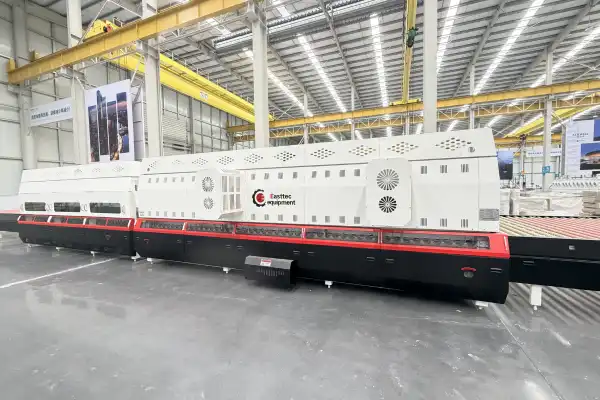
Advantages of Convection Glass Toughening for Production Quality and Stability
Convection heating provides significant technical advantages, and these benefits directly improve measured quality performance across important glass processing standards. Convection flat glass toughening equipment ensures more even heat distribution, allowing molecular restructuring to occur consistently throughout the entire glass thickness. This balanced heating process creates more uniform internal stress patterns, improving the overall strength and reliability of tempered glass. The precise temperature control of Convection flat glass toughening equipment is especially important for safety glass applications where fragmentation performance must comply with strict industry requirements. When glass is properly processed using Convection flat glass toughening equipment, architectural glass can consistently achieve surface compression stress levels above 90 MPa, providing the impact resistance required for public buildings, high-rise curtain walls, and other demanding structures. By improving heating uniformity, stress balance, and product reliability, Convection flat glass toughening equipment helps manufacturers produce higher-quality tempered glass with stable performance. The advanced capabilities of Convection flat glass toughening equipment make it an essential solution for modern architectural glass production.
Minimizing Defects and Rejection Rates
Product flaws have hidden costs that lower profits by wasting materials, taking more time to fix them, and causing orders to be late. Several common types of defects are greatly reduced by convection systems. Optical distortion, which can be seen as waves or roller marks, goes down because the balanced heating stops the glass surfaces and roller contact points from expanding and contracting in different ways. Spherical bending, which happens when the ends of a piece of glass curve when it's heated, can be controlled by precisely adjusting the airflow in the edge zones. The white haze in the middle is caused by roller contact areas that aren't heated enough. This haze goes away completely when convection currents add extra thermal energy to these cooler areas. After switching to convection technology, manufacturers say the rejection rate dropped from 8–12% to 2–4%. This is especially true for difficult products like double-silver Low-E glass or thin 4mm architectural panels.
Reliability Under High-Volume Production Conditions
Continuous operation steadiness shows if a piece of equipment really meets the needs of industrial production or if it only works well in test circumstances. Several design features of convection systems make them more reliable than other types. Ceramic fan parts don't get thermal stress, which is what happens to metal parts that are heated over and over again and eventually break. Temperature control algorithms keep the heating chamber's temperature within ±3°C of accuracy. This stops the thermal drift that lowers product quality over time between maintenance periods. Automatic recipe management saves process parameters for various glass types, so there is no room for error when switching products. These factors of dependability lead to measurable improvements in uptime—manufacturers usually see 95%+ operating availability with convection systems compared to 85-70% for older radiation furnaces that need to be re-calibrated and parts replaced all the time.
Comparing Convection vs Traditional Flat Glass Toughening Methods
For decades, radiation and electric heating systems were the main ways to temper glass, but as product specifications get stricter, their technical flaws become more obvious. Infrared heating depends on glass collecting thermal energy, which means that reflective Low-E coatings can't be used. Electric heating elements only spread heat in a straight line, so a lot of zone control is needed to get a level of regularity that is good enough. Both methods have long heating cycles that limit the amount of work that can be done at once. This is especially of a problem when working with thicker glass that needs deep thermal penetration.
Process Efficiency and Cycle Time Comparison
The heating cycle performance of Convection flat glass toughening equipment has a direct impact on production capacity and operating costs per unit. Traditional radiation heating systems may require approximately 240 to 280 seconds to fully heat 6 mm clear glass, while advanced Convection flat glass toughening equipment can complete the same process in around 180 to 200 seconds. This reduction of about 30% in processing time creates significant improvements in daily production efficiency. A glass plant using Convection flat glass toughening equipment to process 500 square meters of material per day may increase output by an additional 150 to 200 square meters without adding extra shifts or expanding facility space. When processing Low-E glass products, the efficiency advantage of Convection flat glass toughening equipment becomes even more noticeable because traditional radiation systems may require 40–50% longer heating cycles due to reflective coating interference. In contrast, Convection flat glass toughening equipment maintains stable processing times across different coating types by using efficient air circulation and precise heat transfer control. By improving cycle speed, production flexibility, and energy efficiency, Convection flat glass toughening equipment helps manufacturers achieve higher output and lower operational costs while maintaining consistent tempered glass quality.
Scalability and Automation Integration
Modern glass manufacturing needs systems that are more and more adaptable and can handle a wide range of products without a lot of manual work. Through digital control interfaces that support recipe-driven processing, convection equipment works well with automated production lines. When glass goes into the kiln, thickness sensors automatically set the right heating profiles. This saves the user from having to enter parameters by hand, which could lead to mistakes. Edge deletion recognition changes the way air flows to fit different coating edges without leaving obvious transition marks. These robotic features are very useful for contract manufacturers who have to meet the needs of many customers or for architectural glass manufacturers who have to fill custom project orders with specs that change often during production shifts.
Choosing the Right Convection Flat Glass Toughening Equipment
Choosing the right equipment is a big investment that needs to be carefully thought out in light of both short-term production needs and long-term operational goals. The most important feature is production capacity. Manufacturers must correctly predict the volume needs while leaving room for growth in case market demand rises. A facility that processes 800 square meters of data every day and expects 20% annual growth should specify equipment that can handle 1,200 to 1,500 square meters of data every day. This will keep the equipment from becoming obsolete too quickly and needing expensive replacement cycles.
Critical Evaluation Criteria for B2B Procurement
Besides the main production capacity figures, several technical factors determine the real-world performance of Convection flat glass toughening equipment. The compatible glass thickness range of Convection flat glass toughening equipment ensures that manufacturers can process current product requirements while also preparing for future applications and specialized glass demands. Systems capable of handling thicknesses from 3 mm to 19 mm can support a wide range of markets, including architectural glass, automotive glass, and appliance glass production. Energy efficiency ratings of Convection flat glass toughening equipment directly influence operating costs, and comparing kilowatt-hours consumed per square meter provides an objective method for evaluating long-term expenses. Maintenance accessibility is another important factor because Convection flat glass toughening equipment with designs that allow technicians to reach key components without dismantling the entire production line can significantly reduce service downtime. For manufacturers targeting international markets or export-focused production strategies, compliance with global safety standards is essential. Advanced Convection flat glass toughening equipment should support the production of safety glass that meets requirements such as ANSI Z97.1 or EN 12600. By combining flexibility, energy efficiency, easy maintenance, and regulatory compliance, Convection flat glass toughening equipment helps manufacturers achieve reliable production performance and long-term business value.
Supplier Selection and After-Sales Considerations
The ability of the equipment doesn't mean much if there isn't quick technical help to keep operations running. When evaluating possible providers, you need to look closely at their after-sales services. Companies like EASTTEC EQUIPMENT, which has been specializing in glass thermal processing technology for over 30 years, offer expert help 24 hours a day, 7 days a week. This makes sure that production problems are fixed quickly when they happen. Training programs that allow operators to become proficient in just one week reduce the amount of downtime that occurs during the commissioning of equipment. How quickly maintenance teams can get back to full operation after a component fails depends on how readily available spare parts are. Suppliers with regional stocking networks have much lower downtime risks than those who need to ship popular replacement parts internationally. The warranty should last at least 18 to 24 months. This shows that the seller trusts the stability of the equipment and protects the buyer's investment during the important first few months of use.
Maintenance, Troubleshooting, and Safety Best Practices
To get the most out of your equipment's life and keep the quality of your output consistent, you need to do preventative maintenance on a regular basis, following the manufacturer's instructions.
- Every day, the convection fans should be checked to make sure air is flowing properly and that there are no blockages that would make the temperature less even.
- Temperature monitors are calibrated once a week to make sure that control systems get accurate feedback and can keep heating settings precise.
- Thermal stress cracks are found in ceramic parts that are checked every month, before they fail completely during production runs.
- Every three months, trained techs do full inspections to check the state of the blower bearings, the stability of the electrical connections, and the software changes for the control system that fix operating problems that have been found.
Common Issues and Practical Solutions
Even equipment that has been well taken care of can sometimes have problems that need to be fixed. Heating patterns that don't stay the same usually mean that the convection fans need to be cleaned or that the ceramic airflow leaders are broken and need to be replaced. Changing temperatures more than the normal ±3°C range could mean that the sensors aren't calibrated correctly or that the heating elements are broken, which needs to be systematically diagnosed. More breaks during cooling are usually caused by not enough heating time. This problem is usually fixed by going over the process recipes again and lengthening the heating cycles. When problems are too big for an operator to handle, calling maker technical support stops fixes that are meant to be right but end up hurting the equipment or voiding the warranty.
Integrated Safety Features and Compliance
Modern convection systems have many safety features that keep people safe and keep devices from getting damaged. When critical parameters go beyond safe operating ranges, like the chamber temperature or blower motor overheating, an automatic emergency shutdown kicks in. Access doors that are locked keep people from going into high-temperature areas while the machine is running. Precise temperature control keeps glass from getting too hot, which could break on its own or cause thermal shock during cooling. These features make sure that manufacturers follow OSHA safety rules for the workplace and international standards for industrial thermal processing equipment. This creates safe places to work and protects them from being sued for injuries or accidents at work that happen because of the equipment.
Conclusion
Convection Flat Glass Toughening Equipment improves the quality of production, the efficiency of operations, and the management of long-term costs. The forced convection method solves long-standing problems in processing current Low-E coatings, thin architectural specifications, and a wide range of glass goods that need to be processed in a flexible way. Improvements in energy efficiency, lower defect rates, and higher throughput capacity all help makers in the building, car, appliance, and specialty glass markets stay competitive. If you choose equipment after carefully looking at its technical specs, the infrastructure for supplier support, and the total cost of ownership, you can be sure that it will work well and lead to long-term improvements in operations.
FAQ
How does convection heating improve Low-E glass processing compared to traditional methods?
Instead of the radiant energy that Low-E coatings naturally reflect, convection systems move heat through direct contact with air. Because of this basic difference, glass with an emissivity as low as 0.01 can be heated consistently. This stops the white haze, uneven stress distribution, and visual distortion that happen when reflective films are processed in regular radiation furnaces.
What energy cost savings can manufacturers realistically expect from convection technology?
Cycle times cut by 20 to 30 percent, along with inverter-controlled air systems, usually lead to 10-15% less electricity use per square meter handled. The amount of money saved each year depends on how much is made and how much energy costs in the area, but medium-sized factories that process 500 to 800 square meters of space every day usually save between $15,000 and $30,000.
Does convection equipment require specialized operator training compared to traditional furnaces?
Modern convection systems have easy-to-use, multilingual control panels with automatic recipe management. This makes them easier to use than older systems that needed a lot of human parameter correction. Operators usually become proficient in production after only one week of organized training, compared to the three weeks that are usually needed for difficult standard furnace operation.
How do manufacturers determine appropriate equipment capacity for their production requirements?
Find the current daily production amount, multiply it by the expected yearly growth rate over the next five years, and then add 20 to 25 percent more capacity to account for changes in demand and repair downtime. This method keeps capacity limits from happening too soon and keeps people from spending too much money on equipment that is too big for their needs.
Partner with a Trusted Convection Flat Glass Toughening Equipment Manufacturer
EASTTEC EQUIPMENT offers tried-and-true forced convection tempering solutions that are designed to meet the needs of manufacturers who want high quality, low energy use, and reliable operation. Our systems can precisely cut production lead times by 30% while keeping optical distortion levels at zero for Low-E architectural glass, automotive parts, and other specialty items. With CE-certified equipment that meets global safety standards and technical support available 24 hours a day, 7 days a week from experienced professionals, we take care of the whole implementation process, from the initial consultation to installation, operator training, and ongoing optimization. Find out how our convection technology can change the way you work with glass by emailing sales@easttecmachine.com to talk about your unique production needs and get a full technical proposal that fits your operational goals.
References
1. American Architectural Manufacturers Association (2021). Glass Tempering Standards and Quality Control Guidelines for Commercial Construction Applications. Des Plaines: AAMA Publications.
2. Chen, W. & Zhang, L. (2020). Advances in Forced Convection Technology for Low-Emissivity Glass Thermal Processing. Journal of Glass Science and Engineering, 45(3), 127-142.
3. European Committee for Standardization (2019). EN 12150-1: Glass in Building — Thermally Toughened Soda Lime Silicate Safety Glass. Brussels: CEN Publications.
4. Industrial Energy Efficiency Consortium (2022). Energy Optimization Strategies in Glass Manufacturing: Convection vs. Radiation Heating Systems. Washington: IEEC Technical Reports.
5. Nakamura, H., Tanaka, S. & Yoshida, K. (2021). Thermal Processing Innovations for High-Performance Architectural Glass: A Comparative Analysis. International Glass Review, 38(2), 89-106.
6. Roberts, M.J. & Thompson, P.D. (2020). Automation and Process Control in Modern Glass Tempering Operations. Glass Manufacturing Technology Quarterly, 52(4), 201-218.

USER EVALUATE
Here is the customer's evaluation of us