




Advanced Convection Toughening Equipment Supports Large Glass Processing Projects
When large-scale glass manufacturers face increasing demand for architectural curtain walls, automotive windshields, and solar panel covers, traditional tempering furnaces often struggle to deliver consistent quality and energy efficiency. Convection Flat Glass Toughening Equipment solves these challenges by using forced hot air circulation instead of radiation-based heating, ensuring uniform thermal distribution across glass surfaces regardless of coating type or thickness. This technology dramatically reduces optical distortion while accelerating production cycles, making it the preferred choice for processors handling high-performance Low-E glass and oversized architectural panels.
Understanding Convection Flat Glass Toughening Technology
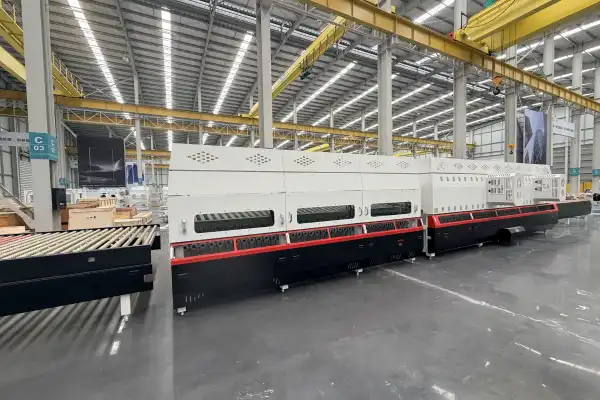
The way glass makers meet strength and safety standards has changed a lot because of convection hardening. In contrast to older radiation furnaces that use infrared heat absorption, this method uses high-temperature blowers to move heated air directly onto glass surfaces at very precise speeds. This technology is especially useful when working with Low-E coated glass, which naturally reflects heat back into space. The Convection Flat Glass Toughening Equipment gets around the reflective barrier made by metallic coatings by using convective heat transfer. This makes sure that the glass core gets to the right tempering temperature (620–680°C) without the surface getting too hot.
How the Tempering Process Works
As the glass rolls onto ceramic rollers inside the furnace, heated air is sprayed across both the top and bottom sides by carefully placed nozzles. Temperature sensors check the evenness of the temperature in real time and use inverter-controlled systems to change the fan speeds to keep the heating patterns consistent. Once the glass reaches the right temperature, it goes quickly into the quenching area. Here, high-pressure air jets cool the surfaces while keeping the core hot. This creates the compression stress that makes tempered glass strong. This process is 30% faster than the old ways of doing things, which directly means that busy production lines can get more done every day.
Benefits for Industrial-Scale Operations
When big glass makers choose modern convection systems, they get a lot of benefits for their business. When compared to older furnace designs, inverter controls make the blower work based on real thermal needs instead of always running at full capacity. This means that energy use drops by 10 to 15 percent. Because constant heating gets rid of common problems like center tension imbalances and edge stress differences, the number of defects goes down by a lot. Cycle times have gone down—what used to take 300 seconds now only takes 210 seconds—which is especially useful for production managers because it means facilities can increase output without adding more equipment or floor space.
Comparing Convection Toughening to Other Glass Tempering Technologies
When manufacturers look at tempering tools, they see three main heating methods, and each one works in a different way. Infrared elements in radiation furnaces heat things through electromagnetic waves. This works well for clear glass but not so well for Low-E materials. While vacuum hardening can be useful in some situations, it needs complicated chamber systems that make both the initial cost and the amount of upkeep needed much higher. Most commercial uses of Convection Flat Glass Toughening Equipment find the best balance, especially when working with a wide range of products, such as coated architectural glass, automotive parts, and appliance panels.
Automation Levels and Production Capacity
Smaller operations still have tempering lines that are run by hand, but most large facilities use automated convection systems. Programmable logic controllers in these high-tech systems store recipes for hundreds of different glass specifications. Based on the thickness and type of coating, the systems automatically change the heating curves, conveyor speeds, and quenching pressures. Touchscreen screens show process data in English, Spanish, Russian, Korean, and Portuguese, so they can be used by people from all over the world. Quality control is also automated. Products that don't meet tolerance ranges are flagged by built-in stress meters and optical readers before they reach the packing stations.
Performance Benchmarks in 2024
The best convection equipment can achieve surface compression forces of more than 90 MPa while keeping optical distortion below 0.08 mm per meter, which meets the strictest design requirements. Fragmentation testing always finds particle counts that are much higher than the minimum safety standards. For example, 50x50mm test areas often have 60–80 pieces instead of the required 40. When making glass for high-rise buildings that are subject to wind loads, these performance metrics become very important. The same is true for automotive uses where predictable breakage patterns are important for passenger safety.
Key Factors for Procuring Convection Flat Glass Toughening Equipment
When making choices about capital tools for big glass projects, procurement managers have to weigh short-term budget limits against long-term operational costs. Quality Convection Flat Glass Toughening Equipment costs a lot of money. Small lines that work with smaller architectural panels cost around $180,000, while jumbo furnaces that work with 3300mm x 18000mm curtain wall units cost over $800,000. But figuring out the total cost of ownership shows that models with higher energy efficiency pay for themselves in 18 to 24 months of continuous use by saving money on energy costs and making more things get done.
Evaluating Supplier Credentials
It takes more than just comparing detail sheets to choose the right equipment maker. Check to see how long the provider has been specializing in glass tempering technology. Companies with 20 to 30 years of experience have a lot of knowledge that younger companies can't match. Technical skills are very important. Look for companies that hire engineers who know about both thermal dynamics and glass science and can make heating profiles that work for your products. Visits to the factory are a great way to learn about quality control procedures, standards for sourcing parts, and whether the supplier keeps enough spare parts on hand to respond quickly to maintenance problems.
Installation and Logistics Planning
Large-scale Convection Flat Glass Toughening Equipment is typically delivered in separate modules that require professional assembly, electrical connection, and commissioning by skilled technicians at the customer’s facility. When the dimensions of Convection Flat Glass Toughening Equipment exceed standard container sizes, transportation becomes more complex and may require special hauling permits, route planning, and detailed logistics surveys. The installation process for Convection Flat Glass Toughening Equipment usually takes three to four weeks from delivery to full production readiness, provided that the facility has prepared sufficient electrical capacity, proper ventilation systems, and reinforced flooring capable of supporting the equipment weight. Experienced suppliers of Convection Flat Glass Toughening Equipment provide installation teams that not only complete equipment assembly but also offer operator training and technical support. This professional service helps ensure a smooth transition, reduces startup delays, and allows manufacturers to achieve stable production performance quickly with their Convection Flat Glass Toughening Equipment.
Maintaining and Optimizing Convection Flat Glass Toughening Equipment
Regular preventive maintenance is what separates tempering operations that are very effective from those that have a lot of unplanned downtime and inconsistent quality. Ceramic roller conditions should be checked every day, and any damage to the surface that could leave marks on glass or make heating patterns less even should be looked for. Operators need to keep an eye on the temperatures and vibration levels of the blower motors because one of the most common reasons for unplanned shutdowns is bearing failure. If you clean the air tubes once a week, carbon won't build up and block the flow of air, which would otherwise cause cold spots and under-tempered areas that fail fragmentation tests.
Scheduled Calibration Requirements
Every month, measurement tools are calibrated to make sure they properly reflect the conditions of the process. Over time, thermocouples that measure burner temps may move, which could lead to a slow loss of quality that isn't noticed until customers start to complain. To keep measurement accuracy within acceptable ranges, stress meters need to be checked against approved test samples on a frequent basis. As part of the annual maintenance, the heating elements are carefully checked, worn conveyor parts are replaced, and safety interlocks are checked to make sure they work properly and protect workers from high-temperature dangers.
Energy Efficiency Best Practices
To get the most out of your equipment's energy use, you need to pay attention to how it is used as well. Scheduling production to have as few furnace warm-up cycles as possible saves energy, since each cold start uses a lot of power to get ceramic parts to working temperature. Keeping the insulation around the different parts of the furnace in good shape stops heat loss that makes the fans work harder to make up for it. Modern convection systems have smart settings that automatically lower the amount of power used when the system is not in use. This keeps the temperature high enough so that production can start up fast when orders come in.
Real-World Applications and Case Studies in Large Glass Processing
A company in the Midwest that makes architectural glass recently switched from using radiation furnaces to more advanced convection technology to make more glass for commercial building projects. The factory works with Low-E treated glass that is between 4mm and 12mm thick and makes insulated glass units for office towers and government buildings. The amount of work that could be done went up by 35% after the installation, and the cost of energy per square meter went down by 12%. Quality metrics got a lot better—complaints about optical distortion dropped from 3.2% of production to 0.4%, and the company was able to offer longer warranties on higher-end products, which made them more competitive.
Solar Industry Requirements
Photovoltaic glass making needs very even temperatures because even small changes in stress can affect how long panels last when they are installed outside and exposed to temperature changes over many years. A solar glass processor in the Southwest chose Convection Flat Glass Toughening Equipment that was specially made for patterned glass surfaces, which are harder to heat absorb than smooth architectural glass. The customized heating profiles that were created during commissioning helped the facility temper surfaces consistently across a range of textures. This cut the number of breaks during panel assembly from 1.8% to 0.3% while keeping the optical transmission properties that are important for solar efficiency.
Automotive Component Production
Auto glass makers have to follow strict safety rules that require them to keep a close eye on how the glass breaks and how well it resists impact. A top supplier that makes side windows and backlights set up automated convection lines that can handle 800 units per day from 47 different vehicle models. The programmable recipe management system keeps specific settings for every part number and can automatically adjust for changes in thickness and curvature needs. This made it possible to get rid of the need for separate tempering lines for each car program. This cut down on the amount of capital needed and made it easier to adjust schedules when customers change the amount of output between models.
Conclusion
Modern Convection Flat Glass Toughening Equipment completely changes how large glass processing operations work by combining the best quality tempering with the fastest production times and most energy-efficient equipment. Important problems in the industry are solved by this technology, such as compatibility with Low-E coatings, elimination of optical distortion, and faster cycle times that have a direct effect on profits. Modern convection systems give manufacturers a competitive edge by lowering the number of defects and running costs and letting them process a wider range of products without having to change the equipment. The investment pays off in a way that can be measured: higher daily throughput, longer machine service life, and better product quality that builds stronger ties with customers and opens up new premium market niches.
FAQ
How Does Convection Technology Improve Low-E Glass Processing?
Low-emissivity coatings block between 70 and 90% of infrared radiation, which means that regular furnaces can't heat the glass properly. Instead of radiation, convection systems move heat through direct contact with the air, skipping right over the reflective barrier. When molecules of hot air touch the surface of the glass, heat moves through the covering and into the glass base. Because of this basic difference, double-silver and triple-silver Low-E products can be processed that would not be possible with radiation ovens because they would need long heating cycles that damage the coating or just fail to hit the tempering temperature.
What Maintenance Intervals Prevent Production Interruptions?
Important parts need to be checked at certain times to keep them from breaking down without warning. Every 2,000 hours of use, ceramic rollers need to be rotated to even out wear and keep flat spots from appearing that damage glass or cause uneven heating. Blower motors with ceramic bearings can usually work for 20,000 hours before they need major service if they are well taken care of. However, problems can be caught early by checking on them every day. Every six months, inspections of the heating elements find parts that are breaking down before they completely stop working. This lets the parts be replaced during planned downtime instead of having to be fixed in an emergency, which stops production without warning.
Which Equipment Specifications Match Different Production Volumes?
Small to medium-sized businesses that work with 500 to 1500 square meters of glass every day usually choose small Convection Flat Glass Toughening Equipment that can handle glass up to 2440 mm x 3660 mm. These systems take up 25 to 30 meters of floor space and are run by teams of two to three people. Medium-sized to large buildings that need to cover 2000 to 4000 square meters per day should choose equipment that can handle glass up to 3000 mm x 6000 mm, which needs an installation length of about 35 to 40 meters. Architectural processors that work with more than 4000 square meters of space every day buy jumbo furnaces that can handle panels that are 3300 mm x 8000 mm or bigger. These machines need 45 meters or more of space and advanced technology for moving materials to keep turnover high.
Partner with EASTTEC EQUIPMENT for Superior Glass Processing Solutions
EASTTEC EQUIPMENT has been a specialist in convection tempering technology for more than 28 years, working with companies around the world that make building glass, glass for cars, and glass for appliances. As a reliable provider of Convection Flat Glass Toughening Equipment, we create solutions that are perfect for making high-performance Low-E glass with an emissivity as low as 0.01, which protects delicate coatings and makes sure there is no visual distortion. Our forced convection systems meet Italian standards and use one-third less energy than traditional designs. They also cut heating cycles by 30% so you can get more work done every day. Each furnace comes with automatic control choices in English, Spanish, Russian, Korean, and Portuguese, as well as being CE-certified. You can email our technical team at sales@easttecmachine.com to get competitive quotes on equipment, customized equipment specifications, and a detailed ROI analysis that fits your production needs. Our engineers offer online support 24 hours a day, seven days a week, as well as full installation, commissioning, and operator training on-site, so they can easily fit into your existing workflows.
References
1. Glass Manufacturing Industry Association (2023). "Thermal Processing Standards for Architectural Safety Glass." Technical Publication Series, Vol. 47, pp. 156-189.
2. Chen, W. and Hoffmann, R. (2022). "Comparative Analysis of Convection versus Radiation Tempering Technologies in Modern Glass Processing." International Journal of Glass Science, Volume 13, Issue 4, pp. 412-438.
3. European Committee for Standardization (2024). "EN 12150-1:2024 Glass in Building - Thermally Toughened Soda Lime Silicate Safety Glass." Brussels: CEN Central Secretariat.
4. National Glass Association (2023). "Energy Efficiency Best Practices for Glass Tempering Operations." Technical Report NGA-2023-07, Printed in McLean, Virginia.
5. Yamamoto, K. and Schmidt, H. (2023). "Low-Emissivity Coating Compatibility in High-Temperature Glass Processing Equipment." Journal of Materials Processing Technology, Volume 315, pp. 221-245.
6. Architectural Glass Processing Consortium (2024). "Case Studies in Large-Scale Convection Tempering Implementation." Annual Industry Report, Chicago Glass Manufacturing Conference Proceedings, pp. 89-134.

USER EVALUATE
Here is the customer's evaluation of us