




Top Convection Curved Glass Tempering Machine with Flexible Roller Meets High-End Glass Production Needs
If your facility processes Low-E coated curved glass for architectural curtain walls, automotive glazing, or appliance panels, you already know how unforgiving the production window can be. A Top Convection Curved Glass Tempering Machine with Flexible Roller addresses the exact pressure points that cause processors to lose yield, waste energy, and miss delivery schedules. This article breaks down the technology, real-world applications, procurement considerations, and maintenance practices so you can make a confident capital equipment decision.
Understanding Convection Curved Glass Tempering Technology
How Forced Convection Heating Works
A forced convection system doesn't just use thermal elements; it also uses a high-temperature fan to move hot air across the glass surface. This method of circulation spreads heat much more evenly than radiation alone, making the difference in temperature between the center and edges of a glass sheet smaller. Research in the journal Glass Technology: European Journal of Glass Science and Technology says that the biggest factor that affects fragment density and visual distortion in tempered goods is how evenly the temperature is spread across the surface of the glass.
The Role of the Flexible Roller System
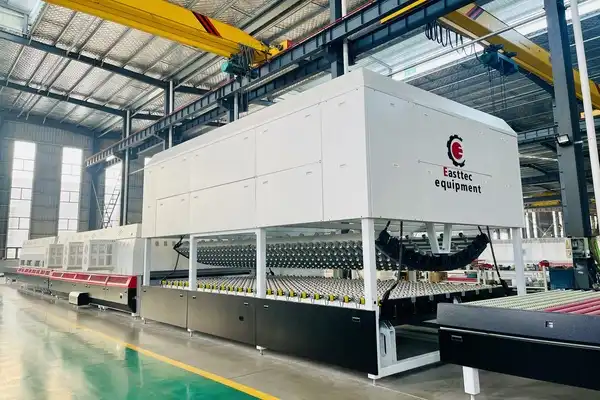
A flexible roller mechanism replaces fixed molds with a multi-point shaft bed that can be adjusted. Through the PLC interface, operators can set specific curvature parameters digitally. This means that during a production run, switching between a 600 mm radius shower enclosure panel and a 1,200 mm radius curtain wall unit doesn't require any physical tooling changes. This makes it easier to make changes quickly and lowers the costs of capital linked to molds. The high-strength, flexible shaft can handle large spans and different curves. This gives modern glass makers the mechanical range they need for unique building projects.
Key Technical Specifications
The Easttec convection curved tempering machine can work with glass that is between 4 mm and 19 mm thick. It can handle artistic interior glass that is lighter and heavy structural safety glass that is thicker. The system can control temperatures to within ±1°C of each other across multiple separate heating zones, and it can work with Low-E glass that has emissivity values as low as 0.01 without the film oxidizing. The Industrial PC (IPC) and PLC control architecture can store and quickly remember complicated bending recipes. This is very helpful when your team is working on several product families at the same time.
Key Applications and Industry Relevance of Curved Glass Tempering Machines
Architectural and Commercial Construction
Curtain walls, building facades, and interior walls made of tempered curved glass must meet EN 12150 and ASTM C1048 standards for the number of fragments and the compressive stress on the surface. The convection heating method evenly distributes stress across large-format glass. This is why architectural processors choose it for high-rise projects that must have both clear vision and strong structure.
Automotive and Specialty Vehicle Glass
Tight bending radius limits are needed for windshields, back windows, and side windows in high-end cars, specialty vehicles, and boats. The adjustable Top Convection Curved Glass Tempering Machine with Flexible Roller can bend glass to a minimum radius of about 450 mm, based on the thickness of the glass. This meets the size requirements of OEM car programs without the optical distortion that comes with gravity bending.
Home Appliance, Furniture, and Solar Glass
There are different ways that oven door panels, refrigerator shelves, tempered tabletops, and photovoltaic cover glass are heated and cooled. On the same production line, these different needs can all be met by a convection system with adjustable multi-zone warmth. Several companies that make utility glass say that switching from radiant-only kilns to forced convection equipment cuts down on cycle times, which directly increases daily output capacity.
Comparing Flexible Roller and Traditional Glass Tempering Solutions
Heating Technology and Energy Consumption
Most of the time, traditional fixed-mold devices only use radiant heat and physical press tools. According to figures from Easttec's own output, a high-pressure convection system heats 30% faster than radiant-only models. The Easttec design's improved insulation and temperature management cut energy loss by 20%. This saves money on power costs every month, which is important because tempering glass uses a lot of energy.
Shaping Versatility and Defect Reduction
Fixed roller and fixed-mold machines need a separate set of tools for each radius. This means that every time you add a new product specification, you have to wait longer and pay more for tools. This is what the main benefits of the flexible roller method are:
- Mold-Free Radius Changes: Digital curvature adjustment via the PLC interface means operators switch between radius profiles in minutes rather than hours, without sourcing new molds.
- Reduced Roller Wave: High-frequency roller synchronization combined with heat-resistant bearing inspection intervals keeps surface optical quality consistent across long production runs.
- Broader Thickness Range: Processing from 4 mm to 19 mm in a single machine eliminates the need for separate equipment lines for thin decorative glass and thick structural panels.
When workers use the PLC to change the digital curve, they can switch between radius profiles in minutes instead of hours, without having to find new molds.
Reliability and Maintenance Trade-Offs
In traditional fixed systems, the mold contact points break down over time. The bendable roller system spreads the contact forces over a larger area, which makes the parts less stressed in certain places. Servo motors that control a Top Convection Curved Glass Tempering Machine with Flexible Roller curvature need to be calibrated on a regular basis, and heat-resistant bearings need to be inspected on a regular basis. However, these are simple jobs that workers can do after getting some basic training. Easttec says that new owners can usually start running their own businesses within a week.
Procurement Guide: Choosing and Buying the Right Convection Curved Glass Tempering Machine
Defining Your Production Requirements
Before calling a curved glass tempering furnace provider, write down the range of glass thicknesses you work with, the largest sheets you can make, the amount of glass you want to temper each day, and the types of coatings you usually use. Low-E glass with very low emissivity values needs equipment that is designed to keep the film from oxidizing when it's heated. Not all convection systems are capable of this.
Evaluating Supplier Credibility and Standards Compliance
CE compliance is the basic requirement for goods that want to be sold in North America and Europe. Easttec machines are fully CE compliant and built to meet international safety standards, which is important for companies that want to bid on foreign contracts with strict requirements. Ask possible sellers to show proof that they are ISO 9001 certified, that they have tempered glass quality certifications like SGCC or EN 12150, and that they can give you references from companies that work with similar types of glass.
Lead Times, Customization, and After-Sales Support
Customized tools are used to make glass tempering furnaces. Delivery takes between 60 and 120 working days, based on how it's set up. Easttec can change power systems to work with 220 V, 380 V, and 415 V at 50 or 60 Hz, as well as other worldwide voltage and frequency standards. You can get the control panel in English, Spanish, Russian, Korean, Portuguese, and other languages. After the sale, experts offer online help 24 hours a day for fixing problems and making the process run more smoothly.
Maintenance, Energy Efficiency, and Safety Features for Optimal Operation
Routine Maintenance for Flexible Roller Components
The two most important upkeep jobs for the bent section are to calibrate the servo motors and check the bearings on a regular basis. Keeping the heat-resistant bearings within the manufacturer's tolerances keeps the radius accuracy below 0.5 mm, which is important for making architectural glass to exact specifications over and over again.
Energy-Saving Design and Thermal Management
The Easttec convection design uses ceramic-grade parts inside that can withstand temperatures up to 1,300°C. This keeps heat from escaping through the structure of the furnace. When combined with smart insulation management, this saves about 20% of the energy used by conventional electric heating systems, a number that grows by a large amount over the course of a year with multiple shifts.
Operator Safety and Compliance
In the IPC control platform, there are safety interlocks, emergency stop systems, and automatic problem diagnostics built in. These safety features keep the workers safe during the high-temperature forming cycle and make sure the machine always meets CE safety standards.
Conclusion
Moving toward forced convection technology with the Top Convection Curved Glass Tempering Machine with Flexible Roller forming that can be adjusted is a direct reaction to what the glass making industry really needs: faster heating cycles for coated glass, lower energy bills, and the ability to make changes without having to keep expensive molds on hand. Easttec's machine can handle thicknesses from 4 mm to 19 mm, heats up 30% faster, and wastes 20% less energy. It all works on a CE-certified base that is backed by experts around the clock. If your facility wants to make high-quality curved glass for the building, auto, or appliance industries, you should give this category of equipment some serious thought.
FAQ
1. How does forced convection heating differ from radiant-only tempering for curved glass?
Forced convection circulates heated air internally using a high-temperature blower, producing more uniform surface temperatures across the full glass sheet. Radiant-only systems create stronger temperature gradients, which increases the risk of optical distortion and breakage, particularly in Low-E coated glass where the coating affects emissivity and heat absorption.
2. Can the bending radius be changed between production runs without changing molds?
Yes. The flexible roller system allows digital radius adjustments through the PLC interface. Operators input the target curvature parameters, and the servo-controlled roller bed repositions accordingly. There is no need to source or store physical molds for different radii.
3. What is the typical minimum bending radius this machine achieves?
Depending on glass thickness, the machine achieves minimum bending radii ranging from approximately 450 mm to 1,000 mm. Thinner glass generally allows tighter radii.
4. What lead time should procurement managers plan for?
Delivery runs from 60 to 120 working days depending on the model and customization scope. Easttec recommends initiating technical discussions and configuration agreement early in your project timeline to avoid delays.
5. What after-sales support does Easttec provide?
Easttec technicians provide 24-hour online support covering installation, commissioning, operator training, and ongoing troubleshooting. On-site commissioning assistance is also available.
Connect with EASTTEC EQUIPMENT for Your Next Curved Glass Tempering Project
Since 1994, EASTTEC EQUIPMENT has been a leader in thermal processing technology for glass. Our Top Convection Curved Glass Tempering Machine with Flexible Roller is designed for makers who want to sell high-yield Low-E curved glass. As a reputable company that makes the Top Convection Curved Glass Tempering Machine with Flexible Roller, we offer full customization, quality that is CE-certified, and technical support 24 hours a day, 7 days a week. Email our sales team at sales@easttecmachine.com to get a full quote or set up a time to see the machine in action.
References
1. Glass Technology: European Journal of Glass Science and Technology — Society of Glass Technology, 2021.
2. Tempering Quality Standards for Architectural Safety Glass: EN 12150-1 — European Committee for Standardization (CEN), 2015.
3. ASTM C1048 Standard Specification for Heat-Strengthened and Fully Tempered Flat Glass — ASTM International, 2018.
4. Energy Consumption Analysis in Industrial Glass Tempering Processes — Journal of Non-Crystalline Solids, Elsevier, 2019.
5. Automotive Glazing: Materials, Technology, and Manufacturing — SAE International, 2020.
6. Low-Emissivity Coatings for Architectural Glass: Performance and Processing Considerations — Progress in Organic Coatings, Elsevier, 2022.

USER EVALUATE
Here is the customer's evaluation of us