




Full Convection Flexible Roller Glass Tempering Machine Improves Uniform Heating for Specialty Glass
When glass manufacturers face rising rejection rates, uneven stress distribution, or coating damage on Low-E glass, the root cause is almost always inconsistent heating. A full convection flexible roller glass tempering machine directly addresses this problem by combining forced-air convection with adjustable roller mechanics. The result is a system capable of processing glass from 4mm to 19mm with temperature control precision of ±1°C, protecting coated surfaces while cutting heating cycles by up to 30%. For factories producing architectural, automotive, or appliance glass, this technology represents a measurable shift in both output quality and operating economics.
Understanding Full Convection Flexible Roller Glass Tempering Technology
What Makes Flexible Rollers Different from Fixed Rollers
In traditional fixed roller systems, the pressure is spread out evenly on a flat surface. This works well for regular flat glass, but it puts stress on curved or covered surfaces in certain places. Flexible roller systems use high-tensile rollers that can be adjusted to fit different bending radii without mechanical force spikes. This directly lowers the stress on the surface, which in turn lowers the distortion and flaws caused by roller waves—an important property for car windshields and curtain wall panels in buildings.
How Full Convection Heating Achieves Temperature Uniformity
Hot air under pressure moves across both sides of the glass sheet at the same time through convection heating. A high-pressure convection system, not a radiant-only system, gets rid of cold spots near the edges of the glass and gets through the thermal barrier that Low-E coatings create. This forced-air method is the only reliable way to get even heat absorption across the whole surface of Low-E glass with an emissivity as low as 0.01. It does not oxidize the coating film.
The Tempering Process: Step by Step
The glass moves on a flexible roller conveyor into the heating chamber, where an IPC and PLC control system starts pre-programmed heating curves. The convection fans move air around at a temperature and pressure that you can control. When the glass hits the desired softening point, it moves to the bending area, where rollers that can be adjusted make the radius that was given. Right after, there is rapid quenching, which locks in the compressive stress across the surface and meets the safety fragment density standards set by EN12150 and SGCC.
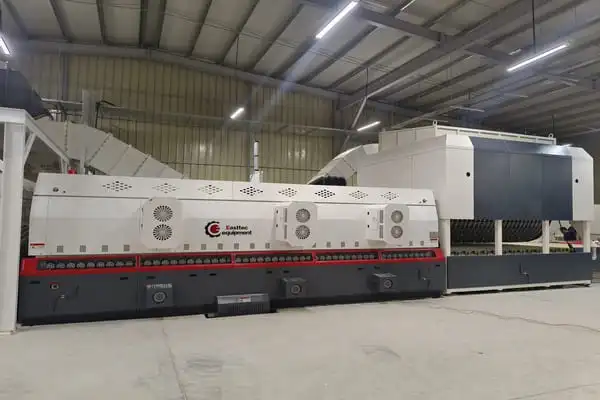
Advantages of Full Convection Flexible Roller Glass Tempering Machines Over Traditional Machines
A lot of factories still use radiant-only or fixed-roller furnaces that were built more than ten years ago. The difference in performance between those old systems and new Full Convection Flexible Roller Glass Tempering Machines is now much bigger. Here are the main reasons why this technology is better than other options:
- Low-E Coating Protection: The improved top-convection method gets through the thermal resistance of coated glass surfaces without exposing the films directly to radiation, which would break down the film. This can't be done with just regular radiant heating.
- 30% Faster Heating Cycles: Independent tests and production data from various plants show that high-pressure convection models reduce heating cycles by about 30% compared to radiant-only models, which directly increases daily furnace capacity.
- 20% Lower Heat Loss: High-density composite insulation cuts heat loss by 20%, which lowers the amount of energy used each month and the amount of carbon dioxide released during each work shift.
- Flexible Bending Range: The flexible roller system can handle large span curves and a range of bending radii, usually from 450mm up to 1200mm depending on the thickness of the glass, without the need to change the mold itself.
- CE Certification: Full compliance with CE standards proves the machine meets international quality and safety standards, which helps it get into international bids with strict requirements.
Because of these benefits, there is less waste, less energy use, and a wider range of products that can be made. Companies that make Low-E architectural glass or specialty curved glass for commercial projects say that customer rejections have gone down a lot since they switched to convection-based tempering systems.
How to Choose the Right Full Convection Flexible Roller Glass Tempering Machine for Your Factory
Choosing Full Convection Flexible Roller Glass Tempering Machines is a big investment that usually takes three to twelve months and involves a lot of technical checks. The factors for selection should match your production mix, glass needs, and long-term goals for capacity.
Glass Thickness and Product Range Compatibility
Make sure the machine can handle all of your thicknesses. Most needs for architectural, appliance, and furniture glass can be met by a reliable processing window of 4mm to 19mm. This range can't be changed if your plant makes both artistic thin glass and heavy-duty structural panels.
Energy Efficiency and Operating Cost Modeling
Ask sources for detailed information on how much energy you use. Over the course of 24 months, the energy costs of a machine with better insulation and convection technology that cuts heat loss by 20% will be different. This should be included in your ROI estimate, along with changes in output amount and scrap rate.
Control System Capability and Operator Training
The IPC and PLC link should allow for safe data storage, quick recipe recall for complicated bending parameters, and options in more than one language. Systems that are meant to be easy to use allow new operators to become proficient within one week, which is a reasonable goal for companies that have to deal with high staff turnover.
Enhancing Efficiency and Uniform Heating: Operational Tips and Best Practices
Temperature Control and Conveyor Speed Calibration
The right mix between the speed of the conveyor and the temperature of the room is needed for uniform heating. If you run the conveyor too fast, the dwell time goes down and under-tempered zones form. When thermocouples are put at the edges of the glass as part of regular PID zone calibration, drift is caught before it affects the quality of the product.
Maintenance Priorities That Prevent Downtime
The two most important maintenance tasks are calibrating the servo motor on the bending section and checking the heat-resistant bearings. High-grade roller sleeves in flexible roller systems need to be checked for wear that could leave surface marks every so often. By scheduling these checks for planned repair windows, work won't have to stop without warning.
Energy Management During Off-Peak Hours
High-density polymer insulation does a good job of keeping the heater at the right temperature during short breaks in production. Instead of a full cool-down cycle, programming the control system to drop to a standby temperature state between production batches saves energy and increases the life of the heating element.
Procurement and After-Sales Support for Full Convection Flexible Roller Glass Tempering Machines
What to Expect from a Qualified Supplier
A reliable Full Convection Flexible Roller Glass Tempering Machine supplier should give you proof of CE certification, production references that you can check, and a clear delivery schedule. Delivery times for special tempering ovens range from 60 to 120 working days, based on how they are set up. Suppliers should also make sure that their products work with the power grid in your area, whether it's 220V, 380V, or 415V at 50Hz or 60Hz.
Customization Options That Affect Production Fit
At the order stage, you can choose the color of the equipment, the language of the software, the parameters for the heating curve, and the configuration for cooling. Suppliers who can really do ODM/OEM will follow a structured process, which includes an initial inquiry, project design, agreement, production, installation, commissioning, and training for operators. This whole process cuts down on integration risk and speeds up the time it takes to reach full production capacity.
Long-Term Technical Support and Warranty
Quality of after-sales help is what separates investments in equipment that pay off from those that cause long-term costs. Look for providers that offer online technical help 24 hours a day, 7 days a week, as well as written training programs that will teach your maintenance team how to handle common problems on their own. A supplier's long-term commitment to uptime can be seen in how easy it is to get spare parts and do troubleshooting from a distance.
Conclusion
To work with special kinds of glass, like Low-E architectural panels, curved car glass, or precise gadget parts, you need heating technology that can give consistent, manageable results on a large scale. Forced convection airflow and flexible roller mechanics fix the main problems with older radiant systems, which are cold edge zones, coating damage, and visual distortion. This type of full convection flexible roller glass tempering machine has a processing range of 4mm to 19mm, 30% faster heating cycles, 20% less heat loss, and full CE compliance. It gives factories that are serious about quality and cost control a real return on their investment.
FAQ
1. What glass types can this machine process?
The Full Convection Flexible Roller Glass Tempering Machine can work with flat and curved glass that is between 4mm and 19mm thick. It can handle clear glass, Low-E coated glass, layered glass substrates, and special device glass panels.
2. How does forced convection protect Low-E coatings?
The top-convection device moves hot air across the surface of the glass to keep it from getting direct sunlight, which can damage films. For even heat uptake, this works on glass with an emissivity as low as 0.01.
3. Can bending radii be changed without changing molds?
Yes. The PLC interface lets the flexible roller system change the curvature digitally. This lets the production go quickly from one radius to another without having to change the molds.
4. What certifications does this equipment carry?
The machine has full CE certification, which means it meets all the international safety and efficiency standards needed for business, architectural, and export-oriented production.
5. How long does installation and commissioning take?
Installation and commissioning times depend on how the factory is set up, but suppliers with dedicated technical teams usually get the job done quickly, and within a week of commissioning, operators are trained.
Partner with EASTTEC EQUIPMENT for Your Next Tempering Furnace Investment
EASTTEC EQUIPMENT has been making heat processing tools for glass since 1994. They use Italian convection technology and have more than thirty years of experience making them. For sale is a Full Convection Flexible Roller Glass Tempering Machine that can handle glass thicknesses from 4 mm to 19 mm. It has 30% faster heating cycles and comes with full CE approval and expert support 24 hours a day, 7 days a week. Please email our expert team at sales@easttecmachine.com to ask for a production assessment, equipment specs, or a quote that is specifically made for your factory's needs.
References
1. Glass Technology Europe — Thermal Processing of Coated and Specialty Glass, 2022
2. International Journal of Applied Glass Science — Convection Heating Uniformity in Industrial Tempering Furnaces, 2021
3. Glass Processing Days Conference Proceedings — Flexible Roller Bending Systems and Optical Quality in Curved Glass, 2019
4. ASTM International — Standard Specification for Heat-Treated Flat Glass (ASTM C1048), 2020
5. European Committee for Standardization — EN 12150-1: Thermally Toughened Soda Lime Silicate Safety Glass, 2015
6. Construction Specifier Magazine — Energy Performance and Glass Selection in High-Performance Curtain Wall Systems, 2023

USER EVALUATE
Here is the customer's evaluation of us