

Radiation Tempering Technology Ensures Stable Glass Shape Accuracy
When glass shape accuracy becomes non-negotiable, the heating method you choose defines everything. The Radiation Precision Hard Roller Flat & Bent Glass Tempering Line from EASTTEC EQUIPMENT addresses one of the most persistent challenges in industrial glass processing: achieving stable, distortion-free shapes across both flat and curved products. By combining matrix radiant heating with precision hard-roller drive technology, this system delivers measurable improvements in optical clarity, arc uniformity, and dimensional consistency — qualities that conventional tempering equipment routinely struggles to maintain.
Understanding Radiation Tempering Technology and Its Impact on Glass Shape Accuracy
Learning about radiation tempering technology and how it affects the accuracy of glass shapes.
How Infrared Radiation Heating Works Differently?
Glass is heated in traditional kilns that use a lot of convection to move hot air around. Uneven boundary-layer temperatures are the issue. These create localized thermal stress, which is a main reason for optical distortion and rolling wave flaws. Radiation-based heating moves heat straight through high-density infrared elements, which makes the temperature spread faster and more evenly across the surface. In real life, this means that there are fewer stress points during the softening phase. This makes it less likely that flat panels and curved glass shapes will bend.
The Role of Hard Rollers in Dimensional Stability
When heat and load are put on soft rollers, they bend, causing tiny changes that add up to a bow or wave in the finished product. High-purity fused silica rollers with very low thermal expansion coefficients (about 0.6 × 10⁻⁶/°C) are used in EASTTEC's tempering line's hard-roller system. It is very important for architecture curtain wall panels, car side-lites, and appliance glass parts where assembly tolerances are tight that these rollers keep their sub-millimeter positioning accuracy during continuous production cycles.
The heater is split into separate temperature zones by the matrix radiant heating system. Each zone is controlled by its own PID processor. This zoned thermal design accounts for the cooling effects at the edges of the glass and differences in thickness, making sure that the whole sheet gets the right softening temperature before it is pressed, which is necessary for good bending results.
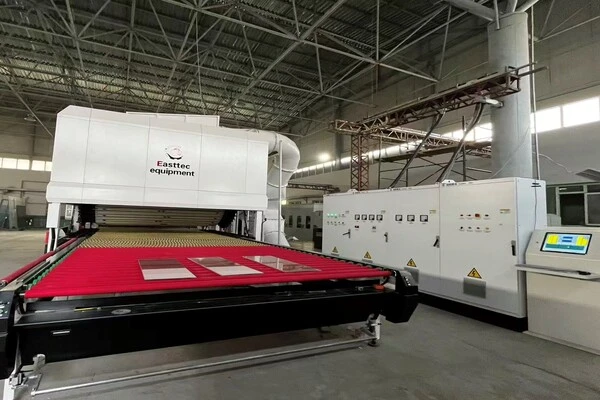
Core Technical Advantages of the Hard-Roller Tempering System
This line, the Radiation Precision Hard Roller Flat & Bent Glass Tempering Line, can work with glass that is 3mm to 19mm thick and can handle both flat and bent shapes. The normal area for flat hardening is 2440 x 3660 mm, and the area just for bending is 2440 x 1500 mm. The minimum bent radius that can be reached is R ≥ 500mm, which meets most requirements for glass used in cars, furniture, and appliances.
Here are the core performance attributes that set this equipment apart from conventional alternatives:
- Arc deviation controlled within 1.5mm: The arc deviation is kept within 1.5 mm, and the hard-roller pressing station uses synchronized mechanical transfer to make sure that every curved panel fits together perfectly. This gets rid of the fitment gaps that cause more work to be done on installation and more guarantee claims.
- Elimination of ghosting and image distortion: Precision-ground roller surfaces and even radiant heat get rid of the optical flaws that keep glass out of high-end furniture showrooms and auto OEM supply chains. Quality-wise, the surface meets both EN 12150 and ASTM C1048 standards.
- Heavy-duty alloy steel drive construction: The hard-axis drive system is made from high-temperature-resistant alloy steel and is designed to work continuously in industrial settings. Compared to soft-roller alternatives, maintenance intervals are much longer, which lowers both the cost of parts and unplanned downtime.
- IPC recipe-based changeover: The PC control station that is built into the machine saves output recipes for various glass thicknesses, radii, and heating curves. It usually takes 20–40 minutes to switch between orders, which cuts down on setup waste during varied production runs.
These benefits directly lead to higher yield rates, lower rework costs, and a more stable production schedule. These are hugely important results for production managers who have to balance daily output goals.
Comparing This Approach With Conventional Tempering Solutions
Standard electric convection lines and gas-fired heaters have been used in the industry for decades, but they have their flaws when precise shape control is needed. When you use gas systems, the burning changes, which makes it hard to adjust the temperature in each zone. Electric kilns that use convection work well for flat, standard-thickness glass, but the quality drops when working with thin glass (less than 5 mm) or complicated, bent shapes.
The Radiation Precision Hard Roller Flat & Bent Glass Tempering Line mix meets both requirements at the same time. It uses less energy because infrared elements react to changes in temperature more quickly than thermal mass-heavy convection chambers. This cuts down on cycle time and heating losses that happen when the machine is not in use. EASTTEC's design philosophy aims to save about one-third of the energy used by traditional tempering furnaces. This is a big number when you think about how long the equipment will last.
Total cost of ownership (TCO) for a precision radiant tempering line is lower TCO due to lower cullet rates, lower maintenance costs, and the ability to serve higher-margin product categories like automotive OEM glass and solar panel substrates.
Procurement Guide: Selecting the Right Radiant Tempering Line for Your Facility
Choosing a glass tempering furnace supplier involves evaluating far more than the equipment specification sheet. Here are the factors that experienced procurement managers prioritize when assessing a Radiation Precision Hard Roller Flat & Bent Glass Tempering Line supplier:
- Customization depth: EASTTEC supports adapting the power system to global voltage and frequency standards (220V, 380V, 415V, 50/60Hz), creating custom heating curves, and having control screens in English, Spanish, Russian, Korean, and Portuguese, among other languages. In the U.S. market, where power infrastructure changes from facility to facility, this is important.
- Turnkey service scope: The collaboration process includes initial questions, project design, production manufacturing, installation and commissioning, training for operators, and ongoing service after the sale. Usually, it takes new workers one week to become proficient in their duties.
- Delivery timeline: Because this is customized capital equipment, shipping takes between 60 and 120 working days, based on how it is set up. Take this into account when planning the project schedule during the procurement planning phase.
- Technical credibility: EASTTEC's engineering team has more than 30 years of experience working with glass. The business has been around since 1994 and uses European (Italian) standard quality management practices in all of its production.
Verifying supplier credibility through factory visits and equipment demonstrations remains standard practice for capital purchases at this scale. Potential customers are welcome to visit EASTTEC's training and production sites.
Real-World Application: Where This Technology Delivers Measurable Results?
Architectural glazing workers who work with big curtain wall panels say that using multi-zone radiant heating cuts down on local bow, which is the slight waviness that makes building facades reflect light unevenly. Auto glass makers who use the bent glass feature say that the R ≥ 500mm radius accuracy is a key part of getting first-time fit rates on aerodynamic frame shapes. Solar glass makers like the radiation method because it can work with anti-reflective coated surfaces without damaging sensitive chemical coatings, which is known to be a problem with high-velocity convection systems.
The main idea that runs through all of these examples is that shape accuracy directly affects how well the next steps are put together and how good the final result is. Controlling arc deviation within 1.5 mm and surface undulation within 0.05 mm is not a luxury item; it is a production necessity for companies that want to compete in markets that are driven by specifications.
Conclusion
Precision hard-roller mechanics and radiation tempering technology work together to solve the problem of shape accuracy that has kept traditional glass tempering methods from reaching their quality peak. The Radiation Precision Hard Roller Flat & Bent Glass Tempering Line has heavy-duty metal construction, zoned temperature control, and IPC-driven process management all in one platform that can be set up in different ways. The technical base of this equipment supports consistent, certified output quality whether your facility works with architectural flat glass, curved automotive panels, or appliance parts. This system is a good long-term investment for manufacturers who want to lower the number of defects they make and make their business more competitive.
FAQ
What glass types is this tempering line compatible with?
Glass that is flat or bent, clear, patterned, or covered can all be processed by the Radiation Precision Hard Roller Flat & Bent Glass Tempering Line. It can support thicknesses between 3 mm and 19 mm. The flat tempering area can handle big architectural panels up to 2440x3660mm, and the bending area can handle curved profiles with a minimum radius of R ≥ 500mm, which makes it good for glass in cars, appliances, and furniture.
How does the radiation heating method contribute to energy savings?
When the temperature changes, infrared heating elements respond faster than thermally dense convection chambers. This means that less energy is used when production is changing. EASTTEC's furnace design aims to save about one-third of the energy used by traditional configurations. This will lower the equipment's operating costs over its lifetime.
What is the typical delivery timeline and warranty arrangement?
Deliveries take anywhere from 60 to 120 business days, depending on the exact design that was bought. EASTTEC offers full package support, which includes installation, setup, and training for operators. We agree on warranty terms and promises for service after the sale during the project agreement stage of the collaboration process.
How long do the ceramic rollers last under normal production conditions?
If you keep your high-purity fused silica rollers in good shape and protect them from breaking glass in the furnace, they should last longer than 10 years.
Request a Custom Quote From EASTTEC EQUIPMENT Today
EASTTEC EQUIPMENT has supported glass manufacturers worldwide since 1994, delivering engineered solutions built on European quality standards and 30-plus years of thermal processing expertise. If your facility is evaluating a Radiation Precision Hard Roller Flat & Bent Glass Tempering Line supplier, our team is ready to assess your production requirements, recommend the right configuration, and walk you through a full turnkey proposal. Contact us directly at sales@easttecmachine.com to request a detailed quote or schedule a factory demonstration.
References
1. Glass Technology International — Advances in Radiant Heating Systems for Flat Glass Tempering, 2021.
2. Journal of Non-Crystalline Solids — Thermal Stress Distribution in Tempered Glass Panels Under Controlled Heating Regimes, 2020.
3. ASTM International — Standard Specification for Heat-Treated Flat Glass (ASTM C1048), 2018.
4. European Committee for Standardization — EN 12150-1: Thermally Toughened Soda Lime Silicate Safety Glass, 2015.
5. Glass Worldwide Magazine — Hard Roller vs. Soft Roller Tempering: A Comparative Performance Analysis, 2022.
6. Building and Environment — Optical and Structural Performance of Tempered Glass in Curtain Wall Applications, 2019.