




Produce Premium Curved Low-E Glass with Forced Convection Technology
Producing premium curved Low-E glass demands more than a standard tempering furnace. The thermal reflectivity of Low-E coatings creates serious challenges for conventional radiant heating systems, often resulting in uneven softening, coating oxidation, and inconsistent arc geometry. A Forced Convection Curved Glass Toughening Machine with Hard Roller directly addresses these pain points by circulating high-pressure heated air across the glass surface, achieving uniform temperature distribution regardless of coating emissivity. Easttec's purpose-built convection bending furnace pairs this technology with rigid hard-roller pressing to deliver arc deviation within ±1.0mm — a benchmark that architectural and appliance glass processors can rely on every production shift.
Understanding Forced Convection Technology in Curved Glass Toughening
Infrared radiation is the main way that traditional radiant furnaces heat glass. When that glass has a high-performance Low-E coating with an emissivity as low as 0.01, the coating bounces back most of that radiation, so the glass never hits a place where it starts to soften. This wastes energy, makes cycle times longer, and makes breakage rates hard to predict.
Forced convection gets rid of this problem by sending hot air through precise tubes that are placed above the glass. The thermal energy gets to the glass even if it is mirrored because heat movement changes from radiation to convection. The variable-frequency high-pressure top convection system from Easttec keeps the thermal field stable across the whole pane. This is why heating processes are over 30% faster than with regular radiant models.
Why Heating Uniformity Defines Curved Glass Quality?
When bending glass, if the difference in temperature across a pane goes over a certain point, the glass either doesn't soften enough at the edges or too much in the middle. Both of these situations cause geometric distortion that doesn't meet the standards for architecture. Easttec's convection system keeps the temperature uniformity high enough to allow the safe processing of glass widths from 3 mm to 19 mm, which includes all types of building lites and appliance panels.
The Role of Hard Rollers in Curved G
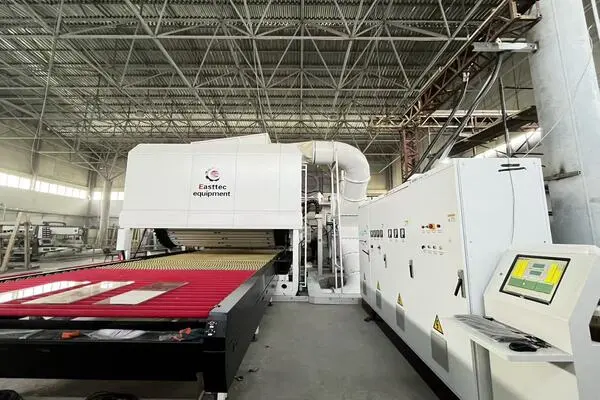
lass Toughening
To get a consistent arc during the bending phase, you have to use precise mechanical force over and over again. In this case, hard rollers are the most important part. In contrast to soft rollers or air-float systems, rigid hard rollers keep the same shape of touch with the glass surface throughout the pressing cycle. This means that they don't change shape when heated to bending temperatures.
Easttec's horizontal hard-roller bending system, part of the Forced Convection Curved Glass Toughening Machine with Hard Roller, uses heat-resistant alloy rollers that were made to work at high temperatures for a long time inside the furnace chamber. Because the wheels don't bend when they're under load, the arc shape stays the same from the first piece to the thousandth. This mechanical stability keeps arc deviation to within 1.0 mm, which meets the strict requirements for curtain wall systems, appliance door panels, and automobile glass.
Maintenance Practices That Protect Roller Performance
Roller surface state has a direct effect on the quality of the glass surface. When residue builds up on roller surfaces, it can leave marks on the glass and change how the contact pressure is distributed. A strict maintenance plan that includes checking the surface on a regular basis, cleaning it in controlled cycles, and replacing the rollers at the right time, before they wear out and cause measurable runout, protects yield rates and extends the life of the machine. Easttec's machines are designed so that rollers can be accessed without taking the whole machine apart. This makes maintenance much faster and easier.
Choosing the Right Curved Glass Toughening Equipment for Your Operation
There isn't a single convection folding heater on the market that works as well as the others. When buying expensive tools like this, the choices you make have effects that get worse over time. Before committing, you should carefully look over a number of technical and operational factors.
Here are the core capabilities that distinguish Easttec's convection bending furnace from standard alternatives:
- Coating Compatibility: The variable-frequency convection system works best with Low-E glass that has an emissivity of as little as 0.01. This keeps the film from oxidizing and makes sure that the glass body absorbs heat evenly.
- Production Efficiency: Heating processes that are over 30% faster than radiant models mean that the plant can make more things every day and spend less on energy per unit.
- Geometric Precision: A uniform convection heat field and stiff hard-roller pressing keep the arc variation to within 1.0 mm, which meets strict standards for architecture and appliances.
- Digital Recipe Management: The Industrial PC (IPC) control system already has specific settings for different types of Low-E coatings. This means that operators can call up tried-and-true recipes instead of having to re-calibrate by hand for each batch.
- Energy Efficiency: Using inverter-controlled convection fans and high-density composite insulation together cuts thermal energy loss by 20%, which lowers operating costs over the life of the equipment.
- CE Compliance: Every Easttec convection oven complies with strict CE safety and quality standards. This gives processors working on foreign building projects a solid base.
These benefits of the Forced Convection Curved Glass Toughening Machine with Hard Roller directly solve the production problems that companies that make building glass, process glass for appliances, and offer deep-processing services face every day. Cutting down on scrap on pricey Low-E covered glass can pay for a lot of the equipment's cost back in the first year of use.
The Curved Low-E Glass Production Process: From Loading to Inspection
A reliable production cycle starts a long time before the glass goes into the furnace. When you load something correctly and prepare the surface, you stop mechanical stress from building up in places where it could break when it gets hot. Once the glass is loaded, the IPC system follows the pre-programmed heating curve, which raises and lowers the furnace temperature based on the thickness of the glass and the coating requirements.
The high-pressure top convection system keeps the temperature even across the pane surface as the glass gets closer to the breaking temperature. This gets around the Low-E coating's reflected barrier. When the material softens to the right point, the hard-roller bending mechanism uses controlled pressing force to get the circle shape that you want. Within the IPC recipe system, the user can change the airflow speed and roller pressure settings to meet the needs of each product without having to guess.
The same level of accuracy is used for post-bending cooling. Controlled quench air distribution makes sure that the glass gets the right surface compression profile for safety glass approval, and the patterns of fragmentation meet CE safety standards. Once each piece has cooled, it is inspected for size and quality. Before the glass moves on to the next step in the process, it goes through a normal quality check that includes measuring the arc deviation, checking the surface stress, and looking for roller lines.
Procurement Considerations for Convection Bending Furnace Investment
Buying a convection bending furnace is a long-term investment of money. Easttec's production and shipping time ranges from 60 to 120 working days, based on the configuration. This means that planning for purchases needs to start a long time before production goals. You can get custom setups, such as adapting the power system to world voltage standards like 380V/50Hz or 415V/60Hz, so that it works with the infrastructure of any building.
Support after the sale is just as important as the purchase decision. Easttec's technical team offers online support 24 hours a day, 7 days a week, as well as on-site installation and commissioning help and operator training programs that are meant to get new employees up to speed on production within a week. The IPC's interface can be used in English, Spanish, Russian, Portuguese, and other languages. This makes it easier to work in working settings with people from other countries.
Conclusion
To make bent Low-E glass on a large scale, you need equipment like the Forced Convection Curved Glass Toughening Machine with Hard Roller that is designed to handle the high-performance coatings' temperature and mechanical needs. Easttec's forced convection bending furnace has a hard-roller bending device that has been tested and proven to work. It has 30% faster working cycles, 20% less heat energy loss, and an arc deviation of less than 1 mm. This mix of accuracy, speed, and dependability gives glass makers fighting on quality and volume in the architectural, appliance, and specialty glass markets a real production edge.
FAQ
What makes forced convection necessary for Low-E glass bending?
Because low-E coatings reflect infrared radiation, regular radiant furnaces can't heat the glass evenly. Forced convection gets around this problem by moving heat around through the air, which makes sure that the temperature is the same everyplace, even if the coating is reflective.
What glass thickness range does Easttec's convection bending furnace support?
The machine can safely work with glass thicknesses ranging from 3 mm to 19 mm, so it can handle thin architectural lites, normal appliance panels, and heavier structural glass jobs.
How precise is the arc geometry on the finished glass?
Uniform convection heating and stiff hard-roller pressing keep the arc deviation to within 1.0 mm, which is fine for curtain wall systems and high-end product glass that needs to meet strict standards.
Does the IPC system require specialized operator training?
It comes with Low-E covering settings and a multilingual interface already set up. With Easttec's training program, new operators can become fully proficient in production in about a week.
Is CE certification standard on all Easttec furnaces?
Yes. Each Easttec convection furnace is made in accordance with CE safety and quality standards. This helps processors who are bidding on international building and architecture projects.
Request a Custom Quote from EASTTEC EQUIPMENT
Since 1994, EASTTEC EQUIPMENT has been improving heat processing technology for glass. Our Forced Convection Curved Glass Toughening Machine with Hard Roller is the current standard for making Low-E bent glass. We make every furnace to fit your voltage, capacity, and process needs as a reliable Forced Convection Curved Glass Toughening Machine with Hard Roller manufacturer. Email our expert team at sales@easttecmachine.com to get a personalized estimate and learn how Easttec can increase the output and profits of your production line.
References
1. Glass Technology: European Journal of Glass Science and Technology Part A — Society of Glass Technology, 2021.
2. Advances in Glass Manufacturing Technology — Springer, 2019.
3. Energy Efficiency in Industrial Thermal Processing Equipment — U.S. Department of Energy, Office of Industrial Technologies, 2020.
4. Architectural Glass: Design and Applications — Wiley, 2018.
5. CE Marking for Machinery and Industrial Equipment: A Practical Guide — British Standards Institution (BSI), 2022.
6. Low-Emissivity Coatings: Performance, Durability, and Processing Challenges — Journal of Non-Crystalline Solids, Elsevier, 2020.

USER EVALUATE
Here is the customer's evaluation of us