




Radiation Flexible Roller Glass Bending and Tempering Machine Improves Curved Glass Production Efficiency
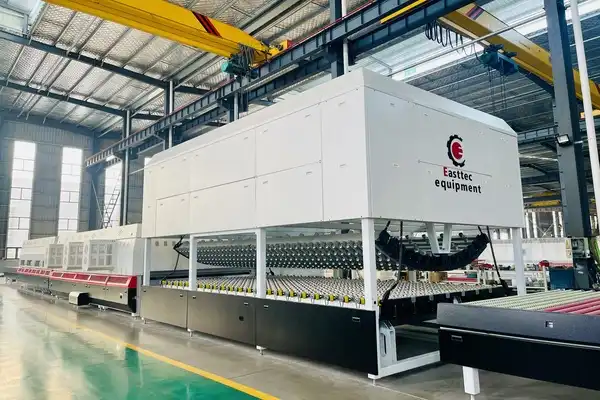
A Radiation Flexible Roller Glass Bending and Tempering Machine is an advanced thermal processing system that heats flat glass to its softening point through high-efficiency radiant energy, then shapes it using an adjustable multi-point flexible roller bed. Unlike fixed-mold gravity bending, this approach eliminates costly tooling changes and reduces optical distortion common in conventional methods. Easttec's version of this technology handles glass from 5mm to 19mm thickness, integrates multi-zone PID thermal control, and delivers consistent tempering stress across both flat and curved profiles — making it a practical choice for architectural, furniture, and specialty glass producers.
Understanding Radiation Flexible Roller Glass Bending and Tempering Machines
What Sets This Technology Apart from Traditional Bending Methods
Usually, rigid molds and convection-heavy ovens are used for gravity bending. This leads to surface marking, uneven heat distribution, and long cycles where tools need to be changed. A PLC-controlled motor moves each roller point physically in a flexible roller bending system. This lets the curve change without having to physically swap molds. Research published in the journal Glass Technology: European Journal of Glass Science and Technology says that differences in thermal uniformity above ±5°C during the bending phase directly raise the chances of residual stress concentrations and visual distortion in tempered curved glass. This difference is kept within ±2°C by Easttec's multi-zone matrix radiant heating.
Core Application Areas in the Glass Industry
This kind of machine does a good job in three main areas of production. High-end architectural curtain wall builders need panels that are round or have more than one radius and don't block the view of light in any way. Manufacturers of commercial refrigerators make curved display case panels that have to pass safety fragment tests according to EN 12150-1. These tests require at least 40 pieces per 50x50mm area. Specialty glass makers for boats and cars need to be able to make complicated curves while still keeping the purity of the layered interlayers. The machine has to meet different needs in each of these areas, and the flexible roller design can do it all without needing separate lines of equipment.
Why Flat-and-Bent Hybrid Processing Matters
Many glass processing plants have different lines for making flat and curved glass. This takes up more floor space, requires more workers, and costs more money. Easttec's Radiation Flexible Roller Glass Bending and Tempering Machine uses one hybrid tempering system to handle both flat and bent glass tempering. The IPC interface lets production managers switch between flat and curved processing by calling up saved recipes. This process only takes minutes instead of hours. This design directly addresses one of the most common production challenges faced by mid-sized to large glass fabrication facilities.
Performance Optimization: Boosting Curved Glass Production Efficiency
Reducing Cycle Time Through Zoned Radiant Heating
One of the biggest problems with making bent glass is that it doesn't always absorb heat evenly before the bending phase starts. There are cold spots in the glass that need more time to heat up, which slows down the process. Before any mechanical bending starts, Easttec's multi-zone matrix radiant heating spreads heat over the whole surface of the glass. Each heated zone has its own PID control, which means that changes are made automatically and in real time. This accuracy cuts down on the total cycle time needed for each batch and makes the stress distribution during tempering more even across the finished piece.
Automation Architecture and Recipe Management
These are the main control factors that make output repeatable:
- Industrial PC (IPC) & PLC Interface: The system operates on a stable IPC and PLC architecture rather than consumer-grade touchscreens, ensuring 24/7 operational reliability. Operators store hundreds of production recipes and recall them instantly, cutting changeover time between product runs to under five minutes.
- High-Strength Flexible Roller Mechanism: The adjustable roller bed achieves arc precision with superior surface quality. The PLC automatically repositions each roller point to match the target radius, reducing manual adjustment errors that cause surface defects like roller waves or vent marking.
- 20% Thermal Energy Savings: High-density composite insulation reduces furnace heat dissipation by 20% compared to conventional models. This thermal retention maintains a stable furnace environment and lowers energy consumption per production cycle.
All of these features work together to solve the production problems that lead to lower yields and schedule delays in curved glass facilities. When factories use this much automation, the cost of energy per unit and the number of mistakes made by operators go down.
Verified Production Gains in Real Processing Environments
Glass processing plants that use flexible roller bending furnaces regularly report two improvements that can be measured: less breaking during the bending phase and faster switching between curvature specs. When physical mold changes aren't needed, which can take two to four hours in a normal setting, more output hours are available per shift. With better insulation that cuts heat loss by 20%, this type of equipment has a good long-term running cost profile that supports a good return on investment for medium- to large manufacturing operations.
Comparing Radiation Flexible Roller Machines with Alternative Solutions
Radiation Bending vs. Vacuum Bending Technology
When vacuum bending, negative pressure is used to push glass against a shaped mold. This method works well for large batches with a single set radius, but a new mold has to be made for each different curvature standard. Radiation flexible roller systems don't need a real mold, which makes them cheaper for places that do custom building orders or small batches of specialty work. Different systems need different kinds of maintenance. Vacuum systems have wearable parts like pump units, sealing parts, and mold surfaces that get damaged when the temperature changes. On the other hand, flexible roller systems need regular bearing inspections and roller sleeve replacements.
Traditional Tempering Ovens vs. Hybrid Flexible Roller Furnaces
Flat tempering ovens that are used by most people can't bend glass. When a business starts selling curved glass, it needs to either buy a separate bending line or replace the equipment that it already has. It is much more cost-effective and easier to run a hybrid flexible roller burner because it can do both jobs in a single space. The Easttec system can work with clear float, tinted, and patterned glass from 5 mm to 19 mm thick, which means it can meet most architectural and furniture glass requirements without having to change any of the equipment.
Evaluating Suppliers for B2B Procurement
When procurement managers look for a curved glass tempering Radiation Flexible Roller Glass Bending and Tempering Machine supplier, they should check whether the supplier is CE-certified, make sure the machine is compatible with their required glass thickness range, and evaluate the supplier's after-sales service. Easttec is CE-certified, provides 24-hour online technical support, and supports voltage standards used worldwide, including 220V, 380V, and 415V at both 50Hz and 60Hz. For each order, customers can choose the equipment color, heating curve settings, and program language. Available languages include English, Spanish, Russian, Korean, and Portuguese.
Maintenance, Safety, and Operational Best Practices
Routine Maintenance Protocols for Long Equipment Life
Regular maintenance directly affects how long the furnace works and how good the glass surface is. A structured schedule should include checking the high-temperature roller bearings and Kevlar/aramid roller sleeves once a week, calibrating the PID controller for each heating zone once a month against a reference thermometer, and checking the insulation panels' integrity on a regular basis to make sure the 20% heat retention benefit lasts. Because new operators can learn how to use and fix Easttec equipment in just one week, businesses with a lot of staff changes can keep up production without having to spend a lot of time teaching new workers.
Safety Mechanisms and Compliance Standards
The IPC and PLC architecture of the machine has automatic fault detection that stops work cycles before temperatures or mechanical conditions become unsafe. When a system gets CE certification, it means it meets European safety and electromagnetic compatibility standards. These standards are generally seen as a measure of quality by buyers around the world. The performance of glass fragments is checked against EN 12150-1, and differential stress refractometers are used to measure the surface stress levels and make sure they meet the requirements for compression surface stress.
Troubleshooting Variable Glass Thickness Scenarios
When working with glass that is very close to or far away from the 5mm–19mm range of compatibility, you need to use different heating curve shapes and roller pressure settings. Process engineers can set and remember the best settings for each thickness group with the IPC recipe storage system. When the surface bow or geometric departure from the CAD profile is more than the accepted 1mm–2mm range, the PLC records the deviation and marks the batch for review. This makes it easier to find mistakes and gives technical directors clear data they can use to make changes to the process.
Conclusion
The Radiation Flexible Roller Glass Bending and Tempering Machine solves real production problems: it reduces downtime for mold changes, heats glass evenly, uses 20% less energy, and handles both flat and curved glass in one machine. If architectural glass manufacturers, furniture glass producers, and specialty glass processors want to produce curved glass without doubling their equipment footprint, this technology can help improve production efficiency. With a CE-certified system, 30 years of glass-processing experience, and technical support available 24 hours a day, 7 days a week, Easttec is a provider that procurement teams can rely on.
FAQ
1. How long does it take to change between different bending radii?
The automated flexible roller system adjusts to a new target radius in approximately 1–5 minutes through the PLC interface. This is a significant time advantage over manual mold-change setups, which typically require 2–4 hours of downtime per changeover.
2. Can this machine process Low-E coated glass?
Easttec's system is optimized for clear float, tinted, and patterned non-coated glass. Processing Low-E glass may require supplementary top-convection assistance to account for the coating's reflective properties. Contact Easttec's technical team to confirm compatibility with your specific glass specifications.
3. What glass thicknesses does the Easttec flexible roller furnace handle?
The machine processes both flat and bent glass within a 5mm to 19mm thickness range, covering the majority of architectural, furniture, and specialty glass applications.
4. What maintenance do the flexible rollers require?
High-temperature bearings and roller sleeves require weekly visual inspection and periodic replacement. The predictable maintenance schedule means facilities can plan parts procurement without unexpected downtime disruptions.
5. Is the equipment customizable for different power systems?
Yes. Easttec configures equipment for global industrial voltage and frequency standards, including 220V, 380V, and 415V at 50Hz or 60Hz, with software available in multiple languages.
Request a Quote from EASTTEC EQUIPMENT for Your Curved Glass Line
Since 1994, EASTTEC EQUIPMENT has helped glass producers by mixing the highest standards of Italian convection technology with a lot of flexibility for customers from all over the world. Get in touch with our tech team if you are looking for a Radiation Flexible Roller Glass Bending and Tempering Machine maker for your business. With every order, we provide full installation, setup, and training for the user. Email us at sales@easttecmachine.com to talk about your production needs and get a quote for the right tools.
References
1. Glass Technology: European Journal of Glass Science and Technology — Part A, Society of Glass Technology, 2021.
2. ASTM C1048 Standard Specification for Heat-Strengthened and Fully Tempered Flat Glass — ASTM International, 2018.
3. EN 12150-1: Glass in Building — Thermally Toughened Soda Lime Silicate Safety Glass — European Committee for Standardization (CEN), 2015.
4. ISO 11485-3: Glass in Building — Curved Building Glass — International Organization for Standardization, 2014.
5. Journal of Non-Crystalline Solids — Thermal Processing and Stress Distribution in Tempered Glass Panels — Elsevier, 2020.
6. Glass Processing Days Conference Proceedings — Advances in Flexible Roller Bending Technology for Architectural Glass — Tampere University of Technology, 2019.

USER EVALUATE
Here is the customer's evaluation of us