




How to Evaluate a Convection Flexible Roller Flat & Bend Glass Tempering System for Factory Production?
First, I test your glass mix on a Convection Flexible Roller Flat & Bend Glass Tempering System for factory production. Then, I test the machine against it. Describe the thickness, size, coating, shape, and daily output. Next, check the even heating, the range of roller bends, the quench strength, the amount of energy used, and the control software. Ask for test runs on your own glass, make sure they meet the standards, and make sure you understand the terms of installation and service. See how much it will really cost to own instead of just getting a quote. Here are the steps your team can take to make sure the clothes fit, are of good quality, and can be returned before they buy them.
Define Your Production Requirements Before Requesting Quotes
Build a Product and Capacity Profile
I always tell people who want to buy glass to start with a written profile of it. Write down every thickness, length, width, coating type, curve, hole, cutout, and edgework that you want to run. Add the average and peak output, the number of shifts per week, and the number of flat to bent pieces. If a plant makes mostly flat glass, the furnace settings need to be different from those for a plant that makes mostly curved facade panels. Plan for growth as well, since furnaces are used for a long time. With this profile, your vague needs are turned into numbers that a supplier can compare to furnace width, heating zones, bending range, and quench capacity.
Set Quality and Standards Targets
Next, figure out what standards of quality your customers want. In the US, architectural tempered glass usually has to meet ASTM C1048, which says that fully tempered glass must have a surface compression of at least 69 MPa (10,000 psi). ANSI Z97.1 and 16 CFR 1201 of the Consumer Product Safety Commission both cover safety glazing. A fragmentation test is part of EN 12150-1, which is often added to export work. In your purchase specification, write down these goals along with limits for roller marks, optical distortion, and flatness. With clear goals, you can judge sample glass objectively instead of arguing about how it looks after it's been delivered.
Match Applications to Machine Needs
Different glass products have different requirements for a Convection Flexible Roller Flat and Bend Glass Tempering System. For architectural panels, doors and facades, coating compatibility, size range of processing and glass flatness are usually the priority for the buyers. Automotive suppliers need consistent curvature, low optical distortion and reliable production traceability. Convection Flexible Roller Flat & Bend Glass Tempering System Shower door manufacturers need a system that allows for rapid recipe changes and flexible small lot production. Surface appearance, processing consistency and low rejection rates are of great interest to appliance and furniture glass manufacturers. Solar glass and specialty glass processors, by contrast, are more concerned with consistent heating and reliable handling of thin glass. Rank these requirements by their potential impact on a Convection Flexible Roller Flat & Bend Glass Tempering System when considering production costs and operational efficiency. In the case of multiple managers being involved in the equipment selection, a weighted scorecard can help make the evaluation objective and consistent. The scores should be weighted according to your two or three highest production priorities to ensure that the Convection Flexible Roller Flat & Bend Glass Tempering System you choose fits your real production needs.
Test the Core Technical Performance of a Flexible Roller Tempering System
How a Convection Flexible Roller Flat & Bend Glass Tempering System Works
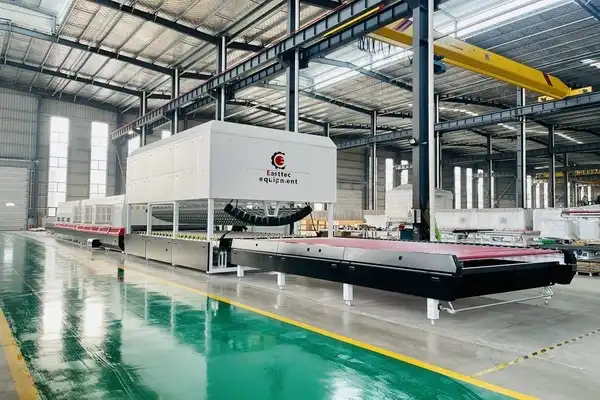
Glass is heated, shaped, quenched, cooled, and unloaded while it moves on rollers. A blower moves hot air around the glass in a convection furnace. This speeds up the transfer of heat to coated surfaces that reflect radiant heat. Rollers that are flexible can move flat glass or bend into an arc to make bent glass. This means that one line can handle both types of glass. Based on Italian convection technology, EASTTEC EQUIPMENT makes its convection furnaces with ceramic convection parts that can handle temperatures up to 1300°C. Results still depend on the coating, thickness, size, shape, and curvature, so make sure you see proof on samples that are typical.
Heating, Roller, and Quench Checks
Check out the layout of the heating zones, the insulation, the fan capacity, the upper and lower temperature controls, and the construction of the rollers. Check the thickness limits, curvature range, and movement synchronization for bending. It's just as important to quench because air pressure, volume, and distribution determine how strong, flat, and likely to break glass is. Not just the largest size shown on a brochure; ask for proof of results on glass like yours. Before you buy, find out how long the rollers last and how quickly technicians can get to the fans and rollers for maintenance. It will take longer to make things if your furnace heats well but the rollers wear out quickly.
Convection, Radiation, and Rigid Roller Comparisons
Standardized, high-volume runs with stable glass specifications can still be done in furnaces that use radiation. With convection, hot air is forced to move around, which helps with Low-E and thick glass. Because convection helps heat the Low-E bending line, EASTTEC EQUIPMENT says that the production cycle is about 30% shorter than with radiant furnaces. When you need to run both flat and curved glass, flexible rollers are more useful than rigid rollers. However, they need more precise controls and more regular maintenance. You can also look at throughput, changeovers, floor space, labor, and energy to compare continuous and batch layouts. Match the technology to the products you actually sell, not to what the company says it can do.
Measure Energy Use, Productivity, and Return on Investment
Compare Energy Consumption Across the Full Cycle
Tempering is an energy intensive process so buyers looking at a Convection Flexible Roller Flat & Bend Glass Tempering System should request detailed electricity consumption figures for start-up, loaded production, standby operation and changeovers. Ask each supplier to calculate the energy consumption per unit of processed glass area based on your actual product mix so that different machines can be compared on a consistent operating basis. Fan control and insulation quality are also important factors that affect energy efficiency. Main equipment of EASTTEC The Low-E glass tempering line uses inverter-controlled fans that adjust the airflow to the needs of the glass load. Its high density insulation helps to reduce thermal energy loss by 20 per cent. Buyers should also consider the heat loss around the furnace doors and roller doors of a Convection Flexible Roller Flat & Bend Glass Tempering System, as these areas can impact the overall thermal efficiency. Even modest savings in hourly energy can translate into significant savings in cost over a year. Therefore, manufacturers can control operating costs while ensuring steady heating performance and consistent glass quality through the use of an energy-efficient Convection Flexible Roller Flat & Bend Glass Tempering System.
Calculate Real Productivity
More than just furnace width affects how much work gets done. Find the effective loading area, the output based on the type and thickness of the glass, the loading speed, the changeover time, and the annual operating hours. Radiant furnaces usually work more slowly with thick, coated glass, so the cycle time on those items should be carefully looked at. The EASTTEC EQUIPMENT Low-E line's convection-assisted heating cuts the production cycle by about 30% compared to radiant furnaces. This works best with thick, coated glass. For this line, you can get a cycle-time table for every thickness from 4 mm to 19 mm. Then, compare it to your order book.
Build a Simple ROI Model
Cost and benefit should be in the same model. Add the cost of the item itself, the shipping, the set-up, the utilities, any spare parts, and any training. Add more output, less rejection, lower energy costs, and money from the curved glass you now hire someone else to do to the list of benefits. Breakage, optical distortion, roller marks, and first-pass yield are all quality indicators that should be added. This is because every scrapped lite wastes glass, energy, and time. One case should be conservative, and the other should be optimistic. If one line can do the job of two separate bending lines, that's money that doesn't have to be spent. This math is a lot easier if the supplier shares data freely.
Check Automation, Support, and Supplier Credibility
Control Software and Traceability
Run the line from screens that are clean and have recipes saved. You should be able to manage recipes, change the temperature and airflow separately, set alarms and diagnostics, and record data with user permissions. With an Industrial PC and PLC interface, the EASTTEC EQUIPMENT Low-E bending line can digitally control the fan pressure and bending parameters. This allows for precise arc control and consistent batch quality. There are menus in English, Spanish, Russian, Korean, and Portuguese, among others. The company says that new operators can learn how to run and fix things in just one week, which helps plants that are having trouble finding skilled workers.
Installation, Utilities, and Customization
Make sure the site is ready before you sign. Make a list of the following: network, foundation, floor space, safety, cooling, ventilation, compressed air, glass flow, and electrical supply. EASTTEC EQUIPMENT can change power systems to work with global standards like 220V, 380V, 415V, and 50/60Hz, so let them know about your plant's supply early on. The size, heating curves, and cooling parameters of the furnace can be changed to fit your products. The color of the equipment can also be changed. Since every furnace is made to order, delivery takes between 60 and 120 business days, depending on the model. You should plan for that lead time, as well as time for installation, commissioning, and training.
Supplier Checklist and After-Sales Support
A good supplier of Convection Flexible Roller Flat & Bend Glass Tempering System should have skills other than selling equipment. Request detailed layout of machines and calculation of production capacity and consumption of energy. Spare parts list. Warranty conditions. Examples of previous installations. Before you commit to a purchase, also ask about process trials, factory visits and equipment acceptance testing. EASTTEC EQUIPMENT has been developing glass tempering technology since 1994 and has a huge experience in the glass processing equipment industry. It offers one-stop project service for Convection Flexible Roller Flat & Bend Glass Tempering System, including from initial inquiry, project design, agreement, manufacturing, installation, commissioning, operator training to after-sales service. The company’s technical support staff is also available online 24 hours a day, 7 days a week to help customers troubleshoot equipment issues and reduce production downtime. For US buyers importing a Convection Flexible Roller Flat & Bend Glass Tempering System there are several other important things to consider besides CE compliance including Incoterms, import documentation and local electrical code requirements. These factors should be evaluated in advance to ensure smoother delivery, installation, commissioning and long-term operation of the equipment.
Avoid Common Mistakes and Make the Final Decision
Mistakes That Raise Long-Term Cost
The cheapest option often means more energy use, more expensive replacement parts, or poor customer service. A brochure's maximum glass size doesn't mean that the output will be stable for all thicknesses, coatings, and shapes. Because emissivity and surface behavior are different, you should test each coated item on its own. Check the curvature, optical quality, and repeatability of curved samples. Before the contract is signed, not after, plan the foundations, utilities, air flow, rollers, and training. Any of these things that are missing usually show up during commissioning, which is also when changes cost the most. You are safer with a full lifecycle review than with just catalog data.
A Step-by-Step Evaluation Process
Do things in a simple order. First, make a matrix of your products and capacities. Second, make a list of features that are required and features that would be nice to have. Third, make a short list of manufacturers based on their technical knowledge, references, ability to make changes, and service coverage. Fourth, ask for full technical and business proposals that include layouts, utilities, delivery, warranty, training, and more. Fifth, test pieces of glass that are flat, curved, coated, and thick. Finally, score each bid on technical fit, quality, energy, automation, implementation risk, and total cost. A shared scorecard lets everyone in the company see the same information. This is important because decisions about new equipment usually take three to twelve months.
When This System Is the Right Choice
Some plants need flat and curved glass, run coated or Low-E products, change their recipes often, or don’t want to keep outsourcing their bent glass. A flexible convection roller system would help them. The main line of EASTTEC EQUIPMENT is intended for the production of Low-E bent glass for the facades of high-end buildings. It has a processing window from 4 mm to 19 mm, a flexible roller mechanism that can be adjusted for large radius and complex curves and top forced convection. A dedicated flat line might be used for very large amounts of standard output . But for shapes to big to bend , they need a different way to shape them . Limits should be confirmed using test samples.
Conclusion
What kind of glass do you have ? How much do you need ? What kind of quality standards do you want to meet ? ASTM C1048 , ANSI Z97.1 , etc . These are things you need to know before you can judge a Convection Flexible Roller Flat & Bend Glass Tempering System . The technical review then goes on to discuss convection heating, bending range of rollers and quench performance. “These things were checked by using sample runs instead of brochure claims. Energy use, cycle time, rejection rates and the amount of outsourcing that is not needed feed a lifecycle return model that shows more than just the purchase price. “After installation the quality of the line depends on the control software, how well it can be tracked, how ready the site is and the support from the supplier. A scored process stops people from making common mistakes like judging based on price or largest size. The most important thing is a system that works with your products and is checked out before you buy it.
FAQ
Can this system process Low-E glass?
Yes. Easttec made its most popular line of equipment for Low-E bent glass, which has an emissivity as low as 0.01. The high-pressure convection system moves air around to evenly heat the coated glass and keep the film from oxidizing. Still, ask for a test run of your own coating.
What thickness range should I confirm?
The EASTTEC EQUIPMENT line works with glass that is between 4 mm and 19 mm thick, so it can handle both thin decorative panels and thick structural glass. Make sure you know the maximum curve for each thickness separately, since the limits of bend depend on the size, coating, and shape.
How long does delivery take?
Because every furnace is made to order, delivery takes between 60 and 120 working days, depending on the model. Installation, commissioning, operator training, and online support 24 hours a day are what come next, so plan your time and utilities ahead of time.
What should I send for a quotation?
Send the types of glass, their thicknesses, sizes, coatings, curves, desired output, plant voltage, automation needs, and sample drawings. That lets engineers suggest a configuration that works.
Request Your Convection Flexible Roller Flat & Bend Glass Tempering System Evaluation
Send your glass specifications to sales@easttecmachine.com, and EASTTEC EQUIPMENT will come up with a configuration that works with them. We make Convection Flexible Roller Flat & Bend Glass Tempering Systems that have true forced convection, CE-compliant design, controls that can be used in more than one language, and online support that is available 24 hours a day, 7 days a week. Tell our engineers about your thicknesses, coatings, curvature, output goal, and plant voltage, and they'll get back to you with information on layout, capacity, and delivery. For more information, go to easttecglass.com.
References
1. ASTM International, Standard Specification for Heat-Strengthened and Fully Tempered Flat Glass (ASTM C1048), 2018
2. European Committee for Standardization, Glass in Building: Thermally Toughened Soda Lime Silicate Safety Glass, Part 1 (EN 12150-1), 2015
3. American National Standards Institute, American National Standard for Safety Glazing Materials Used in Buildings (ANSI Z97.1), 2015
4. U.S. Consumer Product Safety Commission, Safety Standard for Architectural Glazing Materials (16 CFR Part 1201), 2023
5. Shelby, J.E., Introduction to Glass Science and Technology, Royal Society of Chemistry, 2005
6. Haldimann, M., Luible, A., and Overend, M., Structural Use of Glass, IABSE Structural Engineering Documents, 2008

USER EVALUATE
Here is the customer's evaluation of us