




Full Convection Flat Glass Tempering Furnace for Energy-Efficient Building Glass Production
A Full Convection Flat Glass Tempering Furnace is good for making energy-efficient building glass because it heats the glass with hot air that flows around it instead of just using radiant heat. This method makes the heating more even for Low-E, solar-control, and thin architectural glass. This helps protect the coatings, keeps the sheets flat, and shortens the heating cycles. These furnaces are made by EASTTEC EQUIPMENT with inverter-controlled airflow, ceramic parts that can handle temperatures up to 1300°C, and true forced convection. We talk about how the technology works, how it stacks up against other types of furnaces, and what U.S. buyers should look for before they buy.
How Full Convection Tempering Works in Building Glass Production
Your team can decide if this technology fits your product mix better if they know the basics.
Why Energy-Efficient Building Glass Requires Advanced Tempering Technology
Tempered glass is used for curtain walls, windows, doors, skylights, and partitions in energy-efficient buildings. The CPSC rule 16 CFR 1201 says that safety glazing in dangerous places like doors must meet this rule. Many processors also test to ANSI Z97.1 and ASTM C1048. Buyers want Low-E, thin, large-format, and solar-control glass at the same time. Infrared energy is reflected by low-E coatings, which helps keep heat in but makes it harder to heat even things. Normal tempering can lead to uneven heating, damage to the coating, roller marks, optical distortion, and wasted electricity. These issues can be solved by modern technology that controls how heat gets to the glass.
What Is a Full Convection Flat Glass Tempering Furnace?
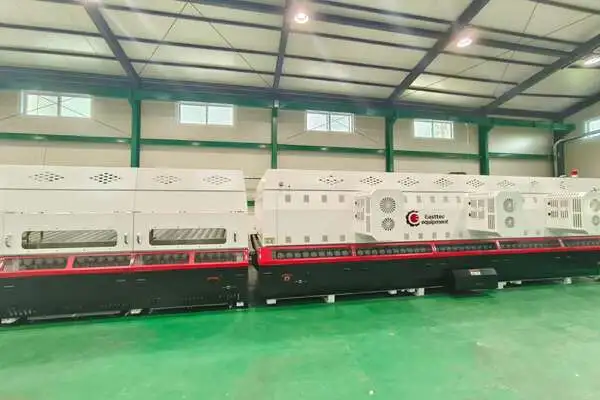
A Full Convection Flat Glass Tempering Furnace heats flat glass by moving hot air around in a controlled way, not just by using radiant elements. A full line usually has equipment for loading, a chamber for convection heating, air circulation modules, ceramic rollers, a section for quenching, systems for cooling and unloading, and PLC-based controls. High-temperature blowers in our design create real internal hot air circulation, and ceramic materials rated to 1300°C are used in the convection parts that go with them. You should look at the working dimensions, thickness range, glass weight, heating zones, quench performance, supported coatings, automation, and data recording when you look at a line. Whether you're making architectural glass, Low-E glass, solar glass, or thin glass, the right specification will depend on what you're making.
How Does a Full Convection Glass Tempering Furnace Work?
The process starts with putting clean, precisely cut, edge-processed glass on a roller conveyor belt. Then, hot air flows through the furnace. How the heat gets to the glass depends on the speed of the airflow, the temperature zones, the performance of the fan, and the design of the nozzles. With the help of sensors and feedback loops, operators can change recipes for things like thickness, size, coating, and loading pattern. After being heated, the glass moves quickly into the quench section, where both sides are cooled by a lot of air. First, the outer layers get harder, and then the hot core gets smaller. This makes compressive stress on the surface and tensile stress in the core. ASTM C1048 says that fully tempered glass must have a surface compression of at least 10,000 psi (69 MPa).
Comparing Heating Systems and Production Performance
The next thing to know about this technology is how it stacks up against others and what it can do on the factory floor.
Full Convection Furnace vs. Radiation and Mixed Convection Systems
Every type of furnace has its place, and the best one for you depends on your products, not what the company says it can do. Standard glass that isn't coated can work with radiation systems. When it comes to process capability and investment, mixed convection strikes a good balance. Full convection is often thought of for coated, thin, or temperature-sensitive glass because it lets heat move more directly and more easily. In exchange, the system is more complicated, airflow needs to be calibrated, and the initial investment is higher. It's important to compare coating compatibility, quality results, energy use, maintenance needs, process flexibility, and test data from different suppliers before making a decision. You should have your own coated samples made by each supplier because test results are more useful than brochures.
Energy Efficiency and Production Performance
Convection heating can save energy because it moves heat from the air to the glass more efficiently, keeps recipes stable, cuts down on heating cycles, and results in fewer rejected lites. Customers can save one-third of their electricity with our energy-efficient design, and the inverter system changes the flow of air in real time. The actual outcomes still depend on the thickness of the glass, the coating, the load on the furnace, the operating temperature, the insulation, the efficiency of the fan, the number of hours spent in standby, and the maintenance. This is why you should use your actual product mix to figure out capacity instead of a theoretical maximum. When the conditions are like yours, the supplier should give you real-world numbers for things like energy use, cycle time, temperature uniformity, flatness, optical distortion, and fragmentation.
Applications in Energy-Efficient Building Glass Production
A lot of energy-efficient and specialty glass products can use full convection technology. It is often tested for Low-E and solar-control glass, where the coating's emissivity affects how much heat is radiated. It is used by architects for things like windows, facades, curtain walls, doors, skylights, walls, balustrades, and other things that need to be flat and look good. Solar glass makers want stable throughput and low defect rates. Thin glass, on the other hand, needs precise heating, transfer, roller alignment, and cooling. Lamination is a separate process, but tempered glass that is consistently flat, has good edges, and is clean helps make laminated glass further down the line. People who make appliances, furniture, or work on contracts can also look at this technology for their flat glass.
EASTTEC EQUIPMENT Convection Furnace Features and Specifications
Based on our own product data, this is what our Full Convection Flat Glass Tempering Furnace can do.
Low-E Coating Protection and Superior Flatness
Low-E coatings are fragile, and radiation furnaces can damage them or change the way light passes through them. Our furnace moves high-pressure hot air across the surface of the glass. This helps the glass absorb heat evenly without damaging any valuable coatings. Glass as thin as 0.01 emissivity and as thick as 19 mm can be used with it. Architectural lites that are 3 to 4 mm thin tend to bow or warp. To keep them flat, advanced top-air convection balances the thermal load precisely. Flat, clear glass stands out right away to your customers, which is good for your business with window and curtain wall customers.
Energy Savings, Faster Cycles, and Simple Operation
Compared to regular furnaces, our forced convection technology cuts down on heating cycles. You can process more glass in a shift without having to hire more people or buy more tools. This means that your return on investment happens faster. Controlled airflow by an inverter uses less electricity. The control software helps operators work with different thicknesses of glass, and the menu can be set to automatically switch between English, Spanish, Russian, Korean, Portuguese, and more. It only takes one week for new operators to learn how to run and fix things, which helps plants that are having trouble finding skilled workers. Technicians also offer online support 24 hours a day, seven days a week to keep production going.
Customization, Certification, and Technical Specifications
Each furnace is made just for you. We change the power system to meet local standards and set the size, heating curves, cooling parameters, and color of the equipment to meet your needs. The furnace meets the requirements of the CE. Send us the voltage and frequency of your plant along with your question so that our engineers can make sure the match is right for your U.S. site. Key specs are shown in the table below.
| Parameter | Specification |
|---|---|
| Glass thickness range | 3mm – 19mm |
| Low-E coating compatibility | Emissivity as low as 0.01 |
| Ceramic components | Rated up to 1300°C |
| Power compatibility | 220V / 380V / 415V, 50Hz / 60Hz |
| Control languages | English, Spanish, Russian, Korean, Portuguese, French, German, Turkish |
| Certification | CE compliant |
| Delivery time | 60–120 working days, depending on model |
| Installation and commissioning | 20–30 days with turnkey service |
| Operator training | Within one week |
| Technical support | 24-hour online |
These numbers give your technical team a good place to begin their review.
How to Choose, Buy, and Protect Your Investment
A structured buying process lowers risk because buying a furnace is a big deal.
How to Choose the Best Full Convection Flat Glass Tempering Furnace
First, write down what your current and future product mix will be. Consider the glass sizes, thicknesses, coatings, daily output, shifts, loading patterns, and expansion plans. Then, when evaluating a Full Convection Flat Glass Tempering Furnace, compare its overall dimensions, handling limits, heating zone design, airflow control, recipe management capabilities, automation, safety systems, and quality tracking functions. Utility bills, installation, labor, repairs, replacement parts, downtime, broken glass, and future upgrades should all be included in the total cost of ownership. Just as important as the machine itself is the supplier's ability to support it. Look for international references, factory testing, commissioning assistance, operator training, remote diagnostics, and after-sales service. Our team has worked on flat and bent glass tempering equipment since 1994, so our recommendations are grounded in real-world experience.
Price, Purchasing, and Installation Considerations
The cost of a convection tempering furnace is based on its working size, thickness range, heating and air-circulation design, automation, quench capacity, handling options, and the rules that apply in your area. It is important to carefully compare rollers, fans, heating systems, controls, software, and spare parts, as well as new, used, and custom equipment. Standard equipment, options, installation, training, shipping, warranty, and payment terms should all be listed separately in a full quote. Prepare the foundations, electrical capacity, cooling, ventilation, compressed air, access routes, and safety measures before the delivery. Trial production and training for operators should be part of commissioning. Our "turnkey" service includes planning the project, making it with quality control, installing it on-site, starting it up, and training people on how to use it.
Common Risks and How to Avoid Them
Some common risks are buying based only on price, believing generic claims about capacity, skipping Low-E tests, underestimating utilities, and not paying attention to support after the sale. A cheap furnace might end up costing more in the long run because of wasted energy, broken glass, less flexibility, or downtime. Ask for capacity calculations based on the actual sizes and thicknesses of your glass, test samples with the coatings you want, and make sure your needs for electricity, cooling, ventilation, floor space, and access are met. Your contract should spell out the requirements for acceptance, the time it takes to provide service, software support, warranty coverage, spare parts obligations, and the supplier's responsibilities during installation and commissioning.
Validation, Delivery, and Long-Term Value
Making sure everything is correct and having clear project steps will keep your schedule and yield after purchase safe.
How to Validate Furnace Performance Before Full-Scale Production
To start, use common types, sizes, thicknesses, and coatings of glass in a structured factory acceptance test. Check the level of uniform heating, the stability of the transfer, the performance of the quench, the flatness, the optical quality, the fragmentation, the surface stress, and the process-data records. After installation, do more important checks during site acceptance, which is when the real utilities, operators, upstream equipment, and downstream handling are being used. While safety standards, building codes, and customer requirements like ASTM C1048 or EN 12150-1 are in effect, compare the results with them. After getting permission, keep track of yield, downtime, maintenance, energy use, and customer complaints to make recipes better over time.
From Inquiry to After-Sales Service
There is a clear order to our collaboration process: initial inquiry, project design, optimal design, cooperation agreement, production manufacturing, installation and commissioning, operator training, and service after the sale. It takes between 60 and 120 working days to deliver a custom furnace, and 20 to 30 days for installation with turnkey service. Our engineers will work with you until the first batch meets quality standards, and technicians are available online 24 hours a day, 7 days a week. Maintenance managers and procurement teams need this structure because they need to plan for uptime, spare parts, and a supplier whose roles are clear.
Why Full Convection May Become the Preferred Choice
Processors are moving toward flexible heating technology because of the growing need for Low-E, solar-control, thin, and large-format glass. By controlling the flow of heat across coated and sensitive materials, full convection can help architects keep up with changing building requirements. Quality, energy use, throughput, yield, service support, and lifecycle cost should all be taken into account when deciding how valuable something is, not just the heating technology. A plant that was built to grow may also be able to handle upgrades to automation, digital monitoring of production, and connections to lines for insulating glass or lamination. A partner in engineering with a lot of experience can match the equipment's capabilities to realistic growth plans.
Conclusion
Hot air flows through a full convection furnace to heat flat glass. This method works well for Low-E, solar-control, thin, and large-format glass used in modern building projects. A Full Convection Flat Glass Tempering Furnace makes it easier to control heat transfer through coated glass compared with radiation and mixed convection systems, although its design is more complex and the initial investment is higher. The product mix affects energy consumption, cycle time, flatness, and production yield, so real glass samples should be used to verify capacity and performance. When making a smart purchasing decision, consider the total cost of ownership, utility consumption, installation requirements, contract terms, and service support. A reliable supplier should also support performance claims with factory and site acceptance tests based on standards such as EN 12150-1 and ASTM C1048. The most important thing to remember is that the best Full Convection Flat Glass Tempering Furnace is the one that has been tested and proven to perform well with your own glass.
FAQ
What is a Full Convection Flat Glass Tempering Furnace?
It's a thermal processing line that uses moving hot air to heat flat glass and then cools it down to make tempered safety glass. High-temperature blowers are used in our design to make real internal hot air circulation.
Why does convection heating suit Low-E glass?
As a result of reflecting infrared energy, low-E coatings can make the heating results uneven. Heat moves through the air around the glass as hot air circulates. This helps the temperature even out without hurting the coating. As low as 0.01, our furnace can handle it.
What glass thickness range can the furnace process?
From 3 mm to 19 mm, our furnace can work with glass. Our control software helps operators handle different thicknesses because each one needs its own tried-and-true recipe. Our engineers need to see your product mix to make sure they have the right recipe range.
What should I send with a quotation request?
Send information about the glass's sizes, thicknesses, coatings, expected output, quality goals, plant location, voltage and frequency, and automation needs. After that, we make a configuration, layout, quote, and delivery schedule. Before you buy, you can test a sample to make sure the process will work with your glass.
Contact EASTTEC EQUIPMENT for a Full Convection Flat Glass Tempering Furnace Quotation
Making plans for a new building glass line? Since 1994, EASTTEC EQUIPMENT has been making Full Convection Flat Glass Tempering Furnaces. They offer Italian convection technology, CE compliance, custom power systems, controls in multiple languages, and online support 24 hours a day, 7 days a week. Send an email to sales@easttecmachine.com with your glass sizes, coatings, and output goals, and our engineers will put together a configuration and quote. For more information, go to easttecglass.com. You are also welcome to come to the factory.
References
1. ASTM C1048 – Standard Specification for Heat-Treated Flat Glass—Kind HS, Kind FT Coated and Uncoated Glass, ASTM International, 2018
2. EN 12150-1 – Glass in Building: Thermally Toughened Soda Lime Silicate Safety Glass, Part 1, European Committee for Standardization, 2015
3. ANSI Z97.1 – Safety Glazing Materials Used in Buildings, American National Standards Institute, 2015
4. 16 CFR Part 1201 – Safety Standard for Architectural Glazing Materials, U.S. Consumer Product Safety Commission, 2023
5. ASTM C1376 – Standard Specification for Pyrolytic and Vacuum Deposition Coatings on Flat Glass, ASTM International, 2015
6. Structural Use of Glass, IABSE Structural Engineering Documents, 2008

USER EVALUATE
Here is the customer's evaluation of us