




How Does Radiation Flexible Roller Glass Bending and Tempering Machine Handle Curved Glass Production?
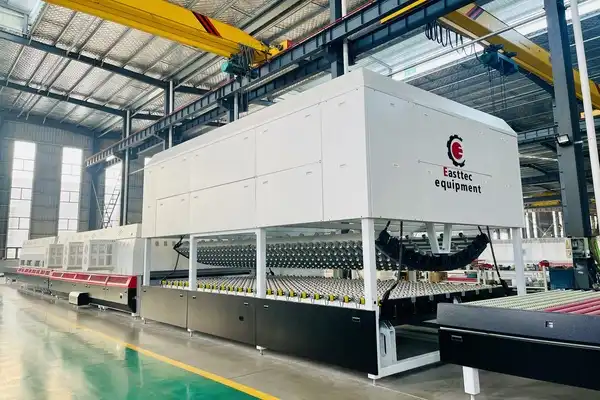
A Radiation Flexible Roller Glass Bending and Tempering Machine handles curved glass production by heating flat glass to its softening point through high-efficiency radiant elements, then shaping it with a dynamic, adjustable flexible roller bed. This approach eliminates fixed molds, giving processors the freedom to dial in precise curvatures for each order. The result is consistent tempering stress across the full glass surface, minimal optical distortion, and higher yield rates. For architectural glass manufacturers, automotive glass suppliers, and furniture glass producers, this technology solves problems that traditional gravity bending and rigid roller systems simply cannot address at scale.
Understanding the Radiation Flexible Roller Glass Bending Process
This kind of machine has an exact, three-step process for making bent glass, which sets it apart from older ways of bending glass.
Stage 1 — Controlled Heating
A roller-moving belt brings the glass into the kiln, where it is heated by multiple zones of radiant elements. With Easttec's Multi-zone Matrix Radiant Heating, the furnace is split into temperature zones that are each controlled by their own PID controllers. As stated in ASTM C1048 for toughened glass, the temperature difference across the glass surface stays within ±2°C. This amount of regularity gets the glass ready to bend without putting it under stress first.
Stage 2 — Flexible Roller Shaping
The high-strength flexible roller mechanism starts to work when the glass reaches its softening point. The roller system's curvature shape can be changed through the PLC interface in just one to five minutes, while fixed models need to be physically changed over. This includes bending radii of 450 mm to 1,000 mm, based on the thickness of the glass. It allows for a wide range of architectural and artistic curved glass designs that fixed systems can't match.
Stage 3 — Tempering and Cooling
After being shaped, the glass goes into the quench area, where controlled air blasts cool both sides quickly. The compressive surface stress that makes tempered safety glass unique is caused by this fast cooling. EN 12150-1 says that tempered glass must break into more than 40 to 60 pieces per 50x50 mm area. This process always meets this standard.
Comparing Radiation Flexible Roller Machines with Traditional Glass Bending Technology
Knowing how this technology is different from past ways in the real world helps procurement teams confidently support the capital investment.
Premium glass manufacturers face practical production challenges such as coating protection, thermal uniformity, bending flexibility, energy consumption, and yield consistency. The Full Convection Flexible Roller Glass Tempering Machine is designed to address these requirements through a combination of high-density insulation, forced-air heating, adjustable flexible roller mechanics, and IPC/PLC control. For manufacturers specifically evaluating a Radiation Flexible Roller Glass Bending and Tempering Machine, the combination of flexible roller technology and controlled heating can provide an alternative approach to handling both flat and curved glass. With controlled convection heating, the Full Convection Flexible Roller Glass Tempering Machine can support more consistent heat transfer across different glass products while helping protect sensitive coatings during the tempering cycle. A Radiation Flexible Roller Glass Bending and Tempering Machine can likewise be considered for production environments where flexible bending and tempering capabilities are important. The adjustable roller system of the Full Convection Flexible Roller Glass Tempering Machine provides greater flexibility when manufacturers need to process both flat and curved glass with different specifications, while a Radiation Flexible Roller Glass Bending and Tempering Machine can support similar production requirements through flexible roller processing. For architectural, automotive, appliance, and solar glass applications, the Full Convection Flexible Roller Glass Tempering Machine can provide an integrated production solution that combines heating, bending, tempering, and process control. For companies evaluating long-term capital equipment investments, comparing the capabilities of a Radiation Flexible Roller Glass Bending and Tempering Machine with other flexible roller systems can help buyers assess production flexibility, energy management, maintenance requirements, and overall operating costs.
All of these problems can be fixed with the radiation flexible roller method. To help you remember the main differences in performance, here they are:
- Mold-free geometry control: The adjustable roller bed removes the cost and lead time of dedicated bending molds, cutting tooling expenses significantly for small-batch and custom orders.
- Optical clarity: Precision-ground rollers combined with even radiant heat prevent surface marking and distortion, helping finished glass meet ISO 11485 optical standards.
- Repeatable geometry: Digital recipe storage through the IPC and PLC interface means operators recall exact curvature settings instantly, keeping geometry consistent across production runs.
These differences directly lead to lower failure rates, faster order changes, and a wider range of products. These are benefits that are relevant whether you run a plant for architectural glass or a line for business freezer glass.
Key Considerations When Procuring Radiation Flexible Roller Glass Bending and Tempering Machines
Buying a machine to bend and heat-bend glass is a big investment. Most buying cycles for this kind of equipment last between three and twelve months and include several technical reviews. Setting the right criteria for evaluation from the start saves time and keeps mistakes from costing a lot of money.
Glass Thickness and Product Range
Make sure the machine works during your whole output time. Easttec's system can work with both flat and bent glass that is 5 mm to 19 mm thick. It can handle the needs of architectural curtain wall glass, furniture tabletops, appliance panels, and specialty automotive glass all on one platform.
Control System Reliability
Less unplanned downtime happens when the control architecture is stable. Consumer-grade touchscreens are not used on this machine; instead, it has an Industrial PC (IPC) and PLC interface. Operators keep and get hundreds of production recipes, which lets them quickly switch between flat and curved product runs without having to call in expert techs every time.
Customization and Compliance
There are different voltage methods and program languages that each factory needs to run. Easttec can change to voltages of 220 V, 380 V, 415 V, and 50/60 Hz around the world. It also has options in English, Spanish, Russian, Korean, and Portuguese. The machine has CE approval, which means it meets international standards for safety and efficiency that buyers in the US and Europe need.
Addressing Common Challenges and Maintenance in Radiation Flexible Roller Glass Bending Machines
Every piece of machinery in production needs a plan for regular upkeep. If you know ahead of time where the most common places of failure are, you can keep your line going and keep your delivery schedules.
Roller Wear and Surface Contamination
Every shift, the flexible roller arms of a Full Convection Flexible Roller Glass Tempering Machine, which are typically made from high-temperature-resistant materials, are exposed to repeated thermal cycling and mechanical stress. For the Full Convection Flexible Roller Glass Tempering Machine, checking the roller surfaces and bearings on a weekly basis can help identify wear before it affects glass quality or bending accuracy. The same maintenance principles apply when operating a Radiation Flexible Roller Glass Bending and Tempering Machine, where regular inspection of roller components can help maintain stable glass movement and bending accuracy. Regular inspection is particularly important because worn roller components can contribute to uneven glass movement, surface defects, or changes in the final curvature. A Radiation Flexible Roller Glass Bending and Tempering Machine also requires attention to its flexible roller sleeves, bearings, and related mechanical components, which may need inspection or replacement as they wear over time. By following a consistent inspection and replacement schedule, operators can help maintain the performance of the Full Convection Flexible Roller Glass Tempering Machine and a Radiation Flexible Roller Glass Bending and Tempering Machine, reducing the risk of unexpected production interruptions. Proper maintenance of the rollers, bearings, and sleeves helps the Full Convection Flexible Roller Glass Tempering Machine maintain stable operation across repeated production cycles, while regular servicing of a Radiation Flexible Roller Glass Bending and Tempering Machine can similarly support consistent processing performance.
Temperature Calibration
Checks of the PID calibration in each zone prevent the temperature from changing over time. Surface stress patterns can be seen in zebra-board reflection tests when there is a difference of more than ±5°C in any one zone. Making sure that the adjustment is checked every month keeps the accuracy that customers of high-end curved glass expect.
Software and Recipe Management
All production recipes can be backed up safely on the IPC-based system. Operators should keep a copy of recipe files on a different computer in case they lose them. Many glass processing plants are having trouble finding skilled workers, but new operators usually learn how to do everything they need to know within a week.
Future Trends and Innovations in Radiation Flexible Roller Glass Bending and Tempering Technology
Three things will drive the next big step forward in bent glass tempering equipment: smarter process tracking, better energy management, and more connections.
AI-Assisted Process Monitoring
In burner control software, machine learning algorithms are increasingly being explored for advanced process monitoring and predictive control. When integrated into a Full Convection Flexible Roller Glass Tempering Machine, these algorithms can analyze temperature data, roller pressure readings, and other operating parameters in real time to identify potential process issues before they result in glass breakage or quality problems. Similar data-driven monitoring concepts can also be applied to a Radiation Flexible Roller Glass Bending and Tempering Machine, allowing manufacturers to track operating conditions and identify abnormal trends during production. For operators of a Full Convection Flexible Roller Glass Tempering Machine, this type of data-driven monitoring can provide earlier warnings and support more proactive maintenance and process adjustment, while a Radiation Flexible Roller Glass Bending and Tempering Machine can benefit from comparable predictive monitoring functions. The Full Convection Flexible Roller Glass Tempering Machine can therefore combine automated control with real-time data analysis to improve production visibility. Instead of relying only on quality checks after a batch has been processed, manufacturers using a Full Convection Flexible Roller Glass Tempering Machine can use predictive monitoring to identify abnormal conditions at an earlier stage, while a Radiation Flexible Roller Glass Bending and Tempering Machine can incorporate similar approaches for continuous process observation. As machine learning technology develops, the Full Convection Flexible Roller Glass Tempering Machine can provide a foundation for more intelligent quality control and preventive production management, and a Radiation Flexible Roller Glass Bending and Tempering Machine can likewise support data-informed production strategies.
IoT and Remote Diagnostics
Remote tracking tools let sellers of machinery see data about machines and help with problems without having to go to the spot. This is already possible with Easttec's 24-hour online technical support, and in future builds, data integration will be improved to allow for more accurate scheduling of preventative maintenance.
Energy Management and Sustainability
Compared to older furnace designs, high-density composite insulation, like the one in Easttec's current model, keeps heat in 20% longer. As energy costs rise in the U.S. and around the world, this 20% edge in thermal retention adds up to a big drop in running costs over the life of a machine.
Conclusion
Every step of producing curved glass requires careful control, from maintaining consistent heating temperatures to achieving accurate forming and distributing stress evenly during cooling. A well-designed Full Convection Flexible Roller Glass Tempering Machine can integrate these production requirements into a single platform, while a Radiation Flexible Roller Glass Bending and Tempering Machine can provide another equipment configuration for manufacturers focused on curved glass processing. With CE-certified construction, IPC and PLC control, multi-zone heating, and a flexible roller bed designed to handle glass thicknesses from 5 mm to 19 mm, the Full Convection Flexible Roller Glass Tempering Machine provides glass manufacturers with a versatile solution for producing curved tempered glass. A Radiation Flexible Roller Glass Bending and Tempering Machine can likewise combine controlled heating, flexible roller forming, and automated process management to support different curved glass production requirements. The Full Convection Flexible Roller Glass Tempering Machine combines controlled heating with adjustable roller forming and automated process management, helping operators maintain repeatable production parameters across different glass specifications. For factories looking to expand their curved glass production capabilities, the Full Convection Flexible Roller Glass Tempering Machine can provide greater production flexibility within one integrated system, while a Radiation Flexible Roller Glass Bending and Tempering Machine can offer flexible processing for manufacturers requiring curved and tempered glass capabilities. With its combination of flexible roller technology, IPC/PLC control, and controlled heating, the Full Convection Flexible Roller Glass Tempering Machine can support manufacturers seeking consistent quality and efficient curved glass production, while a Radiation Flexible Roller Glass Bending and Tempering Machine can also be considered when evaluating equipment for versatile curved glass processing.
FAQ
How does radiation heating differ from convection heating in curved glass production?
Radiant heating transfers thermal energy directly to the glass surface without relying on moving air. This produces faster, more uniform deep-core heating for clear float and tinted glass. Convection heating works well for flat glass but can create uneven temperature profiles on curved profiles. For bent glass tempering, radiation gives processors tighter thermal control.
What glass types are compatible with this machine?
The system works with clear float glass, tinted glass, and patterned glass in the 5 mm to 19 mm thickness range. It is optimized for non-coated glass varieties. For Low-E coated glass, auxiliary top-convection systems are available to manage the reflective properties of the coating.
How quickly can operators switch between different curvature profiles?
The automated flexible roller system adjusts curvature settings through the PLC interface in approximately one to five minutes. This is a significant time saving compared to physical mold changes on traditional bending systems, which typically take several hours.
What quality standards does the tempered output meet?
The machine produces tempered glass that meets EN 12150-1 fragment requirements and ASTM C1048 surface quality standards. Geometric accuracy of the bent profile typically deviates by less than 1 mm to 2 mm from the design specification.
What does routine maintenance involve?
Weekly inspection of roller sleeves and high-temperature bearings is the primary maintenance task. Monthly PID calibration verification keeps zone temperatures within specification. Easttec provides spare parts support and 24-hour online technical assistance to minimize unplanned downtime.
Request a Quote for Easttec's Radiation Flexible Roller Glass Bending and Tempering Machine
Since 1994, Easttec EQUIPMENT has been making thermal processing equipment for glass. They have worked with building glass plants, car glass suppliers, and gadget glass makers all over the world. Our Radiation Flexible Roller Glass Bending and Tempering Machine is a well-known seller to buyers in the U.S. and other countries. It has CE-certified performance, saves 20% of thermal energy, and has IPC/PLC precision control, all in one platform that can be configured. Get in touch with our engineering team at sales@easttecmachine.com to talk about your production needs and get a quote for unique equipment.
References
1. Glass Technology: European Journal of Glass Science and Technology, Society of Glass Technology, 2021.
2. ASTM C1048-18: Standard Specification for Heat-Strengthened and Fully Tempered Flat Glass, ASTM International, 2018.
3. EN 12150-1: Glass in Building — Thermally Toughened Soda Lime Silicate Safety Glass, European Committee for Standardization (CEN), 2015.
4. ISO 11485-2: Glass in Building — Curved Glass, International Organization for Standardization, 2011.
5. Glass Processing Days Conference Proceedings, Tampere University of Technology Glass Group, 2019.
6. Emerging Trends in Architectural Glass Manufacturing and Thermal Processing Technology, Glass Magazine, National Glass Association, 2022.

USER EVALUATE
Here is the customer's evaluation of us