




How Does Forced Convection Protect Curved Low-E Glass Coatings?
Forced convection technology protects curved Low-E glass coatings by replacing radiant heat transfer with pressurized, precisely directed hot airflow that wraps uniformly around every contour of the glass surface. A Forced Convection Curved Glass Toughening Machine with Hard Roller achieves this by combining a variable-frequency high-pressure convection system with rigid hard-roller bending, eliminating the thermal shadowing effect that destroys reflective metallic films in conventional furnaces. The result is a stable, repeatable heating cycle that brings the glass to its softening point without oxidizing the coating or creating dangerous internal stress gradients.
Understanding Forced Convection in Curved Glass Toughening
Why Convection Matters More Than Radiation for Curved Geometry?
Radiation-based heaters use infrared electromagnetic waves to move heat around. This works pretty well on a flat piece of glass. But on a sloped surface, the angle of incidence changes all the way across the profile. This means that some areas soak up a lot more energy than others. As it turns out, Low-E coatings make the problem worse because they reflect a lot of light, which causes the well-known "Low-E shadowing" effect where the covered surface always stays cooler than the bare surface.
With forced convection, this dependence is gone for good. High-pressure fans move hot air through specially designed nozzle arrays that are placed above the path of the glass. Since the moving air transfers heat through convective touch instead of radiation, it doesn't matter how reflective the layer is. The surface of the glass gets heated up in a way that depends on the speed and temperature of the airflow, which are both controlled electronically.
Hard Rollers as the Precision Foundation
Rollers made of ceramic or a heat-resistant metal keep the glass in a precise geometric position while it is being heated and cooled. Without tight positional control, thermal expansion leads to drift, which changes the shape of the intended arc. When you use a hard-roller press, the expansion is limited to a measured forming path. This keeps the arc variation to within 1.0 mm, which meets the strictest architectural curtain wall requirements.
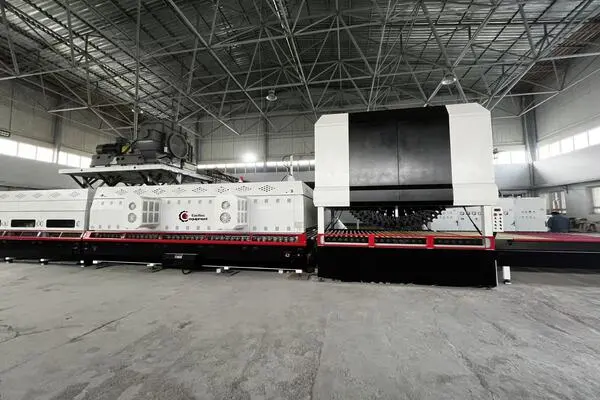
Protecting Curved Low-E Glass Coatings Through Forced Convection
When it comes to high-performance triple-silver coatings with emissivity values as low as 0.01, these are basically nanoscale metallic multilayer stacks. Any overheating in one area, even a difference of 15–20°C across the pane, starts oxidation processes that damage thermal and optical performance forever.
This is taken care of by a variable-frequency drive on each convection fan bank in the Easttec convection bent glass oven, part of the Forced Convection Curved Glass Toughening Machine with Hard Roller. The operators change the volume and pressure of the air in each heating zone separately. This creates a thermal field that reflects the shape of the glass rather than filling it with light. This means that the leading edge, the center panel, and the following edge all get closer to the weakening point at the same time, within a small temperature range.
Hard rollers also play an important role in mechanical safety. During the quenching phase, the glass cools down from about 620°C to room temperature over a controlled period of time. Without a rigid support, thermal contraction puts uneven stress on the interface of the coating. The rollers keep the bent shape fixed during this important change. This keeps the coating from microcracking and delaminating, which happens a lot to coatings that don't last as long in radiant furnaces.
Comparing Forced Convection to Other Glass Toughening Technologies
When purchasing managers look at capital tools, they should be able to make a straight, data-based comparison. Here are the main differences in how well the three most common toughening methods work:
- Radiation-only furnaces heat the glass through infrared waves sent out by electric elements or gas combustion. They work fine on regular clear glass, but they have trouble with coatings that reflect a lot of light. Heating processes for Low-E glass are usually 20–35% longer, which makes the coating contact time longer and the amount of energy used per unit go up.
- Natural convection systems add passive air movement inside the furnace chamber to work with radiant heat. Even though thermal uniformity gets a little better, the air temperature distribution stays uneven without forced circulation. This causes uneven stress patterns and higher optical distortion rates.
- Forced convection systems produce results that can be measured as clearly better. According to independent industry studies, high-pressure convection shortens the heating cycle for Low-E glass by 30% or more compared to radiation models. This directly lowers the cost of energy per unit and raises daily output.
The productivity and quality advantages of forced convection are well known in the architectural glass industry. When rigid hard-roller technology is added, these benefits are expanded to complex curved shapes, where flatness and arc consistency are important quality indicators for both curtain wall makers and car glass providers.
Operation and Maintenance Best Practices for Forced Convection Curved Glass Toughening Machines
Calibrate Temperature Profiles to Glass Thickness and Coating Type
The Easttec IPC control system, integrated into the Forced Convection Curved Glass Toughening Machine with Hard Roller, comes with heating recipes already programmed in it. These cover common types of Low-E coatings and glass thicknesses from 3 mm to 19 mm. These are not permanent settings; operators should think of them as calibrated baselines. The emissivity signatures of glass from different coating lines are not exactly the same. The team can fine-tune zone temperatures before committing to full production volume by doing a small evaluation batch after any change to the coating line and keeping track of the fragmentation count and bow measurement that comes up.
Maintain Fan and Nozzle Systems on a Defined Schedule
The main part of the device is the convection fan array. Particulate buildup in opening ducts lowers the amount of airflow and throws off the intended pressure distribution. The thermal field accuracy that protects coatings is kept up by a monthly repair cycle that checks the integrity of the fan blades, cleans the orifices in the nozzles, and confirms the variable-frequency drive's reaction. Easttec's heat-resistant alloy rollers need to have their surfaces checked for groove wear on a regular basis. Contact marks on the bottom of the glass can be avoided by replacing the rollers as soon as the surface starts to wear down because these marks are what cause high-specification projects to be rejected.
Monitor Energy Consumption as a Process Health Indicator
High-density composite insulation and improved thermal chamber geometry are built into Easttec furnaces to cut thermal loss by 20%. If the amount of energy used per unit starts to go up, it usually means that the insulation seals are breaking down or that there is a problem with how well the fans are working. Both of these problems can be fixed quickly if weekly energy use logs are used. Taking care of these warning signs ahead of time stops the bigger downtime events that throw off supply plans.
Procurement Guide for Forced Convection Curved Glass Toughening Machines with Hard Roller
To find a reliable Forced Convection Curved Glass Toughening Machine with Hard Roller provider, you need to look at a number of factors that are all connected at the same time. The price of the equipment is one factor, but the real return on investment (ROI) over a five- to ten-year period depends on the total cost of ownership, which includes things like energy use, the cost of getting spare parts, and the rate of yield.
Coverage of certification is important for foreign projects. All of Easttec's convection furnaces are CE-approved, which means they can be used in European and North American building projects that need qualified safety glass. Depending on how complicated the model is, delivery times for customized setups run from 60 to 120 working days. Standard voltage adaptation covers 220V, 380V, and 415V at both 50 Hz and 60 Hz. This gets rid of a problem that many buyers in North America and Southeast Asia have.
Easttec's IPC system can be used in English, Spanish, Russian, Korean, and Portuguese, among others. This cuts down on the time needed to train operators and lets new production teams start making consistent output within a week of starting up.
Conclusion
Forced convection technology, as found in the Forced Convection Curved Glass Toughening Machine with Hard Roller, can fix two major issues that regular furnaces can't: heat shadowing due to Low-E coating reflectivity and the instability that comes with handling curved glass. The Easttec curved glass tempering system uses hard-rollers to be very precise and compressed airflow to make processes 30% faster. The coating stays intact down to 0.01 emissivity, and the arc deviation stays within 1.0 mm. This combination of technologies directly leads to lower scrap rates, higher daily output, and a stronger competitive position for companies that make high-quality architectural glass, automotive glazing, or energy-efficient appliance panels.
FAQ
What makes forced convection better for Low-E coatings than radiant heating?
Infrared energy is what radiant stoves use to heat their rooms. Low-E coatings reflect a lot of infrared radiation, so the surface that is coated heats up more slowly and unevenly than the glass substrate. Forced convection gets around this problem by sending heat through direct air contact, so the reflectivity of the coating has no effect on how evenly the heat is distributed.
What glass thickness range does the Easttec system handle?
The system routinely works with glass thicknesses ranging from 3 mm to 19 mm. It can handle thin architectural lites, normal curtain wall panels, and heavier structural glazing all on the same equipment base.
How much energy savings can a plant realistically expect?
Because they use composite insulation and inverter-controlled fan drives, Easttec heaters are designed to cut energy loss by 20%. The 30% faster heating cycle also cuts down on time-at-temperature per unit, which makes the energy loss per unit even bigger.
What certifications does the equipment carry?
Every Easttec convection furnace meets the quality and safety standards set by the CE. This helps processors who are bidding on international building projects that need certified tempered safety glass.
How long does operator training take?
With the help of Easttec's 24-hour online technical support service and the international IPC interface, new operators can usually start operating on their own with confidence within a week.
Partner with EASTTEC EQUIPMENT for Your Next Curved Low-E Glass Project
For more than 30 years, EASTTEC EQUIPMENT has been designing heat processing systems for glass that work well under real production pressure. You can get our Forced Convection Curved Glass Toughening Machine with Hard Roller in a fully designed supplier setup that fits your power, volume, and coating needs. Get in touch with our technical team right away at sales@easttecmachine.com to ask for a thorough equipment plan and production yield analysis for the Low-E products you make.
References
1. Glass Processing Technology — Society of Glass Technology, 2021
2. Energy Efficiency in Industrial Glass Furnaces — U.S. Department of Energy, Office of Industrial Technologies, 2019
3. Low-Emissivity Coatings: Performance Characterization and Tempering Compatibility — Journal of Non-Crystalline Solids, 2020
4. Tempered Safety Glass: Testing Methods and Performance Standards — ASTM International (ASTM C1048), 2022
5. Thermal Stress Analysis in Curved Architectural Glass — Building and Environment, Elsevier, 2021
6. CE Marking for Construction Products: Glass and Glazing Standards — European Committee for Standardization (CEN), EN 12150-1, 2019

USER EVALUATE
Here is the customer's evaluation of us