




How Can Flat & Bent Tempering Lines Handle Multiple Glass Orders?
Flat and bent glass tempering lines handle multiple glass orders by using intelligent process segmentation, automated recipe switching, and precision thermal control to transition seamlessly between different glass specifications without halting production. The Radiation Precision Hard Roller Flat & Bent Glass Tempering Line is engineered precisely for this operational reality. Its dual-purpose design processes both flat and bent glass—from 3mm to 19mm in thickness—within a single production platform. By combining matrix radiant heating, hard-roller pressing, and IPC-based recipe management, this system allows manufacturers to fulfill varied customer orders with consistent quality, reduced changeover waste, and measurable throughput gains.
Understanding the Challenges of Handling Multiple Glass Orders
When you run a high-volume glass-making plant, you have to deal with orders all the time that don't look the same. Curtain wall panels for buildings, curved side windows for cars, oven doors for appliances, and tabletops for furniture all have different thickness limits, curve requirements, and surface quality standards, but they often all arrive at the same time.
These pressures are made stronger by traditional tempering lines. When you change the rollers by hand, you add inconsistency. Slowly moving heating zones around wastes time and money. When conventional ceramic rollers are used over and over again, they wear unevenly, leaving behind small bumps that show up as optical distortion in the final glass. When purchasing managers and production engineers look at capital equipment, these mistakes directly lead to more defects, slower shipping, and smaller profit margins.
The main problem is with the architecture: most old systems were made to be efficient for a single product, not for handling multiple orders quickly. At this point, the glass processing business really needs a platform that was designed from the ground up to be flexible without losing accuracy.
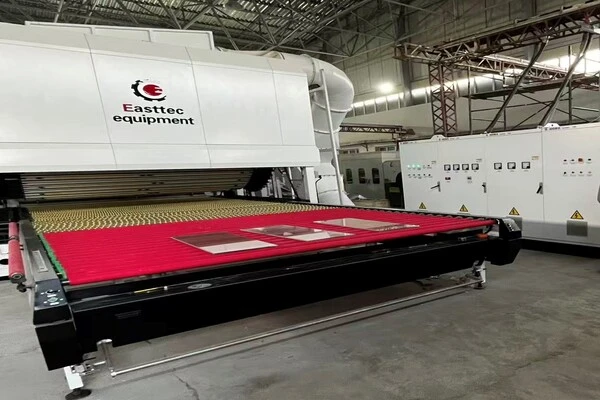
Radiation Precision Hard Roller Technology Explained
What Makes Hard-Roller Pressing Different?
When the glass sheet is bent, the hard-roller pressing device uses timed mechanical transfer to put the same amount of pressure on the whole width of the sheet. Arc variation is kept to 1.5 mm, which is a level of accuracy that regular soft-roller systems can't consistently reach. This level of accuracy is most important for automobile and furniture glass, where assembly fitting doesn't allow for any difference in curvature.
Matrix Radiant Heating and Independent PID Zones
The Matrix Radiant Heating system of the Radiation Precision Hard Roller Flat & Bent Glass Tempering Line doesn't use a single temperature curve to cover the whole furnace. Instead, it splits the heating room into separate zones, each with its own PID controller. With this design, the furnace can instantly adjust to changes in the thickness, emissivity, and shape of the edges of the glass. This makes the glass soften evenly across the whole sheet, which is very important when working with patterned or coated glass because warming in one spot can damage the surface permanently.
IPC & PLC Recipe Management
The Industrial PC and PLC control station that is built in can store process recipes that are already set up for different types of glass. The operators choose the right recipe for the new batch of orders, and the system makes the necessary changes to the heating curves, roller pressure, and cooling settings automatically. Within a week, new operators can be up and running, which directly addresses the skilled labor problem that many U.S. glass-making plants are presently facing.
Process Workflow for Managing Multiple Glass Orders Efficiently
When a batch of orders comes down the line, the IPC recipe system gets the set of parameters that goes with it. These include the heating temperature range, roller pressure profile, quench intensity, and bending radius configuration. The section for flat tempering can work with panels up to 2440x3660mm, and the section for dedicated bending can work with curved glass in a 2440x1500mm space, with a minimum bending radius of R ≥ 500mm.
Here are the core workflow advantages that enable efficient multi-order processing:
- Rapid mechanical changeover: Depending on the arc radius, switching between flat and bent production modes only takes 20 to 40 minutes of rearranging the machinery. The IPC recipe system gets rid of the need to re-enter parameters by hand, which cuts down on setup mistakes and downtime between order batches.
- Zoned thermal precision: The Matrix Radiant Heating furnace has separate temperature zones that let workers add glass of different thicknesses during the same production cycle without having to wait for the whole furnace to reach a new setpoint.
- Integrated quench optimization: The cooling stage changes the airflow and pressure based on the saved recipe. This makes sure that every panel, from a 4 mm furniture pane to a 12 mm architectural lite, leaves the line with a surface compression profile that meets EN 12150 and ASTM C1048 standards.
These workflow features of the Radiation Precision Hard Roller Flat & Bent Glass Tempering Line let glass makers run batches with different specifications at regular cycle times. This is what they need to be able to successfully meet the needs of a wide range of clients.
Comparing Hard-Roller Lines with Traditional Tempering Solutions
When the variety of orders grows, traditional tempering lines that use soft ceramic rollers or heating that is only based on convection have certain problems. When thermal cycling is repeated over and over, soft rollers deform and create rolling wave flaws that can be measured above 0.05mm. This is too small for optical screening to work for high-end building and car uses. Uneven wear on the roller array makes the inconsistency worse, and manual recalibration can't fully fix it.
In Easttec's system, the axis drive is made of high-temperature strong metal steel and a hard-roller design. This choice of material leads to much longer service intervals and less frequent replacement of wear parts. This lowers the cost of maintenance for production managers who are keeping track of how much time equipment is being used. It has been shown that fused silica rollers can last longer than ten years if they are properly maintained.
Energy use is another difference that can be measured. When compared to regular systems, Easttec's energy-saving design architecture cuts power use by about a third. When factory owners look at the total cost of ownership over a number of years, that reduction has a direct impact on their return on investment (ROI).
Maintenance and Optimization for Continuous Multitasking Performance
A proactive repair practice is needed to keep precision over hundreds of daily production runs. Roller surfaces should be checked often for dirt and wear and tear on the surface. Easttec's design includes a SO₂ injection system and automatic roller cleaning processes that keep the hard rollers' high-purity surface finish. This stops the "white haze" flaw that happens when glass touches a dirty roller surface.
Using calibrated reference instruments on a regular basis, you should check the temperature calibration across each PID zone. Polariscope analysis can be used to confirm that the edge stress is uniform, which means that the compression layer across bent panels meets the requirements for safety certification. Easttec offers online technical support 24 hours a day, seven days a week. Its world expert network helps with setting up, fixing problems, and making the best use of parameters for as long as the equipment is in use.
Conclusion
Now, handling multiple glass orders on a single production line is not just a matter of logistics; it is a standard that can be met if the right equipment design is in place, and the Radiation Precision Hard Roller Flat & Bent Glass Tempering Line delivers this capability. Precision hard-roller pressing, matrix radiant heating, and smart recipe management give glass makers the tools they need to handle orders for architectural, automobile, appliance, and furniture glass all in one continuous workflow. Easttec's glass tempering systems are based on more than 30 years of experience in thermal processing. The fact that they can be used for both flat and bent tempering shows that they really understand what modern glass manufacturers need.
FAQ
What glass thickness range does this tempering line support?
The system can work with both flat and bent glass that is between 3 mm and 19 mm thick. This covers most of the requirements for architectural, car, furniture, and appliance glass that are used in normal production settings.
How long does changeover between flat and bent modes take?
Depending on the desired bending radius, changing the machinery from flat to bent production modes usually takes 20 to 40 minutes. The IPC recipe system instantly changes parameters, so there are no mistakes made when entering them again by hand, and the whole transfer process takes less time.
Can the system process coated or patterned glass without surface damage?
When you use radiant heating, you don't have to deal with the turbulent forced air that can damage sensitive coatings. The precisely ground hard rollers get rid of even more surface friction artifacts, so the line can be used with clear, coated, or patterned glass.
What quality standards does the tempered glass output meet?
The system is designed to make glass that meets the certification standards set by EN 12150 and ASTM C1048. This includes meeting certain levels of fragmentation and surface flatness.
What after-sales support does Easttec provide?
Easttec provides full turnkey support that includes installation, commissioning, operator training, and online technical support 24 hours a day, 7 days a week. The system for post-sale help also includes services for getting spare parts and making changes to equipment.
Ready to Streamline Your Multi-Order Glass Production? Contact EASTTEC EQUIPMENT
Every project that EASTTEC EQUIPMENT works on is backed by more than 30 years of experience in thermal processing glass. As a reliable company that makes Radiation Precision Hard Roller Flat & Bent Glass Tempering Lines, we make sure that each system fits the voltage needs, glass specifications, and production goals of your facility. You can email our technical sales team at sales@easttecmachine.com to ask for a quote on custom equipment or to see a sample of a product.
References
1. Glass Processing Technology and Equipment Design — Glass Technology: European Journal of Glass Science and Technology, 2019.
2. Thermal Tempering of Glass: Principles and Industrial Applications — Journal of Non-Crystalline Solids, 2021.
3. ASTM C1048: Standard Specification for Heat-Strengthened and Fully Tempered Flat Glass — ASTM International, 2018.
4. EN 12150-1: Glass in Building — Thermally Toughened Soda Lime Silicate Safety Glass — European Committee for Standardization, 2015.
5. Energy Efficiency in Industrial Glass Furnaces — Glass International Magazine, 2022.
6. Automotive Glazing Manufacturing: Trends in Curved Glass Tempering Technology — International Journal of Automotive Engineering, 2020.

USER EVALUATE
Here is the customer's evaluation of us