




How Does Forced Convection Curved Glass Toughening Machine with Flexible Roller Work?
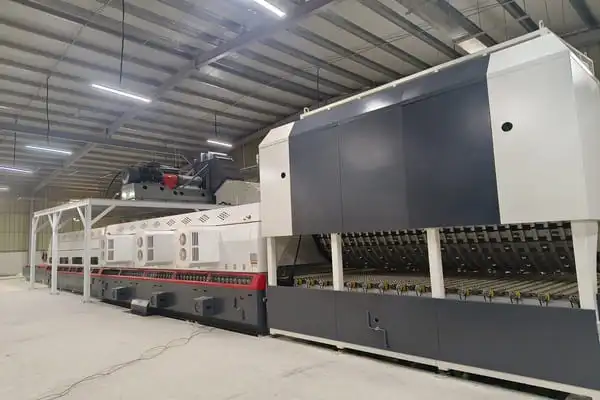
A Forced Convection Curved Glass Toughening Machine with Flexible Roller heats glass to between 680°C and 720°C using high-velocity recirculated hot air, then shapes it through a dynamically adjustable roller bed before rapid quenching locks in the tempered structure. Unlike radiant-only systems, the forced convection method actively pushes heated air across both glass surfaces simultaneously, producing temperature uniformity within ±5°C. The flexible roller bed replaces fixed molds, allowing operators to dial in curvature digitally in minutes. The result is consistent, optically clear bent tempered glass with surface compression stress exceeding 90 MPa.
Understanding Forced Convection in Curved Glass Toughening
It has always been hard to heat bent glass evenly in the glass industry. Flat glass has two sides that are parallel to each other, but bent glass has different distances from the heat source, which is hard for standard radiant heating to handle.
How Forced Convection Solves the Uneven Heating Problem
This problem is fixed by forced convection, which moves hot air through a system of high-pressure blowers. An internal hot-air loop is made inside the furnace room by a high-temperature fan. When air touches every curved surface, the difference in temperature across a complex architectural arc is much smaller than when infrared heating is used alone.
Energy Impact of Active Air Circulation
As you can see, active circulation does more than just heat glass faster. The optimized ceramic-fiber insulation in Easttec's convection furnace cuts thermal energy loss by 20%. The International Energy Agency says that about 70% of all the energy used in manufacturing goes to heating processes. This means that any measurable reduction in furnace heat loss directly leads to lower monthly electricity bills.
Why Low-E Glass Needs Convection Technology
Metallic oxide layers on Low-E glass can have emissivity values as low as 0.01. When processing Low-E products, radiant-only furnaces can be slower and less effective because these coatings reflect a significant portion of infrared radiation. A Forced Convection Curved Glass Toughening Machine with Flexible Roller addresses this challenge by using high-speed top airflow to transfer heat through direct contact between the moving air and the glass surface rather than relying primarily on radiant absorption. This convection-based heating approach allows the Forced Convection Curved Glass Toughening Machine with Flexible Roller to provide more consistent heat transfer across coated glass surfaces. By improving temperature distribution, the Forced Convection Curved Glass Toughening Machine with Flexible Roller can help maintain stable processing conditions for Low-E glass while supporting the required tempering temperature throughout the glass. For manufacturers processing coated architectural glass, the Forced Convection Curved Glass Toughening Machine with Flexible Roller provides a controlled heating solution designed to support consistent glass quality and coating performance.
The Role of Flexible Rollers in Curved Glass Toughening Machines
To keep the shape of the glass while it's being tempered, you need a support system that can bend with the glass and not break the sides or leave roller marks on the surface.
Materials and Construction of Flexible Rollers
Easttec's customizable roller system has heat-resistant, high-strength bendable rollers that are wrapped in a special fiber material. It protects the glass surface from wear and tear and stops the optical distortion lines that are sometimes called "roller wave." ASTM C1048 testing standards say that roller wave error must be less than 0.5 mm over 300 mm. A flexible roller system that is well taken care of stays well within that range.
Dynamic Curvature Adjustment Without Mold Changes
In the old way of tempering bent glass, each radius needed its own metal mold. The cost of making the mold and the time it took to switch it out added days to the production schedule. In a convection bending furnace, the bendable roller bed can be changed digitally. The Human-Machine Interface lets the operator enter the target radius. Within minutes, servo motors move each roller into place. This works for small custom orders, one-of-a-kind architectural projects, and the wide range of specifications that are popular in the business construction market in the U.S.
Yield Rate and Production Economics
Rigid rollers concentrate much of the mechanical stress at fixed contact points, which can increase the risk of edge chipping and surface damage during curved glass processing. In contrast, the Forced Convection Curved Glass Toughening Machine with Flexible Roller uses flexible rollers to distribute the load across a longer contact area. This design of the Forced Convection Curved Glass Toughening Machine with Flexible Roller can help reduce concentrated contact pressure and support more consistent handling of curved glass panels. By improving load distribution, the Forced Convection Curved Glass Toughening Machine with Flexible Roller may contribute to better batch yields, lower cost per finished curved tempered panel, and reduced glass waste. For production managers monitoring quarterly output and material efficiency, the Forced Convection Curved Glass Toughening Machine with Flexible Roller provides a flexible processing approach that can support more stable production. With its combination of forced convection heating and flexible roller handling, the Forced Convection Curved Glass Toughening Machine with Flexible Roller can help manufacturers manage demanding curved glass production requirements.
Step-by-Step Working Principle of Forced Convection Curved Glass Toughening Machine with Flexible Roller
Technical directors and process engineers can figure out if this equipment meets their needs by looking at the real production schedule.
In a normal production cycle, these steps are taken in order:
- Loading: Cut and edge-ground glass sheets are placed onto the roller conveyor at the furnace entry. The IPC automatically recalls the saved recipe for that glass thickness and curvature specification.
- Preheating zone: The glass enters a controlled preheating section where air temperature rises gradually, preventing thermal shock in thicker panels. Easttec's furnace supports glass from 4 mm up to 19 mm within a single machine platform.
- Heating zone: High-pressure convection circulates air at regulated velocity across both surfaces. Integrated temperature sensors feed real-time data to the PLC, making micro-adjustments to maintain ±5°C uniformity throughout the load.
- Bending stage: As glass reaches plastic temperature, the flexible roller bed activates. Servo-controlled rollers conform to the pre-programmed radius, shaping the softened glass without mechanical force beyond the weight of the sheet itself.
- Quenching: High-pressure cooling air blasts both surfaces simultaneously, rapidly dropping surface temperature and creating compressive stress layers that exceed 90 MPa—the threshold for fully tempered glass per EN 12150-1.
- Unloading and inspection: Finished panels exit onto the cooling conveyor. The IPC logs all process parameters for batch traceability.
Every step is automated and monitored. New operators usually learn how to run the whole machine and do routine maintenance in just one week. This directly helps U.S. glass processing plants that are having trouble finding skilled workers right now.
Comparing Forced Convection Flexible Roller Machines with Alternatives
When production managers look at capital tools, they want to see clear technical differences, not marketing speak.
Forced Convection vs. Radiant-Only Heating
Radiant furnaces use infrared radiation to heat glass. They work fine with regular clear float glass, but they move a lot more slowly with Low-E coatings. Easttec's forced convection technology heats 30% faster than similar models that only use direct heat. That difference in speed adds up to extra work that can be useful over the course of a full production shift.
Flexible Rollers vs. Fixed Mold Systems
For large orders requiring a single radius, fixed-mold methods can produce accurate and consistent curves. However, when a factory needs to handle multiple architectural requirements, the cost of maintaining mold inventory and the time required to change between models can affect production efficiency. The Forced Convection Curved Glass Toughening Machine with Flexible Roller uses a flexible roller forming method that can reduce the need for dedicated physical molds when changing between different curve specifications. This flexibility allows the Forced Convection Curved Glass Toughening Machine with Flexible Roller to support different bending requirements while maintaining controlled forming conditions. According to the stated equipment specifications, the Forced Convection Curved Glass Toughening Machine with Flexible Roller can achieve arc accuracy within ±0.5 mm of the specified CAD dimensions. For manufacturers handling varied architectural glass orders, the Forced Convection Curved Glass Toughening Machine with Flexible Roller can simplify production changeovers and reduce tooling requirements. By combining flexible forming with forced convection heating, the Forced Convection Curved Glass Toughening Machine with Flexible Roller provides a versatile approach for curved glass production with different radius specifications.
Automated IPC Control vs. Manual Operation
When temperature and pressure are changed by hand, human error is introduced into a heating process that should be able to be repeated. With a PLC interface and Easttec's Industrial PC control, you can store and quickly access bending recipes. Consistency from batch to batch gets better, the number of rejected customers goes down, and the data trail helps meet the quality certification needs of international construction contracts.
Maintenance Tips and Procurement Considerations for B2B Clients
Buying a bent glass tempering device is a big investment that usually pays for itself in a few years. It makes sense that the buying cycle in this section lasts between three and twelve months.
Routine Maintenance Priorities
The convection fan unit and the bendable roller mechanisms are the two parts that should be inspected on a regular basis. The wear on the bearings in a blower affects the speed of the movement and the evenness of the warmth. Roller surface condition has a direct effect on the quality of the glass. Visual checks should be done once a week, and bearing inspections should be done every three months. Easttec offers spare parts and online technical support 24 hours a day, seven days a week, which lowers the risk of long periods of downtime.
What to Evaluate When Selecting a Supplier
Certifications are important. Easttec's furnaces are made to meet CE standards, which is a big deal for glass makers working on U.S. projects that need safety standards that are known around the world. In addition to certification, you should also look at how customizable the supplier is. Easttec's voltage adapters can handle 220V, 380V, and 415V at both 50 Hz and 60 Hz. The company's software can also be used in English, Spanish, Russian, Korean, Portuguese, and other languages.
Aligning Procurement with Production Goals
Easttec takes between 60 and 120 working days to deliver customized furnaces, depending on how the model is set up. Planning purchases around project deadlines keeps output breaks from happening, which can be expensive. When comparing seller offers, you should look at the total cost of ownership, which includes things like energy use, spare parts, and output rate, along with the purchase price.
Conclusion
The Forced Convection Curved Glass Toughening Machine with Flexible Roller is designed to address many of the technical requirements of modern architectural glass production. Active air circulation, mold-free curvature changes through servo-controlled rollers, and IPC-driven process automation work together to support uniform and consistent curved tempered glass production. The Forced Convection Curved Glass Toughening Machine with Flexible Roller can provide controlled heating and flexible forming for manufacturers processing different glass specifications. In terms of production throughput, energy management, and product consistency, the Forced Convection Curved Glass Toughening Machine with Flexible Roller offers an integrated alternative to conventional radiant or fixed-mold systems. For factories producing Low-E glass, mixed-thickness orders, or customized architectural specifications, the Forced Convection Curved Glass Toughening Machine with Flexible Roller can provide greater flexibility across different production requirements. By combining forced convection heating, servo-controlled flexible rollers, and automated process management, the Forced Convection Curved Glass Toughening Machine with Flexible Roller provides a versatile platform for modern curved glass processing.
FAQ
What glass thicknesses can this machine process?
Easttec's forced convection flexible roller bending furnace handles glass from 4 mm to 19 mm within a single machine platform, covering both decorative thin glass and heavy structural panels.
How long does a radius changeover take?
Because the system uses a servo-controlled flexible roller bed rather than physical molds, a new bend radius is programmed through the HMI console. Changeover typically takes one to five minutes.
Can the machine process Low-E coated glass without damaging the film?
Yes. The high-velocity convection system heats glass through air contact rather than infrared radiation, preventing the film oxidation issue that radiant furnaces cause on metallic coatings with emissivity as low as 0.01.
What standards does the equipment meet?
Easttec furnaces are CE certified, and the tempering performance aligns with ASTM C1048 and EN 12150-1 standards for surface stress and fragmentation requirements.
What after-sales support does Easttec provide?
Easttec technicians offer 24-hour online support, on-site installation and commissioning, and operator training. New operators typically achieve full operational competence within one week.
Get Your Custom Quote from EASTTEC EQUIPMENT Today
Since 1994, EASTTEC EQUIPMENT has been making thermal processing equipment for glass. They use European convection technology to make kilns that use one-third less energy than regular systems. Contact our team directly if your factory needs a Forced Convection Curved Glass Toughening Machine with Flexible Roller. This is true whether you are a first-time buyer or an existing customer looking to switch suppliers. Send your production needs and specs to sales@easttecmachine.com, and you'll get a quote for custom equipment.
References
1. Glass Technology: European Journal of Glass Science and Technology, Society of Glass Technology, 2021.
2. ASTM C1048-18: Standard Specification for Heat-Strengthened and Fully Tempered Flat Glass, ASTM International, 2018.
3. EN 12150-1: Glass in Building — Thermally Toughened Soda Lime Silicate Safety Glass, European Committee for Standardization, 2015.
4. International Energy Agency, Tracking Industrial Energy Efficiency and CO₂ Emissions, IEA Publications, 2022.
5. Glass Processing Days Conference Proceedings: Advances in Tempering Technology, Glaston Corporation, 2019.
6. Journal of Materials Processing Technology: Thermal Stress Analysis in Glass Tempering, Elsevier, 2020.

USER EVALUATE
Here is the customer's evaluation of us