




Hard Roller Convection Technology Enhances High-Value Glass Production
When high-value glass demands zero compromise on quality, the Convection Hard Roller Flat & Bend Glass Tempering System has become the benchmark technology for architectural and industrial glass processors worldwide. This guide explores how Easttec's advanced convection hard roller platform solves the most persistent challenges in tempered glass production — from Low-E coating protection and arc precision to energy cost reduction — giving procurement decision-makers the technical clarity they need to invest with confidence.
Understanding Convection Hard Roller Glass Tempering Technology
Infrared elements are the only ones used in traditional radiation-based bending furnaces, and they have trouble penetrating high-performance Low-E coatings evenly. The convection hard roller method gets rid of that problem by using a completely different way to heat things up.
How the Convection Thermal System Works?
A variable-frequency high-pressure top convection unit in Easttec's system moves hot air directly across the glass surface. This moving thermal field gets rid of cold spots, evenly heats the glass to the right breaking point, and then starts the hard-roller bending mechanism at the perfect time. This makes a glass panel that bends evenly all the way around, not just around the edges.
The hard rollers are made of heat-resistant alloys that are ground to very tight tolerances and synced by a drive controlled by an inverter. It reliably goes through glass thicknesses from 3 mm to 19 mm without scratching the surface, and the system keeps the temperature within ±1 °C across the width of the furnace. This directly supports meeting the EN 12150-1 standards for thermally toughened safety glass.
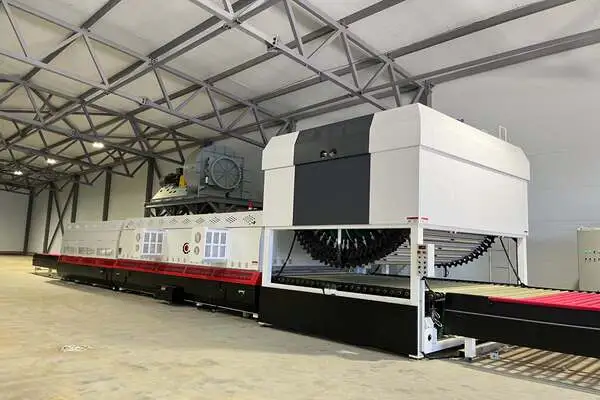
Advantages of Using Convection Hard Roller Technology for High-Value Glass
Curtain wall panel, car glass, and gadget glass manufacturers are always balancing the need for high output with low defect rates, and a Convection Hard Roller Flat & Bend Glass Tempering System really stands out in this area. When compared to older methods, convection hard roller tempering really stands out in this area.
Here are the main performance benefits that make this tool unique:
- 30% Faster Heating Cycles for Low-E Glass: The forced convection system gets around the heat-reflective properties of low-E coatings, such as glass with an emissivity as low as 0.01, by moving heat through the air instead of letting it be absorbed by radiation. Compared to regular infrared bending furnaces, this cuts the heating cycle time by more than 30%. This protects the film's structure by limiting the coating's exposure to high temperatures.
- 20% Reduction in Thermal Loss: Easttec designed its furnace room with high-density composite insulation and a thermal structure that works best. When inverter-controlled convection fans that change output based on real-time zone needs are added, energy loss drops by about 20%. This makes the cost of electricity per unit produced go down in a way that can be measured.
- Arc Deviation Within 1.0mm: When you use a uniform convection thermal field along with stiff hard-roller pressing, you can keep the arc's variation to within 1.0 mm. This level of accuracy in measurements meets the tightest requirements for high-end show glass and complicated building facades.
These numbers about performance are not just guesses. They show the technical choices Easttec made when choosing global tier-1 parts for its alloy pressing rollers, convection fans, and electrical control elements. All of these parts are rated for ongoing high-temperature use.
These advantages translate directly into lower scrap rates, higher daily output, and a stronger competitive position when bidding on international architectural projects that require CE-compliant bent tempered glass.
Comparing Convection Hard Roller Systems with Alternative Glass Tempering Technologies
Standard clear glass works well in a flat and bend kiln that only uses radiation, but when a production line has to work with high-performance Low-E substrates, the radiation model's flaws become clear with a Convection Hard Roller Flat & Bend Glass Tempering System: it takes longer to cycle, there's a chance that the film will oxidize, and the arc geometry won't be consistent on complicated shapes.
Where Convection Hard Roller Systems Pull Ahead?
The Easttec convection base fills in these gaps right away. Its variable-frequency convection system adjusts the heat supply to the emissivity of each type of glass. Fixed-output radiation furnaces, on the other hand, use the same energy profile no matter what the coating is made of. This flexibility is very important for workers who work with different types of production batches, like curtain wall panels in the morning and gadget glass in the afternoon.
While air quench hardening systems work well for flat glass, they can't match the geometric accuracy of hard-roller bending for bent items. Easttec's design uses a hard-axis horizontal bending mechanism that makes accurate arcs over and over again, which is something that air-pressure forming can't do on a large scale.
Procurement Guide for Global B2B Clients: How to Choose and Buy Convection Hard Roller Tempering Systems
When the glass processing industry makes decisions about large pieces of equipment, they have to go through three to twelve months of procurement cycles, multiple site evaluations, and strict technical reviews. Any real evaluation should be based on these factors.
Key Selection Criteria for Procurement Teams
Make sure the heater for the Convection Hard Roller Flat & Bend Glass Tempering System can handle all of your thicknesses. For most building and device uses, the 3mm to 19mm range works well. Make sure the control system doesn't use a simple PLC but an Industrial PC (IPC) platform that comes with recipe management already set up for different Low-E coatings. For bent-tempered goods, you should ask for proof that they are CE certified. This is what allows you to sell them in regulated building markets.
Easttec furnaces can be fully customized in terms of power systems (220V, 380V, 415V at 50/60Hz), equipment size, heating curve profiles, and program language (English, Spanish, Russian, Korean, and Portuguese). Depending on the setup, the wait time for delivery is between 60 and 120 working days. Technicians offer online support 24 hours a day, seven days a week after installation, and new operators usually become fully proficient within a week.
Best Practices and Tips for Maximizing the Benefits of Your Convection Hard Roller Tempering System
To get the most out of a convection hard roller furnace, you need to carefully handle the process as well as place it correctly.
Calibration and Maintenance Priorities
To keep the radius accurate, check the hard-roller system's mechanical drive and synchronization every 500 hours of use. Check the synchronization of the rollers on a regular basis. An uneven rotation speed can cause surface distortion that fails fragmentation testing. After servicing the heating elements, use thermal imaging to make sure there are no cold spots across the width of the furnace.
For Low-E glass specifically, load the IPC recipe that fits the emissivity number of your coating before each production run. The smart recipe management system lets your team save and quickly access process settings for each type of glass you work with. This cuts down on setup time and differences between batches. This directly supports even stress distribution above 90 MPa, which is the level needed for most safety glass certifications.
Conclusion
Convection hard roller technology, as found in the Convection Hard Roller Flat & Bend Glass Tempering System, is a real step forward for glass processors who need a single production tool that can handle both precise geometry and heat control that works with coatings. Easttec's system produces faster cycles, lower energy use, tighter arc tolerances, and CE-compliant output for all types of architectural and industrial glass by combining forced convection heating with rigid hard-roller forming. If processors want to increase their capacity, lower their unit costs, and be eligible for high-stakes international projects, this platform is a smart way to spend their money.
FAQ
How does convection heating protect Low-E coatings during bending?
Forced air flow boosts the temperature of glass without using radiation absorption, which Low-E films naturally don't do. This stops burning in certain areas and layer oxidation, so the coating keeps working well after cooling.
What glass thickness range does the Easttec convection hard roller furnace support?
When working with glass from 3 mm to 19 mm, the system reliably keeps the flatness and arc consistency across the whole range.
How much energy does convection hard roller tempering save compared to radiant furnaces?
Easttec's thermal insulation design and inverter-controlled fans cut down on energy loss by about 20%. The 30% faster heating cycle also lowers the total amount of energy used for each production batch.
What geometric tolerance can the hard-roller bending mechanism achieve?
The arc can only deviate by 1.0 mm, which meets the size needs of complicated architectural curtain wall and facade uses.
How long does operator training take?
The easy-to-use IPC interface and Easttec's on-site setup and training service help new users become fully proficient within a week.
Explore Easttec's Convection Hard Roller Flat & Bend Glass Tempering System
The Convection Hard Roller Flat & Bend Glass Tempering System supplier-grade platform was made by EASTTEC EQUIPMENT to meet the needs of major glass producers in the U.S. and around the world. This is a production investment that will pay off in the long run thanks to CE compliance, 30% faster Low-E processing, and the ability to make any changes you want. Email our expert team at sales@easttecmachine.com right now to get full specs, equipment demos, or a consultation that is made just for your project.
References
1. Glass Technology: European Journal of Glass Science and Technology, Society of Glass Technology, 2022.
2. Tempering and Strengthening of Glass, H. Rawson, Pergamon Press, 2019.
3. EN 12150-1: Glass in Building — Thermally Toughened Soda Lime Silicate Safety Glass, European Committee for Standardization, 2015.
4. International Journal of Applied Glass Science, American Ceramic Society, 2023.
5. Energy Efficiency in Industrial Furnaces and Thermal Processing Equipment, U.S. Department of Energy, Industrial Technologies Program, 2021.
6. Glass Processing Days Conference Proceedings, Glaston Corporation & Tampere University of Technology, 2022.

USER EVALUATE
Here is the customer's evaluation of us