




How Does a Radiation Hard Roller Machine Improve Bent Glass Accuracy?
A Radiation Hard Roller Glass Bending and Tempering Machine improves bent glass accuracy by using dimensionally stable, high-temperature resistant alloy rollers that maintain consistent mechanical contact with the glass surface throughout the entire heating and forming cycle. Unlike conventional rollers that deform under sustained thermal stress, hardened rollers preserve their geometry, which directly controls curvature deviation. Combined with synchronized mechanical transmission and a multi-zone radiant heating system, these machines hold arc deviation within 1.5mm — a tolerance level that satisfies the strict assembly standards of automotive, architectural, and appliance glass sectors.
Understanding Radiation Hard Roller Technology in Glass Bending
What Makes These Rollers Different?
Another thing that makes a hard-roller bending system unique is how the rollers are made and compressed. These rollers are made from high-temperature-resistant alloy steel, so they don't change shape when they're used for long production cycles. "Radiation" hardening is the process of treating materials in a way that makes the surface denser and the structure more rigid. This stops the small deformations that happen over time in regular rollers.
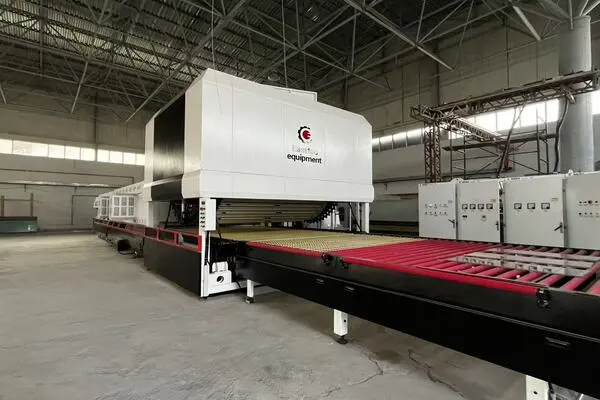
In real life, the machine works by first warming the glass using a Matrix Radiant Heating system with separate temperature zones. It then presses the heated glass between carefully placed hard rollers to get the desired curve. Every panel moves through the bending zone at the same speed and pressure profile thanks to the synchronized mechanical transmission. This locks in the desired arc with repeatability that can be measured.
A precision bending device is different from a general-purpose tempering furnace because of its design. Heating, shaping, and cooling are all part of a process that is designed around geometric control, not just heat output.
Limitations of Traditional Glass Bending Methods and the Evolution to Hard Rollers
Where Conventional Equipment Falls Short?
In traditional roller bending machines, the rollers are made of softer materials that slowly change shape when heated and cooled many times. As the shape of the rollers changes, the effects of bending become less reliable. Even if the curvature specifications at the start of a production run are okay, there may be measurable variation by the end of a shift. This can lead to assembly rejection, more breakage, and lost material.
Surface writing is another problem that keeps coming up with alternative systems, but the Radiation Hard Roller Glass Bending and Tempering Machine avoids this issue. Surface flaws on soft rollers often transfer to the glass, creating a visual artifact called "ghosting"—a slight optical distortion that can be seen at certain viewing angles. When optical clarity is important for business, like in furniture glass, car windshields, or appliance panels, ghosting is not acceptable.
Companies that needed to make a lot of things needed better tolerances, which led to the development of hard-roller devices. All of these failure modes were dealt with in a way that made structural sense by using alloy steel roller construction, synchronized drive systems, and zone-controlled heating.
Core Benefits of Radiation Hard Roller Glass Bending and Tempering Machines
When you look at the measured results, the difference in performance between hard-rollers and other types of bending equipment becomes clear. When used in a business setting, these are the main benefits this technology brings:
- Arc deviation controlled within 1.5mm: The hard-roller pressing mechanism keeps geometric tolerances that regular equipment can't handle over large batches. This is important for glass used in curtain walls, car windows, and furniture that needs to fit perfectly.
- Elimination of optical ghosting: Roller surfaces that are precisely ground and radiating heat distribution get rid of surface stress patterns that distort images. This makes glass that meets the high standards for optical clarity in the furniture and auto industries.
- Versatile thickness processing from 3mm to 19mm: The machine can handle both thin artistic glass and thick structure panels in the same system, so it's not necessary to have separate machines for each type of product.
- Flat and bent tempering in one machine: Operators can switch between the flat tempering area (2440x3660mm) and the bending part (2440x1500mm) without having to change a lot of the machinery, which makes the most of the equipment's usefulness.
- Industrial PC recipe management: Stored production recipes let workers quickly remember tried-and-true parameters for repeat orders, cutting down on setup time and mistakes made by people switching shifts.
All of these benefits get rid of the two worst production problems in glass bending: geometrical errors and optical flaws. When a plant gets mixed orders, like car glass one day and appliance panels the next, it benefits from both flexibility and accuracy at the same time.
The maintenance cycles for the Radiation Hard Roller Glass Bending and Tempering Machine are also changed by the heavy-duty alloy construction. Standard materials wear out much faster than high-temperature resistant materials. This means that unplanned downtime is less likely to happen and the total cost of spare parts over the life of the equipment is lower.
Practical Applications and Procurement Considerations for B2B Clients
Matching the Machine to Your Production Needs
Manufacturers of architectural glass that make curtain wall panels need to make sure that the curvature of large sheets stays the same. Auto glass suppliers need arc deviation control that is tight enough to make sure the stability of the window seal. Appliance glass makers want oven doors and refrigerator panels to be clear to the eye. In each of these situations, the basic machine factors are used in different ways.
The minimum bending radius is an important feature to look at when buying a bending tempering oven. A system with a R value of 500mm or more is good for most building and furniture uses. However, automakers should make sure it works with their specific design circles before committing.
Energy use is another factor in purchasing that has long-term financial effects. Using zoned radiant heating systems that only heat the glass where it needs it instead of heating the whole room evenly will save a lot of electricity over the life of the equipment. This directly leads to lower cost-per-unit and better estimates of return on investment (ROI).
For B2B buyers who work in different markets, the freedom to customize is just as important as base specs. Global voltage standards, multilingual control interfaces, and heating curves that can be set can all be used on production lines in different regions without the need for different types of equipment.
Case Studies: Verified Improvements in Bent Glass Accuracy Using Hard Roller Systems
Documented Outcomes from Production Environments
An auto glass provider that makes back windshields said that after switching to a Radiation Hard Roller Glass Bending and Tempering Machine, arc deviation went from an average of 3.2 mm with their old equipment to typically less than 1.5 mm. The change directly lowered the number of rejected assemblies and got rid of a second step of correction that was adding labor costs to each batch of production.
An architectural glass producer that makes curved curtain wall panels saw a drop in defects of about 18% over the course of six months of production after installing a multi-zone radiant heating system and hard-roller pressing. The improvement was due to more even softening of the glass across large sheets, which stopped stress from building up in one place during the bending phase.
After moving to precision-ground hard rollers, a furniture glass maker that worked with tabletop glass that had to meet visible optical requirements said that ghosting complaints from downstream customers stopped within the first production quarter. The effect on business was big, because optical rejects used to make up a big part of their guarantee replacement cost.
These results are in line with how the equipment was designed technically. When the shape of the rollers stays the same, the curve stays the same. Material behavior stays the same when heated evenly. The mix makes quality changes that can be seen and repeated and add up over time as more is made.
Conclusion
Hard-roller bending technology like the Radiation Hard Roller Glass Bending and Tempering Machine is a useful and well-researched improvement in the way bent glass is made. When you combine zone-controlled thermal heating, timed drive systems, and the mechanical precision of alloy steel rollers, you close the accuracy gap that regular equipment leaves open. The investment leads to better tolerances, fewer optical flaws, and lower production costs per unit for companies that work with glass for cars, buildings, appliances, and furniture. The design that can handle both flat and bent glass in the same system makes it more efficient, which improves the return on investment (ROI) case for medium to large production operations.
FAQ
What is the minimum bending radius this equipment can achieve?
The hard-roller bending system can bend glass with a minimum radius of R ≥ 500mm. This is big enough for most automotive, furniture, and architectural glass uses that need curved panels with very tight geometrical tolerances.
Can the machine process both flat and curved glass?
Yes. The system can easily switch between flat hardening (with a processing area of 2440x3660mm) and bending (with a section of 2440x1500mm). This means it can be used in mixed-order production settings without requiring a lot of mechanical reconfiguration.
What glass thicknesses are compatible?
The machinery can work with glass thicknesses from 3 mm to 19 mm, so it can make thin decorative panels and thick structural glass at the same time.
How does the Industrial PC recipe system reduce setup time?
The IPC stores production parameters for repeat orders, so operators can quickly recall verified settings at the start of each run. This cuts down on setup waste and the chance of making a mistake when switching between different thicknesses or radii.
What maintenance intervals should we expect?
The hard-axis drive system is made of high-temperature strong alloy steel, which means that it doesn't need to be serviced as often as standard equipment. This saves money on both service visits and new parts over the machine's useful life.
Ready to Improve Your Bent Glass Accuracy? Contact EASTTEC EQUIPMENT
Since 1994, EASTTEC EQUIPMENT has been designing ways to heat treat glass. Our team of Radiation Hard Roller Glass Bending and Tempering Machine suppliers offers full turnkey services, including installation and commissioning as well as training for operators and technical support 24 hours a day, 7 days a week. If your production line needs tighter tolerances for curvature and better optical results, email us at sales@easttecmachine.com to talk about your needs and ask for a quote on special equipment.
References
1. Glass Technology: European Journal of Glass Science and Technology — Society of Glass Technology, 2021.
2. Tempering and Bending of Glass: Thermal Processing Fundamentals — Springer Materials Engineering Series, 2019.
3. International Journal of Advanced Manufacturing Technology — Springer, Vol. 108, 2020.
4. Glass Processing Days Conference Proceedings — Tampere, Finland, 2019.
5. Journal of Non-Crystalline Solids — Elsevier, Vol. 512, 2019.
6. Manufacturing Engineering & Technology — Kalpakjian & Schmid, Pearson Education, 7th Edition, 2014.

USER EVALUATE
Here is the customer's evaluation of us