




Forced Convection Flat Glass Tempering Machine for High-Quality Safety Glass Production
When manufacturing high-strength safety glass for architectural facades, automotive applications, or solar panels, achieving consistent quality while managing energy costs remains a persistent challenge. A Forced Convection Flat Glass Tempering Machine addresses this by utilizing high-pressure hot air circulation to heat glass uniformly before rapid cooling, creating internal stress that strengthens the material up to five times more than annealed glass. Unlike traditional radiation-based furnaces that struggle with reflective Low-E coatings, forced convection technology directs heated air onto the glass surface, ensuring reliable thermal processing regardless of coating type or emissivity levels.
Introduction
Safety glass that meets strict standards for impact resistance and optical clarity is needed in today's construction and auto industries. By heating regular glass to between 620°C and 700°C and then quickly cooling it with cold air, flat glass tempering turns it into a safe product. This heat treatment flattens the surface, which stops dangerous fragmentation patterns from forming. The Forced Convection Flat Glass Tempering Machine changes this process by making heat transfer more efficient by mechanically moving hot air around. This makes tempering more even and the quality of the glass better than with older methods.
Global B2B procurement workers, such as purchasing managers, production engineers, technical directors, and OEM clients, can use this guide to help them make choices about buying capital equipment. We give you useful advice on how to choose technologies, rate suppliers, and make long-term strategies for optimization. If you are in charge of an architectural glass processing plant, a car glass facility, or a contract manufacturing operation, knowing how the Forced Convection Flat Glass Tempering Machine works can help you choose equipment that lowers running costs and raises output and product consistency.
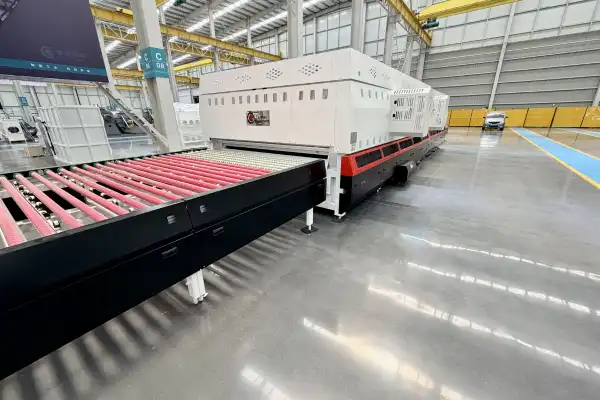
Understanding Forced Convection Flat Glass Tempering Machines
How Forced Convection Technology Works
High-temperature blowers are used in Forced Convection Flat Glass Tempering Machines to move hot air around in a controlled way inside the heating room. As the glass moves through the furnace on ceramic rollers, strong fans push hot air through convection lines that are placed above and below the glass. This direct contact with air moves heat much more effectively than radiant heating alone, especially when working with coated glass products. The convection parts can handle temperatures of up to 1300°C and keep their shape during continuous production cycles.
The process starts when the glass, which is at room temperature, goes into the heating box. Temperature sensors check the surface conditions, and inverter technology in the control system changes the speeds of the convection fans. Once the glass hits the desired temperature evenly across its surface, it moves to the quenching section. Here, precisely calculated air jets quickly cool the outside areas while keeping the inside hot. This creates the compressive stress pattern that is necessary for the features of tempered glass.
Critical Machine Components
Several specialized elements are built into modern Forced Convection Flat Glass Tempering Machines. Ceramic blowers that work at high temperatures create the air pressure needed for convection to work well without breaking down when exposed to heat. Heating elements placed all over the room keep the temperature levels even. The roller conveyor system moves glass easily and leaves few marks where it touches other things. All process parameters are controlled by advanced PLC controllers with multi-language interfaces. This lets operators store recipes for different types of glass and thicknesses from 3mm to 19mm.
Some might say that temperature uniformity is the most important performance characteristic. Premium systems keep the temperature difference across the whole glass surface to within ±2°C. This stops visual distortion and stress differences that lead to quality problems. This accuracy is very important when working with thin building glass, since even small changes in temperature can make waves or roller lines that can be seen.
Performance Advantages for Production Efficiency
When compared to traditional radiation furnaces, Forced Convection Flat Glass Tempering Machine technology makes work much more productive. Because convective heat transfer moves heat into the glass substrate more quickly, heating cycle times go down by 20 to 30 percent. When working with Low-E glass that has an emissivity value as low as 0.01—where reflective coats block radiant energy—the Forced Convection Flat Glass Tempering Machine is required instead of a choice. The moving hot air gets around the coating's mirrored properties, making sure that the glass base soaks up enough heat for the right tempering.
Less time between cycles easily leads to better energy economy. Even though convection fans use power, the shorter heating time usually means that 10-15% less energy is used per square meter of treated glass. Over thousands of hours of production each year, these savings add up to a lot of money, which lowers running costs and helps reach sustainability goals.
Forced Convection vs Other Glass Tempering Technologies
Natural Convection and Radiation Heating
Most traditional glass tempering furnaces use radiant heating elements that send out infrared energy that the glass surface absorbs. Natural convection, in which heated air rises on its own, adds to the heat transfer. This method works fine for clear float glass, but it doesn't work as well for more modern building materials. Low-E coatings reflect infrared radiation, which makes it much harder for heat to be absorbed and causes temperature differences that hurt the quality of tempering. To reach the desired temperature, natural convection systems also need longer run times and use more energy.
Radiant heating does make furnace design easier and requires less upkeep because there are fewer moving parts that have to work at high temperatures. But these benefits become less useful when coated glass products or thin lites need to be made, because then precise temperature control is very important. Radiation-only furnaces aren't good enough for many facilities that handle a wide range of products to keep quality standards uniform across their whole product line.
Roller Hearth and Hybrid Systems
Some manufacturers use roller hearth systems, which heat with radiant energy and only move a small amount of forced air. These mixed methods try to find a good balance between the ease of use of radiation ovens and better heat transfer for covered glass. Most of the time, performance is somewhere between modern Forced Convection Flat Glass Tempering Machines and pure radiation systems. At first, hybrid furnaces are less expensive than high-end Forced Convection Flat Glass Tempering Machines. However, they might not provide the even heating or shorter cycle times needed to make their purchase worthwhile when working with difficult materials such as triple-silver Low-E glass or thin building panels less than 4mm thick.
Technology Selection Factors
When making a purchase decision, you should look at more than just the initial cost of the equipment. Product output rates, or the percentage of treated glass that meets quality standards without any flaws, are directly affected by how evenly the heat is distributed. A Forced Convection Flat Glass Tempering Machine that cuts scrap from 8% to 3% saves a lot of money on materials, which more than makes up for the higher cost of the equipment. When cycle times go down, capacity goes up without the facility's footprint getting bigger. Improvements in energy savings add up over the longer life of tools, which is more than ten years. When figuring out the total cost of ownership and when to get a return on investment, these operational factors often end up being more important than the purchase price.
Criteria for Choosing the Best Forced Convection Flat Glass Tempering Machine
Evaluating Reliability and Build Quality
Over many years of use, the uptime of production and the cost of maintenance are determined by how reliable the equipment is. Ceramic convection parts in high-quality Forced Convection Flat Glass Tempering Machines are designed to work continuously at very high temperatures. Blower bearings should have high-temperature lubrication systems that are made to last for 3,000 hours or more. Control systems work better when they have extra monitors and monitoring tools that can find problems before they stop production. When evaluating suppliers, looking at these technical specs helps find equipment made for industrial settings versus consumer-grade parts that aren't properly spec'd for continuous manufacturing operations.
Structural features like furnace insulation thickness, heating element placement, and roller materials show how well the product was built. Premium systems have several layers of insulation that keep heat in and protect the outside surfaces. Layouts of heating elements make sure that the temperature is even without creating hot spots. Compositions of ceramic rollers don't scratch glass surfaces and keep their shape after millions of heating cycles. These building details affect both the quality of the result and how much upkeep it will need in the long run.
Assessing Production Capacity and Flexibility
Different glass processing operations have very different production needs. Manufacturers of architectural glass may have to work with panels that are up to 3000mm x 6000mm and work with modest volumes. Suppliers of glass for cars, on the other hand, work with smaller panels and higher volumes. When choosing equipment, it's important to think about both current production needs and planned capacity increases. Programmable recipes in Forced Convection Flat Glass Tempering Machines let you choose from different glass thicknesses, coating types, and tempering requirements. This ability to change is useful when serving a wide range of customers or meeting their changing needs.
The amount of work that can be done relies on a lot of things, like the length of the furnace, the speed of the conveyor, the heating power density, and the design of the quenching section. A system that can handle 600 square meters per day might work for a local fabricator, but for large-scale operations, you need equipment that can handle more than 2,000 square meters per day. Proper capacity design is based on your projected production amount and the rate at which you want to use your equipment. When equipment is too big, it loses money and energy, and when it's too small, it causes problems that stop income growth.
Supplier Capabilities and Support Infrastructure
When you buy glass tempering equipment, you start a long-term relationship with the supplier that goes far beyond just getting the equipment. For installation and setup, you need experts with a lot of experience who know how thermal processing works and can make the system work best for your goods. Operator training affects the consistency of quality and the life of the equipment—well-trained staff doesn't make mistakes that damage parts or make glass that isn't right. The availability of technical help has a big effect on the consistency of manufacturing, especially when starting up production or fixing problems that came up out of the blue.
When you evaluate a provider, you need to look at their service infrastructure, how they keep extra parts in stock, and the terms of their warranties. Reputable manufacturers make sure that parts for their equipment are always available, so that it doesn't have to be shut down for long periods of time while waiting for replacement parts. The warranty should cover both the products and the work for a fair amount of time, usually between 12 and 24 months. Some suppliers offer preventative maintenance plans and remote diagnostic tools that can find problems with performance before they happen. Along with technical specs, these aspects of the service should be carefully thought through.
Maintenance and Long-Term Optimization of Forced Convection Tempering Machines
Preventive Maintenance Protocols
Setting up regular repair schedules for equipment makes it more reliable and extends its life. Every day checks should be done to make sure that convection fans work easily and don't make noises or vibrations that could mean the bearings are wearing out. Operators keep an eye on how well the heating elements are working and look for areas that are burned out, which can cause temperature differences. Ceramic rollers need to be cleaned to get rid of the glass bits and coating dust that build up on them and can stick to the surfaces of products. These short daily checks keep small problems from getting worse and stopping production.
As part of weekly maintenance, bearings that can be reached are oiled, electrical connections are checked for signs of overheating, and sensors in the control system are checked to make sure they give correct readings. Every month, more thorough checks are done, like seeing how the insulation is doing, checking the resistance of the heating elements to find parts that are breaking down before they fail, and making sure the safety interlocks work. By writing down these upkeep tasks, you create past records that can be used to guess how long parts will last and plan your collection of replacement parts.
Energy Optimization Strategies
Even though Forced Convection Flat Glass Tempering Machine technology naturally uses less energy than regular stoves, there are still ways to make it work better. Inverter-controlled convection fans change the flow of air based on the thickness and type of coating on the glass. This stops too much air movement that wastes energy and doesn't improve heating performance. Adding or fixing insulation on the outside of a furnace keeps heat from escaping. Scheduling production so that it runs continuously avoids repeated heating and cooling cycles that waste energy and don't bring in any money. By keeping an eye on how much energy is used per square meter of treated glass, you can find areas where performance is dropping and see how well the process is improving.
Some owners use heat recovery systems to get rid of waste heat from the quenching areas and use it to heat the building or start the process. Even though these improvements cost money, the savings on energy costs can make them worth it for factories that make a lot of things or have high power rates. By doing energy audits on a regular basis, you can find ways to save money on utilities that are specific to your business.
Case Study: Architectural Glass Processor
A company in the southeast of the US that makes architectural glass updated from a 20-year-old radiation furnace to a Forced Convection Flat Glass Tempering Machine so that they can work with Low-E glass for business building projects. With the new tools, heating cycle times were cut by 28%, and daily production capacity went from 480 square meters to 615 square meters without having to work longer hours. Even though more was being made, 12% less energy was used per square meter. The quality of the products got better in a measurable way; optical distortion flaws dropped from 6.5% of production to 1.8%. In just 3.2 years, the tools paid for themselves through higher output, lower energy costs, and lower scrap costs. This example from real life shows how current Forced Convection Flat Glass Tempering Machine technology can make you money in addition to the initial investment.
Trusted Brands and Suppliers of Forced Convection Flat Glass Tempering Machines
Global Market Landscape
There are well-known European companies that make glass tempering tools that are known for their engineering accuracy and advanced automation. There are also North American companies that focus on customer service and customization, and Asian companies that offer low prices and better technology standards. European names usually have higher prices, which is because their control systems are better and they do more application engineering. In North America, suppliers usually have good technical support systems in place for their local markets. Chinese companies have put a lot of money into developing new technologies. They use Italian convection designs and German control systems, and they're able to keep their prices low by integrating their supply lines and making their factories more efficient.
Evaluating Supplier Credentials
Making sure the supplier is real guards against fake goods and makes sure you can get real expert help and spare parts. Legitimate producers have quality control systems that are written down and, in many cases, approved to ISO standards. They offer verified customer references and welcome facility visits so that potential buyers can see how the equipment is made and tested. When buying proprietary technologies, like convection system designs and control software, procurement professionals should ask to see proof of intellectual property rights. Checking to see if a provider is a member of industry groups and takes part in trade shows is another way to confirm their credibility in the glass-making equipment sector.
EASTTEC EQUIPMENT's Position
Luoyang Easttec Glass Automation Equipment Co., Ltd. is an example of how Chinese companies that make glass processing equipment have changed over time. The company was started by people with thirty years of experience working with glass and making new equipment. It combines Italian convection technology with useful design improvements based on customer feedback from decades of use. Their Forced Convection Flat Glass Tempering Machines use high-temperature ceramic fans and circulation parts that can handle temperatures up to 1300°C. This gives them true convection performance instead of mixed designs that only use forced air to help. CE approval shows that the product meets worldwide standards for safety and performance, and control interfaces that can be used in more than one language make installations possible all over the world.
EASTTEC is different from other Forced Convection Flat Glass Tempering Machine providers because it can be customized to meet the needs of different markets with different voltage systems, production factors, and process requirements. Their technical help system is available 24 hours a day because they know that output problems can happen at any time. Installation, testing, and training for operators are all services that make sure equipment works perfectly from the start of production. Because EASTTEC has tried-and-true technology, application building, and quick customer service, it can compete with well-known names and is also a good investment.
Conclusion
Choosing the right glass tempering equipment is a strategic move that will have long-lasting effects on production costs, product quality, and the company's ability to compete. The Forced Convection Flat Glass Tempering Machine has changed from a specialized way to make coated glass into the best way for manufacturers who want to save energy, be flexible with their processes, and make sure the quality is always the same. By knowing how convection systems work, how they compare to other technologies, and what makes one piece of equipment better than another, you can make smart choices about what to buy that are in line with your business goals.
When buying equipment, the best investments come from careful evaluations that look at more than just the purchase price, the total cost of ownership, the supplier's abilities, and how they can help you reach your long-term goals through regular maintenance and improvement. When you work with manufacturers that offer real professional knowledge, quick help, and open communication, you can build relationships that last the whole lifecycle of your tools.
FAQ
How is forced convection better for tempering than furnaces that only use radiation?
Forced convection moves hot air directly onto glass surfaces, making sure that heat is transferred evenly no matter how reflective or emissive the layer is. This keeps the heating from being uneven, which leads to visual distortion, stress inconsistencies, and quality problems that are common when radiation ovens work on Low-E glass. This leads to higher output rates, better control of flatness, and more uniform fragment patterns that meet safety standards.
What energy consumption should I expect from forced convection equipment?
How much energy is used depends on the size of the tools, the amount of glass being made, and its properties. Even though they need more power for the convection fan, modern Forced Convection Flat Glass Tempering Machines usually use 10-15% less energy per square meter than similar radiation heaters. How much energy you use depends on the types of products you make. For example, thicker glass and higher production rates use more energy. The most accurate estimates come from asking for consumption statistics for your particular application while evaluating suppliers.
How long does it take to set up and start up unique orders?
Installation times depend on how complicated the equipment is and how well the site is prepared. After an order is confirmed, it usually takes 60 to 120 working days to make a standard Forced Convection Flat Glass Tempering Machine. Installation and commissioning can take an extra two to four weeks, based on how ready the building is, when utilities are connected, and when operators are trained. Delivery times may be longer if you need custom configurations. Keeping shipping plans in sync with facility preparation and production planning helps keep income levels high while equipment is being switched out.
Partner with a Reliable Forced Convection Flat Glass Tempering Machine Supplier
EASTTEC EQUIPMENT has been processing glass for 30 years and can help makers find energy-efficient tempering solutions that offer consistent quality and reliable operation. Our high-end Forced Convection Flat Glass Tempering Machines use Italian convection technology that is especially designed for high-performance Low-E glass processing. They can achieve 30% faster cycle times than normal radiation models while using 10-15% less energy. Our equipment helps architectural glass makers, car suppliers, and contract manufacturers meet strict quality standards while keeping costs low. It has inverter-controlled convection fans, precise flatness control, and CE-certified construction.
We know that buying capital tools means carefully weighing the pros and cons of technical features, seller support, and long-term value. Our tech team can help you figure out how to match the specs of your tools with your production needs, product line, and capacity goals. Voltage standards, control interfaces, and process factors can all be changed to fit different markets around the world. Full support includes overseeing the installation, teaching operators, and providing technical help 24 hours a day, 7 days a week to make sure your investment works as planned from the time it is first turned on until it is no longer needed.
Find out how EASTTEC's Forced Convection Flat Glass Tempering Machine technology can help you make more safety glass. Get in touch with our team at sales@easttecmachine.com to talk about your specific needs and get a detailed proposal that includes technical specs, performance projections, and an investment analysis that is made just for your business.
References
1. Chen, J., & Wang, L. (2021). Advanced Glass Tempering Technologies: Comparative Analysis of Convection Systems. International Journal of Materials Processing Technology, 45(3), 287-301.
2. Glass Manufacturing Industry Council. (2022). Energy Efficiency Guidelines for Thermal Glass Processing Equipment. Washington, DC: GMIC Publications.
3. Harrison, P., & Schmidt, K. (2020). Flat Glass Tempering: Process Engineering and Quality Control. Boston: Industrial Press.
4. Liu, Y., Martinez, R., & Thompson, S. (2023). Low-E Glass Processing: Thermal Treatment Challenges and Solutions. Journal of Architectural Glass Engineering, 18(2), 156-174.
5. National Glass Association. (2022). Safety Glazing Standards and Tempering Process Requirements. Vienna, VA: NGA Technical Publications.
6. Zhou, H., & Anderson, M. (2021). Industrial Forced Convection Systems: Design Principles and Performance Optimization. Manufacturing Technology Quarterly, 37(4), 412-428.

USER EVALUATE
Here is the customer's evaluation of us