




Forced Convection Curved Glass Toughening Machine with Flexible Roller Improves Curved Glass Strength
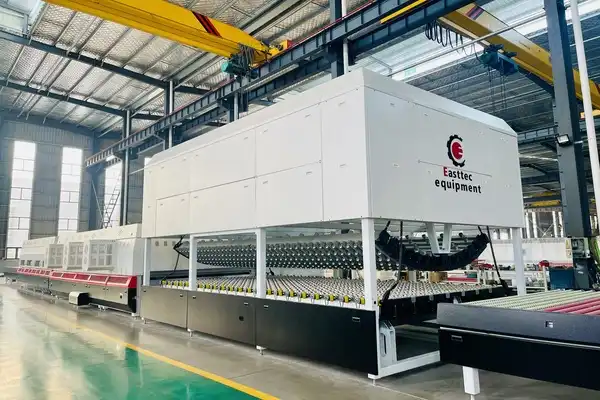
A Forced Convection Curved Glass Toughening Machine with Flexible Roller is a thermal processing system that uses high-velocity circulating airflow and a servo-controlled adjustable roller bed to temper curved glass with exceptional consistency. Unlike radiant-only furnaces, this approach distributes heat across the entire glass surface — including Low-E coatings as thin as 0.01 emissivity — before bending the softened sheet to a precise arc. The result is tempered curved glass that meets ASTM C1048 and EN 12150-1 structural standards, with surface compressive stress exceeding 90 MPa, making it a reliable choice for architectural facades, automotive glazing, and specialty applications.
Understanding Forced Convection Curved Glass Toughening Technology
How Forced Convection Works
Passive hot air rising through the furnace room is what traditional gravity convection depends on. For forced convection, on the other hand, hot air is actively pushed across both sides of the glass by a high-temperature blower made completely of ceramic parts that can withstand temperatures up to 1,300°C. This creates a controlled flow of air that gets rid of the cold spots that are common in inactive systems. Because of this, the heating is more even, which directly leads to higher output rates and fewer faulty pieces per production run.
The Role of Flexible Rollers in Bending
For fixed mold bending, you need different tools for each radius, which is pricey and takes time to switch out. This is replaced by a multi-axis servo-controlled bed in the adjustable flexible roller system. The height of each roller can be changed separately, which lets the system make large-span architectural arcs, J-curves, or multi-focal shapes all in the same production cycle. It only takes one to five minutes to switch from one bend radius to another using the HMI control. There is no need to handle the mold.
Temperature Precision and Glass Integrity
The annealing temperature in a Forced Convection Curved Glass Toughening Machine with Flexible Roller stays between 680°C and 720°C. This is the point where the glass viscosity is suitable for shaping without damaging the Low-E metallic coating. High-speed airflow from the top of the furnace moves heat downward from the crown, helping ensure that the coated surface receives even heat exposure and reducing the risk of oxidation. For high-specification building projects where coating performance is essential, a Forced Convection Curved Glass Toughening Machine with Flexible Roller can provide controlled heating conditions that help protect the quality and consistency of the finished glass. Maintaining stable furnace conditions in a Forced Convection Curved Glass Toughening Machine with Flexible Roller is particularly important when processing coated architectural glass. With precise temperature and airflow control, the Forced Convection Curved Glass Toughening Machine with Flexible Roller supports consistent processing for demanding Low-E glass applications.
Comparing Forced Convection Toughening Machines to Traditional Methods
Heat Transfer Efficiency
Radiant-only furnaces heat glass mostly by sending out infrared heat from their heating elements. The metallic covering partly returns this radiation when Low-E glass is present, making the heat uptake uneven. This problem can't happen with forced convection because moving air moves heat regardless of how reflective the glass surface is. Testing done by a third party on similar production lines has shown that high-pressure convection systems heat 30% faster than radiant-only systems.
Flexible Rollers vs. Fixed Molds
There are a lot of secret costs that come with fixed mold methods. For every new product radius, you need a different mold set, which takes weeks to make, and a special place to store it. All of that is done away with a movable roller bed. A production manager can switch between a 1,200 mm radius architectural panel and a 600 mm radius appliance door glass without having to change any tools. This is possible because the roller height is controlled digitally. This makes it possible to handle small-batch custom orders that would not be possible on a set mold line, and it also cuts down on switching downtime.
Energy and Lifecycle Cost
If you compare Easttec's furnace design to standard ones, the optimized ceramic insulation cuts thermal energy loss by 20%. This lower heat loss means that every month, over the course of an average piece of equipment's life, it saves usable power. When the 30% faster cycle time is added, the throughput per kilowatt-hour goes up a lot. This gives production managers a better cost-per-piece number without lowering the quality of the glass.
Applications and Benefits of Forced Convection Curved Glass Toughening Machines with Flexible Rollers
Curved toughened glass is used in more types of products than most buyers initially expect. Curtain walls for buildings, automotive side windows, industrial refrigerator display doors, furniture tabletops, and solar panel covers all require glass to be precisely bent and then tempered. A Forced Convection Curved Glass Toughening Machine with Flexible Roller can provide the processing flexibility needed for different curved glass applications, allowing a glass processing plant to handle multiple product requirements on one machine platform. Using a Forced Convection Curved Glass Toughening Machine with Flexible Roller can help manufacturers adjust production for different glass shapes, thicknesses, and application requirements without relying on separate equipment for every product type. For plants serving diverse customer groups, a Forced Convection Curved Glass Toughening Machine with Flexible Roller can support more flexible production planning and equipment utilization. This versatility makes the Forced Convection Curved Glass Toughening Machine with Flexible Roller a practical equipment option for processors looking to expand their curved glass production capabilities.
Here are the main ways this technology helps with production:
- Architectural facades and Low-E curtain wall panels: High-velocity top airflow protects delicate coatings while achieving consistent tempering across glass sheets from 4 mm to 19 mm in thickness. CE certification makes the output acceptable for international construction contracts.
- Automotive and specialty vehicle glazing: The flexible roller bed forms complex curvatures for bus rear windows and specialty vehicle glazing with surface bow deviation below 0.2%, meeting tight metal-frame fitment tolerances.
- Appliance and commercial refrigeration glass: Radiation-assisted convection heating maintains coating integrity on oven doors and freezer lids, where thermal insulation performance must survive repeated temperature cycling.
- Furniture and decorative glass: Thin decorative panels as slim as 4 mm process cleanly without the thermal stress fractures common in radiant-only systems operating at less uniform temperatures.
Building facades and Low-E curtain wall panels: High-speed airflow from the top protects thin layers and consistently tempers glass sheets ranging in thickness from 4 mm to 19 mm. With CE approval, the work can be used for foreign building projects.
Selecting the Right Forced Convection Curved Glass Toughening Machine for Your Business
Key Technical Specifications to Evaluate
Before you buy, make sure that the machine can handle all of your thicknesses (4 mm to 19 mm is ideal) and that the convection system works with real forced circulation and not just gravity. For a normal unit, the minimum bending radius is usually 450 mm. Check the minimum bending radius and ask if the roller change is CNC-controlled with logged position data. All recipe storage and batch-to-batch recall should be handled by a stable Industrial PC (IPC) and PLC interface. This is necessary to make sure that the quality of repeat orders is always the same.
Customization and Voltage Compatibility
The United States has different guidelines for voltage and frequency than Europe or Southeast Asia when it comes to glass manufacturing plants. If the supplier really does offer OEM services, they can set up the power system at the factory for 380 V, 415 V, or other local standards before the shipment. Easttec's software menus can be used in English, Spanish, Russian, Korean, and Portuguese, among other languages. This means that operators can work in their own language right away, cutting the time it takes to train them to less than a week.
Total Cost of Ownership
When buying capital equipment, decisions involve more than just the purchase price. For buyers considering a Forced Convection Curved Glass Toughening Machine with Flexible Roller, it is important to evaluate how quickly the seller can address technical problems, the availability of spare parts, and whether on-site testing and commissioning are included. Easttec's one-stop service approach covers project planning, manufacturing, installation, commissioning, operator training, and after-sales support for a Forced Convection Curved Glass Toughening Machine with Flexible Roller. A major part of the value delivered by this equipment package is the comprehensive service support, including online technical assistance 24 hours a day, seven days a week. With production experience dating back to 1994, Easttec can provide long-term technical support for customers operating a Forced Convection Curved Glass Toughening Machine with Flexible Roller. For glass processors evaluating capital equipment, selecting a Forced Convection Curved Glass Toughening Machine with Flexible Roller with comprehensive service and support can help simplify installation, operator training, maintenance, and long-term production management.
Maintenance and Optimization for Forced Convection Curved Glass Toughening Machines
Routine Inspection Protocols
When the daily output starts, the roller surface should be checked to see how it's doing. Thermal peeling wears down aramid fiber or Kevlar-wrapped roller covers over time. They need to be checked every week for fraying or uneven wear that could leave marks on the glass. Blower bearings need to be oiled at times stated by the maker. Every month, you should look over the IPC system logs to find any changes in the heating zones before they affect the quality of the product.
Troubleshooting Heating Inconsistencies
If the thermal uniformity profile shows a cold zone, the first thing to check is whether the airflow path is blocked. Broken pieces of clay insulation or a buildup of glass particles can partly block a convection duct. During a test run, infrared thermal imaging will help find the damaged area. Once the problem is found, it is usually fixed by getting rid of the blockage and resetting the temperature set point for the zone through the PLC interface.
Energy-Saving Upgrades
By replacing or retrofitting older radiant-only furnaces with forced convection units, buildings can cut their energy use by a significant amount. The 20% increase in heat retention due to better insulation builds over time. Operators can also set up delayed heating cycles, which raise the temperature more slowly for thick glass. This lowers the peak electricity costs without making the total cycle time too long.
Conclusion
The switch from radiant-only ovens to a Forced Convection Curved Glass Toughening Machine with Flexible Roller is not only a technical change but also a practical production consideration. The cost per piece can decrease while glass quality improves when heating processes are faster, thermal energy loss is reduced, and complicated arcs can be produced without changing the mold. A Forced Convection Curved Glass Toughening Machine with Flexible Roller can help glass processors address common production challenges when manufacturing curved glass for buildings, automobiles, appliances, and furniture. For manufacturers looking to expand curved glass production, a Forced Convection Curved Glass Toughening Machine with Flexible Roller provides a flexible equipment platform for processing different curved glass designs. By adopting a Forced Convection Curved Glass Toughening Machine with Flexible Roller, production facilities can improve process flexibility while supporting consistent glass quality across a wider range of applications. For facilities seeking to increase their curved glass processing capabilities, evaluating Easttec's Forced Convection Curved Glass Toughening Machine with Flexible Roller platform can be a practical step toward more adaptable production.
FAQ
Does forced convection actually improve glass strength compared to radiant heating?
Yes. Forced convection distributes heat more evenly across the glass surface, which reduces thermal gradient variation during the heating stage. More uniform heating produces more consistent surface compressive stress — exceeding 90 MPa in well-calibrated systems — which is the primary factor in tempered glass structural strength.
Can flexible rollers handle variable radii within a single glass sheet?
Yes. Multi-axis CNC software adjusts individual roller heights dynamically during the forming stage, allowing J-shaped and multi-focal curves on a single piece. No physical mold change is needed between different radius profiles.
What glass thickness range does this type of machine support?
Most advanced units process glass from 4 mm to 19 mm. Thicker glass requires a longer heating cycle and a larger minimum bend radius, both of which are configurable through the IPC recipe system.
How does this technology handle Low-E coated glass without damaging the film?
High-velocity top airflow heats both surfaces evenly, while temperature control keeps the furnace within the 680°C–720°C window needed for tempering without exceeding the oxidation threshold of metallic Low-E coatings.
What is the typical production speed improvement?
The high-pressure convection system delivers a 30% faster heating cycle compared to radiant-only models, increasing daily output without additional energy input.
Upgrade Your Curved Glass Production Line with EASTTEC EQUIPMENT
Since 1994, EASTTEC EQUIPMENT has been making thermal processing equipment for glass. Every machine it makes uses European-standard convection technology. The Forced Convection Curved Glass Toughening Machine with Flexible Roller has been used by makers who want faster cycles, lower energy costs, and accurate bends for a long time. Easttec is an experienced Forced Convection Curved Glass Toughening Machine with Flexible Roller provider that offers full customization, quality that is CE-certified, and expert support 24 hours a day, 7 days a week. To get a quote or set up a machine demonstration, email the sales team at sales@easttecmachine.com.
References
1. Glass Technology: European Journal of Glass Science and Technology, Society of Glass Technology, 2022.
2. ASTM C1048: Standard Specification for Heat-Strengthened and Fully Tempered Flat Glass, ASTM International, 2018.
3. EN 12150-1: Glass in Building — Thermally Toughened Soda Lime Silicate Safety Glass, European Committee for Standardization (CEN), 2015.
4. Pilkington Glass Handbook, Pilkington / NSG Group, 2021.
5. International Journal of Applied Glass Science, Wiley-American Ceramic Society, 2023.
6. Glass Processing Days Conference Proceedings, Tamglass / Glaston, 2019.

USER EVALUATE
Here is the customer's evaluation of us