




Forced Convection Curved Glass Toughening Machine with Flexible Roller Enables Precise Glass Forming
When glass processors need to produce architecturally precise curved glass at scale, the Forced Convection Curved Glass Toughening Machine with Flexible Roller has become the go-to solution. Unlike conventional radiant furnaces that heat glass from the outside in, this technology circulates high-velocity hot air across both glass surfaces, achieving uniform temperature distribution before shaping begins. The adjustable flexible roller bed then forms precise curvatures without fixed molds, reducing changeover time to minutes. The result is consistent tempered curved glass that meets ASTM C1048 and EN 12150-1 standards across thicknesses from 4mm to 19mm.
Understanding Forced Convection Curved Glass Toughening Technology
Before you spend a lot of money on a glass processing line, you should know what makes forced convection different from other ways of heating. This part goes over the main ideas so that your team can confidently test tools.
How Forced Convection Works in Glass Heating
Through a system of high-temperature blowers, forced convection moves hot air at high pressure across the glass surface. This makes a pattern of hot air movement inside the object that moves heat around much faster than passive radiation alone. When the glass reaches its softening range of 680°C–720°C, it does so more evenly across the whole sheet. This directly lowers the risk of breaking during the quench stage by reducing changes in internal stress.
The Role of Flexible Rollers in Curved Glass Forming
Without expensive set molds, traditional flat-bed rollers can't make complicated architectural curves. On the other hand, flexible rollers are made of high-strength, heat-resistant materials, and each roller's position is changed dynamically by a servo motor. In the same production run, this lets the bed make large-span cylinder shapes, J-shaped profiles, and multi-focal arcs. The HMI panel makes it possible to switch between radius specs in about 1 to 5 minutes. This greatly reduces the cost per batch for short-run custom orders.
Forced Convection vs. Radiant and Infrared Heating
Radiant heating works well with regular float glass but can be less effective when processing Low-E coated glass. A significant portion of the radiant energy can be reflected by the metallic coating, which may contribute to uneven heat absorption and coating-related processing concerns. Instead of relying primarily on direct radiation, the Forced Convection Curved Glass Toughening Machine with Flexible Roller uses forced airflow to circulate heat around the glass surface and promote more uniform heat transfer. This approach can help support stable processing of Low-E coatings with emissivity values as low as 0.01. The Forced Convection Curved Glass Toughening Machine with Flexible Roller is therefore suitable for applications where controlled temperature distribution and coating protection are important. According to studies published in Glass Technology: European Journal of Glass Science and Technology, convection-assisted furnace designs can help control temperature differences across the glass width, although actual performance depends on equipment design and process conditions. For manufacturers seeking more controlled heating of coated glass, the Forced Convection Curved Glass Toughening Machine with Flexible Roller provides an integrated approach that combines forced convection with flexible roller forming. By improving heat distribution while supporting curved glass production, the Forced Convection Curved Glass Toughening Machine with Flexible Roller can help processors manage demanding Low-E glass applications.
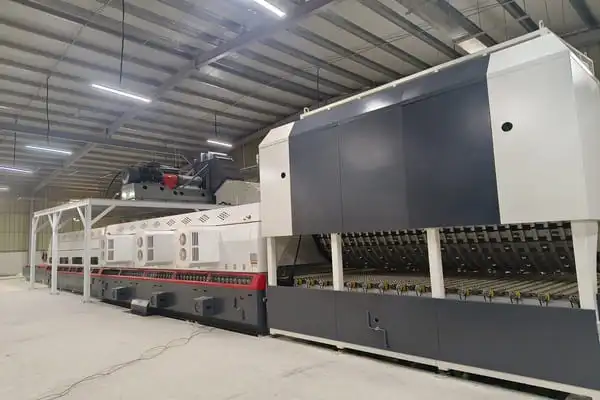
Advantages of Forced Convection Curved Glass Toughening with Flexible Rollers
It's easy to see how the technology helps with production once you know how it works. Here are the main benefits that this equipment brings to everyday manufacturing.
- 30% Faster Heating Cycles: The high-pressure convection system accelerates the heating stage compared to radiant-only models, which directly increases the number of production cycles per shift and boosts daily output for architectural and automotive glass lines.
- Low-E Coating Protection: By directing airflow uniformly across the glass surface, the furnace prevents localized overheating that would oxidize delicate metallic coatings. It supports Low-E glass with emissivity as low as 0.01, making it suitable for high-specification curtain wall and insulated glass units.
- 20% Reduction in Thermal Energy Loss: Optimized insulation design and precise heat retention reduce thermal energy loss, lowering monthly electricity costs and carbon footprint without compromising output temperature stability.
- Consistent Batch-to-Batch Quality: An Industrial PC (IPC) and PLC control interface stores and recalls complex bending recipes instantly, ensuring that every batch meets the same geometric and surface stress specifications, even when switching between glass thicknesses or curvature profiles.
These benefits directly address the two biggest problems that glass makers say they have: the cost of energy and the accuracy of the products they make. They make a real difference on the work floor and in the bank account when put together.
Edge Integrity and Surface Quality
Flexible rollers spread the contact pressure evenly along the edge of the glass. This keeps stress from building up around the edges too much. This is especially important for side windows in cars and bathroom walls, where flaws at the edges lead to field failures. Roller wave distortion stays below 0.05mm, which meets optical standards for architectural grade.
Maintenance and Uptime
Since the flexible roller system replaces mechanical molds, there are fewer custom tooling parts to keep up. Regular changes and roller checks can be done by operators who have been trained in just one week. Standardizing spare parts cuts down on the time it takes to get them and keeps equipment running at high levels.
How to Choose the Right Forced Convection Curved Glass Toughening Machine
There are more steps to choosing the right machine than just looking at price lists. The things below should help you with your evaluation.
Match Capacity to Your Production Mix
Start by writing down the glass thicknesses, largest sheet sizes, and target curve radii that your plant works with most often. A Forced Convection Curved Glass Toughening Machine with Flexible Roller that can process glass from 4 mm to 19 mm can cover a broad range of applications, from heavy safety glass for buildings to decorative glass for interior spaces. When evaluating a Forced Convection Curved Glass Toughening Machine with Flexible Roller, buyers should also check whether the furnace's effective heating zone is long and wide enough to accommodate the largest architectural glass panels without requiring repeated heating. The Forced Convection Curved Glass Toughening Machine with Flexible Roller should match the plant's typical sheet dimensions and production requirements to support consistent processing. For manufacturers handling different glass thicknesses and bending specifications, the Forced Convection Curved Glass Toughening Machine with Flexible Roller can provide greater production flexibility within one integrated system. Carefully reviewing the heating zone, maximum glass dimensions, thickness range, and target bending radii of the Forced Convection Curved Glass Toughening Machine with Flexible Roller can help buyers determine whether the equipment is suitable for their planned applications.
Evaluate Flexible vs. Fixed Roller Systems
Fixed mold systems are good for making a lot of single-radius parts, but they get pricey as the number of products they make grows. A flexible roller bed works better for processors who work on custom architectural projects, specialty automotive glazing, or contract work for more than one client. Over a 12-month production plan, the ability to change the curve digitally instead of by changing the mold physically saves a lot of money on setup costs.
Assess Supplier Credibility and After-Sales Support
Ask for proof of CE certification, written quality test results according to ASTM C1048 guidelines, and references from past customers in your area. Make sure the seller offers online technical help 24 hours a day, 7 days a week, installation and setup services, operator training, and a trusted chain of spare parts suppliers. Customized furnaces usually take between 60 and 120 working days to deliver, so make sure that the date you want to buy them matches the date you want to start making things.
Real-World Applications and Case Studies
It's clear that this technology is useful in many fields that work with curved tempered glass on a regular basis.
Architectural Curtain Wall and Facade Glass
Low-E bending glass is being used more and more by high-rise curtain wall builders because it saves energy and keeps the view clear. When processing large cylindrical panels, processors using convection-assisted flexible roller furnaces report measurable yield gains. This is because even heating gets rid of the soft spots that cause panels to break on their own in the field. The recipe system is managed by the IPC, and it also makes sure that repeat orders for the same building project always result in units that are the same shape.
Automotive and Specialty Vehicle Glazing
Bus and specialty vehicle makers need complicated side and back windows with many radiuses that fit perfectly into metal frames. With flexible roller systems, one furnace can make more than one window profile without having to buy new molds. This makes small-batch production cost-effective. As long as the surface stress uniformity is higher than 90MPa, the glass meets the ISO 12543 safety fragmentation standards for cars.
Appliance and Furniture Glass
The heating approach used by a Forced Convection Curved Glass Toughening Machine with Flexible Roller is well suited to coated applications such as oven door glass and curved refrigerator display screens. By using forced convection instead of relying solely on radiant heating, the Forced Convection Curved Glass Toughening Machine with Flexible Roller can provide more uniform heat transfer across coated glass surfaces during the tempering process. This can help manufacturers reduce processing waste, particularly when the glass contains valuable coatings that need to remain intact throughout the heating and tempering cycle. For appliance glass processors, the Forced Convection Curved Glass Toughening Machine with Flexible Roller provides a controlled heating and forming solution for different curved glass applications. The Forced Convection Curved Glass Toughening Machine with Flexible Roller can also support consistent processing when manufacturers need to handle coated glass products with specific shape and thickness requirements. By combining forced convection heating with flexible roller forming, the Forced Convection Curved Glass Toughening Machine with Flexible Roller offers a practical approach t
Practical Procurement Guide: From Inquiry to Installation
An easy way to buy something starts before the purchase order is signed.
Preparing Your Technical Inquiry
Write down the details of your glass, including the range of thicknesses, the largest and smallest sheet sizes, the bend radius or radii you want, the types of coatings you want, and the amount of glass that needs to be made each shift. Share this information with possible suppliers early on so that they can help you choose the right furnace configuration and give you a correct quote.
Key Questions to Ask Your Supplier
Check to see if the voltage will work with the power source at your building, if the HMI can be programd in more than one language, and if the provider can setup and operate the system on-site. Find out more about the training program for new operators and how long remote technical support is available after the system is up and running.
Logistics and Compliance Planning
Make sure you know the shipping dimensions and weight ahead of time so you can plan your receiving dock and foundation needs. Check that the equipment has CE approval and that the seller can show proof that the equipment is legal to import in the country you want to sell it to.
Conclusion
The combination of forced convection heating and adjustable flexible roller forming gives glass processors a practical path to producing high-quality curved tempered glass across a wide range of thicknesses and curvature profiles. A Forced Convection Curved Glass Toughening Machine with Flexible Roller combines these two technologies to provide controlled heating and flexible forming for different glass specifications. The technology can help protect Low-E coatings, while the Forced Convection Curved Glass Toughening Machine with Flexible Roller can also support lower energy consumption and faster production cycles compared with radiant-only systems, depending on the specific equipment configuration and process conditions. With IPC-managed recipe control and CE-certified construction, the Forced Convection Curved Glass Toughening Machine with Flexible Roller suits architectural, automotive, appliance, and furniture glass manufacturers that need consistent processing and production flexibility. For manufacturers seeking to manage operating costs while processing different curved glass products, the Forced Convection Curved Glass Toughening Machine with Flexible Roller provides an integrated approach to heating, bending, and tempering. Overall, the Forced Convection Curved Glass Toughening Machine with Flexible Roller can support reliable production where coating protection, curvature control, and repeatable tempering performance are important.
FAQ
What glass thicknesses can a flexible roller convection furnace process?
Up-to-date units can work with glass from 4 mm to 19 mm thick. The minimum bend radius gets bigger as the glass gets thicker, so panels that are thicker need a bigger arc standard. Before finalizing furnace specifications, you should always check with the supplier to make sure they know what your thickest and thinnest product needs are.
How does forced convection protect Low-E coatings during tempering?
Instead of direct radiation, forced convection warms glass by moving air around. This keeps the glass from getting too hot in one spot, which happens with metallic surfaces in radiant furnaces. This method stops the film from oxidizing and keeps the coating's emissivity performance after tempering, which is very important for insulated glass units used in energy-efficient facades.
How long does it take to change the bend radius setting?
A new radius profile can be set through the HMI panel in about 1–5 minutes because flexible roller systems are digitally managed and don't depend on molds. This means that short-run and custom-order production can be done without having to pay a lot for tools like with set mold methods.
What certifications should I look for when purchasing this type of furnace?
Equipment sold in the construction supply chains of North America and Europe must have CE certification. Also, ask for proof that the safety glass meets ASTM C1048 standards for quality and ISO 12543 standards for performance in breaking safety glass.
Partner with EASTTEC EQUIPMENT for Your Next Curved Glass Line
Since 1994, EASTTEC EQUIPMENT has been a leader in heat processing for glass. They use Italian convection technology and have more than 30 years of technical experience. Our Forced Convection Curved Glass Toughening Machine with Flexible Roller is fully CE approved, works with voltage standards around the world, and comes with full operator training and technical support 24 hours a day, 7 days a week. As a reliable company that makes Forced Convection Curved Glass Toughening Machine with Flexible Roller, we make sure that every furnace fits your exact needs. To get a professional advice right away, email our team at sales@easttecmachine.com.
References
1. Glass Technology: European Journal of Glass Science and Technology — Part A, Society of Glass Technology, 2021.
2. ASTM C1048-18: Standard Specification for Heat-Strengthened and Fully Tempered Flat Glass — ASTM International, 2018.
3. EN 12150-1: Glass in Building — Thermally Toughened Soda Lime Silicate Safety Glass — European Committee for Standardization, 2015.
4. ISO 12543-2: Glass in Building — Laminated Glass and Laminated Safety Glass — Methods of Test for Durability — International Organization for Standardization, 2011.
5. Proceedings of Glass Performance Days: Advances in Convection Heating for Architectural Glass Processing — Glaston Corporation Conference Series, 2019.
6. Energy Efficiency in Industrial Furnaces: Thermal Insulation and Heat Recovery Technologies — U.S. Department of Energy, Industrial Technologies Program, 2017.

USER EVALUATE
Here is the customer's evaluation of us