




Dual-Chamber Glass Tempering for Consistent Flatness in Building Facades
On a finished facade, flatness defects show up where buyers notice them most: in reflection. Roller wave, edge lift, and bow distort the image in a curtain wall or window, and the effect is worst on reflective, coated glass. Specifiers and glaziers reject lites on this basis, even when the glass passes strength and fragmentation tests. For a processor, the cause usually lies in the heating stage of the tempering furnace, and in how evenly and how quickly the glass reaches tempering temperature. A dual-chamber architectural glass tempering furnace addresses this by splitting heating into two stages. This article explains how that design affects flatness, what to verify for Low-E and thick glass, how to check the manufacturer’s claims, and what to confirm before you buy.
Why Facade Glass Loses Flatness in the Furnace
Glass is tempered by heating it to roughly 610–650 °C and then cooling it rapidly. The quench creates surface compression and core tension [5]. Flatness is mostly decided before the quench, while the glass is soft and supported on ceramic rollers.
Two mechanisms drive distortion:
Uneven top-to-bottom heating. If one surface heats faster, the sheet bends in the furnace. Karvinen’s analysis shows that coated glass heats unsymmetrically under radiation alone, because the low-emissivity coating reflects radiant heat while the uncoated side absorbs it. The bending then causes defects such as optical distortion, unstable bow, coating burn, and large fragmentation [5].
It makes a big difference how flat and clear the glass is when it's done, and how long it heats up on the rollers. Glass is more likely to sag and get roller wave flaws if it stays at high temperatures for a long time. This can be fixed with a good dual-chamber architectural glass tempering kiln, which will improve the heating cycle and make the heat spread more evenly across the glass surface. A dual-chamber architectural glass tempering kiln can keep the right conditions for tempering while lowering the amount of time the glass is exposed to high temperatures that isn't needed. This is achieved by combining how well it heats with how precisely it controls the temperature. Roller waves can be cut down, surfaces can be made flatter, and optical performance can stay the same with even heating and faster processing times. For a business that makes architectural glass, getting a reliable dual-chamber architectural glass tempering kiln can help them make more glass faster and better. People who want to buy a dual-chamber architectural glass tempering furnace should check how well the cycle-time performance works, how accurate the temperature is, and how evenly the heat is distributed. This will help them make sure that the equipment fits their specific glass processing needs.
Vitkala makes the same point for Low-E glass, noting that in a traditional radiation furnace the glass bends during the heating cycle, which leads to coating distortion and surface defects. Adding forced convection allows Low-E glass to be tempered with current methods [4]. In Karvinen’s simulation of a 1 cm sheet six minutes after entering the furnace, with identical heating and only top-surface emissivity changed, the maximum temperature difference through the glass was 18 K for coated glass and 4 K for clear glass [5]. That is a modelled result under stated conditions, not a measurement from any Easttec furnace, but it shows why heat balance deserves attention.
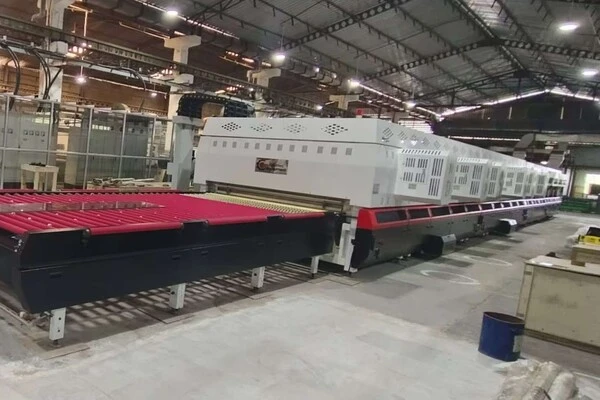
How the Dual-Chamber Design Supports Flatness
Staged heating
A dual-chamber furnace has a pre-heating chamber and a high-temperature chamber. Glass is brought up gradually in the first chamber and finished in the second, so two batches are in the heating process at once. Vitkala describes a two-stage convection arrangement in which the first furnace runs at 350–450 °C with convection heating, and notes that temperature and airflow control are easier at lower temperatures and radiation is minimized. He identifies keeping glass flat during the first half of the heating cycle as the hardest part [4]. This example describes another manufacturer’s equipment, so it supports the principle of staged heating, not specific performance figures for an Easttec furnace. Ask Easttec for its pre-heat chamber setpoints.
Easttec’s product information says the two-stage process allows a more gradual and uniform temperature rise, which reduces thermal shock and stress and gives better surface flatness than rapid single-stage heating. For thick glass, the same literature supports a gentler start. In a high-convection furnace, thermal shock for glass of 10 mm and more can be reduced by lowering heat transfer for a period at the start of the cycle [4].
Forced convection and top convection
Forced convection blows hot air onto the glass to even out heat transfer between surfaces, so the glass stays flat while it heats [4][5]. Easttec describes its system as a high-temperature blower circulating hot air through the furnace, with convection components and structures made of ceramic rated to 1,300 °C. The Low-E specification adds top convection to the dual-chamber arrangement and describes the design as optimized for high-performance Low-E glass.
Control
When forced convection is used to help heat move faster during glass tempering, it's important to have strict control over the heating balance. Karvinen says that to keep the processing conditions fixed, you need a high-tech control system because convection gets stronger when it's heated [5]. In Easttec's two-chamber architectural glass tempering furnace, there is an Industrial PC (IPC) in the middle that manages the heating, time coordination, and convection strength between the two chambers and the quench section. This unified control method helps workers keep the work environment stable and keep track of each step of the tempering process. People who are buying a dual-chamber architectural glass tempering oven should ask the seller to show them how they store, change, and use different types of glass and coatings for different recipes. Manufacturers can improve optical quality and cut down on defects by being able to change how each product is heated and cooled. A good architectural glass tempering furnace with two chambers should also have clear working data, settings that can be used again and again, and process changes that are easy to get to. A factory demonstration is the best way for buyers to find out if a dual-chamber architectural glass tempering furnace has the control options and process consistency needed for tough architectural glass jobs.
Low-E and Coated Glass: What the Supplier Claims and What to Verify
Easttec’s product information makes several claims specific to Low-E glass:
The dual-chamber setup with top convection speeds up Low-E heating cycles by 30%.
Balanced heating prevents film oxidation and protects the optical integrity of architectural coatings.
The furnace is designed for 24/7 industrial use and for a high yield of energy-saving glass.
The technical direction is credible because uneven heating is a known cause of coating burn and distortion in Low-E glass [4][5]. The numbers still need conditions. For the 30% figure, ask: 30% faster than which furnace, which glass thickness, which coating, and which loading? For coating protection, ask which coating types (for example, soft-coat or hard-coat) were tested, and request results on your own coated glass. The supplied material does not list coating types, and the literature cited here concerns soft-coated, toughenable Low-E glass with emissivity of 0.1–0.23 [4], so do not assume results transfer to other coatings.
A sensible acceptance approach is to run your own coated and clear glass samples during a factory visit or commissioning, and to record coating condition, haze, flatness and breakage results.
What Flatness Means in Standards
Furnace specifications do not certify glass, but the product standards define what your customers will measure. EN 12150-1 specifies tolerances, flatness, edgework, fragmentation and mechanical characteristics for flat thermally toughened soda lime silicate safety glass used in buildings [1]. Its contents include measurement of edge lift for horizontally toughened glass and limits on overall bow, wave, and perimeter deformation [1]. In North America, ASTM C1048 covers monolithic flat heat-strengthened and fully tempered glass made on a horizontal heat-treating system. It states that a strain pattern, not normally visible, may become visible under certain light conditions, and that the glass cannot be cut after treatment [2]. ANSI Z97.1 covers safety performance specifications and test methods for safety glazing in buildings [3].
Practical implications for a facade processor:
Agree on the flatness measurement method and acceptance limits with the customer before production, using the standard that applies in your market.
Expect strain pattern to be visible at some angles, because it comes from the quench process. The standard acknowledges it [2], so manage customer expectations and mock-up reviews.
Remember that these standards describe the glass, not the furnace. Ask the supplier to document how its furnace performs against the measurements you need.
Performance, Throughput and Energy
Easttec’s supplied information reports three figures that appear in different forms and need care:
| Claim | Source context | What to confirm |
|---|---|---|
| Production capacity 1.8–2× that of standard single-chamber furnaces | General dual-chamber specification | Baseline furnace, thickness, loading |
| Low-E heating cycles 30% faster | Low-E, dual-chamber with top convection | Baseline and coating type |
| 20% reduction in thermal energy loss | Insulation and power management | What is being compared, and over what period |
These come from different descriptions of the machine. Do not add them together or apply one to another’s conditions. Easttec also states, as a company-level claim, that its energy-saving design helps customers save one-third of electricity. The supplied material gives no baseline for this, so ask for one before comparing quotations. The company notes that the throughput advantage is strongest for high-volume 4–6 mm architectural lites.
Throughput also depends on the rest of the line. Doubling heating output moves the bottleneck to quenching, loading and unloading, and upstream cutting and washing. Karvinen notes that thinner glass needs higher heat transfer in cooling, and that high air flow rates add to power consumption [5]. Ask how the quench section is sized for 4 mm glass at full furnace rate.
Choosing a Dual-Chamber Architectural Glass Tempering Furnace: A Buyer’s Checklist
| Check | What to ask |
|---|---|
| Thickness window | Does 4–19 mm cover your range, with tested recipes at both ends? |
| Coated glass | Which Low-E types were tested, with what flatness and coating results? |
| Flatness evidence | Roller wave, bow, and edge-lift measurements on your glass against your applicable standard |
| Throughput basis | Conditions behind the 1.8–2× and 30% figures |
| Quench capacity | Air capacity for your thinnest glass at full rate |
| Size range | Maximum and minimum sheet sizes for your facade orders |
| Controls | IPC functions, recipe handling, fault display, language options |
| Electrical supply | Match to your site voltage and frequency (options supplied: 220/380/415 V, 50/60 Hz) |
| Safety documentation | CE declaration of conformity and the directives applied |
| Delivery and installation | Committed delivery date, site requirements, commissioning scope |
A wrong choice has concrete costs. A furnace without proven coated-glass recipes can leave you rejecting Low-E lites. An undersized quench caps output. A voltage mismatch delays start-up.
Evaluating the Manufacturer
Luoyang Easttec Glass Automation Equipment Co., Ltd. says it has been specializing in glass tempering technology since 1994. Its technicians have more than twenty years of experience designing and making glass deep-processing equipment, and its factories know how to make large amounts of equipment. European quality management norms, especially Italian ones, and Italian convection technology are also used by the company. If someone is looking to buy a dual-chamber architectural glass tempering furnace, they should check these claims against written quality procedures, technical specifications, and the furnace's real operating performance. Ask Easttec to explain how its convection technology makes heating more even, lowers optical distortion, and supports consistent tempering results for all types of glass and coatings. When buying a dual-chamber architectural glass tempering furnace, procurement teams should also ask for a list of setups at factories that make the same amount of glass, have the same glass dimensions, and have the same processing needs. If you can, visit reference sites or talk to current customers to find out how reliable the equipment is, how much energy it uses, how often it needs to be maintained, and what kind of support is available after the sale. By looking at these details before buying a dual-chamber architectural glass tempering furnace, people can make a better financial choice and see if Easttec's technical skills fit with their long-term manufacturing goals.
On safety conformity, the supplied information says the furnace complies with CE standards. For machinery placed on the EU market, Directive 2006/42/EC requires the manufacturer to draw up an EC declaration of conformity that accompanies the machinery [6]. Regulation (EU) 2023/1230 is listed as repealing that directive [6], so confirm which instrument applies to your delivery date. Ask for the declaration itself, not only the marking.
Customization matters for international projects. Easttec supports voltage and frequency adaptation, configurable equipment size, heating curves and cooling parameters, custom equipment color, and a multi-language operating menu including English, Spanish, Russian, Korean, and Portuguese. The company states that new operators can master operation and maintenance within one week, and that technicians provide 24-hour online support. Ask what the training covers and how remote support is handled across time zones.
Cost, Delivery and Implementation
No price or warranty terms were supplied, so none are given here. Easttec states that its furnaces are customized equipment with delivery of 60–120 working days depending on model. Confirm the date for your configuration in the contract.
Factors that shape cost include furnace size, thickness range, quench capacity, convection and control package, electrical configuration, and customization. Before installation, prepare power supply, foundation, floor space, compressed air, and glass handling. Easttec’s collaboration process runs from preliminary inquiry and project design through manufacturing, installation and commissioning, operator training and after-sales service. Before signing, define acceptance tests, spare parts supply, warranty scope, and response times.
Conclusion
Consistent facade flatness depends on even, fast heating before the quench, and a dual-chamber architectural glass tempering furnace is designed around exactly that: staged heating, balanced convection and synchronized control. Easttec’s supplied specifications point in the right direction, with 4–19 mm capacity, convection heating, and Low-E optimization. The benefit for your plant depends on verifying the conditions behind its figures, testing your own coated and thick glass, and checking that quench capacity, documentation, and support match your project. Make those evidence requests the core of your technical evaluation.
FAQ
Why does a dual-chamber furnace help flatness in architectural glass?
Staged heating lets glass warm up gradually in a pre-heating chamber and reach tempering temperature in a second chamber, which reduces thermal shock and temperature differences through the sheet. The literature identifies the first half of the heating cycle as the hardest to keep flat [4]. Easttec states its two-stage process gives better flatness than rapid single-stage heating. Verify this on your own glass.
Can it temper Low-E glass without damaging the coating?
Easttec states that balanced heating prevents film oxidation and protects coating optical integrity. Forced convection is the established method for balancing heat transfer on coated glass [4][5]. Coating types vary, so request test results on the specific coatings you process.
What glass thicknesses can it handle?
Easttec specifies 4 mm to 19 mm. The company says speed advantages are greatest for 4–6 mm architectural lites. For thick glass, check the recipes for the upper end of the range.
What flatness standard should I measure against?
Use the standard your customer or market requires. EN 12150-1 covers flatness, bow, wave, and edge lift for horizontally toughened glass in buildings [1]. ASTM C1048 applies in North American projects [2]. Agree on the measurement method and limits before production.
What should I ask before buying?
Ask for the conditions behind the throughput, 30% heating and energy figures, coated-glass test results, quench capacity, CE documentation, committed delivery date, training scope, spare parts, and warranty terms.
Partner With EASTTEC EQUIPMENT for Advanced Facade and Low-E Glass Tempering Solutions
If you are planning a dual-chamber tempering line for facade or Low-E glass, Easttec’s team can review your thickness range, coating types, sheet sizes, output target and site power supply, and discuss a suitable configuration. Send your project details to sales@easttecmachine.com, including the glass products you process, target daily output, and the flatness standard your customers require.
References
1. European Committee for Standardization (CEN). (2019). EN 12150-1:2015+A1:2019 – Glass in building – Thermally toughened soda lime silicate safety glass – Part 1: Definition and description. https://genorma.com/en/standards/en-12150-1-2015-a1-2019
2. ASTM International. (2025). ASTM C1048-25: Standard Specification for Heat-Strengthened and Fully Tempered Flat Glass. https://doi.org/10.1520/C1048-25 (https://store.astm.org/c1048-25.html)
3. Glazing Industry Secretariat Committee. (2020). ANSI Z97.1-2015 (R2020): Safety Glazing Materials Used in Buildings – Safety Performance Specifications and Methods of Test. https://webstore.ansi.org/standards/gisc/ansiz972015r2020
4. Vitkala, J. (1997). Low-E glass tempering. Glass Processing Days, 13–15 September 1997, Tampere, Finland, pp. 103–107. https://aisglass.com/wp-content/uploads/2020/10/AIS-226.pdf
5. Karvinen, R. (1997). Connection between glass quality and the convection furnace. Glass Processing Days, 13–15 September 1997, Tampere, Finland, pp. 67–71. https://aisglass.com/wp-content/uploads/2020/10/AIS-68.pdf
6. European Parliament and Council of the European Union. (2006). Directive 2006/42/EC of 17 May 2006 on machinery, and amending Directive 95/16/EC (recast). https://eur-lex.europa.eu/eli/dir/2006/42

USER EVALUATE
Here is the customer's evaluation of us