




Convection Flexible Roller Flat & Bend Glass Tempering System Improves Quality Control in Glass Manufacturing
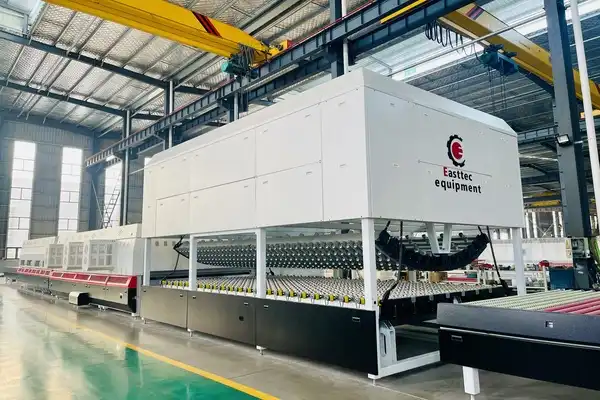
The Convection Flexible Roller Flat & Bend Glass Tempering System represents a significant advancement in thermal glass processing. By combining high-pressure forced convection heating with an adjustable flexible roller mechanism, this system delivers uniform temperature distribution across both flat and curved glass surfaces. Manufacturers processing architectural Low-E glass, automotive glazing, or appliance panels can achieve tighter quality tolerances, lower breakage rates, and faster production cycles — all within a single, CE-certified production line designed to handle glass thicknesses from 4mm to 19mm.
Understanding the Convection Flexible Roller Glass Tempering System
The structure of this machine is very different from how furnaces are usually built. Three main parts work together to make sure that every production run produces the same results.
Forced Convection Heating Chamber
In contrast to radiation-only heaters, this device moves hot air quickly through a top forced convection array. The forced airflow goes through Low-E coatings with an emissivity as low as 0.01, keeping the film from oxidizing and making sure that the glass surface absorbs heat evenly. Compared to radiant-only models, this mechanism cuts heating cycle times by about 30%. This is a measurable throughput gain for plants that make a lot of food.
Adjustable High-Strength Flexible Roller Mechanism
The flexible roller assembly can change shape from flat to curved by using a servo motor to control its position. Roller covers that can handle high temperatures keep the surface from getting scratched during the bending phase. This mechanical design gets rid of the need to change molds by hand when moving between flat panels and complex curved units. This cuts the time it takes to switch between them to less than five minutes using the HMI.
Industrial PC and PLC Control Interface
With a stable Industrial PC and a PLC link, you can control the fan speed, roller curvature factors, and heating zone temperatures all at the same time. Digital bending recipes can be saved and retrieved by operators, who can keep arc variation within ±1mm per meter during long production shifts. Due to the software menu's availability in English, Spanish, Russian, Korean, and Portuguese, new operators usually become fully proficient within one week.
Advantages of Using Flexible Roller Tempering Over Traditional Methods
There are a lot of problems with traditional rigid roller furnaces. For example, uneven heating zones can distort images, fixed roller configurations limit the types of products that can be made, and bad insulation wastes energy and raises monthly costs. The Convection Flexible Roller Flat & Bend Glass Tempering System solves all of these issues in a clear and useful way.
What makes this system better for performance on the production floor is:
- 30% Faster Heating Cycles: The high-pressure convection system speeds up the absorption of heat across covered and thick glass. This cuts down on the time it takes to run each unit and boosts daily output without adding staff or floor space.
- Broader Processing Range: More types of glass can be reliably tempered, from 4 mm to 19 mm. This includes artistic thin glass, structural curtain wall panels, car backlites, and oven door glass. This means that different production lines are not needed.
- 20% Reduction in Thermal Energy Loss: Easttec's special high-density insulation and inverter-controlled fans make energy use much lower. For a plant that works two shifts every day, these savings add up to big cuts in the annual cost of electricity.
- Surface Quality Preservation: Even roller speed and precise SO₂ dosing or roller maintenance protocols stop white haze and roller wave distortion, two flaws that make rejection rates go up in curved glass production.
Most of the time, production managers and technical directors complain about yield loss, high energy costs, and how hard it is to run different product plans on the same line. These benefits directly address these issues.
Comparative Analysis: Flexible Roller vs. Traditional Glass Tempering Systems
When purchasing professionals look at big pieces of equipment, they need more than just a list of features. They also need to know how differences in performance show up in production numbers.
Equipment Longevity and Maintenance Demand
Because the contact shape changes for each curvature profile, rigid roller systems wear out randomly when they work with curved glass. Flexible rollers spread mechanical stress more widely, which makes sleeves last longer and cuts down on unexpected upkeep. Easttec's systems have Kevlar- or ceramic-coated tubes that can work for a long time at tempering temperatures, which keeps the cost of extra parts stable.
Energy Consumption and ROI Calculation
A radiation-only burner that works with 8mm Low-E glass uses more electricity per square meter than the Convection Flexible Roller Flat & Bend Glass Tempering System with the same throughput. Together, the 20% increase in insulation efficiency and the inverter fan control make the output cycle use fewer kilowatt-hours. This energy difference directly leads to higher ROI numbers over the standard equipment depreciation period of eight to ten years. This is something that factory owners and general managers think about a lot when they decide what to buy.
Automation and Process Consistency
When you use a mold-based bending method by hand, you can make mistakes when measuring the radius. The servo-controlled flexible roller setup on Easttec's system uses high-temperature encoders and real-time feedback loops to fix for changes in thermal expansion over long production runs. This keeps the geometry the same from batch to batch.
Practical Applications and Industry Use Cases
Because the system can handle a wide range of data, it is truly multi-sector equipment and not just a niche tool for one type of application.
Architectural Curtain Wall and Façade Glass
When used on the outside of commercial buildings, large-format curved glass needs to be both strong and clear. The method makes curtain wall units that go from flat panels to corner curves without losing quality. They meet the safety standards set by EN 12150-1 and ASTM C1048 that builders and building code inspectors need.
Automotive Side Windows and Backlites
To fit aerodynamic body frames, automotive glazing needs to be curved with great accuracy. Depending on the thickness of the glass, the flexible roller mechanism can bend in circles as small as 450 mm. This makes it possible to make side windows and rear glass that pass tests for optical distortion and fragmentation that are in line with international safety standards for vehicles.
Appliance and Specialty Glass
Oven door glass and refrigerator screens must be able to withstand repeated heating and cooling cycles without losing their shape or structural integrity. The stable IPC/PLC control of the Convection Flexible Roller Flat & Bend Glass Tempering System helps maintain consistent tempering conditions and can support surface compression levels above 90 MPa for fully tempered products, depending on the glass specification and applicable standard. For appliance manufacturers, using a Convection Flexible Roller Flat & Bend Glass Tempering System with precise process control can help maintain consistent quality across different glass components. The automated controls of the Convection Flexible Roller Flat & Bend Glass Tempering System also allow production parameters to be monitored and adjusted according to specific glass requirements. By supporting stable heating, forming, and tempering processes, the Convection Flexible Roller Flat & Bend Glass Tempering System can help appliance manufacturers produce reliable glass parts for demanding applications.
Procurement Guide for B2B Buyers: Selecting the Right Tempering System
Deciding on this kind of tool is a big investment that usually takes three to twelve months of detailed research. Buyers who set up the process clearly are more likely to get good results.
Define Your Production Specifications First
Before you get quotes, write down the range of glass thicknesses you need, the largest sheet sizes you can handle, the amount of curved and flat products you want, and the daily output you want to reach. Based on these factors, you can easily tell if a standard design or a custom voltage and heating zone setting is best for your building.
Evaluate Supplier Credibility and Support Infrastructure
The quality of commissioning, operator training, and ongoing technical support have a big impact on how well equipment works after it has been installed. Ask suppliers if they offer online technical support 24 hours a day, spare parts that can be bought locally, and written installation and training programs. For big capital purchases, it's safer to buy from suppliers who have been in the business for a long time and whose goods are CE-certified.
Request a Detailed Technical Quotation
A reliable quote should include information on the roller material specs, the control system design, the heating uniformity tolerances, and the delivery wait time. Standard shipping for Easttec equipment takes between 60 and 120 working days, based on the model. Power systems (220V, 380V, 415V, 50/60Hz), process parameters, and software language can all be fully customized.
Conclusion
The Convection Flexible Roller Flat & Bend Glass Tempering System for tempering flat and curved glass fills in the performance gap that rigid radiation-based systems have never been able to fully close. Manufacturers now have a production tool that pays for itself over time thanks to faster heating processes, greater product compatibility, measured energy savings, and digitally managed bending accuracy. This type of equipment meets the technical needs of all three sectors in a single, certified platform, so it doesn't matter if your main goal is architectural Low-E quality, accurate automotive glazing, or consistent appliance glass.
FAQ
What glass thicknesses does this system process reliably?
The system works with glass thicknesses ranging from 4 mm to 19 mm, which means it can handle most business architectural, car, and appliance glass needs without having to change any equipment.
Can it process Hard-Coat Low-E glass?
Yes. The forced convection heating system goes through Low-E coats with an emissivity as low as 0.01, stopping the film from rusting and keeping the heat even across the glass surface.
How long does it take to switch from flat to bend mode?
The HMI touchscreen interface and servo-controlled flexible rollers make the configuration change happen in less than five minutes. This means that production is interrupted as little as possible during product changes.
What quality standards does the finished glass meet?
This method makes tempered glass that meets the standards set by EN 12150-1 and ASTM C1048. The fully tempered product has a surface stress value of more than 90MPa and an arc variation of less than 1mm per meter.
What after-sales support does Easttec provide?
Easttec techs offer online help 24 hours a day, 7 days a week, on-site installation and setup, operator training programs, and spare parts available all the time to keep production lines running without long periods of downtime.
Get a Custom Quote from EASTTEC EQUIPMENT Today
EASTTEC EQUIPMENT has been building glass tempering technology since 1994, backed by European convection expertise and a fully CE-certified production standard. If you are evaluating a Convection Flexible Roller Flat & Bend Glass Tempering System supplier for your next capital investment, we are ready to provide a detailed technical consultation and factory-specific configuration. Contact our team directly at sales@easttecmachine.com to request your customized quotation and start the conversation.
References
1. Glass Technology Europe — Advances in Forced Convection Tempering Furnace Design, 2022.
2. ASTM International — Standard Specification for Heat-Treated Flat Glass (ASTM C1048), 2023.
3. European Committee for Standardization — EN 12150-1: Thermally Toughened Soda Lime Silicate Safety Glass, 2021.
4. Glass Processing Days Conference Proceedings — Flexible Roller Technology in Architectural and Automotive Glass Production, 2023.
5. International Journal of Applied Glass Science — Energy Efficiency in Industrial Glass Tempering: Convection vs. Radiation Methods, 2022.
6. Glass Worldwide Magazine — Quality Control Benchmarks for Curved Tempered Glass in Commercial Construction, 2023.

USER EVALUATE
Here is the customer's evaluation of us