




Convection Flat Glass Tempering Furnace for High-Volume Building Glass Processing
Because it heats glass with hot air that is circulated rather than just using radiant heat, a Convection Flat Glass Tempering Furnace is suitable for processing large quantities of building glass. There is more even heating on the top and bottom thanks to this forced airflow, which is good for Low-E, coated, and large architectural lites. When compared to radiation models, the furnaces we make at EASTTEC EQUIPMENT heat up about 20–30% faster thanks to Italian convection technology. Every day, more facades, curtain walls, doors, and shower enclosures are made when cycles are faster. I explain how it works and how it differs from infrared heating in this guide. I also talk about how to choose, price, and buy a furnace.
What Is a Convection Flat Glass Tempering Furnace and How Does It Work?
The Thermal Process from Loading to Unloading
Glass is loaded into the furnace, heated in a controlled way, soaked, moved, quenched, inspected, and then unloaded. Fans move hot air around inside the heating chamber, warming both the top and bottom surfaces at the same time. When the glass has reached 600°C, it is moved by rollers to the quench section, where high-pressure air quickly cools the surfaces. This makes the surface hold on to the compressive stress. Fully tempered glass must reach at least 10,000 psi (69 MPa) of surface compression according to ASTM C1048. This means that both the balance of heat and the speed of cooling are important. The final recipes will still depend on the type of glass, its thickness, coating, and its size.
Why Forced Convection Suits Low-E and Coated Glass
Since low-E coatings reflect infrared energy, heat from the sun can slowly and unevenly warm coated glass. Moving hot air breaks through the thermal boundary layer and brings heat straight into the glass. This is called forced convection. Our furnaces are made to work with Low-E glass that has an emissivity of as little as 0.01, which protects the coating and keeps optical distortion to a minimum. The design of the top convection also keeps the temperature even on the top and bottom surfaces. Large sheets and thin 3mm to 4mm architectural glass are less likely to bow because of this. This makes the light flatter and clearer.
Inside the Line: Fans, Heaters, Rollers, and Controls
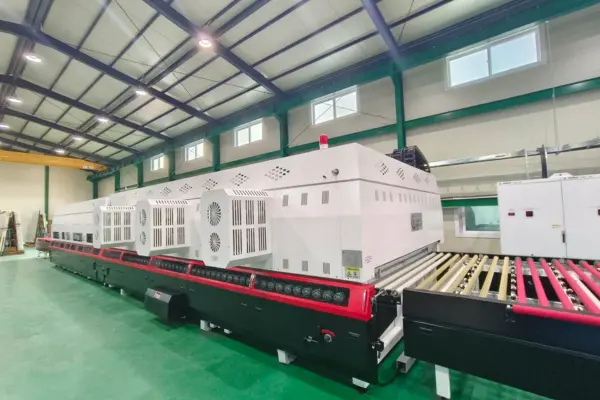
Heating elements, insulation, high-temperature fans, air ducts, temperature sensors, rollers, a PLC, and an HMI screen are all parts of a tempering line. Our convection parts are made of ceramic that can handle temperatures up to 1300°C. This means that less energy is wasted and the glass heats up faster. Operators can change recipes for each thickness and coating because the upper and lower temperatures can be controlled separately. Fans that are controlled by inverters change the amount of convection to fit the type and thickness of glass. In the quench section, the strength, flatness, and breakage performance were set by the fan capacity, the layout of the nozzles, and the air pressure. You can choose from English, Spanish, Russian, Korean, Portuguese, and more on the menu.
Advantages, Limits, and Convection vs. Infrared Heating
Key Advantages of a Convection Tempering Line
The best things about our Convection Flat Glass Tempering Furnace for building glass are these:.
- Faster cycles: The forced convection cycle reduces heating time by about 20–30% compared with radiation models. Shorter cycles raise daily output for facades, curtain walls, and doors, and they help plants that run mixed orders across several shifts without long waits between loads.
- Coating protection and flatness: Top convection balances the thermal load between the top and bottom surfaces. This protects Low-E coatings with emissivity as low as 0.01 and limits bowing or warping, even in 3mm to 4mm glass. Large sheets keep their clarity and shape through the cycle.
- Energy control: Inverter-controlled fans adjust airflow in real time and reduce energy use by 10–15% without slowing heating speed. Operators can lower fan output for simple loads and raise it for coated glass, so electricity matches the actual job.
Three problems that often happen in production are fixed by these benefits: slow Low-E processing, uneven heating, and high power bills.
Limitations to Plan For
I like to say right away that a convection system isn't right for every plant. The cost is higher than for a simple radiation unit. The line also needs a steady supply of electricity, compressed air, air flow, floor space, and operators who have been trained. Capacity numbers on the front page can be misleading because real throughput depends on cycle time, furnace load, product mix, uptime, and changeover time. Planning is needed for commissioning, and recipes need to be tested for each thickness and coating before production can begin. Our technicians offer online support 24 hours a day, seven days a week, and new operators can learn how to run and fix things in just one week.
Convection vs. Infrared Heating for Building Glass
Radiation is the main way that infrared furnaces heat. For simple clear-glass work, they can start quickly and use small layouts. Moving hot air is added by convection furnaces, so heat can reach coated and reflective glass as well as radiant absorption. This is important for mixed, Low-E, and reflective building orders. Neither choice wins just because of what the ads say. I think you should send sample glass to each supplier and then compare the results for quality goals, cycle time, size, coating, and thickness range. Some modern heating systems use more than one method, so make sure you ask each supplier to describe the exact setup and show you test results.
System Design and Applications for High-Volume Building Glass
Furnace Architecture and Throughput
Design is the first step in throughput. How much glass moves in an hour depends on the drum's length, the number of heating zones, the insulation, and the size of the roller table. Single-chamber layouts work best for simpler product lines, while double-chamber or multi-zone layouts make it easier to handle orders with a mix of products. Flatness and breakage are affected by the fan capacity, the arrangement of the nozzles, and the balance of upper and lower air on the quench side. We make the size, heating curves, and cooling parameters of our equipment fit the needs of your product. Delivery takes between 60 and 120 working days, depending on the model, because each machine is made to order. Specifying early on protects your project schedule.
Automation, Line Integration, and Energy Use
The furnace works best when it's connected to stations for cutting, edging, washing, and drilling, and then to lines for insulating or laminating. Recipe management, barcode tracking, alarms, data logging, and remote diagnostics are all tools that you should look for because they cut down on mistakes and speed up troubleshooting. Look at how much energy is used per square meter, not just how much power is installed, and don't forget to look at ventilation and cooling as well. The energy-saving design of EASTTEC is meant to help customers save one-third of the electricity they use, and the ceramic convection parts keep heat from going to waste. Ask any supplier to show you how much energy they use when they are making your product.
Applications Across Building Glass
For architectural applications like facades and curtain walls, where large, flat panels with little distortion are crucial, a convection flat glass tempering furnace is frequently used to process clear, tinted, coated, and Low-E glass. The Convection Flat Glass Tempering Furnace must provide precise dimensions, smooth edges, consistent surface quality, and dependable fragmentation performance for items like glass doors, shower enclosures, and interior partitions. These tempered glass products must typically adhere to relevant safety regulations in the US market, such as 16 CFR 1201 and ANSI Z97.1. The tempered panels for laminated and insulating glass units must also keep their flatness and optical quality during the next steps of processing and assembly. High-clarity glass furniture panels can also be made using the same Convection Flat Glass Tempering Furnace technology. Manufacturers should consider the quality of the final glass products when evaluating a Convection Flat Glass Tempering Furnace, as actual production results offer a more trustworthy indication of equipment performance and suitability for particular applications.
Technical Specifications and Selection Guidance
Specifications to Request Before You Buy
Ask for confirmation of the glass's largest and smallest sizes, thickness range, heaviest weight, loading direction, cycle time, and expected output for the products you will be using. We can heat glass from 3 mm to 19 mm in our furnaces. Then look over the fan power, cooling air volume, temperature range, roller diameter and spacing, transfer speed, fan power, electrical supply, foundation needs, and the layout of the heating zones. We can change power systems to work with 220V, 380V, and 415V at 50/60Hz, so send us information about your plant supply. The quote should include manuals, electrical drawings, lists of spare parts, the scope of the installation, training, and commissioning.
How to Choose the Right Configuration
First, make a list of the different kinds of products, their sizes, thicknesses, coatings, annual output, peak demand, shifts, and plans for growth. Then, make a list of the things that are most important to you: even heat, coating compatibility, throughput, automation, energy use, service response, and access for maintenance. Give each supplier the same written list of requirements so that you can compare their prices fairly. Customization and support are usually better with new equipment, while used furnaces need to be carefully inspected. Buying cycles last between three and twelve months, so plan early to visit factories and try out samples. People are welcome to come to our plant, and we can show them how the equipment works.
Common Procurement Mistakes
If you only look at the largest glass size when you buy, you might not see how thickness, coating, loading, and shifts affect the real output. When you compare prices without checking the scope, you might miss out on quench systems, installation, training, or spare parts. Before you place an order, make sure you have enough power, compressed air, ventilation, floor loading, crane access, and space for maintenance. Make sure you have enough rollers, heating elements, sensors, fans, and controls on hand. Lastly, make sure that the machine is tested in production using your real Low-E and coated glass before you give it the green light. These steps will keep your budget and delivery date safe.
Cost, ROI, and Supplier Selection
What Drives Furnace Price
The cost of a Convection Flat Glass Tempering Furnace depends on several factors, including its size, heating power, number of heating zones, automation level, quench configuration, coating capabilities, transportation, training, installation, and customization requirements. Since each Convection Flat Glass Tempering Furnace is typically made to order, you need to specify the type of glass you intend to process before requesting an accurate quotation. When comparing the price of a Convection Flat Glass Tempering Furnace, consider the total cost of ownership, including electricity, labor, repairs, spare parts, downtime, glass breakage, rework, servicing, and equipment wear and tear. A lower initial price can quickly lose its appeal if the furnace requires frequent repairs or consumes excessive energy. To evaluate the long-term operating costs of a Convection Flat Glass Tempering Furnace, ask suppliers how much energy it consumes per square meter or per batch under typical production conditions, and request this information in writing from every supplier to ensure a fair and reliable comparison.
Building a Practical ROI Model
When figuring out return on investment (ROI), it's important to look at things like extra output that can be sold, less waste, saved labor, and energy costs. If the rest of the line can keep up, a furnace that cuts the time it takes to heat up by 20–30% can result in more work being done per shift. Higher yield comes from fewer losses due to pitting, bowing, and breaking. Premium Low-E, oversized, and high-performance architectural glass can also help increase the amount of money made per square meter. Don't use general averages; instead, use your own order data and test three different scenarios: current demand, expected growth, and peak season. This tells you a payback period based on real numbers.
Selecting a Dependable Supplier
Look for someone who has worked with flat glass tempering, architectural uses, similar glass sizes, coatings, and installations for export. Check the engineering skills, testing methods, paperwork, packaging, shipping support, spare parts logistics, and compliance with local electrical rules. Online or in-person factory audits check the quality of the wiring and parts. Need factory acceptance testing with standard glass, clear site acceptance criteria, training, and the ability to do diagnostics from afar. EASTTEC EQUIPMENT has been making thermal processing equipment for glass since 1994, and their work meets CE standards. Inquiries, project design, design review, agreement, production, installation, commissioning, operator training, and service after the sale are all part of our one-stop process.
Conclusion
This is how a Convection Flat Glass Tempering Furnace works: it moves hot air across both surfaces of Low-E, coated, and large architectural glass to heat them more evenly. As the article explained, the process goes from loading to quenching. It also talked about why forced convection cuts heating time by 20–30% compared to radiation models and how it works with infrared units. Choices of design, uses like curtain walls and shower enclosures, requests for specifications, cost and return on investment (ROI) factors, and supplier checks were also talked about. The main point is that real performance depends on how well the furnace is set up for the sizes, thicknesses, coatings, and output of the glass that will be used. Before you buy, make sure that the production trials, recorded energy data, and clear acceptance terms all match.
FAQ
Can this furnace process Low-E glass?
Yes. Our top convection system is made for Low-E glass that has an emissivity of less than 0.01. Final recipes depend on the size, thickness, and type of coating, so we suggest trying sample recipes first before giving the go-ahead.
What glass thickness range does it cover?
We can heat glass from 3 mm to 19 mm in our furnaces. The exact size limits depend on the model, so we write down the largest and smallest sizes that are possible.
Why is pricing project-specific?
All of the furnaces are made to order. The final cost is based on the size, heating power, quench setup, automation, voltage, and the scope of the installation.
What should an RFQ include?
Include the types of glass, their sizes, thicknesses, coatings, output goals, utilities that can be used, automation needs, delivery location, standards that apply, and what is expected after the sale.
Request a Convection Flat Glass Tempering Furnace Recommendation from EASTTEC EQUIPMENT
Making plans for a new building glass line? Get in touch with EASTTEC EQUIPMENT. They make Convection Flat Glass Tempering Furnaces and have been tempering glass since 1994. Please email sales@easttecmachine.com with your glass sizes, thickness range, coating types, daily output, voltage, and plant location. We have online support 24 hours a day, 60–120 working days a week, and you can change the power systems and parameters to fit your needs. You can find out more at easttecglass.com, and we'll put together a technical proposal for your project.
References
1. ASTM C1048 Standard Specification for Heat-Treated Flat Glass—Kind HS, Kind FT Coated and Uncoated Glass, ASTM International, 2018
2. EN 12150-1 Glass in Building—Thermally Toughened Soda Lime Silicate Safety Glass, European Committee for Standardization, 2015
3. ANSI Z97.1 Safety Glazing Materials Used in Buildings—Safety Performance Specifications and Methods of Test, American National Standards Institute, 2015
4. 16 CFR Part 1201 Safety Standard for Architectural Glazing Materials, U.S. Consumer Product Safety Commission, 2023
5. Engineering Standards Manual, Glass Association of North America Tempering Division, 2008
6. Fundamentals of Inorganic Glasses, Arun K. Varshneya, Society of Glass Technology, 2006

USER EVALUATE
Here is the customer's evaluation of us