




How Does a Full Convection Flat Glass Tempering Furnace Process Low-E Glass?
A Full Convection Flat Glass Tempering Furnace works on Low-E glass by using forced hot air circulation instead of radiant heat. High-temperature blowers push air onto both sides of the glass through nozzle boxes. This way, energy gets to the reflective coating through convection instead of infrared absorption. Heat can now move through the sheet without being blocked by the coating. This means that the sheet warms up evenly from edge to center and from top to bottom. When you control the soaking, the transfer, and the quench pressure, you lock in the surface's flatness, compression, and coating integrity. The end result is tempered Low-E glass that rejects fewer things and cycles faster than what radiant furnaces usually do.
What Is a Full Convection Flat Glass Tempering Furnace?
The way it moves heat is what gives it its name. It's helpful to see what's on the factory floor before we go through the Low-E curve.
The Main Sections of a Convection Tempering Line
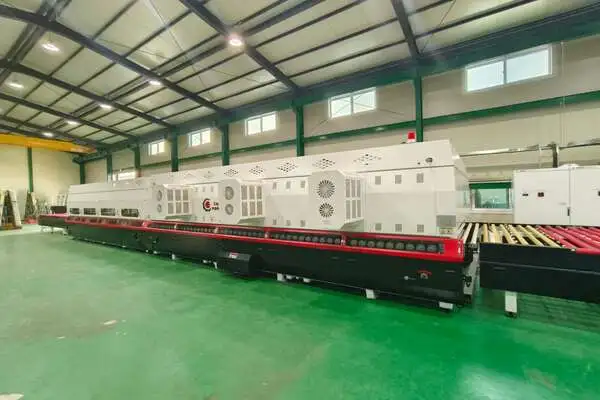
There is a loading table at the beginning of a horizontal line that moves glass over a roller conveyor into a heating chamber, then into a quench section, and finally to an unloading table at the end of the line. Both the upper and lower convection systems work on their own inside the chamber. Fans that are powered by inverters push air through nozzle boxes that are aimed at the glass. Ceramics that are rated to 1300°C are used for our convection parts and the structures that hold them up. This way, they keep their shape at working temperature and don't lose heat that isn't needed. There is a control matrix that reads thermocouples in different areas and changes the output of the heating element. The quench has two separate plenums, one at the top and one at the bottom. Each has its own pressure setting. Each part of the line has its own drive, so it can handle both short and long sheets without having to reset the whole machine.
Which Glass Types the Line Can Process
Provided the coating supplier confirms compatibility, a Full Convection Flat Glass Tempering Furnace can process a wide range of glass products, including clear, tinted, reflective, hard-coated, and many soft-coated Low-E glass types. The system can temper coatings with emissivity as low as 0.01, while supporting glass thicknesses ranging from 3 mm to 19 mm. These capabilities cover many common architectural applications, such as curtain wall panels, insulating glass units, front doors, shower enclosures, and interior partitions. With a suitable heat-treatment window published by the coating manufacturer, the furnace may also process glass for furniture tabletops, appliance panels, and solar cover applications. Before preparing a quotation, we recommend requesting the coating data sheet because two Low-E products with similar visible light transmission values may behave very differently when exposed to tempering temperatures. Checking the coating specifications in advance helps confirm process compatibility and select the appropriate heating parameters.
Specifications That Matter to B2B Buyers
It pays to read a specification sheet carefully. These are the three things we talk about with every buying team.
- Glass geometry. Maximum and minimum sheet size, the 3mm to 19mm working band, and the lowest emissivity the line tempers without haze together decide which contracts you can bid. A machine rated at 0.01 emissivity opens the triple-silver segment, while a unit limited to pyrolytic coatings cannot follow you into that market.
- Proven output. Request cycle time, sheets per shift, and first-pass yield measured on your own Low-E samples. Theoretical capacity assumes perfect loading, no changeovers, and a machine running at full line speed all day, so trial data from a factory acceptance test tells you far more than a brochure figure ever will.
- Site conditions. Confirm voltage and frequency (220V, 380V, or 415V at 50Hz or 60Hz), compressed air demand, quench blower power, floor area, and crane access before signing. These details shape civil works, utility connections, and the shipping schedule months before an installation crew reaches your dock.
If you read them together, you can tell if the furnace is right for your plant.
How Does a Full Convection Furnace Heat Low-E Glass?
With coated glass, the outcome depends on how heat moves through it. On a running line, this is the order that our operators follow.
Recipe Selection and Controlled Preheat
Each batch starts with a recipe. When the order's thickness, size, type of coating, and safety standard are typed in, the software loads a heating curve that fits. With preheat, the sheet is slowly warmed up so that thermal shock doesn't break the edges or chip the corners. How long the glass stays under the nozzles is set by the roller speed in the recipe. Because coatings with the same emissivity can absorb heat at different rates, we keep separate recipes for each producer. By only storing those recipes once, operators don't have to rebuild the settings every time an order comes in.
Forced Circulation Across Both Surfaces
Within the space, hot air is pushed by blowers through nozzle boxes that are placed above and below the rollers. The moving air breaks up the thin layer of still gas that is stuck to the glass. This layer would normally make it take longer for heat to move through. Now that the barrier is gone, energy gets to the coating through convection instead of infrared absorption. For Low-E glass, the difference is important because the coating sends a lot of radiant energy back into the space. The operator can match the amount of heat going to the coated and uncoated faces by controlling the top and bottom separately. This keeps the sheet flat as it gets closer to the tempering temperature.
Soaking, Transfer, and Quench
After being heated, the glass soaks at the target temperature for a short, timed amount of time. This evens out any differences in the sheet. After that, it only takes a few seconds to move to the quench. This speed is part of the recipe. Heavy air from both plenums cools the surfaces quickly enough during the quench to keep the compressive stress in place. The number of fragments and the mechanical strength of the finished lite depend on the pressure settings and the condition of the nozzle. After the glass cools down and is inspected, the system writes down the temperatures, speeds, and quench pressures next to the order number.
Full Convection Versus Radiation and Partial Convection Furnaces
A convection label is on a lot of machines. The difference in how they move air is seen in the yield.
How Radiant Heating Limits Coated Glass
In a conventional radiation-dominated furnace, heating elements positioned above and below the rollers transfer heat to the glass primarily through infrared radiation. Since clear glass absorbs this energy effectively, the method works well for many standard tempering applications. However, Low-E coatings can change the heating behavior. Soft-coat Low-E surfaces reflect or block a significant portion of incoming infrared radiation, causing the coated side to heat more slowly than the uncoated side. Operators may need to extend the heating cycle to compensate for this difference, but a longer heating time can increase the risk of optical distortion, roller wave, and coating damage. A Full Convection Flat Glass Tempering Furnace offers an alternative by using forced hot-air circulation to improve heat transfer and promote more uniform heating, particularly when processing coated glass. For this reason, some manufacturers use conventional radiation systems for hard-coated pyrolytic products while choosing full-convection technology for more demanding soft-coat Low-E applications.
What Partial Convection Can and Cannot Do
A radiant chamber gets some airflow from partial convection systems. This method lowers the cost of entry and makes heating hard-coated glass better. It may be a good choice for plants that only make a few products. They show up as the mix gets bigger. Radiation can still change the balance between faces, since airflow may only cover a small part of the chamber's width or just the top surface. Then, soft-coated Low-E work moves more slowly than the line's rated cycle, and workers have to choose between quality and output. People who are buying should not only ask if there is a blower, but also how much of the heating work is done by the air.
Comparing Cycle Time, Yield, and Total Cost of Ownership
Do not compare claims, but trials. On each candidate machine, run the same 6mm triple-silver lite and keep track of cycle time, flatness, haze, and break count. Finally, compare the results over a full week of production to see first-pass yield and kWh per square meter. Cost of spare parts, service response time, and the cost of a line that won't work should all be added. The purchase price is one line in a longer calculation. Even though the invoice is higher, a furnace that has a shorter cycle and fewer rejects often costs less per square meter. We give buyers a blank sheet to keep the numbers next to each other.
Critical Control Parameters and Quality Verification
Small mistakes are punished by coated glass. If you can keep these factors in check, most defects will go away before they reach the customer.
Temperature, Airflow, and Roller Speed
The upper-to-lower balance, the blower speed, the roller speed, the transfer timing, and the quench pressure all affect each other. As the area, thickness, and type of coating on the glass change, so does the thermal load. This means that a fixed airflow setting rarely works for a mixed order book. The inverter control changes the output of the blower in real time. This keeps the heating curve stable even when the sheet size changes. When the rollers move too quickly, they don't heat up the coating enough, and when they move too slowly, they heat up the bottom face too much. We make sure that all six variables are in line with the coating that the customer uses and then save the result as a locked recipe.
Fragmentation, Flatness, and Coating Checks
Performance standards for safety are written down. Based on where the project is going, test it against EN 12150-1, ASTM C1048, or ANSI Z97.1 for fragmentation, surface compression, and impact resistance. When you do visual checks, you should look for things like haze, bow, roller wave, edge lift, and edge lift under the lighting that the client will actually install. When inspecting a coating, for example, scratches, pinholes, discoloration, delamination, contamination, and any change in emissivity after tempering are all things that are looked for. Each result should be written down next to the batch number. A record that can be tracked settles disagreements faster than a conversation and gives architects the paperwork they need.
Common Low-E Defects and How to Prevent Them
Weak tempering, heavy roller waves, bows, scratches, coating damage, long cycles, and high energy use are just a few of the problems that can occur during glass processing. A Full Convection Flat Glass Tempering Furnace helps address these challenges by providing more consistent heat distribution and improving temperature control throughout the heating process. Most defects are caused by incorrect recipes, insufficient convection, displaced thermocouples, dirty or worn rollers, uneven quench airflow, improper positioning of the coated side, and excessive soaking. To prevent these issues, testing should first be carried out using the exact coating and substrate specified in the order. This should be followed by zone calibration and recipe validation. After that, the production line must be maintained within the required operating range through regular inspections of rollers, sensors, blowers, nozzles, and control hardware. Running a new product with outdated settings is one of the most costly mistakes manufacturers can make. Maintaining separate recipes for each coating supplier, glass thickness, and sheet size helps prevent this problem and ensures stable production quality.
Energy, Capacity, and Furnace Selection
A board needs numbers it can back up when making capital decisions. You can get our help building them here.
Calculating Real Capacity and Energy Demand
Installed power, insulation quality, glass thickness, coating type, target temperature, soak time, line speed, loading pattern, blower power, and standby behavior all affect how much energy is needed. There is a simple formula for figuring out capacity: theoretical cycles per hour ÷ usable glass area per cycle · operating availability · first-pass yield. Most marketing numbers are based on the best possible outcome for each factor. To get accurate information about your product's kilowatt-hours per square meter, standby draw between shifts, and the impact of a changeover, you should ask for these numbers. Our design for saving energy aims to use about a third less electricity than regular radiant heating, and we explain how we came up with that number.
Matching the Furnace to Your Product Mix
Start with the mix of goods, not the list of prices. Make a list of the sheet sizes, thicknesses, coating families, output per year, and products you plan to add in the next five years. The technical scope includes the range of emissivity, the uniformity of heating, the flatness of thin layers, the cycle time, the level of automation, the logging of data, and access to the service. Which is better for heating—gas or electricity? The answer varies from state to state and depends on things like utility costs, grid capacity, emissions rules, and maintenance resources. If you buy a furnace that is too small for today's orders and not big enough for tomorrow's, you will lose more contracts than you save.
Installation, Training, and Long-Term Maintenance
Foundations, crane access, electrical capacity, compressed air, ventilation, and local safety codes are the first things that need to be worked on at the site. Tests at the factory and on-site should compare a sample of Low-E glass to written standards for quality, output, uniformity, and energy use. English, Spanish, Russian, Korean, Portuguese, French, German, and Turkish menus help operators learn how to control recipes, handle coatings, inspect, and handle emergencies in less than a week. As a rule, commissioning takes twenty to thirty days. Rollers, elements, thermocouples, blowers, filters, nozzles, seals, and interlocks are all part of preventive maintenance. We've been making tempering tools since 1994, and our techs are available 24 hours a day, seven days a week for support calls. Every export unit has CE paperwork that goes with it.
Conclusion
The tempering cycle is changed by the fact that low-E glass reflects infrared energy. This article explained how a Full Convection Flat Glass Tempering Furnace solves the issue: blowers and nozzle boxes move heat through the air instead of radiation, making sure that both sides of a coated sheet warm up at the same rate. Then, it went through the steps of operating, from choosing a recipe to quench. It also looked at full convection, radiant, and partial systems, and set out the quality standards and tests. Planning for energy and capacity, matching products, installation, and maintenance finish off the picture. Process control, not just the price of the glass, determines whether the coated glass leaves the line flat, clear, and properly tempered.
FAQ
Can one furnace temper every Low-E product?
No, compatibility depends on the substrate, thickness, emissivity, coating construction, and the heat-treatment needs of the coater. Triple-silver soft coatings need more control over airflow than pyrolytic hard coatings, and some products have temperature limits that make tempering impossible. Get the data sheet to me before I place my order.
How much electricity does forced convection save?
Because savings depend on design, recipe, load, and site conditions, there isn't a single percentage that works for all plants. Our inverter-driven airflow and ceramic convection parts are meant to use about a third less energy than radiant lines. Find out how many kilowatt-hours are used per square meter of your product instead of just hearing a claim.
What information speeds up a quotation?
Sizes of the glass, the range of thicknesses, the coating requirements, the annual output, the standards that apply, the location of the factory, the voltage and frequency that are available, and the level of automation that you want. We use this information to figure out the sizes of the heating zones, the quench capacity, and the line speed. Then we send back a proposal with the expected output, energy assumptions, and delivery schedule.
How long does delivery and commissioning take?
Most custom builds are shipped 80 to 100 working days after the drawing is approved. It takes 20 to 30 days to install and commission something on-site, and one week is enough time to train operators.
EASTTEC EQUIPMENT — A Full Convection Flat Glass Tempering Furnace Manufacturer Built for Low-E Work
Email sales@easttecmachine.com with your glass sizes, thickness range, coating needs, and desired output. For your specific mix of products, our engineers will figure out the right size for heating zones, quench capacity, and line speed. They will then send you a proposal with the expected output, energy assumptions, and lead time. At easttecglass.com, you can look at information about installations and machines. Not the other way around, let's build a furnace that fits your plant.
References
1. EN 12150-1:2015, Glass in Building — Thermally Toughened Soda Lime Silicate Safety Glass (European Committee for Standardization, 2015)
2. ASTM C1048-18, Standard Specification for Heat-Strengthened and Fully Tempered Flat Glass (ASTM International, 2018)
3. ASTM C1376-15, Standard Specification for Pyrolytic and Vacuum Deposition Coatings on Flat Glass (ASTM International, 2015)
4. ANSI Z97.1-2015, Safety Glazing Materials Used in Buildings — Safety Performance Specifications and Methods of Test (American National Standards Institute, 2015)
5. ISO 9050:2003, Glass in Building — Determination of Light Transmittance, Solar Direct Transmittance, Total Solar Energy Transmittance and Related Glazing Factors (International Organization for Standardization, 2003)
6. NFRC 200-2020, Procedure for Determining Fenestration Product Solar Heat Gain Coefficient and Visible Transmittance at Normal Incidence (National Fenestration Rating Council, 2020)

USER EVALUATE
Here is the customer's evaluation of us