




How Does a Radiation Flat Glass Toughening Furnace Support Building Glass Production?
A Radiation Flat Glass Toughening Furnace supports building glass production by heating flat glass evenly with radiant energy, then cooling it fast with controlled air to create safety glass. This process gives façade, door, partition, and shower glass the strength and safe breakage pattern that building codes require. With multi-zone heating, stable controls, and repeatable recipes, a processor can hold flatness, limit rejects, and keep output steady across many glass sizes. I wrote this guide for owners, plant managers, and engineers who want to understand the technology, compare options, and make a confident equipment decision.
Tempered glass appears in façades, curtain walls, doors, windows, shower enclosures, partitions, and balustrades. Projects now call for larger panels and tighter optical quality, so your furnace sets the limit on what your plant can sell.
Understanding the Radiation Flat Glass Toughening Furnace
What Is a Radiation Flat Glass Toughening Furnace?
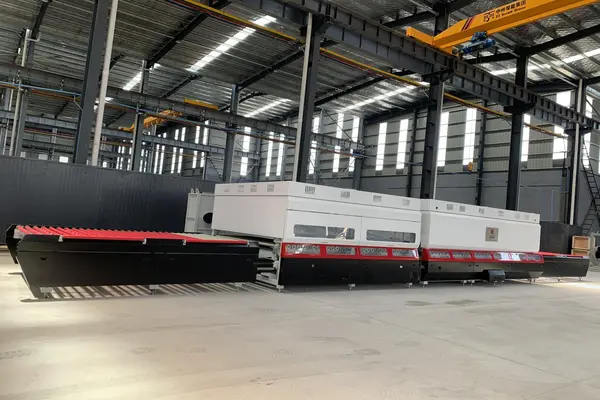
A Radiation Flat Glass Toughening Furnace is a horizontal tempering line. Its heating chamber warms flat glass mainly with radiant energy, and a quench section then cools the glass with controlled air. Radiation refers to the heat-transfer method, while electricity usually supplies the power. A full line includes loading tables, a roller conveyor, a multi-zone heating chamber, quench fans and nozzles, unloading tables, and PLC automation. Buyers also search for this equipment as a flat glass tempering furnace or a glass toughening machine.
The Easttec model uses a matrix radiant heating system with independent PID control in each zone. It is built for clear float, tinted, and decorative printed glass, which suits standard architectural and furniture glass requirements.
How the Heating and Quenching Process Works
The process has four steps. First, operators load clean glass with good edge quality onto the roller conveyor. Second, the furnace heats the glass to a temperature above 600°C, near its softening range, while zone controls limit differences between the center, edges, and corners. Third, high-pressure air cools both surfaces quickly. The outer layers harden first and lock in compressive stress, while the core stays in tension. Fourth, the glass moves to unloading, where inspectors check flatness, roller marks, optical quality, and fragmentation. This balance of surface compression and core tension makes tempered glass several times stronger than annealed glass of the same thickness. It also makes the glass break into small, blunt pieces.
Why Tempering Matters for Building Codes and Safety
Building glass must pass defined tests before it reaches a project. In the United States, ASTM C1048 sets requirements for fully tempered glass, including a minimum surface compression of 69 MPa. ANSI Z97.1 and 16 CFR 1201 cover safety glazing in places such as doors, side panels, and shower enclosures, where impact safety matters most. Europe uses EN 12150-1, which sets fragmentation limits. For clear float glass from 4 mm to 12 mm, the minimum is 40 particles in any 50 × 50 mm square.
We build our furnace to meet international requirements for 4–19 mm glass tempering, and it complies with CE standards. I still advise every buyer to test sample glass against the local standard during acceptance.
How Radiation Heating Supports Quality and Production Efficiency
Heating Uniformity, Flatness, and Optical Quality
Heating uniformity drives most quality results in a Radiation Flat Glass Toughening Furnace. If the center of a glass sheet runs hotter than the edges, the glass can warp, develop roller wave, or break during quenching. Our matrix radiant heating system divides the chamber into multiple zones, each equipped with its own PID controller. This allows operators to adjust the heating curve according to different glass thicknesses and sizes, helping maintain flatness and minimize optical distortion.
When you compare suppliers, ask for measured results rather than claims. Useful checks include roller wave readings, edge lift at the leading and trailing edges, fragmentation counts, surface stress measurements, and periodic furnace temperature mapping to catch thermocouple drift or element wear. These tests show whether a furnace holds quality over months, not just on delivery day.
Energy Use and Operating Cost
Tempering uses a lot of electricity, so energy cost affects your margin on every sheet. Easttec states that its insulation and airflow design reduces energy use by 15–20%, which shortens the payback period.
When you evaluate any furnace, I suggest comparing kilowatt-hours per square meter of good tempered glass, not just installed power. Installed power ignores cycle time, loading density, and rejects. A furnace that loads fully, changes recipes quickly, and breaks few sheets often costs less per square meter than a cheaper machine that wastes heat and glass. Ask each supplier to state the glass thickness, load pattern, and test conditions behind its energy figure so you can compare offers fairly.
Capacity and Product Flexibility
Building glass plants rarely run one product. A single week may include thin partition glass, thick balustrade panels, and a few oversized façade lites. Our furnace handles glass from 3 mm to 19 mm. The largest model loads sheets up to 3300 × 6000 mm, and the smallest model processes small lites down to 50 × 100 mm.
One-key recipe recall lets operators load a saved heating program instead of building one by hand, which speeds changeovers and reduces setup errors. Judge capacity against your actual product mix. Cycle time, changeovers, uptime, and yield set real output, not the largest sheet size on a brochure.
Choosing the Right Furnace Technology and Supplier
Radiation vs. Convection and Hybrid Designs
Radiation, convection, and hybrid designs describe how a furnace moves heat, and many machines combine them. Radiation transfers energy directly from heating elements to the glass. Convection moves heated air across the glass surface. Horizontal roller furnaces of either type are standard for architectural flat glass because they carry large panels at high volume.
A radiation design suits clear, tinted, and printed glass, making our Radiation Flat Glass Toughening Furnace an ideal choice for these applications. Coated glass, such as Low-E glass, requires validation of the coating type, emissivity, and loading orientation. If coated products are central to your production plan, let us know early. Our engineers can then recommend the right configuration, including our true forced convection furnaces, which use a high-temperature blower and ceramic convection components rated to 1300°C.
Key Selection Criteria for Building Glass Processors
Start with the glass you sell, not the machine you want. List your applications, such as façades, doors, windows, shower enclosures, partitions, and balustrades. Then set minimum and maximum sizes, thickness range, glass weight, and daily output. Add your quality targets and automation needs.
Next, check the build. Our furnaces use Siemens and Schneider electronics, and Easttec cites a service life of more than 20 years. Ask every supplier for sample testing, reference projects, and documented temperature-uniformity results. Then calculate total cost of ownership, which covers energy, labor, maintenance, spare parts, installation, service, and expected rejection rates. Purchase price is only one line in that calculation.
Common Mistakes to Avoid
I see the same errors often. The first is buying on price alone, which can lead to high energy bills, weak automation, and costly spare parts. The second is trusting theoretical capacity. Real output depends on glass mix, heating and quenching time, changeovers, uptime, and yield.
The third is assuming every radiation furnace handles Low-E glass the same way. It does not, so validate your coating first. The fourth is ignoring site planning, such as power supply, compressed air, cooling, ventilation, and maintenance access. The fifth is treating the furnace as a standalone machine when it must connect with cutting, edging, washing, and insulating or laminating lines. A clear checklist at the start prevents most of these problems.
From Inquiry to Installation and Long-Term Support
From Specification to Purchase
A clear technical inquiry lets suppliers send comparable offers. Include glass sizes, thickness range, coatings, target output, operating schedule, automation level, factory location, and utilities. When quotes arrive, compare them line by line: usable glass size, heating zones, roller configuration, quench system, accessories, installation, training, and spare parts.
Before you sign, write acceptance criteria for your Radiation Flat Glass Toughening Furnace covering capacity, flatness, visual quality, fragmentation, and energy use. Our process follows eight steps: preliminary inquiry, project design, design refinement, cooperation agreement, production, installation and commissioning, operation training, and after-sales service. Most buyers take months to decide, so we welcome factory visits and equipment demonstrations.
Installation, Commissioning, and Maintenance
Each furnace is customized, with a typical delivery time of 60 to 120 working days depending on the model. Use that time to prepare the site: foundation, floor space, ceiling height, access routes, power, compressed air, cooling, and ventilation.
Power adaptation matters for U.S. plants. We configure systems for global industrial voltage and frequency standards, including 220 V, 380 V, 415 V, and 50/60 Hz, so please confirm your exact supply in the inquiry. We can also customize equipment size, heating curves, cooling parameters, and color. Our team handles installation and commissioning, then trains your crew. Preventive maintenance focuses on heating elements, insulation, rollers, bearings, fans, air nozzles, sensors, and control cabinets. Keep critical spare parts on site to protect uptime.
Training, Remote Support, and Why Global Buyers Trust Easttec
Skilled labor is hard to find, so the control system matters. Our interface offers an automatic multi-language menu, with English, Spanish, Russian, Korean, Portuguese, and other options. Our software handles different glass thicknesses, and new operators can learn operation and maintenance within one week. Technicians provide 24-hour online support, and remote digital diagnostics help trace problems fast.
Easttec has worked in glass tempering technology since 1994 and serves clients in more than 40 countries. Dozens of partner factories with large-equipment experience support our production, and our products comply with CE standards. We welcome visits to our factory, where you can see the equipment and put your questions to our engineers directly.
Conclusion
A Radiation Flat Glass Toughening Furnace turns annealed flat glass into safety glass through even radiant heating and fast air quenching. This article showed how that process meets standards such as ASTM C1048, EN 12150-1, ANSI Z97.1, and 16 CFR 1201, and how multi-zone PID control supports flatness, energy savings, and flexible capacity. It also compared radiation with convection designs, listed selection criteria, and warned against choosing by price or theoretical output alone. Planning for utilities, maintenance, training, and acceptance testing protects uptime after delivery. The best furnace fits a plant's real glass mix, proves its quality with test data, and comes with dependable long-term service.
FAQ
Can a radiation furnace process Low-E glass?
Not every radiation furnace handles Low-E glass the same way. Coating type, emissivity, and loading orientation need validation. Our radiation model is engineered for clear float, tinted, and decorative printed glass, so please share coating details in your inquiry.
What glass sizes and thicknesses can it process?
The furnace processes glass from 3 mm to 19 mm. The largest model loads 3300 × 6000 mm, and the smallest model handles lites down to 50 × 100 mm.
How long does delivery take?
Each furnace is customized. Depending on the model, delivery takes 60 to 120 working days.
Does the furnace meet safety requirements?
Our equipment complies with CE standards and supports tempering that meets international safety glass requirements for 4–19 mm glass. I recommend testing sample glass against ASTM C1048 or your local code during acceptance.
Request a Radiation Flat Glass Toughening Furnace Quote From EASTTEC EQUIPMENT
EASTTEC EQUIPMENT is a Radiation Flat Glass Toughening Furnace manufacturer with more than 20 years of experience and clients in over 40 countries. Send your glass sizes, thickness range, coatings, target output, voltage, and factory location to sales@easttecmachine.com. Our engineers will recommend a configuration and back it with installation, training, and 24-hour online support. Visit easttecglass.com for details.
References
1. ASTM C1048, Standard Specification for Heat-Treated Flat Glass—Kind HS, Kind FT Coated and Uncoated Glass, 2018
2. EN 12150-1, Glass in Building – Thermally Toughened Soda Lime Silicate Safety Glass – Part 1: Definition and Description, 2015
3. ANSI Z97.1, Safety Glazing Materials Used in Buildings – Safety Performance Specifications and Methods of Test, 2015
4. U.S. Consumer Product Safety Commission, 16 CFR Part 1201, Safety Standard for Architectural Glazing Materials, 1977
5. Haldimann, Luible, and Overend, Structural Use of Glass (IABSE Structural Engineering Documents), 2008
6. J. E. Shelby, Introduction to Glass Science and Technology (Royal Society of Chemistry), 2005

USER EVALUATE
Here is the customer's evaluation of us