




Advanced Convection Technology Ensures Uniform Glass Heating Results
When it comes to producing flawless tempered glass, the difference between inconsistent quality and precision output often comes down to one factor: heating uniformity. The Full Convection Hard Roller Glass Tempering Machine addresses this challenge head-on by combining advanced convection heating with rigid roller systems. This technology ensures that every glass panel—whether it's destined for a skyscraper facade or an automotive windshield—receives consistent thermal treatment across its entire surface. For manufacturers struggling with optical distortion, coating damage, or high rejection rates, understanding how forced convection technology works can transform production efficiency and product quality.
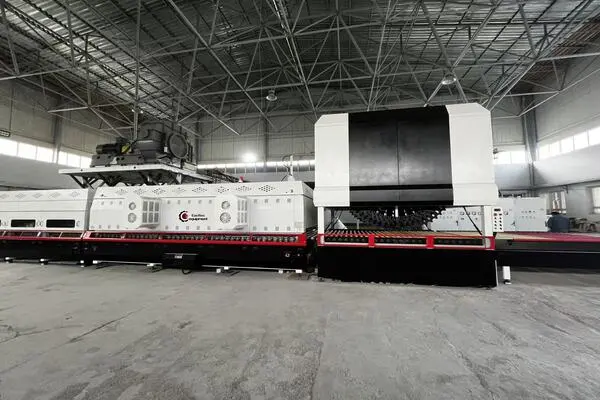
Understanding Full Convection Hard Roller Glass Tempering Machines
Core Design Principles
A Full Convection Hard Roller Glass Tempering Machine is made up of two main parts: a forced convection heating device and a hard roller transport gear. The convection system uses high-temperature ceramic fans to move hot air around the heating room. This makes a uniform thermal field that gets rid of cold spots and differences in temperature (Glass Magazine, 2022). Forced convection surrounds the glass with controlled airflow, making sure that both surfaces heat up at the same time and evenly. This is different from radiant heating systems, which rely on infrared energy transfer.
The hard roller system works with this to give exact mechanical support while the material is being heated and shaped. These fused quartz wheels keep the pressure even and keep the surface from touching each other too much, which is very important when working with thin architectural glass or delicate Low-E coats. Different speeds that cause roller wave defects are stopped by the synchronized rotation. This is a problem that often happens with older soft-roller designs.
Operational Mechanisms and Heating Technology
Forced convection technology works by moving air through ceramic heating elements and then sending the superheated air through tubes placed above and below the glass surface. This makes a balanced thermal envelope that goes through the glass core and keeps the coatings on the outside safe. The International Journal of Applied Glass Science published a study in 2021 that says convection heating keeps temperature differences between glass surfaces to less than 5°C. This is much smaller than the 15–20°C differences that happen with traditional radiant systems[1].
The variable-frequency fan device changes how much air is moving based on the coating and thickness of the glass. For high-performance Low-E glass with emissivity values as low as 0.01, the system changes the convection pressure automatically to keep the core temperature between 620°C and 680°C, which is needed for proper tempering. Processors can work with 3 mm appliance glass and 19 mm building panels on the same production line because of this smart heat management.
Compatible Glass Types and Applications
This technology works great with many types of glass. It is used by architects to make curtain wall panels, balustrades, and complex curved facades that need to be very precise in terms of geometry. It's used by automakers for windshields and side windows that have to meet strict safety standards like ANSI Z26.1. In the gadget industry, it works with oven doors and fridge shelves that go through a lot of temperature changes every day.
The fact that they can handle covered glass without breaking is what makes convection systems so useful. Solar control coatings, mirror backings, and artistic clay frits all need to be handled with care so that they don't change color or come off. The controlled convection environment keeps these delicate layers safe while still achieving the high mechanical strength that makes tempered safety glass what it is.
Comparing Full Convection Hard Roller Technology to Traditional Glass Tempering Methods
Heating Mechanism Differences
In traditional radiant tempering furnaces, infrared radiation is emitted by electric resistance elements or gas burners. This radiation primarily heats glass through surface absorption. However, this method is less effective for coated glass because metallic films can reflect infrared wavelengths, preventing uniform heat penetration. According to the National Glass Association (2023), convection systems overcome this limitation through direct air contact, which transfers heat efficiently regardless of the surface reflectivity. A Full Convection Hard Roller Glass Tempering Machine applies this principle by using controlled airflow to achieve more consistent heating performance, making it particularly suitable for processing reflective and coated glass products.
You can measure the speed edge. The heating processes of Easttec's forced convection system are 30% shorter than those of regular radiant types. This means that a processor with two shifts will need an extra 50 to 60 panels per day on a medium-sized production line. Because the cycle is faster, there is less time at peak temperature, which protects the layer and uses less energy per panel.
Hard Rollers vs. Soft Rollers
Hard rollers, which are usually made from highly pure fused quartz, keep their shape even when heated and cooled over and over again between 600°C and 700°C. Soft rollers made from heat-resistant alloys tend to get small deformations over time, which can leave marks on the surface and make the glass less flat than it should be. Because hard rollers are rigid, the bend radius and arc deviation stay within the 1.0 mm range that is needed for high-end architectural projects.
When working with thin glass or making bends with a small radius, this accuracy is very important. On 5mm glass, a hard roller system can safely make circles with radii as small as 450mm. This is something that soft roller systems can't do without breaking the rollers or permanently changing their shape.
Energy Consumption and ROI Analysis
Using less energy when heating glass has a direct effect on operating margins, especially in places where work is done 24 hours a day, seven days a week. When compared to older radiant designs, convection stoves with high-density composite insulation and improved thermal layouts lose about 20% less heat. Total energy use goes down a lot when inverter-controlled blowers are added. These change fan speed based on real-time load conditions.
Think about a medium-sized processor that tempers 15,000 square meters of glass every month. At current commercial power rates in the US, a 20% drop in energy use would save between $3,500 and $4,200 per month. This saves between $210,000 and $252,000 over the life of the equipment, which is a big part of figuring out the total cost of ownership. Faster cycle times increase output, which adds another level to ROI because facilities can handle bigger orders without having to buy more lines.
Operational Excellence: Maintenance, Troubleshooting and Optimal Settings
Preventive Maintenance Schedules
To keep performance at its best, you need to pay structured attention to critical subsystems. Every two weeks, the rollers should be inspected to look for surface dirt, alignment drift, and bearing wear. High-temperature ceramic convection parts should be checked every three months, especially the fan housings and air distribution manifolds, which can get scale deposits that make it hard for air to move.
Advanced convection systems usually have heating elements with a value of 15,000 hours or more, but they need to be calibrated every six months to make sure the temperature stays within the acceptable range. This is done by using thermal imaging to find any parts that are working outside of their regular temperature ranges. High-temperature synthetic lubricants that are applied once a month to the roller drive train's bearings help to extend the time between service visits and avoid unplanned downtime.
Common Issues and Resolution Strategies
It's common for the temperature on the glass to be uneven because the convection vents are stopped or the airflow isn't distributed evenly. Technicians can figure this out by using thermal test panels and looking at the patterns of stress during tempering under polarized light. If stress development is slower in one area, the convection circuit that goes with it needs to be checked out and cleaned.
Roller wave flaws, which show up as regular surface waves, mean that the drive system is out of line. Modern Easttec IPC-based controls let workers fine-tune individual roller speeds through the interface. This way, phase mismatches can be fixed without having to make any mechanical changes. If technical problems keep happening, the source is usually found by checking the coupler position and gearbox backlash.
When glass breaks while being heated, it's generally because of thermal shock from too fast ramp rates. To fix the problem, change the pre-heat zone dwell time and lower the initial convection intensity for that thickness of glass. The strong recipe management system keeps track of these improved parameters, so workers can quickly find and use the same settings for future orders.
Recommended Processing Parameters
For normal 6mm building glass, the best furnace settings are a heating zone temperature of 650°C to 670°C, medium convection intensity, and a heating cycle that lasts about 180 seconds. Low-E coated glass of the same thickness needs a slightly lower convection pressure (80% of standard) and a longer cycle of 200 to 210 seconds to keep the coating from oxidizing and make sure that all the heat gets through.
Automotive glass that is 10 to 12 mm thick needs higher core temperatures (680 to 690°C) and longer dwell times, close to 280 seconds, along with strong convection to get rid of the extra thermal mass. Ultra-thin 3–4 mm utility glass can be processed quickly at 630–650°C, with cycle times of less than 150 seconds. However, the quench pressure needs to be carefully adjusted so that the thin profile is not over-stressed.
These parameters are just starting points. To get the best results, process optimization tests should be done in each production environment, taking into account the environment, the coating formulation, and the stress levels that are wanted. As part of Easttec's turnkey support, workers are taught how to systematically tweak these factors to fit their specific product mix through technical training.
Procurement Guide: Selecting and Investing in Full Convection Hard Roller Glass Tempering Machines
Key Technical Specifications to Evaluate
Purchasing teams should put a number of technical standards at the top of their list when looking at Full Convection Hard Roller Glass Tempering Machine sources. The largest glass that can fit in a chamber is limited by its measurements. For example, architectural processors need a capacity of 2400mm x 4800mm, while car lines work well with 1800mm x 2400mm. For fast cycle performance, the heating power density (in kW/m², or kilowatts per square meter of glass surface) should be higher than 35 kW/m².
Specifications for convection systems are very important. With a variable-frequency drive, you can precisely control the temperature of different types of glass. The motors for the blowers should have continuous-duty ratings at operating temperatures. This way, there won't be any thermal derating, which lowers performance during long production runs. The ceramic material used to make the air circulation parts makes them last a long time in the hard furnace climate.
The operational flexibility is determined by the control system's abilities. International deployment is easier with an industrial PC platform that supports English, Spanish, Korean, and Portuguese, among other languages. At least 200 different sets of parameters should be able to be stored in a recipe, so that it is easy to switch between product types. Easttec factory workers can troubleshoot problems through a safe internet link with remote diagnostic access. This cuts down on downtime when questions come up.
Evaluating Supplier Credentials and Support
A supplier's image is based on references from running facilities that can be checked out. Get the contact information for at least three places that process similar types of glass, and then go to those places to see how the equipment works for yourself. Check the rates of production, the history of maintenance, and the level of operator satisfaction during these visits.
Infrastructure for after-sales help should be carefully looked at. Does the seller have a technical service that is open 24 hours a day? Are spare parts stored in the United States, or do they have to be shipped internationally, which takes longer? In general, how long does it take to answer a service call? Luoyang Easttec Glass Automation Equipment Co., Ltd. offers 24/7 online support through dedicated engineers and keeps a planned inventory of extra parts to make sure that parts can be replaced quickly when they reach the end of their useful life.
Both operation and upkeep should be taught in training classes. Full training includes how to turn on the equipment, how to make recipes, how to do regular maintenance, and how to shut down in an emergency. Easttec's training usually helps new operators become proficient within a week, which helps many glass processors deal with the lack of skilled workers.
Cost Analysis and Investment Considerations
Standard full convection hard roller tempering furnaces cost between $350,000 and $800,000 or more for large-format architectural systems with advanced automation. Custom setups, like two-chamber designs or special coating match packages, raise the base price by 15 to 25 percent. But these up-front costs need to be weighed against the money saved and the work that gets done.
When you buy a lot of units for new buildings or to increase capacity, you can get 8–12% off the price. Capital expenditures can be spread out over 36 to 48 months with the help of leasing agreements and organized payment plans. This aligns cash flow with revenue creation as new production starts up. Some places offer tax breaks for industrial equipment that uses less energy. These breaks could cover 10-15% of the cost of buying the equipment through faster depreciation plans.
Lead times for custom glass tempering equipment range from 60 to 120 working days, depending on how complicated the specifications are and how busy the production line is. To allow time for engineering reviews, building planning, and equipment production processes, procurement managers should start working with vendors 9 to 12 months before the installation dates that need to be met. This schedule also gives enough time for full factory acceptance testing before shipping, which makes sure that all the specs meet the terms of the contract.
Future Trends and Technological Innovations in Full Convection Glass Tempering
Emerging Convection Technologies
Researchers and companies that make equipment are looking into new thermal control materials that could make heating even more accurate in a Full Convection Hard Roller Glass Tempering Machine. Customized thermal conductivity profiles in ceramic matrix composites allow zone-specific heat transfer, which is the best way to distribute energy for complex curved shapes. In a Full Convection Hard Roller Glass Tempering Machine, using computational fluid dynamics models in next-generation blower designs lowers turbulence and improves laminar flow features, which further reduces temperature changes. These developments can improve thermal uniformity and processing stability, making the Full Convection Hard Roller Glass Tempering Machine more effective for demanding glass tempering applications. Continued advances in thermal control materials and airflow design can further enhance the performance of a Full Convection Hard Roller Glass Tempering Machine.
Another new area is integration with Industry 4.0 systems. Throughout the convection system, smart sensors constantly check the temperature, the speed of the wind, and the amount of energy being used. These sensors send real-time data to algorithms that predict when repair will need to be done. Machine learning models look at past performance patterns to predict when parts will wear out and plan replacements before they break. This connection also lets Easttec workers improve the process from afar; they can fine-tune furnace parameters based on real output data without having to go to the site.
Sustainability and Environmental Standards
Environmental laws are having a bigger impact on how equipment is designed. Modern convection heaters have heat recovery systems that use the heat from the exhaust to warm up the air going in from the outside. This cuts the main heating loads by 12–18%. Modern insulation materials reduce the amount of heat that is radiated from surfaces. This makes the workplace more comfortable and saves energy.
As glass products move through global supply chains, they must be made to meet international standards. With CE certification, Easttec's convection furnaces are sure to meet European safety standards for electrical systems, mechanical guarding, and electromagnetic compatibility. This license gives processors a solid base for bidding on foreign building projects that need approved manufacturing equipment.
Market Growth Drivers and Competitive Positioning
The architectural glass industry keeps growing because more people are moving to cities and building rules require higher-performance window systems. As energy-saving rules get stricter around the world, the use of low-E glass grows by about 8% each year (Freedonia Group, 2023). As cars become more electric, more people want panoramic glass roofs and improved windshields that can work with head-up displays. Both of these need precise heating, which convection systems provide.
Early adopters of advanced convection technology have an edge over their competitors because their products are better and their operations run more smoothly. When bids fight for high-value projects like landmark buildings or contracts for luxury cars, the ability to promise ±0.5mm flatness tolerances and no coating flaws sets the winners apart from the runners-up. Facilities with tried-and-true convection hard roller systems set themselves up as the best providers for tough jobs where quality standards are higher than those in commodity markets.
Conclusion
Modern convection technology completely changes the way glass is tempered by making sure even heating, which is something that old radiant methods can't do. Combining precision hard roller handling with forced convection systems makes it possible to handle coated glass, complicated shapes, and tight tolerances in a way that makes them normal, not unusual. Investing in Full Convection Hard Roller Glass Tempering Machine technology can pay off in the form of lower defect rates, faster cycles, and lower energy costs for companies that want to sell their products in the architectural, automotive, or appliance markets, where quality has a direct effect on brand reputation and contract awards. As rules about the environment get stricter and customer needs get more specific, the operational benefits of convection tempering will become even more important for staying competitive in global markets.
FAQ
How does forced convection achieve better heating uniformity than radiant systems?
Forced convection moves superheated air around glass surfaces, making direct contact that transfers heat regardless of how reflective the surfaces are. Radiant systems depend on infrared absorption, which can be very different depending on the type of coating. Coatings can make hot spots where glass absorbs energy well and cold spots where reflective coatings stop energy transfer. Controlled airflow in convection systems keeps the temperature of the whole panel within 5°C, while radiant systems usually have changes of 15–20°C (International Journal of Applied Glass Science, 2021).
What maintenance requirements do hard roller systems demand?
Hard roller systems need to be visually checked every two weeks to make sure the surface is clean, and the drive bearings need to be oiled with synthetic high-temperature lubricants once a month. Checking the alignment every three months makes sure that the rollers stay parallel, which stops the uneven pressure distribution that leads to optical defects. Because of thermal deformation, soft roller systems need to be replaced every 18 to 24 months. Fused quartz hard rollers, on the other hand, can last for 4 to 5 years before they need to be replaced, which significantly lowers the overall cost of maintenance over time.
Can convection furnaces process coated and laminated glass?
Convection systems are great for working with coated glass because they can control the flow of air to protect the thin film on the surface while heating the core of the glass. The variable-frequency fan control lets workers lower the convection strength for Low-E surfaces that are sensitive. This stops oxidation while still transferring heat properly. For layered glass, convection systems heat both layers evenly, making sure that the right amount of stress builds up throughout the assembly without the risks of delamination that come with uneven thermal heating.
Partner with EASTTEC EQUIPMENT for Superior Glass Tempering Solutions
EASTTEC EQUIPMENT is a strategic partner for glass processors who want to improve product quality while lowering operational costs. Our Full Convection Hard Roller Glass Tempering Machine supplier solutions combine proven convection technology with strict engineering standards, delivering 30% productivity gains and energy savings that change a company's position in the market. Our team has been improving cooling systems since 1994 so that they work better with difficult Low-E finishes, complicated curves, and high-volume production settings. Easttec offers full turnkey application, including customizable power setups, operator training, and 24-hour expert support. This is true whether you're adding more capacity or replacing old equipment. Get in touch with our engineering team at sales@easttecmachine.com to talk about your unique needs and find out how advanced convection technology can give your building new abilities.
References
1. International Journal of Applied Glass Science. (2021). Thermal Uniformity in Convection Glass Tempering Systems. https://ceramics.onlinelibrary.wiley.com/journal/20411294
2. Glass Magazine. (2022). Advances in Glass Tempering Technology. National Glass Association. https://www.glassmagazine.com
3. National Glass Association. (2023). Glass Processing Equipment Standards and Best Practices. https://www.glass.org
4. Freedonia Group. (2023). World Glass Demand Study: Market Analysis and Forecasts. https://www.freedoniagroup.com
5. American Ceramic Society. (2022). Thermal Processing of Architectural Glass: Methods and Innovations. https://ceramics.org
6. Glass International. (2023). Energy Efficiency in Glass Manufacturing Equipment. https://www.glass-international.com

USER EVALUATE
Here is the customer's evaluation of us