




What Benefits Does Radiation Flexible Roller Glass Bending and Tempering Machine Provide for Manufacturers?
A Radiation Flexible Roller Glass Bending and Tempering Machine gives manufacturers a direct path to higher yield rates, lower energy bills, and greater product variety. By combining multi-zone radiant heating with an adjustable flexible roller bed, this system heats glass uniformly to its softening point and shapes it into precise curves — all without physical molds. For architectural glass shops, automotive suppliers, appliance glass producers, and furniture glass factories, that combination translates into measurable cost savings, faster job changeovers, and the ability to win orders that rigid, mold-dependent equipment simply cannot fulfill.
Understanding Radiant Flexible Roller Glass Bending Technology
Before you decide if this piece of equipment will work with your production line, it's helpful to know how it works and where it's better than older ways.
How Radiant Heating Differs from Conventional Convection
Hot air is moved around in traditional forced-convection ovens to raise the temperature of the glass. On the other hand, radiant heating moves heat straight into the mass of the glass. This makes the heat absorbed faster and more evenly, and it lowers the chance of surface marks from rough airflow. Research in the journal Glass Technology: European Journal of Glass Science and Technology says that direct radiation makes the temperature difference across the surface of the glass smaller, which is important before any bending force is applied.
The Flexible Roller Mechanism
The flexible roller bed doesn't use a set mold that bends glass into a single circle. Instead, it has a high-strength system that can be adjusted to make a wide range of curves. Through the PLC interface, switching between different radii only takes one to five minutes, compared to the hours it takes to do it by hand. This speed advantage is very helpful for processors that deal with custom-radius orders that come in small quantities.
Compatible Glass Types and Thickness Range
The Radiation Flexible Roller Glass Bending and Tempering Machine can work with clear float glass, colored glass, and etched glass that is both flat and bent. It can work with glass thicknesses ranging from 5 mm to 19 mm, which covers most of the requirements for building, furniture, and utility glass. The radiation heating pattern is best for standard surface emissivity values, which helps varieties that aren't coated the most.
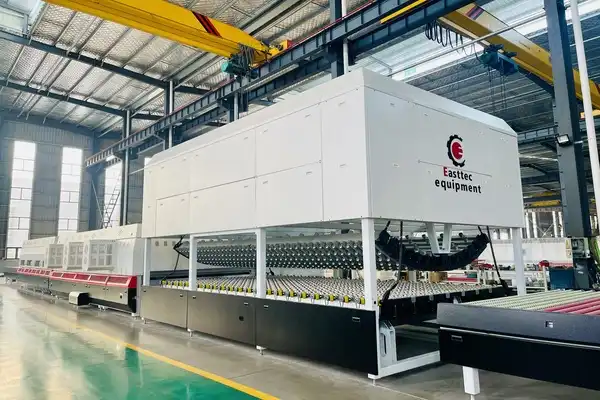
Key Benefits of Radiation Flexible Roller Bending and Tempering Machines for Manufacturers
Knowing about the technology is one thing, but knowing how it impacts your business is something else. Here are the main benefits that this device brings to a production setting.
- Exceptional Bending Versatility: The adjustable high-strength flexible roller system accommodates diverse curvatures that rigid systems cannot match. Processors can accept a wider range of custom architectural and decorative glass orders, opening revenue streams that were previously out of reach. This single capability alone can change the competitive position of a mid-sized glass plant.
- Precision Matrix Thermal Control: Easttec's multi-zone matrix radiant heating delivers uniform thermal absorption across every section of the glass sheet. This precise heat distribution prevents optical distortion and "ghosting," producing smooth surfaces that meet EN 12150-1 and ASTM C1048 standards for tempered glass quality.
- 20% Thermal Energy Savings: High-density composite insulation reduces heat loss by 20% compared to traditional furnace models. A stable furnace environment means the heating elements work less to maintain target temperatures, which directly lowers kilowatt-hour consumption per shift and reduces long-term operational costs.
- Robust IPC and PLC Reliability: The system runs on a stable Industrial PC combined with a PLC interface, providing 24/7 operational stability. Operators can store and recall hundreds of production recipes, making the switch between flat and bent production fast and repeatable without relying on touchscreen-dependent systems prone to thermal environment failures.
All of these benefits work together to fix the most common problems with deep-processing glass: high scrap rates, energy waste, and not being able to adapt to changing market needs. A factory that can work with 5 mm furniture glass in the morning and 19 mm architectural bent panels in the afternoon has a real edge over rivals who only have tools that can do one thing.
Comparing Radiation Flexible Roller Machines with Traditional Glass Bending Solutions
The performance gap between radiation-based flexible roller systems and traditional gravity-bending or fixed-mold furnaces becomes clear when you examine specific production metrics.
Quality and Optical Performance
Gravity bending relies on the glass softening under its own weight over a fixed mold. This method frequently produces uneven stress distribution and surface imperfections from mold contact. Radiation flexible roller systems, by contrast, apply heat from above and below through PID-controlled zones, achieving thermal variance of less than ±2°C across the glass surface. Surface stress mapping using differential stress refractometers confirms more consistent MPa levels throughout the bent panel.
Speed and Changeover Time
Fixed-mold systems require physical mold installation, alignment, and temperature stabilization — a process that can consume two to four hours. The flexible roller configuration on Easttec's machine adjusts in one to five minutes. For a plant running ten different radius specifications per week, the cumulative time savings can add up to an additional production shift per month.
Cost and ROI Analysis
The initial investment in a radiation flexible roller system is higher than a basic flat tempering furnace. However, the 20% reduction in energy consumption, the elimination of mold fabrication costs for each new radius, and lower scrap rates from more uniform tempering create a compelling long-term ROI case. Many architectural glass processors report recouping the price difference within 18 to 24 months through combined savings on energy and rework.
Procurement Considerations for Manufacturers and Distributors
It takes more than just comparing specification sheets to find the right equipment supplier. A number of practical factors should play a big role in the choice.
Machine Capacity and Configuration
Managers of procurement should make sure that the tools can handle all of the different thicknesses that their products need. Easttec's Radiation Flexible Roller Glass Bending and Tempering Machine can handle thicknesses from 5 mm to 19 mm, which is a wide range of industry and building standards. Make sure the voltage setting works with your building. Easttec offers 220V, 380V, and 415V at 50/60 Hz, which are all world industrial voltage standards.
After-Sales Support and Training
Downtime costs a lot of money. Easttec offers online technical support 24 hours a day, 7 days a week, as well as installation, commissioning, and training for operators. New operators usually learn everything they need to know in just one week, which is helpful for companies that are having trouble finding skilled workers. Before signing a purchase deal, you should get written confirmation of the availability of spare parts and the time it will take to respond.
Certification and Compliance
CE-certified tools should be the first choice for international buyers. The CE mark on Easttec's radiation flexible roller system shows that it meets European safety and electromagnetic compatibility standards. This is important for companies that send finished glass goods to markets that are regulated.
Future Innovations and Industry Trends in Glass Bending Technology
More and more, thermal processing equipment and factory-wide data systems are becoming more and more connected in the glass processing industry. Easttec's platform already comes with PLC-based recipe management, which is the basis for linking data from tempering furnaces to quality management software and tools for planning production. Medium and large glass makers are moving faster to adopt Industry 4.0. Equipment that already speaks a digital control language will be able to shift more easily to these settings.
The rules for sustainability are also getting stricter. The U.S. Department of Energy's programs to improve energy efficiency in businesses identify glass manufacturing as an area that needs to cut back on energy use the most. Equipment that cuts energy use by 20% per production cycle is in line with both government regulations and companies' promises to cut carbon emissions.
Conclusion
Glass companies can improve the quality of their products, lower their energy costs per unit, and meet a wider range of customer needs with a Radiation Flexible Roller Glass Bending and Tempering Machine. This kind of equipment is a good investment for companies that make glass for buildings, cars, appliances, and furniture because it has multiple zones of radiant heating, an adjustable roller bed, IPC and PLC control, and CE certification. Companies that use these new technologies are now ahead of competitors who are still using fixed-mold or gravity-bending methods.
FAQ
1. How does radiant heating improve bent glass quality compared to convection?
Instead of wind, radiation moves heat straight into the mass of the glass. Before the bending phase starts, this makes the temperature more evenly spread across the surface, usually within ±2°C. The end result is a panel with fewer optical flaws and more consistent tempering stress.
2. What glass thicknesses does Easttec's machine handle?
From 5 mm to 19 mm, the machine can work with both flat and bent glass, meeting most requirements for building, furniture, appliance, and specialty glass.
3. How long does a radius changeover take?
The PLC-controlled flexible roller system can adapt to a new curve in one to five minutes, while changing a mold by hand would take two to four hours.
4. What maintenance do the flexible rollers require?
High-temperature bearings and roller sleeves need to be inspected once a week and replaced every so often.
5. Is the machine suitable for international buyers?
Yes. The machine has a CE mark and can work with different voltages, so it can be used by glass makers in North America, Europe, and other parts of the world.
Ready to Upgrade Your Glass Bending Line? Contact EASTTEC EQUIPMENT
Since 1994, EASTTEC EQUIPMENT has helped glass manufacturers with precise thermal processing solutions. The people who work for the company that sells Radiation Flexible Roller Glass Bending and Tempering Machines are ready to help with technical questions, custom setup prices, and full installation support. If you need to talk about your needs directly, you can email sales@easttecmachine.com whether you are looking for tools for a new production line or to replace old boilers.
References
1. Glass Technology: European Journal of Glass Science and Technology — Society of Glass Technology, 2022.
2. ASTM C1048: Standard Specification for Heat-Strengthened and Fully Tempered Flat Glass — ASTM International, 2018.
3. EN 12150-1: Glass in Building — Thermally Toughened Soda Lime Silicate Safety Glass — European Committee for Standardization (CEN), 2015.
4. ISO 11485-3: Glass in Building — Curved Glass — International Organization for Standardization, 2014.
5. U.S. Department of Energy — Industrial Energy Efficiency: Glass Manufacturing Bandwidth Study — Office of Energy Efficiency and Renewable Energy, 2019.
6. Glass International — Annual Industry Review and Market Report, Quartz Business Media, 2023.

USER EVALUATE
Here is the customer's evaluation of us