




Dual-Chamber Architectural Glass Tempering Furnace for Low-E Glass
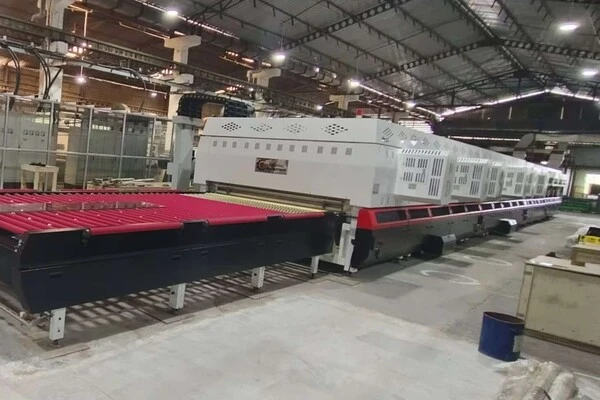
A Dual-Chamber Architectural Glass Tempering Furnace for Low-E glass uses a pre-heating chamber and a high-heating chamber, supported by forced convection, to temper coated architectural glass faster and with fewer defects. While one batch finishes heating, the next batch warms up, so capacity reaches 1.8 to 2 times that of a standard single-chamber furnace. Balanced heating protects sensitive coatings, and an Industrial PC keeps both chambers and the quenching section in step. At EASTTEC EQUIPMENT, we build this furnace for glass processors who need steady quality, lower energy loss, and strong output on 4mm to 19mm glass.
Understanding the Dual-Chamber Architectural Glass Tempering Furnace
How does the Two-Chamber Design Work?
The sheet has to be warmed, held, and the temperature evened out all in the same room. That work is split up by a Dual-Chamber Architectural Glass Tempering Furnace layout. The first chamber warms the glass up ahead of time. The second chamber, which is very hot, gets it to the tempering temperature, which for building glass is usually between 680°C and 720°C. Instead of waiting for each load to clear, production keeps going because two batches move through at the same time. The slow rise in temperature also lowers the risk of heat shock and stress. Compared to fast single-stage heating, this helps keep the surface flat and reduces warping. If you compare this design to a single-chamber design, this split is the main structural difference.
Why Low-E Glass Needs Forced Convection?
Thin layers of metal in low-E coatings reflect infrared energy. While that trait helps buildings save energy, it makes it so that covered glass absorbs radiant heat in a furnace in an uneven way. This is fixed by forced convection, which moves hot air across the glass. True convection technology is used in our furnace. A high-temperature blower moves hot air around inside the machine, and the convection parts that go with it are made of ceramic that can handle temperatures up to 1300°C. With the two chambers set up, top convection works to speed things up. Heating cycles with low-E are 30%. Balanced heating also helps keep the film from oxidizing, which maintains the coating's optical quality.
Control Hub and Process Stability
Two tanks and a quench section must move at the same time. If they don't, timing gaps become flaws. An Industrial PC (IPC) in the middle handles all the heating and convection settings, as well as the time between the two rooms and the quenching area. People who work there only see one screen, and the menu can be shown in English, Spanish, Russian, Korean, Portuguese, and other languages upon request. Our program can work with different sizes of glass. Within a week, new workers can learn how to run and fix the furnace, which helps US plants that have trouble hiring skilled furnace staff.
Benefits of Using Dual-Chamber Furnaces for Low-E Glass
Higher Output for High-Volume Orders
With the Dual-Chamber Architectural Glass Tempering Furnace layout, throughput is where it pays off first. The next batch is warmed up in the pre-heating chamber while the first batch finishes in the high-heating chamber. This shortens the heating cycle and keeps the oven full. A normal single-chamber furnace can only make 1.8 to 2 times as much as our type can. It works best with building lites that are 4 to 6 mm thick. High-quality energy-saving glass can be made on it, and it can be used in factories 24 hours a day, seven days a week. That extra space can let a contract processor take on bigger orders without having to add a second line.
Lower Energy Loss and Operating Cost
It takes a lot of electricity to temper with a Dual-Chamber Architectural Glass Tempering Furnace, so every place where heat is lost shows up on the bill. This furnace has high-tech insulation that cuts thermal energy loss by 20%. The smart power management system divides the electricity between the two chambers, and the ceramic convection parts speed up the heating of the glass while reducing the use of energy that isn't needed. These traits lower the cost of doing business per square meter when put together. If your finance team reports in US units, I think you should keep track of that number per square foot. Each load spends less time in the oven because Low-E heating runs are shorter.
Better Coating Protection, Flatness, and Safety
In order to keep customers happy, here are the main benefits in terms of quality and safety:
- Coating protection: Even heating stops film oxidation, which means that delicate architectural coatings keep their look. Low-E layers, like Triple Silver, can exactly absorb heat thanks to top and bottom airflow. This keeps the metallic layers from burning. Fewer broken lights mean a more consistent look across a big wall order and less work that needs to be redone.
- Surface flatness: The two-stage heating method raises the temperature slowly and evenly. That lowers thermal shock and stress, which makes the flatness better and the distortion less noticeable than with fast single-stage heating. With a range of 4mm to 19mm, one line can cover both thin lites and thick body panels. Flatter glass also fits together more easily into sealed pieces.
- CE compliance: The furnace is fully CE certified and was built according to CE safety guidelines. This means that it can be used safely in high-power, 24 hours a day, seven days a week production and meets the technical needs of high-end international projects. Buyers in the US should still check that finished glass meets ASTM C1048 and ANSI Z97.1 standards, since CE doesn't replace them.
These benefits solve the problems that glass processors tell us about most often: coating damage, visible waves, and doubts about compliance.
How to Choose the Right Dual-Chamber Architectural Glass Tempering Furnace
Match Capacity to Your Product Mix
Start with your list of things to do. The Dual-Chamber Architectural Glass Tempering Furnace plan gives you the clearest gain if most of your space is 4mm to 6mm Low-E lites for windows and curtain walls. Check the temperature curves for thick structural glass up to 19 mm before you sign if you also do that. Our program can handle different thicknesses, but for the best quality, I suggest running widths that are similar together. You can set the equipment's size, heating curves, and cooling parameters to your liking. You should ask each supplier for cycle times that are broken down by thickness and coating type. A number that is given for 4 mm clear glass doesn't tell you much about 12 mm coated glass.
Compare Single-Chamber, Dual-Chamber, and Multi-Chamber Options
A single-chamber furnace is easier to set up and works better for smaller volumes. However, long residence times can cause roller-wave distortion and lower output on big projects. Because it has two chambers, the heating process is split into two steps. This increases output by 1.8 to 2 times in our model and makes the temperature rise more slowly. If you have a lot of volume, you should compare multi-chamber systems because they have more cooking steps. Use the same test for each choice: We measured the cycle time, the flatness, and the amount of energy used per square foot for low-E sample sheets. Your technical director and plant manager can talk about the same facts when they look at test results.
Evaluate the Manufacturer, Not Just the Machine
If you want to buy a heater, make sure you know who will stand behind it. The Luoyang Easttec Glass Automation Equipment Co., Ltd. has been working with glass tempering technology since 1994. They use quality management standards from Europe (Italy) and convection technology from Italy. Our product meets the requirements set by the CE. Buying big pieces of equipment usually takes three to twelve months and a lot of technical reviews. To speed up the process, ask to see the plant, see a live show, and talk to the engineers who will be setting up your line. Our technicians offer online support 24 hours a day, seven days a week. This is important when a US plant has more than one shift.
Maintenance, Troubleshooting, and Operating Routines
Daily and Weekly Upkeep
Most heating problems in a Dual-Chamber Architectural Glass Tempering Furnace can be avoided by sticking to good habits. Check the ceramic rollers every day for sulfur buildup, go over the IPC temperature readings and alarms, and write down anything out of the ordinary in a shift log. I think you should check the airflow and cooling areas for dust and other things that might be in the way once a week, and then compare the cycle times to your average. Every three to six months, based on how much is being made, the rollers should be deep cleaned and lined up. Set up a fuller inspection with a technician once a year. When it comes to Low-E glass, proper maintenance is even more important because uneven heating can show up as flaws on coated sheets.
Troubleshooting Quality Defects
If you do quality checks, you can find the cause. As a general rule, roller waves should be less than 0.08 mm per 300 mm, edge lift should be less than 0.1 mm, surface compression should be more than 69 MPa for fully toughened glass, and there should be more than 40 fragments in a 50 mm by 50 mm area. Strain patterns, which are sometimes called "leopard spots," can also be seen with a polariscope. If roller waves get bigger, check the state of the rollers and the stay time first. If the number of fragments is too low, look at the cooling settings again. If the color of coated glass isn't even, check the heating balance and convection settings first. Write down every change that is made so that the next person working on it can get the same good result.
Operator Training and Support
Experts are hard to come by, so a furnace shouldn't depend on just a few of them. There are several languages on the IPC menu, and new users can learn how to use and fix things in just one week. Installation, commissioning, operation training, and service after the sale are all part of our one-stop process. We can also help you with technology for deep-processing glass and train your staff. Technicians are available online 24 hours a day to help with problems. Ask for a list of extra parts for rollers and convection parts before the order is finalized. This way, your repair manager will know what to keep in stock.
Procurement Guidelines for Dual-Chamber Architectural Glass Tempering Furnaces
What Drives the Price
I don't give a single price because it depends on the setup. The quote is based on the size of the furnace, its production capacity, its heating and cooling parameters, its voltage and frequency, the language of the software, and the color of its parts. When you compare deals, don't just look at the purchase price; also think about how much the tempered glass will cost per square foot over a number of years. Include the cost of energy, the yield, the labor, the upkeep, and the projected output. A cheaper unit that doesn't fill as many orders can cost you more in the long run than a more expensive unit that does.
Customization for US Plants
Each plant has its own power source, floor plan, and list of products. Our burners can work with power systems that use 220V, 380V, 415V, or 50/60Hz, which are all common industrial voltage and frequency standards around the world. Early on, let engineers know about your supplies so they can match the electrical design. Customized production includes machine size, heating curves, and cooling parameters that are based on the specs of your glass. You can also change the language of the software and the color of the equipment. Set your daily goal, thickness range, and largest glass size during the design phase, and make sure you're happy with them again before production begins.
Lead Time, Installation, and Contract Terms
Because Dual-Chamber Architectural Glass Tempering Furnaces are made to order, delivery can take anywhere from 60 to 120 business days, depending on the model. From the first question, through project design, optimal design, partnership agreement, production manufacturing, installation and testing, operation training, and service after the sale, we do it all in one place. Plan for power and cooling needs during the design phase so that installation doesn't have to wait. Write down the terms of payment, the scope of the guarantee, the number of training days, and the terms of assistance. A visit to the plant during production lets your team check on progress before the shipment.
Conclusion
A Dual-Chamber Architectural Glass Tempering Furnace increases output and protects delicate surfaces. Two groups can work at the same time with a pre-heating chamber and a high-heating chamber. This gives the unit 1.8 to 2 times its capacity. Low-E layers reflect infrared light, but forced convection cancels that out, and slow heating helps keep things flat. Insulation cuts down on thermal energy loss by 20%, and an Industrial PC makes sure that both cylinders and the quench section work together at the same time. Buyers get the best results when they match the capacity and thickness range to the products they want to sell, check the CE status along with the needs of ASTM C1048 and ANSI Z97.1, plan regular roller care, and confirm the terms of customization, lead time, and support before signing.
FAQ
Can it temper Triple Silver Low-E glass?
Yes. The precise absorption of heat by top and bottom convection keeps the metal layers from getting too hot or burning. Talk to your coater to make sure that the coating is a temperable Low-E product.
How much energy can it save?
The clever power management system shares electricity between rooms to lower the cost of running the machine per square meter, and advanced insulation cuts thermal energy loss by 20%. Savings depend on the type of glass you use and how often you work shifts.
Can it produce heat-strengthened glass?
Yes. The surface compression range for heat-strengthened glass is 24 to 52 MPa. This range can be met by changing the quenching system to lower cooling rates.
How long does the furnace last, and what maintenance does it need?
We don't give a single number for service life because it varies with work hours, quality of maintenance, and availability of parts. If you want to add more space for Low-E glass, check the ceramic rollers every day for sulfur buildup and plan to deep clean and align them every 3 to 6 months.
Request Your Dual-Chamber Architectural Glass Tempering Furnace Quote from EASTTEC EQUIPMENT
Planning to add capacity for Low-E glass? EASTTEC EQUIPMENT works as a Dual-Chamber Architectural Glass Tempering Furnace manufacturer, offering true convection technology, CE certification, multi-language controls, and 24-hour online support. Send your glass sizes, thickness range, and local voltage to sales@easttecmachine.com, and our team will propose a configuration. Factory visits are welcome. Visit saihebollizidonghua.aixdb.cn for more product details.
References
1. ASTM C1048 – Standard Specification for Heat-Strengthened and Fully Tempered Flat Glass, ASTM International, 2018
2. EN 12150-1 – Glass in Building: Thermally Toughened Soda Lime Silicate Safety Glass, Part 1: Definition and Description, European Committee for Standardization, 2015
3. ANSI Z97.1 – Safety Glazing Materials Used in Buildings: Safety Performance Specifications and Methods of Test, American National Standards Institute, 2015
4. Structural Use of Glass (IABSE Structural Engineering Documents 10), International Association for Bridge and Structural Engineering, 2008
5. Fundamentals of Inorganic Glasses, Society of Glass Technology, 2006
6. Glass: Science and Technology, Volume 5 (chapter "Thermal Tempering of Glass"), Academic Press, 1980

USER EVALUATE
Here is the customer's evaluation of us